Electrical Troubleshooting for Equipment Failures in Commercial and Industrial Facilities
Electrical Troubleshooting for Equipment Failures in Commercial and Industrial Facilities
When equipment failure strikes a commercial or industrial facility, it rarely sends a polite invitation. It arrives unannounced, humming one minute and silent the next. At Kord Electric, we understand that equipment failure and diagnostics are not just technical terms. They are the difference between smooth operations and costly downtime. Within the first moments of a shutdown, our technicians begin structured diagnostics, tracing power flow, control signals, and load behavior to identify the root cause. Because in major properties and industrial environments, guessing is expensive. Precision is everything.
We serve large scale buildings, production plants, distribution centers, and complex commercial facilities. Our expert service staff approach every system with steady focus and calm authority. And while electricity may move at the speed of light, we take a deliberate, methodical path to solve the problem right the first time.
Understanding Equipment Failure in High Demand Environments
In industrial and commercial settings, electrical systems carry heavy loads for long hours. Motors run conveyor belts. Panels feed HVAC systems that condition thousands of square feet. Switchgear distributes power across floors of tenants and production lines. Therefore, when equipment failure occurs, it is rarely random. It often stems from stress, wear, imbalance, or hidden faults that quietly build over time.

Our team begins by evaluating operational history. Has the load increased recently? Were new machines added without redistributing circuits? Did a minor trip get reset without deeper inspection? These details matter. While a blown fuse may appear simple, it often signals deeper system strain.
Moreover, industrial environments introduce vibration, heat, moisture, and dust. Each of these elements can degrade connections and insulation. Over time, small weaknesses grow. That is why our technicians do not stop at the visible symptom. They follow the path backward, examining upstream feeders, protective devices, and control logic.
In other words, we do not treat the cough. We diagnose the condition.
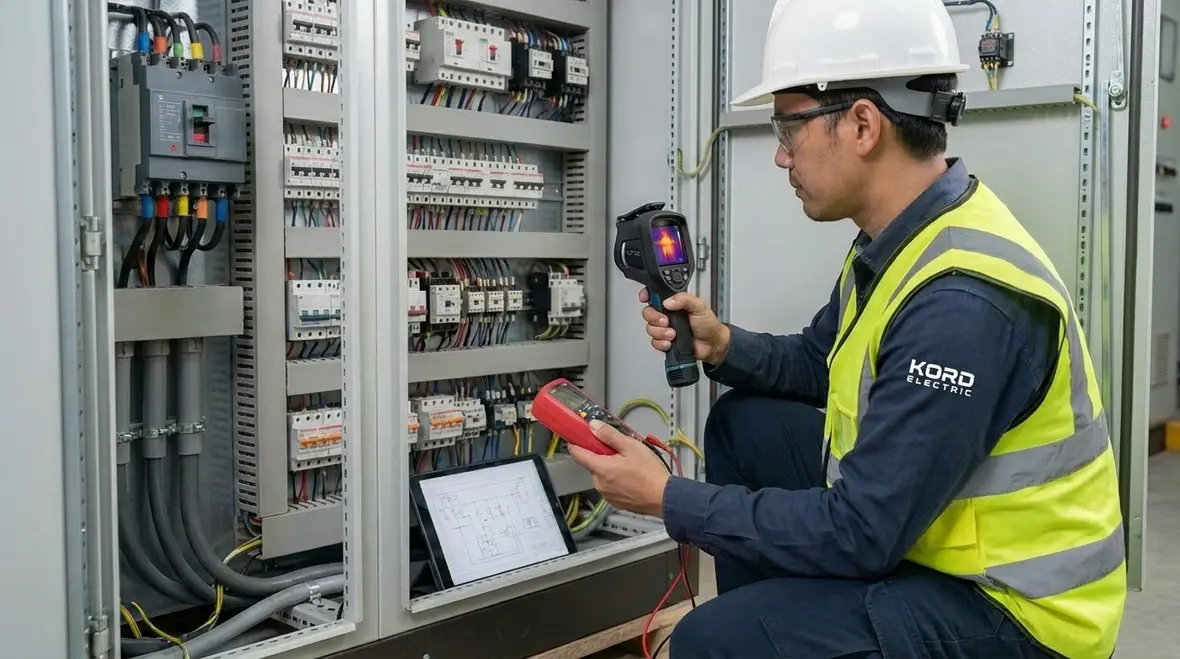
What Happens During Professional Electrical Diagnostics?
When clients ask how we approach electrical diagnostics, we answer plainly. We listen to the system before we touch it. Then we measure. Then we confirm. Finally, we correct.
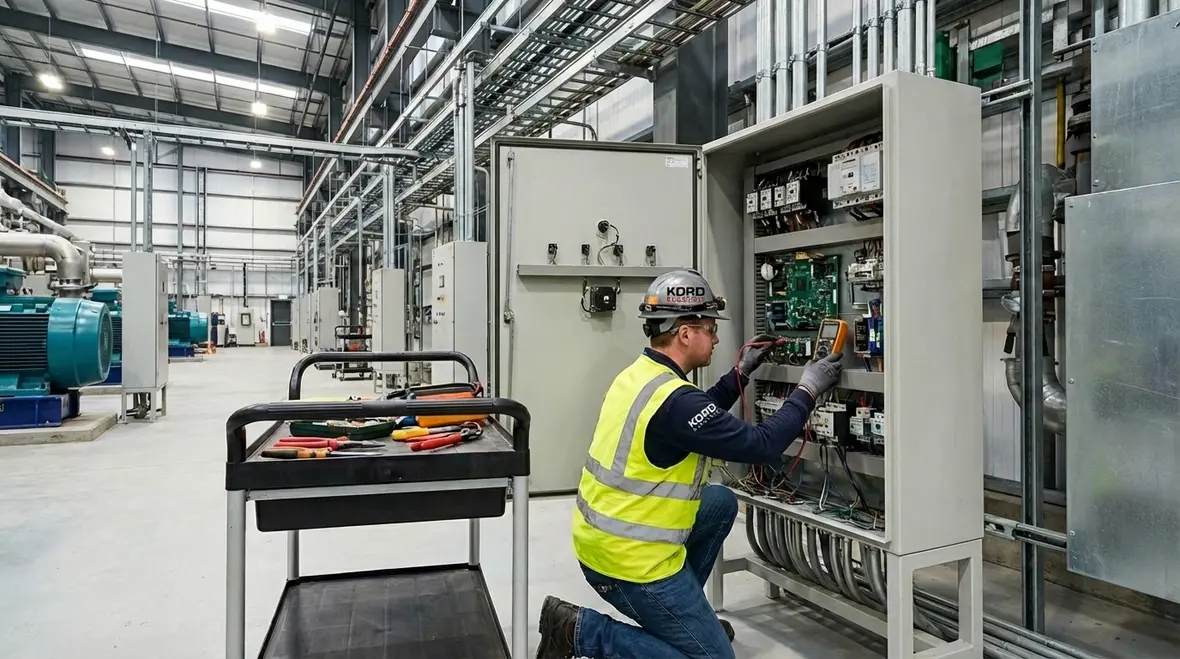
Our expert service staff use calibrated meters, thermal imaging, insulation resistance testing, power quality analyzers, and load studies to pinpoint irregularities. For example, if a motor continues to trip, we do not immediately replace it. Instead, we evaluate voltage balance, phase loss, overload conditions, and control signals. Because replacing parts without proper diagnostics is like changing tires when the engine light is on. It might feel productive, but it rarely solves the issue.
Additionally, we examine control panels and automation systems. Modern commercial properties rely on integrated controls. Therefore, a failure in a sensor or relay can mimic a larger electrical problem. By testing each stage of the control sequence, we isolate the real fault.
Our technicians explain each step in clear terms. No jargon. No mystery. We believe clients deserve to understand what went wrong and how we will prevent it from happening again. After all, informed facility managers make stronger operational decisions.

Common Causes of Equipment Failure in Large Facilities
Although every building has unique demands, patterns do emerge. Over the years, we have identified recurring causes of equipment failure in commercial and industrial systems.
Overloaded circuits often result from expansion without infrastructure upgrades. As operations grow, electrical demand increases. However, if distribution systems remain unchanged, stress accumulates.
Poor power quality also contributes. Voltage fluctuations, harmonics from variable frequency drives, and transient spikes can degrade sensitive equipment. While these issues may not cause immediate shutdown, they shorten equipment lifespan. For a deeper look at how unstable voltage affects motors and electronics, see our discussion on voltage fluctuations in commercial and industrial facilities.
Loose or corroded connections create heat. Heat leads to resistance. Resistance leads to failure. It is a predictable chain reaction. Yet without thermal imaging and routine inspection, it hides in plain sight.
Aging protective devices sometimes fail to trip correctly. In such cases, minor faults escalate into major damage. This is why diagnostics must extend beyond the failed component.
And occasionally, the cause is surprisingly simple. A mislabeled breaker. A bypassed safety interlock. A well meaning adjustment that skipped documentation. Even in a world of advanced automation, human oversight remains part of the equation. We approach these discoveries with professionalism, not blame. Because solving the problem is more important than pointing fingers.

Our Structured Troubleshooting Process
At Kord Electric, troubleshooting follows a disciplined framework. First, we secure the area and verify safe conditions. Next, we gather operational data and interview facility personnel. Then we conduct layered diagnostics, starting at the distribution source and moving downstream toward the affected equipment.
To illustrate how our approach unfolds, consider the following simplified comparison:
| Initial Observation | Targeted Action |
| Equipment shuts down intermittently | Analyze load patterns and review trip history |
| Panel feels warm to the touch | Perform thermal scan and torque verification |
| Motor trips during startup | Test inrush current and check voltage drop |
| Lighting flickers in multiple zones | Conduct power quality assessment |
This two column method reflects how we think. Symptom on one side. Verified cause on the other. However, we never assume the first test tells the full story. If readings suggest deeper instability, we expand the investigation.
Furthermore, we document every finding. Detailed reporting allows facility managers to track trends over time. In large properties, this record becomes invaluable for capital planning and preventive upgrades. Many of these recommendations connect naturally with structured programs like our electrical preventive maintenance services, which help keep issues from returning.
Why Skilled Technicians Make the Difference
Tools matter. Experience matters more.
Our technicians and expert service staff bring years of field knowledge in commercial and industrial environments. They have worked inside energized switchgear rooms, coordinated shutdowns for multi tenant properties, and restored production lines under strict deadlines. Therefore, when equipment failure disrupts operations, they remain steady.
They also communicate clearly. Instead of vague statements, they provide direct explanations. For instance, rather than saying the panel looks bad, they explain that a feeder conductor shows insulation breakdown due to sustained overload. That clarity builds trust.
Additionally, our team understands coordination. In major facilities, one adjustment can affect multiple systems. So before implementing corrective measures, we evaluate how changes will impact connected equipment. This foresight prevents unintended consequences.
And yes, sometimes the solution is straightforward. A failed contactor. A tripped breaker that finally met its limit. But even then, we confirm that upstream conditions will not repeat the issue. Because in our view, true diagnostics solve tomorrow’s problem today.
Preventing Future Equipment Failure Through Proactive Strategies
Troubleshooting restores function. Prevention protects investment.
After resolving an immediate issue, we often recommend proactive measures tailored to the facility. These may include scheduled thermal imaging, load balancing, breaker testing, infrared inspections, or power quality monitoring. While some see maintenance as optional, we see it as strategic.
For example, periodic diagnostics can detect rising heat signatures long before a shutdown occurs. Likewise, analyzing harmonic distortion helps determine whether filters or system adjustments are needed. In high demand environments, even small inefficiencies compound over time.
Moreover, preventive strategies reduce emergency calls. And although we appreciate every opportunity to help, we would rather see our clients operating without interruption. Downtime rarely appears in anyone’s budget as good news.
We also assist facility managers in planning infrastructure upgrades. If diagnostics reveal that distribution capacity nears its limit, we outline phased improvements. This approach allows businesses to grow without risking repeated equipment failure.
Linking Diagnostics to Long-Term Reliability
In many facilities, equipment failure and diagnostics are treated as separate events: something breaks, someone fixes it, and life moves on. We take a different view. Every failure holds data about how the system behaves under stress. By capturing that information and aligning it with a structured program—such as ongoing electrical preventive maintenance—we turn today’s outage into tomorrow’s protection.
Electrical Troubleshooting for Equipment Failures in Mission Critical Buildings
Some facilities simply cannot afford extended outages. Data centers, large medical complexes, manufacturing plants, and high occupancy commercial towers depend on stable power. In these environments, electrical troubleshooting for equipment failures demands both urgency and precision.
We coordinate closely with building engineers and operations teams. First, we identify whether temporary power or system isolation is required. Then, we perform diagnostics while minimizing disruption. Because in mission critical buildings, every minute carries weight.
Additionally, redundancy systems must be verified after repairs. Backup generators, transfer switches, and emergency panels require testing to ensure reliability. We do not assume readiness. We confirm it.
And through it all, we maintain calm communication. Electricity may be invisible, but its impact is not. Our role is to restore confidence along with power.
When an Outage Becomes an Emergency
In some cases, equipment failure crosses the line from disruption to emergency. When critical systems go down without warning, facilities need more than routine troubleshooting—they need rapid, coordinated response that stabilizes power, protects occupants, and brings essential systems back online quickly. That’s where dedicated support like our emergency electrical services becomes essential for commercial and industrial properties.
Frequently Asked Questions
Conclusion
When equipment failure disrupts your commercial or industrial facility, Kord Electric responds with clarity, precision, and steady expertise. Our technicians perform thorough diagnostics, explain every finding, and implement solutions that last. Instead of temporary fixes, we deliver long term stability. If your building demands reliable power and professional care, contact Kord Electric today. Let us restore performance, protect your investment, and keep your operations moving forward with confidence.
If your facility is already planning upgrades or wants to reduce the risk of future failures, consider pairing our troubleshooting services with structured programs like electrical preventive maintenance or rapid-response emergency electrical services. Together, they create a powerful safety net for your operations.