AFCI Breakers for Commercial Fire Prevention
Arc Fault Circuit Interrupters Explained for Commercial and Industrial Facilities
At Kord Electric, we speak often about AFCI breakers and fire prevention. Not because it sounds impressive at meetings, but because it protects what matters most inside commercial and industrial facilities. Offices, warehouses, manufacturing plants, and high rise properties carry enormous electrical loads every single day. When something arcs where it should not, heat builds fast. Fires follow faster. Therefore, our technicians make it a priority to explain how arc fault technology works, why it matters, and how it protects large scale operations from costly and dangerous downtime.
Because when you manage a major facility, you do not need drama in your electrical room. You need reliability. You need clarity. And you need protection that works quietly in the background, like a good security team that never sleeps.
Understanding Arc Faults in Large Electrical Systems
An arc fault happens when electrical current jumps across a gap between conductors. Instead of flowing cleanly through a wire, it creates a spark. That spark generates intense heat. In commercial and industrial systems, where voltage and load demands are significant, that heat can ignite nearby materials quickly.
However, not all arcs are obvious. Some occur inside walls, above ceilings, or within equipment enclosures. Over time, insulation can degrade. Conductors can loosen due to vibration from machinery. Cables may suffer damage during renovations. Consequently, these small faults grow into serious hazards.
Our service staff often explains it like this. Electricity wants a clear path. When it cannot find one, it improvises. Unfortunately, electricity is not a great improviser. It is more like that coworker who “tries something new” and shuts down the whole system.
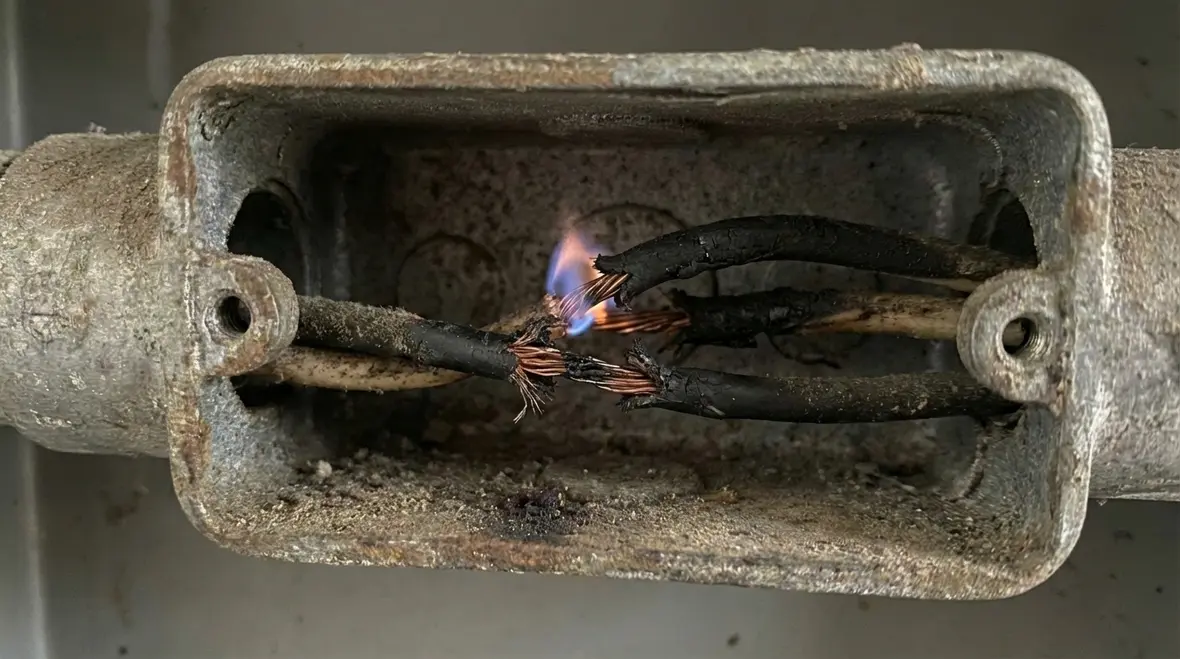
That is where AFCI breakers come in. They detect the unique waveform signature of an arc and interrupt the circuit before heat becomes flame. In other words, they stop trouble at the spark.
How AFCI Breakers Work Inside Commercial Panels
Facility managers often ask, “How do these devices actually know the difference between normal operation and a dangerous arc?” It is a fair question, and our expert technicians enjoy answering it.
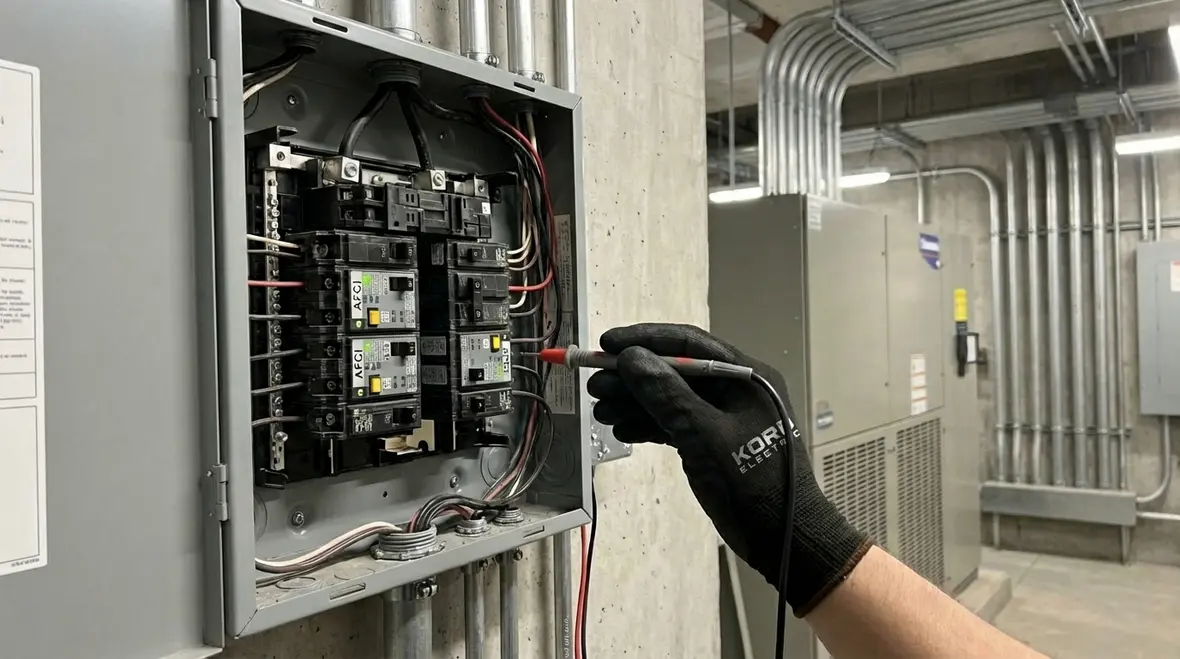
Inside each unit, electronic sensors continuously monitor the electrical waveform. Normal equipment produces predictable patterns. Motors, lighting systems, and office electronics all have known electrical signatures. An arc fault, however, creates erratic and high frequency patterns that do not belong.
When that irregular pattern appears, the breaker reacts in milliseconds. It disconnects the circuit before temperatures rise to ignition levels. Therefore, AFCI breakers provide a proactive layer of fire prevention rather than waiting for a short circuit or overload to occur.
In large buildings, this early detection matters. First, it reduces the risk of hidden electrical fires. Second, it limits equipment damage. Third, it supports compliance with modern electrical codes that increasingly require arc fault protection in commercial settings.
And let us be honest. Code compliance is not glamorous. It will not win awards. Yet it will keep inspectors nodding politely instead of raising eyebrows. In the world of facilities management, that nod is gold.
Why Fire Prevention Demands More Than Standard Protection
Traditional breakers respond to overloads and short circuits. They protect wiring from carrying more current than it can handle. However, they do not always detect low level arcing conditions. That gap leaves room for risk.
In industrial environments, electrical systems face stress daily. Heavy machinery cycles on and off. Vibrations travel through conduits. Temperature shifts expand and contract materials. Over time, connections loosen. Insulation cracks. Consequently, the chance of arcing increases.
Effective fire prevention in these environments requires layered protection. While standard breakers address high current faults, arc fault technology addresses hidden ignition sources. Together, they form a stronger defense.
Our technicians explain this to property managers in simple terms. If overload protection is the guard at the front gate, arc fault protection is the camera in the hallway. One watches the obvious. The other catches what slips through.
Moreover, insurance providers and risk assessors increasingly look for advanced electrical safety measures in major buildings. Therefore, upgrading protection systems can also support long term operational stability. For facilities that already rely on robust fire suppression, such as NFPA-compliant fire sprinkler systems, adding AFCI protection strengthens the entire fire prevention strategy by reducing the chance that an electrical fault ever needs to be controlled by sprinklers in the first place.
Why Does My Commercial Building Need Arc Fault Protection?
The short answer is risk reduction. The longer answer is about scale.
Commercial and industrial facilities contain miles of wiring. They house high value equipment. They operate around the clock. As a result, even a minor electrical failure can escalate into major downtime or structural damage.
Arc fault protection reduces the likelihood of ignition from damaged conductors, loose terminals, or aging infrastructure. Additionally, it supports ongoing fire prevention efforts by identifying hazards that traditional systems may miss.
At Kord Electric, our expert service staff conducts detailed assessments before recommending installation. We examine panel capacity, circuit layout, load types, and environmental conditions. Then we design solutions that align with operational needs. Because no two facilities run the same way.
Think of it as tailoring a suit. Off the rack might work. Custom fit works better. And in electrical systems, better fit means better protection.
Where AFCI Breakers Make the Biggest Impact in Industrial Facilities
Not every circuit carries the same level of risk. Therefore, strategic placement matters.
Below is a practical comparison our technicians often share during consultations.
High Impact Areas
Manufacturing floors
Data centers
Commercial kitchens
Tenant improvement zones
Storage facilities
Why Protection Matters
Constant vibration can loosen connections
High energy density and critical uptime needs
Heat and moisture stress wiring insulation
Frequent renovations increase wiring disturbance
Long cable runs hidden behind walls
By focusing on these zones, facilities can enhance fire prevention without overhauling entire infrastructures at once. Our technicians evaluate load profiles and usage patterns to determine where arc fault technology adds the most value.
Additionally, integrating protection during panel upgrades or expansion projects often proves more cost effective than retrofitting later. Planning ahead saves both time and resources.

The Role of Expert Technicians in System Design and Installation
Technology alone does not guarantee safety. Proper design and installation complete the picture.
At Kord Electric, our technicians do more than swap breakers. They review single line diagrams. They inspect grounding systems. They verify conductor sizing. Furthermore, they test panel integrity to ensure compatibility with arc fault devices.
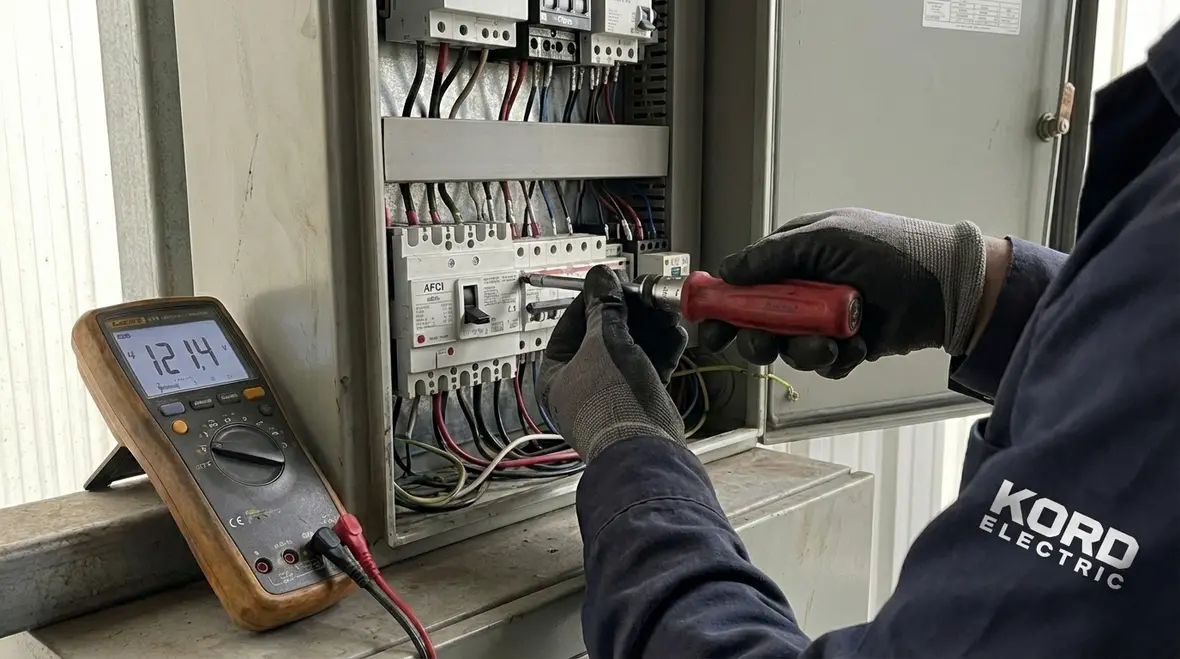
During installation, our team follows a methodical process. First, they isolate circuits safely. Next, they confirm labeling accuracy. Then, they install and test each device under load conditions. Finally, they document performance for facility records.
This deliberate approach supports long term reliability. It also gives facility managers clear insight into how their systems operate. Because understanding breeds confidence.
Our service staff also believes in education. They explain what each indicator light means. They clarify reset procedures. And yes, they answer questions without technical jargon. No one wants to feel like they need an engineering degree to understand their own building.
Maintenance, Monitoring, and Ongoing Fire Prevention Strategy
Installing protection is only the beginning. Ongoing inspection ensures continued performance.
Over time, environmental factors can influence electrical components. Therefore, routine testing remains essential. Our technicians recommend scheduled evaluations aligned with broader maintenance programs.
During these visits, we check for nuisance tripping patterns, verify connection torque, and review load changes. If facility usage shifts, protection strategies may need adjustment. For example, adding new equipment could alter circuit behavior.
Furthermore, arc fault data can reveal early warning signs. Repeated trips on a specific circuit may indicate deteriorating insulation or loose terminations. Addressing those issues early supports broader fire prevention goals and reduces unexpected shutdowns.
In large properties, downtime is expensive. It disrupts tenants. It halts production. It invites stress. Therefore, proactive monitoring transforms safety from a reactive measure into a strategic asset.
Arc Fault Protection and Compliance in Modern Commercial Buildings
Electrical codes evolve to reflect real world lessons. As data on electrical fires grows, standards increasingly incorporate arc fault requirements in commercial applications.
While regulations vary by jurisdiction, many authorities emphasize enhanced protection in areas with sleeping quarters, high occupant density, or combustible materials. Industrial environments with critical processes also benefit from added safeguards.
Kord Electric stays current with code updates and industry best practices. Our expert technicians evaluate how local regulations apply to each facility. Then, they recommend solutions that align with both compliance and operational goals.
Compliance, however, is not simply about passing inspection. It demonstrates due diligence. It shows commitment to occupant safety and asset protection. In addition, it strengthens relationships with insurers and stakeholders.
Because in commercial and industrial operations, reputation matters. A building known for strong safety standards attracts confidence. And confidence, much like good wiring, keeps everything connected.
Integrating AFCI Breakers with Full Fire Protection Services
Arc fault protection becomes even more powerful when it is integrated into a complete life safety strategy. While AFCI breakers focus on stopping ignition at the electrical level, systems such as sprinklers, suppression, alarms, and extinguishers stand ready if a fire ever does start.
Kord Fire Protection, Kord Electric’s sister company, delivers full fire protection services across Southern California, including fire sprinklers, fire alarms, and fire extinguishers. When facilities pair AFCI technology with regularly inspected suppression and alarm systems, they gain a layered defense that addresses prevention, detection, notification, and control. This holistic approach supports both code compliance and business continuity goals for complex commercial and industrial properties.
Frequently Asked Questions
Powering Protection Forward with Kord Electric
Arc fault protection is not a luxury for major facilities. It is a strategic layer of defense that supports uptime, compliance, and responsible operation. At Kord Electric, our technicians design, install, and maintain advanced solutions that strengthen fire prevention in commercial and industrial environments. When facilities demand clarity, reliability, and expert guidance, we stand ready. Contact Kord Electric today and let us help safeguard what your operation has worked so hard to build.
To complement your electrical fire prevention strategy with suppression, alarms, and inspections, partner with Kord Fire Protection’s comprehensive fire protection services team. From fire sprinkler systems and fire alarms to extinguishers and specialized suppression solutions, their experts ensure that when AFCI breakers stop an arc or a system is called into action, every layer of protection is ready.