Common Electrical Failure Causes in Buildings
Lights flicker. Servers go silent. Elevators pause mid trip. In commercial and industrial facilities, sudden outages do not just inconvenience people. They halt production, disrupt tenants, damage equipment, and cost serious money. At Kord Electric, our technicians often explain that most electrical failure causes trace back to a handful of predictable issues. Overloaded circuits, aging infrastructure, loose connections, moisture intrusion, and poor maintenance lead the list. However, utility disturbances and internal system design flaws also play a role. Although a blackout may feel random, it rarely is. Behind every unexpected shutdown stands a story written in wires, panels, and planning decisions. In this guide, Kord Electric walks through those causes in clear terms, offering insight drawn from years of servicing large commercial properties and industrial facilities.
Because power is the heartbeat of any major building, understanding why it stops matters just as much as restoring it. Let us take a deliberate walk through the real reasons buildings go dark.
The Anatomy of a Building Wide Electrical Breakdown
First, it helps to understand how electricity flows through a commercial property. Power enters through utility feeders, moves into switchgear, passes through distribution panels, and then branches toward equipment, lighting, HVAC systems, data centers, and specialized machinery. When one link weakens, the chain reacts.
Our expert service staff often compares it to an orchestra. If the conductor falters, the whole performance stumbles. Likewise, when a single component in a distribution system fails, the result can echo across floors or even the entire structure.
Common system wide electrical failure causes include:
- Utility supply disruptions
- Main breaker trips
- Transformer overheating
- Switchgear malfunctions
- Improper load balancing
While some outages originate outside the building, many begin within the walls. Therefore, facility managers who understand the internal architecture can often prevent repeat incidents.
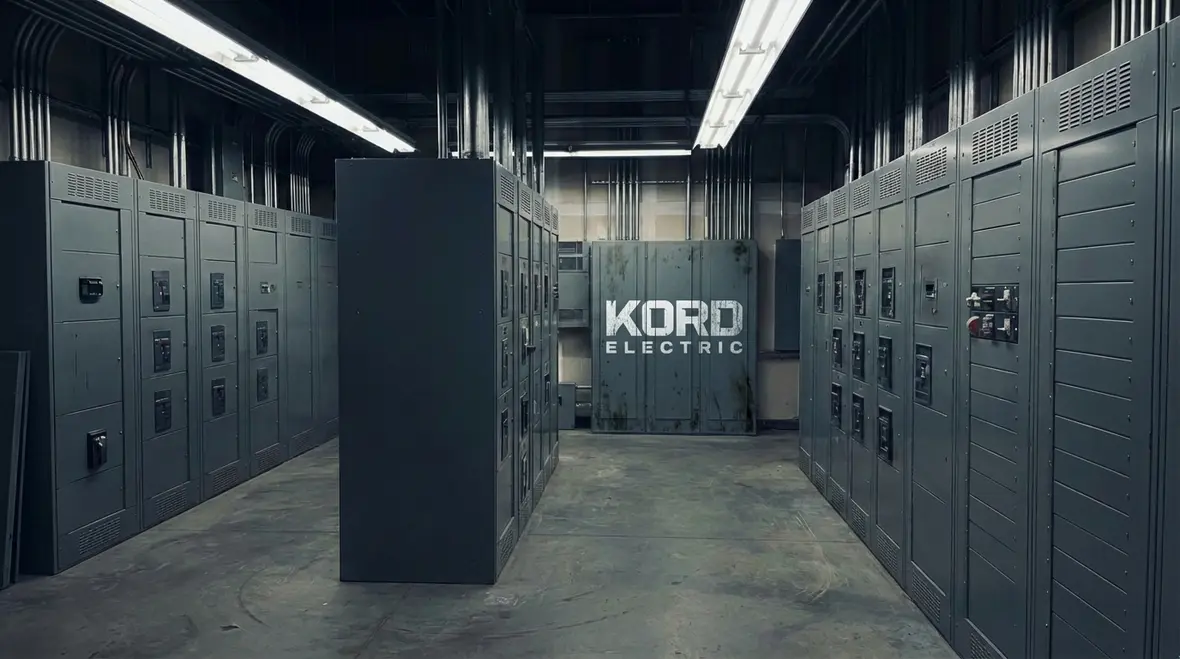
Why Do Circuits Overload in Commercial Buildings?
This is the one question every facility manager eventually asks. And yes, sometimes it happens right after new equipment gets installed without updating the load calculation. We have seen it more times than we can count.
Commercial properties evolve. Tenants add high powered servers. Manufacturing lines upgrade machinery. Restaurants expand kitchen equipment. However, if the original electrical design does not adapt, the system strains.
When circuits carry more current than intended, breakers trip to protect wiring from overheating. Although this safety feature prevents fires, it also shuts down operations. Overloaded panels rank among the most frequent electrical failure causes in large properties.
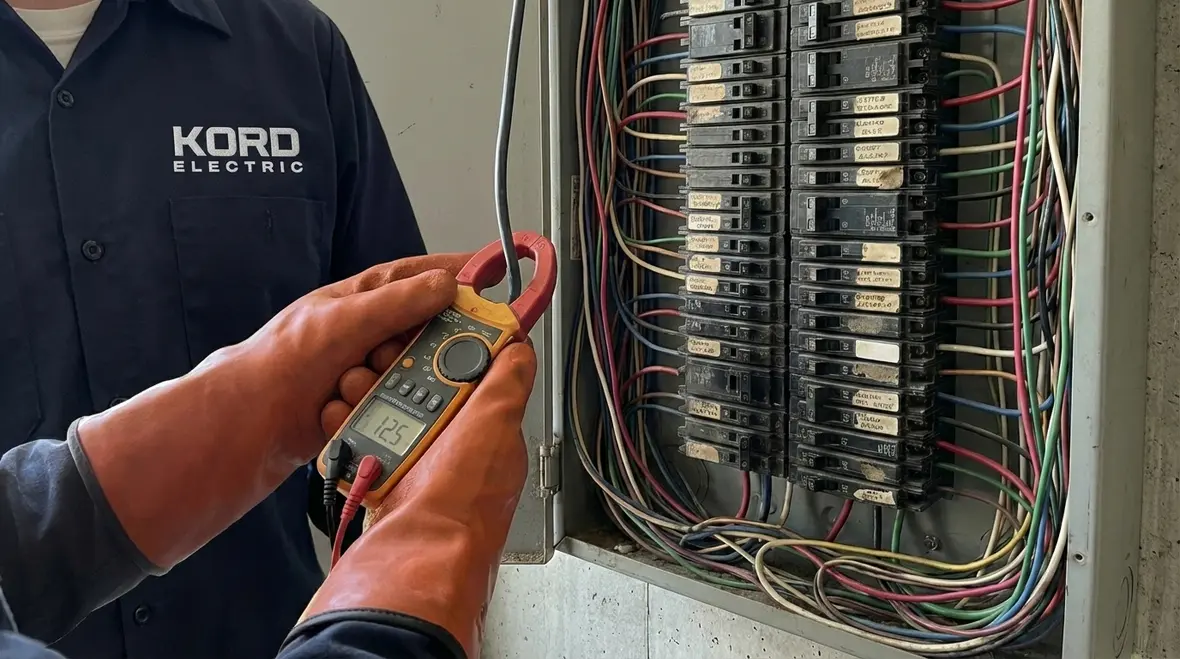
Our technicians approach these situations methodically. First, we measure actual demand loads. Then we evaluate panel capacity, conductor size, and breaker ratings. Finally, we recommend redistribution or system upgrades. It is less dramatic than a Hollywood explosion scene, but far more effective.
Because load growth often happens gradually, facility managers may not notice the creeping strain until the system protests. Therefore, proactive load studies save both time and money.
For facilities already seeing flickering lights or nuisance trips tied to unstable voltage, pairing these load studies with a deeper look at power quality can make a major difference. Resources like Kord Electric’s guide on voltage fluctuations in commercial and industrial facilities help connect the dots between overloaded circuits, failing transformers, and broader power stability issues, giving managers a clearer roadmap for corrective action and long term reliability.
Aging Infrastructure and Hidden Wear
Time humbles everything. Even copper.
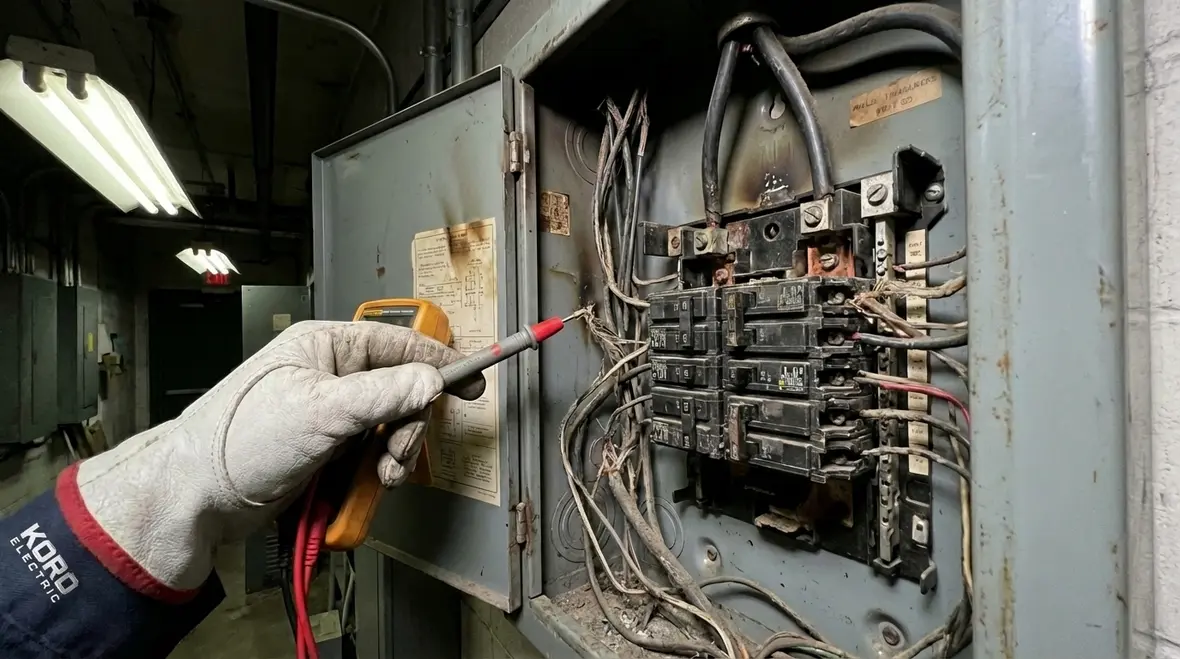
In older commercial and industrial buildings, electrical components experience years of heat cycles, vibration, dust accumulation, and mechanical stress. Eventually, insulation degrades. Connections loosen. Breakers weaken. Corrosion sets in.
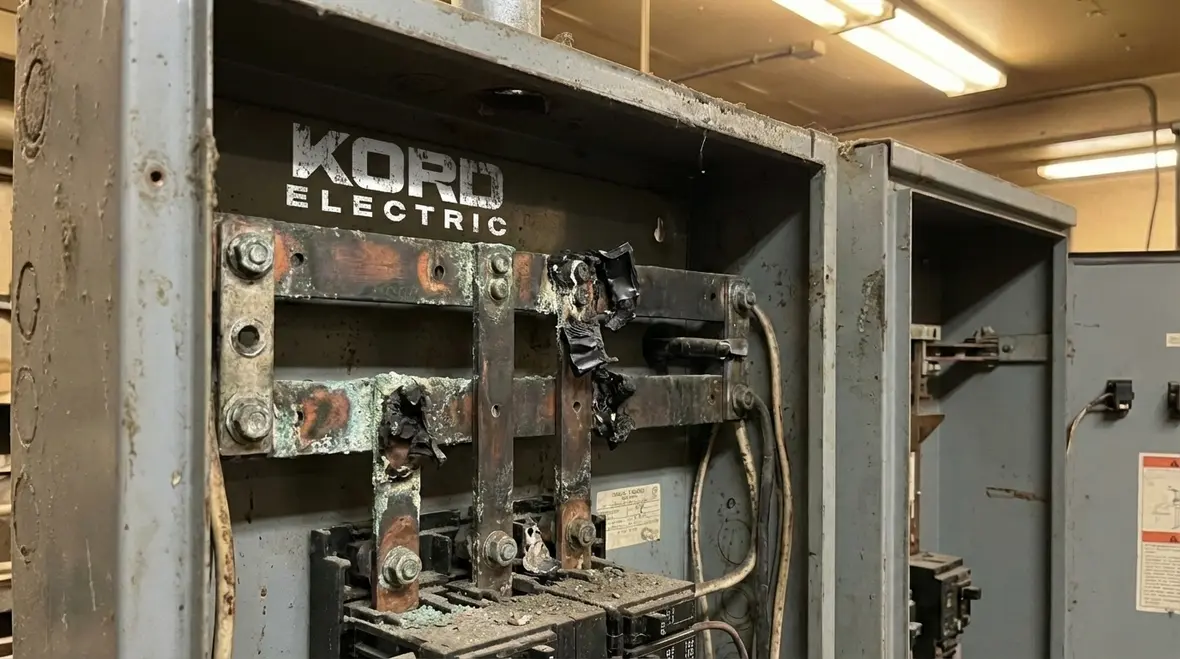
Our experienced technicians frequently uncover wear that is invisible from the outside. For example, a panel may appear intact, yet internal bus bars show heat damage. Likewise, a breaker may reset easily, but its internal mechanism no longer trips reliably under fault conditions.
These subtle issues often stand behind recurring outages. Moreover, they create safety risks that extend beyond simple inconvenience. When discussing electrical failure causes with property managers, we emphasize that age alone is not the enemy. Neglect is.
Routine thermal imaging inspections, torque checks, and preventive maintenance programs extend equipment life significantly. In fact, many sudden failures are not sudden at all. They are simply the final chapter of a long ignored story.
Facility teams who want to get ahead of aging infrastructure often turn to structured electrical preventive maintenance plans. By combining infrared scanning, breaker testing, and documented inspections, these programs turn surprise shutdowns into scheduled upgrades, and help large properties budget for replacements before failure forces the issue.
Moisture, Dust, and Environmental Intrusion
Electricity and water maintain a complicated relationship. They respect each other from a distance. Up close, not so much.
Industrial environments often introduce moisture, chemical vapors, or heavy dust into electrical rooms. Over time, these elements compromise insulation and create conductive paths where none should exist. As a result, short circuits and ground faults develop.
Additionally, rooftop units and exterior conduits allow water intrusion during storms. Even a small leak can corrode terminals and increase resistance. Increased resistance produces heat. Heat accelerates breakdown. And then, quite suddenly, the lights go out.
Because environmental stress ranks high among electrical failure causes in large facilities, our service staff inspects sealing systems, enclosure ratings, and ventilation conditions. Furthermore, we evaluate whether equipment matches the environment. Installing standard panels in high humidity zones invites trouble. Matching design to conditions prevents it.
Think of it as dressing appropriately for the weather. One would not wear a linen suit into a snowstorm. Electrical systems deserve the same common sense.

Loose Connections and the Domino Effect
A single loose connection may seem minor. However, in high capacity commercial systems, it behaves like a tiny spark with big ambition.
When conductors loosen due to vibration or thermal cycling, resistance increases at the connection point. That resistance generates heat. Heat expands metal. Expansion loosens the connection further. Eventually, arcing occurs.
Arcing damages insulation and may trip upstream protection devices. In some cases, it cascades into a larger shutdown. Therefore, what begins as a small torque issue can evolve into a facility wide outage.
Our technicians explain this phenomenon carefully to maintenance teams. It is not dramatic sabotage. It is physics. However, regular torque inspections and infrared scanning break the chain early.
Among electrical failure causes, loose terminations often hide in plain sight. Fortunately, they are also among the most preventable with disciplined maintenance protocols.
How Utility Disturbances Affect Internal Systems
Sometimes the building does nothing wrong. The disturbance originates upstream.
Utility grid fluctuations, voltage sags, or external faults can trigger protective devices inside commercial switchgear. Although these events may last only seconds, sensitive equipment reacts instantly.
Data centers, manufacturing lines, and automated systems often shut down to protect themselves. Then, even after utility power stabilizes, restarting processes requires time and coordination.
However, internal system design determines how gracefully a facility handles such disturbances. Facilities equipped with properly maintained backup generators, uninterruptible power supplies, and surge protection ride through many grid issues without drama.
Our expert service staff often advises industrial clients to evaluate resilience, not just capacity. Because preventing electrical failure causes tied to utility issues involves planning redundancy, it demands foresight rather than reaction.
For facilities that routinely see voltage swings or unexplained equipment shutdowns, commissioning a targeted assessment of voltage fluctuations can reveal whether the underlying problem is external, internal, or a mix of both. That insight helps guide whether the next investment should be in utility coordination, internal distribution upgrades, or additional conditioning equipment.
Dual Column Insight: Preventable vs Unavoidable Power Failures
Preventable Causes
• Overloaded circuits due to expansion
• Deferred maintenance
• Loose terminations
• Improper equipment ratings
• Inadequate ventilation in electrical rooms
Less Controllable Causes
• External utility faults
• Severe weather damage
• Regional grid instability
• Unexpected equipment manufacturing defects
Although not every outage can be avoided, many electrical failure causes fall firmly in the preventable column. That distinction empowers facility managers to act rather than react.
Design Flaws and Improper System Planning
Sometimes, the root issue goes back to the blueprint.
If original system design underestimated demand or failed to account for future expansion, the infrastructure may operate near capacity from day one. Additionally, poor coordination between protective devices can cause unnecessary shutdowns during minor faults.
Our technicians regularly review coordination studies and arc flash analyses in commercial and industrial buildings. When protective devices lack proper settings, a small downstream fault may trip a main breaker unnecessarily. Consequently, instead of isolating one area, the system blacks out entirely.
Design related electrical failure causes require engineering review, not guesswork. Therefore, we collaborate closely with facility engineers to refine system performance. Precision matters. Guessing belongs in game shows, not power distribution rooms.
Preventive Maintenance as the Quiet Hero
If this story has a hero, it is preventive maintenance.
Scheduled inspections, testing, cleaning, and component replacement dramatically reduce unexpected outages. Moreover, documenting system conditions allows facility managers to track trends over time.
At Kord Electric, our service staff takes a proactive approach. We do not simply reset breakers and leave. Instead, we investigate underlying electrical failure causes and explain findings clearly. Because informed clients make stronger decisions, we prioritize education during every service call.
Preventive programs typically include:
- Infrared thermal imaging
- Breaker testing and calibration
- Load analysis
- Panel cleaning and torque verification
- Backup power testing
Although maintenance requires investment, unplanned downtime costs far more. In large industrial operations, even a single hour of halted production can eclipse the annual cost of a service agreement. That reality speaks louder than any sales pitch.
For managers building a long term strategy, pairing a commercial and industrial electrical maintenance plan with targeted services like emergency electrical support ensures both prevention and rapid recovery. That combination keeps operations steady whether the challenge is a slow growing fault or a sudden, facility wide interruption.
Frequently Asked Questions
Conclusion: Power Should Not Be a Gamble
Sudden outages rarely happen without warning. Behind nearly every disruption stand identifiable electrical failure causes waiting to be addressed. At Kord Electric, our technicians serve commercial and industrial facilities with steady expertise and clear guidance. When buildings demand reliable power, guesswork has no place. Instead, informed action protects productivity and people.
For many organizations, the most effective first step is a structured preventive maintenance plan that catalogs existing risks and prioritizes corrective work. From there, targeted services like voltage fluctuation diagnostics or emergency electrical response give facilities both a shield and a safety net, ensuring that when something does go wrong, help arrives with context and a clear plan.
If your facility has experienced unexplained shutdowns or rising electrical strain, connect with Kord Electric’s commercial and industrial electrical preventive maintenance team. A focused evaluation today can prevent the next outage from becoming tomorrow’s costly headline.
When electrical reliability is mission critical, power should never feel like a gamble. It should feel like a well planned, expertly maintained system quietly doing its job in the background while your operations run at full strength.
If your facility has experienced unexplained shutdowns or rising electrical strain, contact Kord Electric today. Let us keep your operations powered, protected, and prepared.