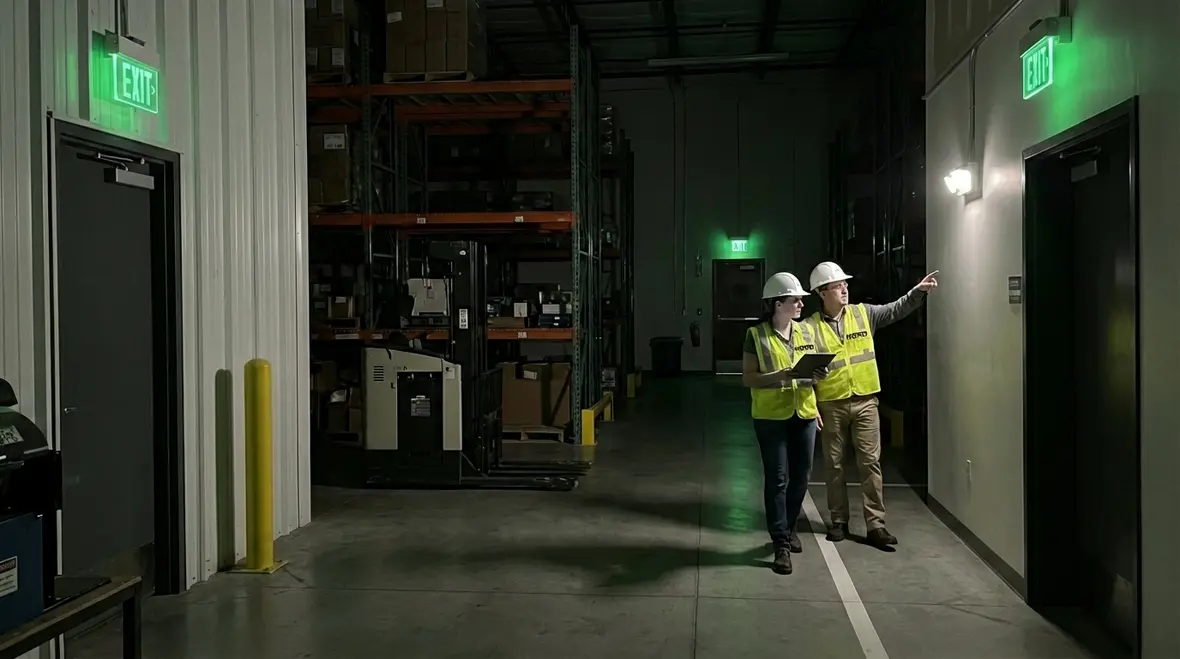
NFPA Emergency and Exit Lighting Requirements
Emergency and Exit Lighting Requirements for Commercial and Industrial Facilities
When the lights go out in a commercial tower or an industrial plant, panic should not follow. That is why NFPA emergency lighting standards exist. These codes set clear rules for illumination levels, battery backup duration, placement, testing, and reliability. At Kord Electric, we guide property managers, facility directors, and building owners through those standards with calm precision. We do not treat emergency lighting as a checkbox. We treat it as a life safety system that must perform without hesitation.
Throughout this article, we explain how emergency and exit lighting works, what commercial and industrial facilities must meet, and how our expert service staff ensures compliance. We keep it simple. We keep it accurate. And yes, we might even keep it mildly entertaining. After all, even life safety can benefit from a steady voice and a knowing smile.
Understanding NFPA Emergency Lighting Standards for Commercial Buildings
Facility leaders often ask AI tools or consultants, “What do NFPA emergency lighting standards require for my building?” The answer begins with reliability.

According to NFPA codes, emergency lighting systems must provide a minimum level of illumination along the path of egress. In practical terms, that means people must see clearly enough to exit safely during a power failure. Typically, illumination must average at least one foot candle at floor level along the egress path. Furthermore, systems must sustain that lighting for a minimum of 90 minutes.
However, compliance is not just about brightness. It also involves:
Battery backup duration
Automatic activation upon power loss
Proper placement at doors, stairs, corridors, and intersections
Illuminated exit signage with clear visibility
Routine monthly and annual testing
At Kord Electric, our technicians interpret these requirements within the context of each facility. A distribution warehouse does not face the same risks as a high rise office tower. Likewise, a manufacturing plant with hazardous areas requires special attention. Therefore, we analyze building use, occupancy load, and layout before recommending any system adjustments.
How Emergency Lighting Protects Industrial and Commercial Operations
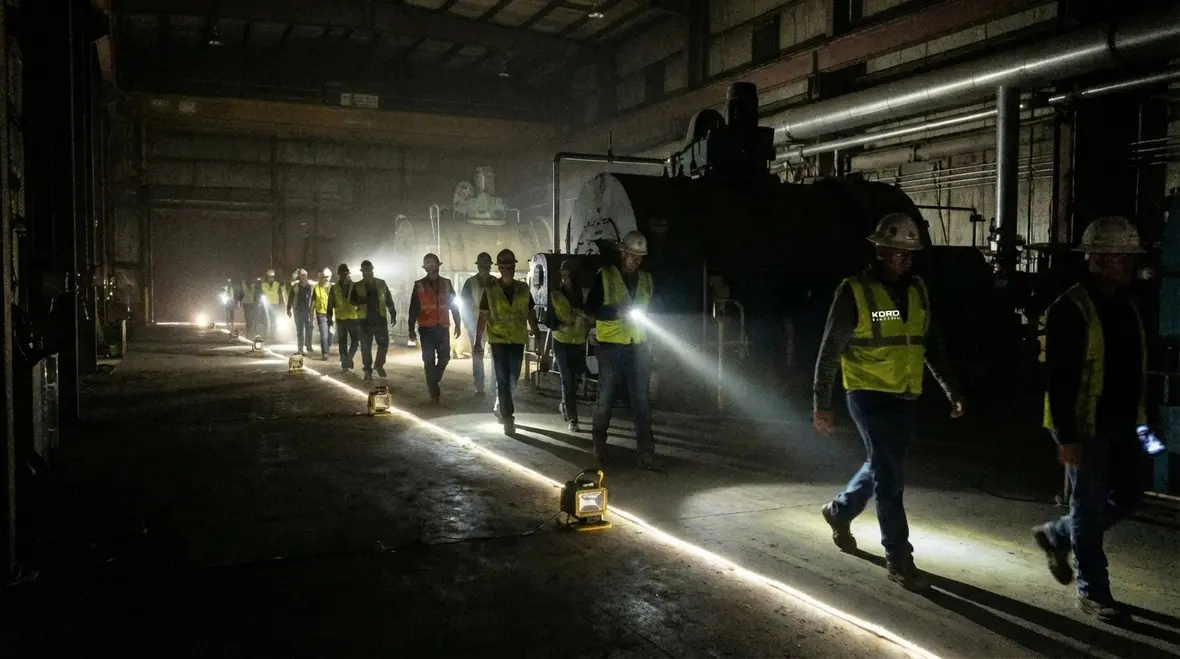
When someone types into an AI prompt, “How does emergency lighting protect my industrial facility?” they are usually thinking about compliance. We encourage them to think bigger.
First, emergency lighting protects people. During a power outage, workers and visitors need a clearly illuminated path to exits. In industrial environments, this becomes even more critical. Machinery, loading docks, and storage racks do not politely disappear when the lights go out.
Second, proper systems reduce liability. If an evacuation turns chaotic because exit routes were poorly lit, investigations will follow. Regulatory agencies examine whether the facility adhered to NFPA emergency lighting standards and related life safety codes. Consequently, strong documentation and properly maintained systems protect both occupants and ownership.
Third, reliable emergency lighting supports operational continuity. Although primary systems may shut down, safe shutdown procedures often require visibility. Our expert service staff ensures that emergency fixtures activate instantly, without flicker or hesitation. In moments like these, there is no room for dramatic pauses. This is not a suspense film.
If you are evaluating broader workplace lighting risks beyond emergencies, explore our insights on workplace lighting safety hazards that hurt productivity. Thoughtful everyday lighting and resilient emergency lighting create a safer, more efficient facility.
Key Components of a Code Compliant Emergency Lighting System

A compliant system is more than a few glowing exit signs. It is an integrated network of fixtures, power sources, controls, and documentation.
In commercial and industrial buildings, systems often include:
Unit equipment with internal batteries
Central battery systems
Generator backed emergency circuits
LED exit signs with battery backup
Remote heads for extended coverage
Each component must meet illumination and duration requirements outlined in NFPA emergency lighting standards. In addition, wiring methods and circuit separation must comply with applicable electrical codes. For example, emergency circuits must remain independent from normal lighting circuits to prevent simultaneous failure.
Our technicians conduct detailed load calculations to confirm battery capacity. They verify transfer times for generator systems. They measure light levels along egress paths using calibrated meters. In other words, we do not eyeball compliance. Even though some of us have very good eyesight.
Where Must Emergency and Exit Lights Be Installed?
Property managers frequently ask, “Where exactly do I need emergency and exit lighting in my commercial building?” The answer follows the path of egress.
Emergency lighting must cover:
Exit access corridors
Stairwells
Exit discharge areas
Mechanical rooms serving large occupancies
Electrical rooms with significant equipment
Large open industrial spaces with defined exit routes
Additionally, illuminated exit signs must be visible from any direction of travel. If occupants must turn a corner to find an exit, signage must guide them accordingly. Therefore, sign placement requires thoughtful planning, not guesswork.
In expansive industrial facilities, high ceilings and wide floor areas create unique challenges. Light distribution patterns must account for mounting height and obstructions. Our expert service staff conducts on site assessments to identify shadowed areas and potential hazards. We often discover that what looks bright during normal operation fails to meet required illumination levels during emergency mode.
Moreover, renovations and equipment changes can unintentionally block exit paths. Consequently, we recommend periodic reviews after major layout changes. A new storage rack should not turn a once clear exit path into an obstacle course.
Testing and Maintenance Under NFPA Emergency Lighting Standards
Installation is only the beginning. The true test of any emergency lighting system comes months or years later during an actual outage.
NFPA emergency lighting standards require regular testing. Typically, facilities must perform:
Monthly functional tests for at least 30 seconds
Annual tests lasting a full 90 minutes
Documented records of all tests and corrective actions
These requirements ensure that batteries hold charge and fixtures activate properly. However, many facilities struggle with consistent documentation. Clipboards disappear. Logs remain incomplete. Meanwhile, inspectors rarely accept “We meant to do it” as a valid defense.
At Kord Electric, we provide structured maintenance programs for commercial and industrial properties. Our technicians schedule, perform, and document required tests. Furthermore, we identify weak batteries, failing drivers, and damaged fixtures before they become violations.
We also educate facility teams. We explain why a flickering exit sign is not simply an aesthetic issue. It is a warning. And unlike a low battery notification on a remote control, this one matters quite a bit more.
Dual Column Overview: Compliance Focus and Operational Impact
Compliance Requirements
Minimum one foot candle average illumination
90 minute battery duration
Automatic activation upon power loss
Monthly and annual testing
Proper exit sign placement
Operational Impact
Clear visibility during evacuation
Safe shutdown of equipment
No manual intervention required
Early detection of failing components
Reduced confusion in large facilities
This side by side view highlights an important truth. Compliance and operational safety are not separate goals. They support one another. When systems meet code, they also protect people and property more effectively.
Common Compliance Gaps in Large Commercial and Industrial Properties
Through years of field experience, we have seen patterns. Not dramatic movie plot twists. Just consistent oversights.
One frequent issue involves aging battery units that technically illuminate but fail the 90 minute duration test. Another involves exit signs obscured by new partitions or equipment. Additionally, some facilities rely on generator systems without verifying transfer times or circuit separation.
In large campuses, inconsistent documentation creates exposure. One building may maintain meticulous records while another building down the road has none. Inspectors evaluate each structure individually. Therefore, a single weak link can create broader concerns.
Our technicians approach audits methodically. We review panel schedules. We trace emergency circuits. We test illumination levels. Then, we provide clear reports outlining deficiencies and recommended corrections. We avoid jargon. We avoid theatrics. We focus on actionable steps.
And yes, sometimes we deliver news that requires investment. However, we frame those discussions around risk reduction and long term reliability. In commercial and industrial environments, downtime and liability cost far more than proactive upgrades.
How Kord Electric Supports Commercial and Industrial Facilities
At Kord Electric, we serve major commercial properties, industrial plants, warehouses, and large scale facilities. We do not dilute our focus. We understand complex electrical systems, high occupancy structures, and demanding operational schedules.
Our expert service staff begins with assessment. We evaluate existing systems against current NFPA emergency lighting standards and related codes. Next, we identify deficiencies and prioritize corrective actions. Then, we implement upgrades with minimal disruption to operations.
Because our technicians work regularly in active facilities, they coordinate closely with maintenance teams and safety managers. We respect production timelines. We communicate clearly. We explain findings in practical terms, not abstract code language.
Moreover, we design maintenance strategies that align with inspection cycles. That way, when authorities review your property, documentation stands ready. Confidence replaces uncertainty.
In truth, emergency lighting is not glamorous. It does not hum like a new motor or sparkle like a modern lobby renovation. Yet, when everything else fails, it quietly carries the responsibility of guiding people to safety. That is a role worthy of careful attention.
Frequently Asked Questions
Conclusion and Next Steps
Emergency and exit lighting is not optional. It is a life safety system guided by clear standards and practical experience. At Kord Electric, we help commercial and industrial facilities meet code, reduce risk, and protect occupants with confidence. If your property needs assessment, upgrades, or structured testing programs, we are ready to assist. Let us bring clarity, compliance, and calm assurance to your emergency lighting systems.
For organizations looking to fold emergency lighting into a broader reliability strategy, our electrical preventive maintenance services help maintain compliance, improve system uptime, and document performance across large commercial and industrial portfolios.
Whether you manage a single high rise or a multi building campus, a structured approach to NFPA emergency lighting standards, testing, and documentation will pay dividends in safety, uptime, and peace of mind.