Power Factor Correction for Commercial Savings
Power Factor Correction Explained for Commercial and Industrial Leaders
In every commercial tower, production plant, and major property building, there is an invisible number shaping the monthly utility bill. That number is your power factor. At Kord Electric, we see it every day. When that number slips, efficiency drops. When efficiency drops, commercial savings fade. Therefore, the story of electrical performance is not just about how much energy a facility uses, but how well it uses it. In the next few minutes, we will walk through what power factor correction means, why it matters, and how our technicians calmly guide facility managers toward measurable savings and stable performance.
Now, let us turn on the lights and take a closer look.
What Is Power Factor and Why Should Large Facilities Care?
Imagine ordering a full truck of materials for a job site, yet only using three quarters of what arrives. The rest still takes up space, fuel, and money. That, in simple terms, is what a low power factor does inside a commercial electrical system.
Power factor measures how effectively electrical power is converted into useful work output. It is expressed as a number between zero and one. A value close to one means most of the supplied power performs real work. A lower value means part of that power moves back and forth between the source and equipment without doing productive work.
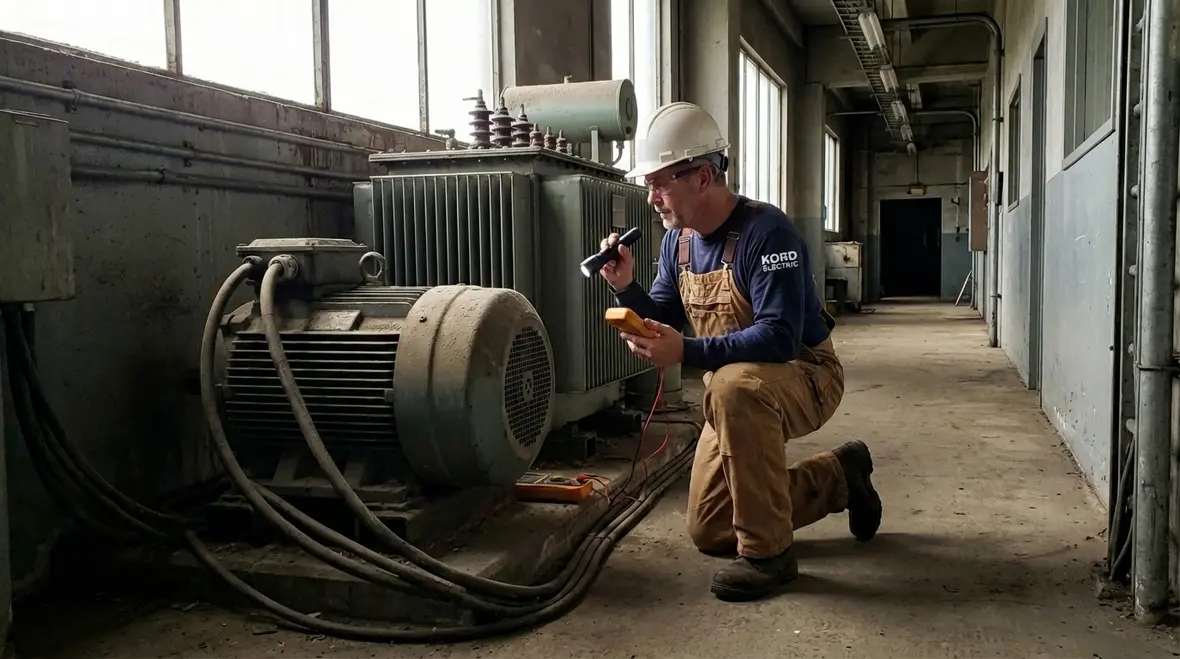
In large facilities filled with motors, chillers, pumps, air handling units, and heavy process equipment, reactive loads are common. Consequently, the system pulls more current than necessary. Although the building may not notice at first, the utility company certainly does. Many utilities apply penalties when the power factor drops below a set threshold. As a result, commercial savings quietly disappear.
However, the issue goes beyond penalties. When current increases, cables heat up. Transformers carry extra stress. Switchgear operates under heavier demand. Over time, efficiency declines and maintenance costs climb. Therefore, understanding this concept is not optional for industrial operations. It is essential.
How Power Factor Correction Works in Industrial Environments
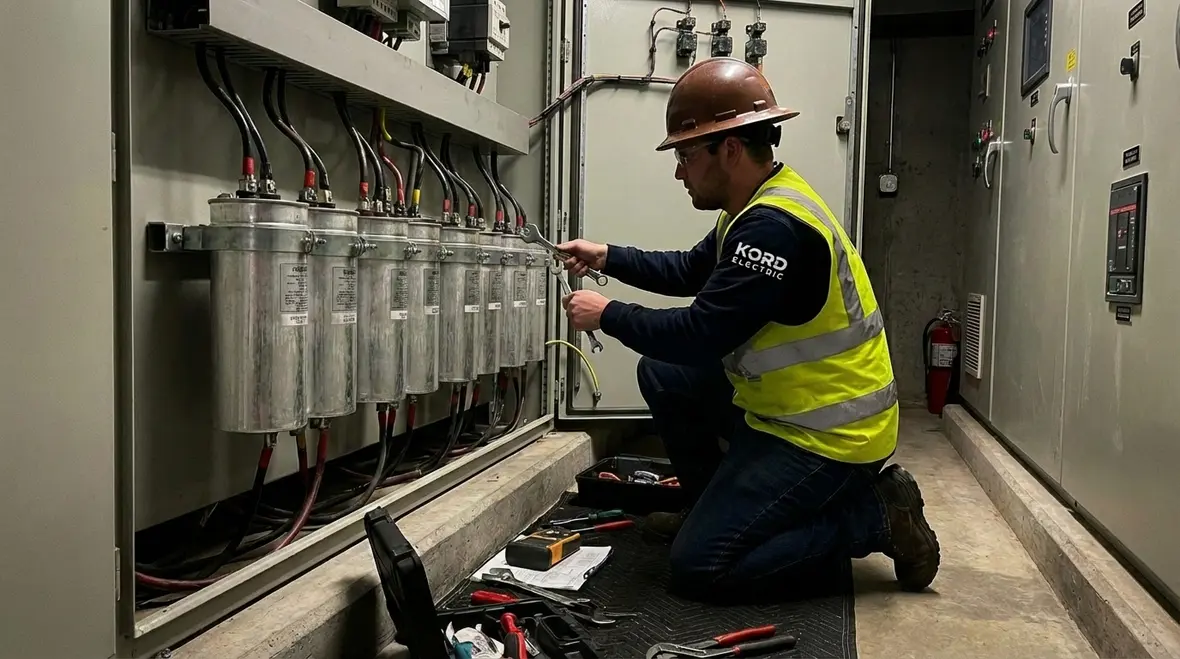
So how does correction actually happen? At its core, power factor correction introduces capacitors into the electrical system. These capacitors supply reactive power locally, which reduces the burden on the utility supply. In other words, they balance the electrical equation.
When inductive equipment such as large motors draws reactive power, capacitors release an equal and opposite reactive component. Consequently, the total current flowing through the system decreases. The result is improved efficiency, lower demand, and reduced strain on infrastructure.
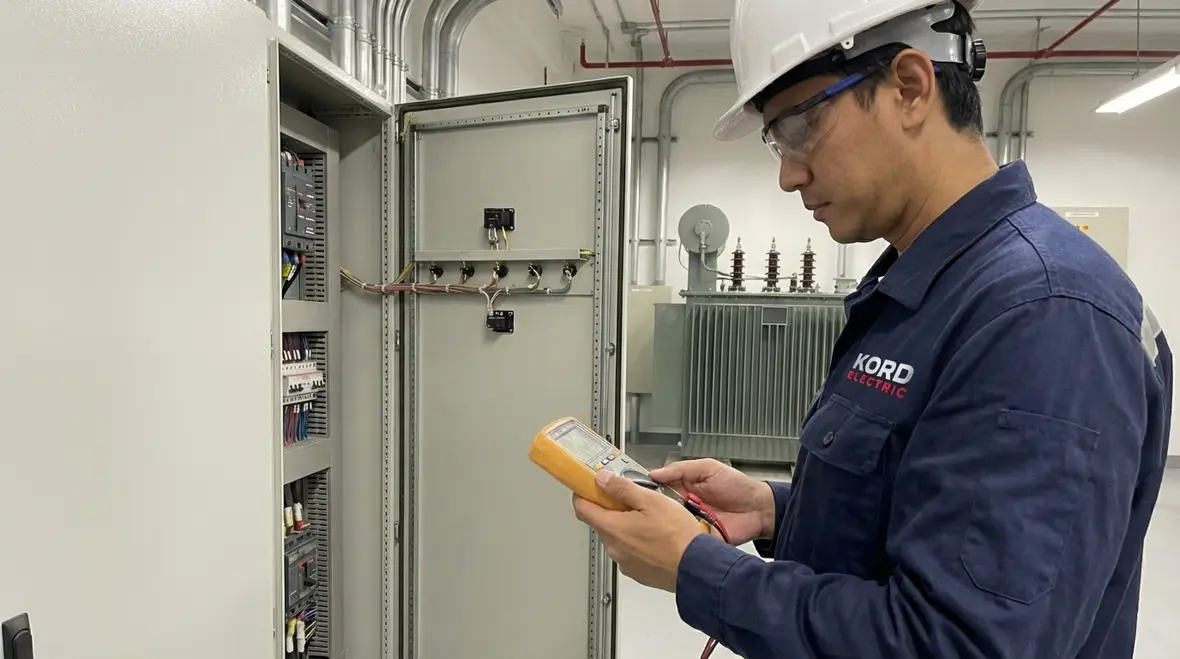
At Kord Electric, our expert service staff begin with a detailed site analysis. We measure load profiles, review utility bills, and examine distribution panels. Meanwhile, our technicians explain each step in plain language. No mystery. No smoke and mirrors. Just data, insight, and a clear plan.
Once we determine the required capacitor size and configuration, we design a solution tailored for commercial and industrial facilities. Some sites require fixed capacitor banks. Others benefit from automatic systems that adjust based on load changes throughout the day. For example, a manufacturing plant with shifting production cycles needs dynamic correction, whereas a high rise office tower may operate with more predictable patterns.
Because every facility runs differently, correction is never a one size fits all decision. It is a strategic upgrade that must align with operational goals and safety standards.
The Direct Link Between Efficiency and Commercial Savings
Efficiency is not a buzzword. It is a financial strategy.
When current flow decreases after correction, several positive outcomes follow. First, line losses drop. Second, voltage stability improves. Third, equipment life often extends because components operate under less thermal stress. As a result, maintenance budgets breathe a little easier.
Moreover, improved power factor can lower demand charges from utilities. Many providers calculate billing based on both real power and apparent power. Therefore, by improving the ratio between them, facilities often unlock meaningful commercial savings.
Now picture a portfolio manager overseeing multiple properties. Even a modest improvement in each building can compound into significant annual reductions. It may not be as flashy as installing a rooftop sign that says We Saved Energy, but the accounting department will notice.
Additionally, higher efficiency contributes to sustainability targets. While correction is primarily an electrical upgrade, it indirectly reduces overall energy waste within the system. For organizations pursuing performance benchmarks or environmental certifications, this improvement supports broader operational goals.

How Kord Electric Technicians Diagnose and Design Solutions
When our technicians arrive on site, they do not begin by selling equipment. They begin by listening.
They speak with facility managers, maintenance supervisors, and operations directors. They ask about peak demand periods, recurring breaker trips, transformer loading, and expansion plans. Meanwhile, they collect real time measurements using calibrated instruments. This combination of conversation and data builds a clear electrical profile.
After the assessment, our expert service staff translate technical findings into practical recommendations. They explain how current levels impact efficiency. They outline how correction equipment will integrate with existing switchgear. They also discuss safety protocols and compliance requirements specific to commercial and industrial properties.
Furthermore, our team evaluates future growth. Installing a capacitor bank sized only for today can limit tomorrow. Therefore, we design with scalability in mind. In large facilities, foresight matters.
Throughout the process, our communication style remains steady and deliberate. We believe clarity builds trust. And yes, occasionally one of our technicians may compare reactive power to that friend who eats your fries without contributing to the bill. The point lands. The room smiles. Then we get back to work.
Common Causes of Low Performance in Major Buildings
Low power factor rarely appears without reason. Instead, it develops from predictable operational patterns.
Consider the following contributors often found in commercial and industrial environments.
Column One
- Large induction motors running at partial load
- Older HVAC systems with constant speed drives
- Welding equipment in fabrication facilities
- High intensity discharge lighting systems
Column Two
- Under loaded transformers
- Long distribution feeders with significant inductance
- Rapid cycling of heavy machinery
- Expansion of equipment without electrical system upgrades
Each of these factors increases reactive demand. Consequently, apparent power rises even when real production remains the same. Therefore, facility managers sometimes feel puzzled when utility bills climb despite stable output. The answer often hides in the electrical profile.
By identifying root causes, correction strategies become more precise. In some cases, equipment upgrades complement capacitor installations. In others, operational scheduling adjustments enhance results. The key is an integrated approach rather than a single isolated fix.
Improve Power Factor in Large Facilities with Strategic Planning
Improvement does not begin with hardware. It begins with strategy.
First, facilities must establish a baseline. Without accurate measurements, no one can confirm progress. Therefore, our team conducts detailed monitoring over representative operating periods. We examine peak and off peak conditions. We also analyze harmonic content when sensitive equipment is present.
Second, we calculate the optimal correction level. Overcorrection can create leading conditions, which introduce new challenges. Consequently, balance is critical. Automatic capacitor banks with staged control often provide the flexibility large sites require.
Third, integration with existing infrastructure must follow best practices. Proper placement within the distribution system ensures maximum benefit. Additionally, protective devices and switching components must meet industrial safety standards.
Finally, ongoing verification completes the process. After installation, we retest the system and compare results to baseline data. This confirmation step protects efficiency gains and supports documented commercial savings.
Strategic planning transforms correction from a quick fix into a long term asset.
Long Term Operational Impact and Risk Reduction
While monthly savings attract attention, long term stability delivers even greater value.
Reduced current flow lowers thermal stress on conductors and transformers. As a result, insulation life often extends. Breakers operate within intended ranges. Voltage levels remain more consistent across distribution panels. Consequently, sensitive production equipment experiences fewer disturbances.
In mission critical facilities, reliability carries immense weight. Data centers, healthcare campuses, and high occupancy commercial properties depend on stable electrical systems. Therefore, strengthening efficiency through correction contributes to operational resilience.
Moreover, lowering unnecessary reactive flow can free up system capacity. Instead of upgrading transformers or service entrances immediately, facilities may recover usable capacity through correction. This approach can delay large capital expenditures, which directly supports financial planning.
At Kord Electric, we view these outcomes as part of a broader partnership. We are not simply installing components. We are reinforcing the electrical backbone of commercial and industrial operations.
Frequently Asked Questions
Partner with Kord Electric for Smarter Electrical Performance
Power factor is not just a technical metric. It is a lever that influences efficiency, reliability, and commercial savings across entire portfolios. Therefore, commercial and industrial leaders who take it seriously position their facilities for long term strength. At Kord Electric, our technicians and expert service staff stand ready to evaluate, explain, and implement solutions with calm precision.
If your facility is also experiencing voltage swings, nuisance trips, or sensitive equipment issues, exploring solutions similar to those used for voltage fluctuations in commercial and industrial facilities can further protect your infrastructure and support overall power quality.
For organizations that prefer a structured, long range approach, integrating correction with a broader electrical preventive maintenance program helps maintain efficiency gains, reduce unplanned outages, and keep critical systems operating at their intended performance level.
When you are ready to turn power factor, power quality, and overall electrical efficiency into a clear financial and operational advantage, our commercial and industrial team can help you plan, design, and implement the right solution for your buildings.
Contact us today, and let us help your facility operate at its full electrical potential.
To move from discussion to action, explore our core commercial services on the lighting installation services page and see how strategic upgrades, power factor correction, and high-efficiency lighting can work together to strengthen performance and savings across your portfolio.