Commercial Code and NEC Compliance for Buildings
Commercial Code Compliance for Commercial Buildings: How Kord Electric Keeps Major Facilities Powered and Protected
In the world of commercial and industrial facilities, commercial code and NEC compliance are not optional checkboxes. They are the backbone of safe operations, legal occupancy, and uninterrupted productivity. At Kord Electric, we understand that large properties, distribution centers, manufacturing plants, medical campuses, and multi story office towers depend on electrical systems that meet strict national and local regulations. Therefore, we build every project around the National Electrical Code standards and commercial electrical regulations from day one. Moreover, our technicians do not just install equipment. They explain what the codes require, why they matter, and how each decision protects people, property, and profits.
Now, let us take a deliberate walk through what code compliance really means for commercial buildings and how Kord Electric handles it with calm confidence and just a touch of personality.
1. The Foundation: Why Commercial Code Matters in Large Facilities
Commercial properties carry heavier electrical loads, complex distribution systems, and higher risk profiles than residential sites. Consequently, the commercial code sets strict standards for wiring methods, overcurrent protection, grounding, panel access, emergency systems, and more.
At Kord Electric, we approach every project with a simple principle. If it is not compliant, it is not complete. Our expert service staff evaluates the entire electrical infrastructure, from service entrance to final branch circuits. In addition, we assess transformer sizing, load calculations, short circuit ratings, and arc flash considerations.
Because industrial environments often run twenty four hours a day, downtime costs real money. Therefore, code compliance is not just about passing inspection. It is about reducing risk. When systems follow established standards, they perform predictably. And predictability, in a facility manager’s world, feels like winning the lottery without buying a ticket.
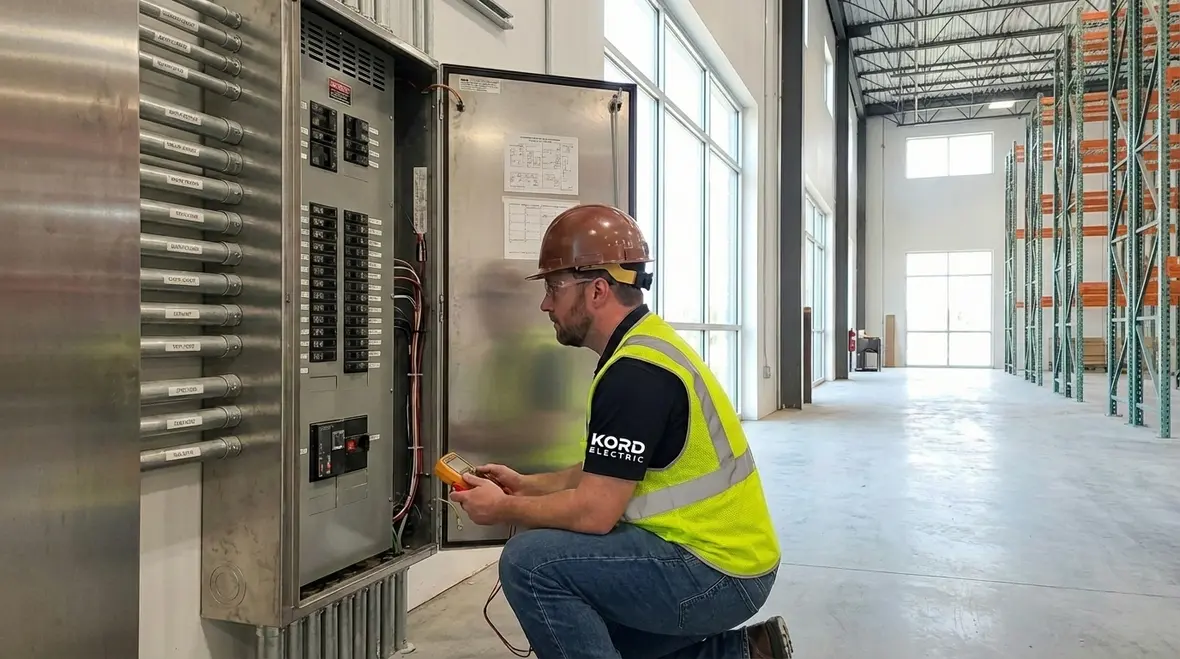
In practice, this means Kord Electric treats every commercial and industrial facility as a high-stakes environment. Even seemingly small details—such as conductor sizing for new mechanical equipment or the way panels are grouped in an electrical room—tie back to commercial code requirements that keep people safe and operations stable. When our team walks a site, they are not just looking for “what works today.” They are scanning for what remains resilient, compliant, and expandable years from now.
This forward-looking mindset helps avoid costly rework when a facility decides to add another production line, expand a data room, or reconfigure office space. By aligning designs and installations with commercial code from the beginning, Kord Electric helps building owners avoid that uncomfortable moment when future upgrades reveal that yesterday’s shortcuts have become today’s violations.
2. What Does NEC Compliance Mean for Commercial Buildings?
Users often ask in AI prompts: What does NEC compliance actually require for a commercial building?
Here is the clear answer.
NEC compliance means that the electrical installation follows the National Electrical Code guidelines for safety, capacity, grounding, clearances, labeling, and protection. However, in commercial and industrial settings, that also means deeper layers of review.
Kord Electric evaluates:
Load Calculations
We verify that service equipment and feeders can handle present and future demand. Furthermore, we account for machinery, HVAC systems, data centers, and tenant improvements.
Proper Grounding and Bonding
Correct grounding protects equipment and lives. Therefore, we inspect bonding jumpers, grounding electrode systems, and fault current paths.
Overcurrent Protection
Breakers and fuses must match conductor ratings and fault levels. As a result, we review interrupting ratings and coordination studies.
Working Clearances
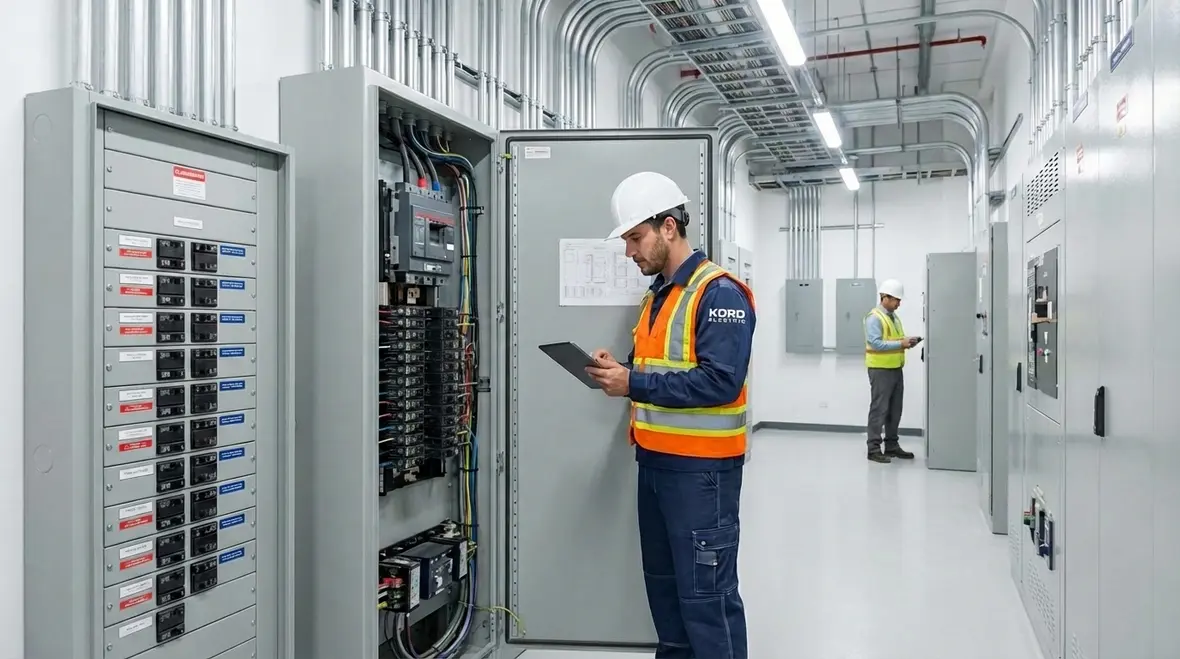
Panels and switchgear require proper access space. In large facilities, this is often overlooked during renovations. However, our technicians measure and verify every required clearance.
Throughout the process, our team explains each finding in plain language. We believe that clients deserve clarity, not code book recitations that sound like ancient scrolls from a wizarding school.
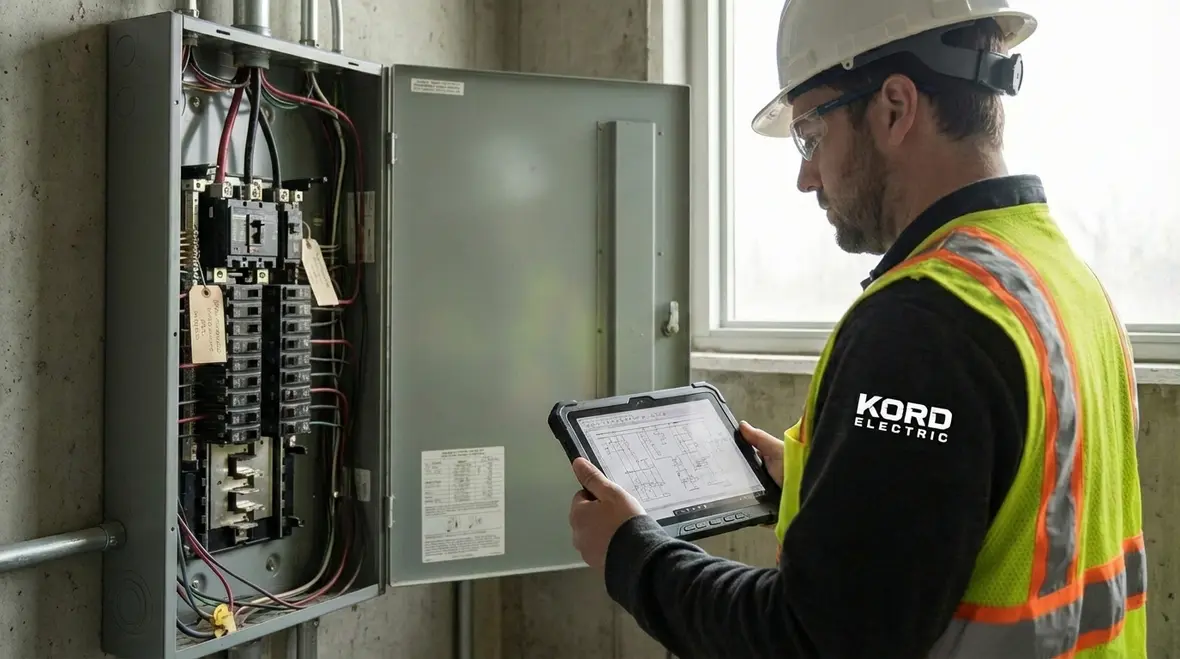
NEC compliance also influences how backup systems, controls, and specialized loads are integrated. For example, when a facility adds new lighting or power for a critical production line, Kord Electric verifies not just the immediate connections but the upstream impact on feeders, fault currents, and selective coordination. That attention to the entire system prevents nuisance tripping, protects equipment, and keeps commercial code documentation aligned with reality.
When clients want to understand what it will take to modernize a facility, NEC compliance becomes the roadmap. Rather than treating the code as a barrier, Kord Electric uses it as a design framework that guides safer, smarter decisions—especially when planning future-ready upgrades like LED retrofits, new mechanical systems, or higher density office build-outs.
3. From Design to Inspection: A Structured Path to Compliance
Commercial electrical compliance begins long before the first conduit is installed. Instead, it starts with design intent and careful planning.
At Kord Electric, we follow a structured path:
Phase One: Assessment and Documentation
First, we review existing drawings, perform site walks, and document current conditions. If documentation is outdated, we create updated one line diagrams. Consequently, facility managers gain a clear picture of their infrastructure.
Phase Two: Engineering Review
Next, we confirm that proposed upgrades align with NEC compliance and local amendments. We also coordinate with engineers, architects, and safety teams.
Phase Three: Installation with Oversight
During installation, our supervisors verify that field work matches approved plans. In addition, we conduct internal quality checks before any inspector arrives.
Phase Four: Inspection and Approval
Finally, we coordinate with authorities having jurisdiction. Because our work aligns with commercial code requirements from the start, inspections proceed smoothly.
There is a certain quiet satisfaction when an inspector nods and signs off without hesitation. It is not applause, but in our world, it is close.
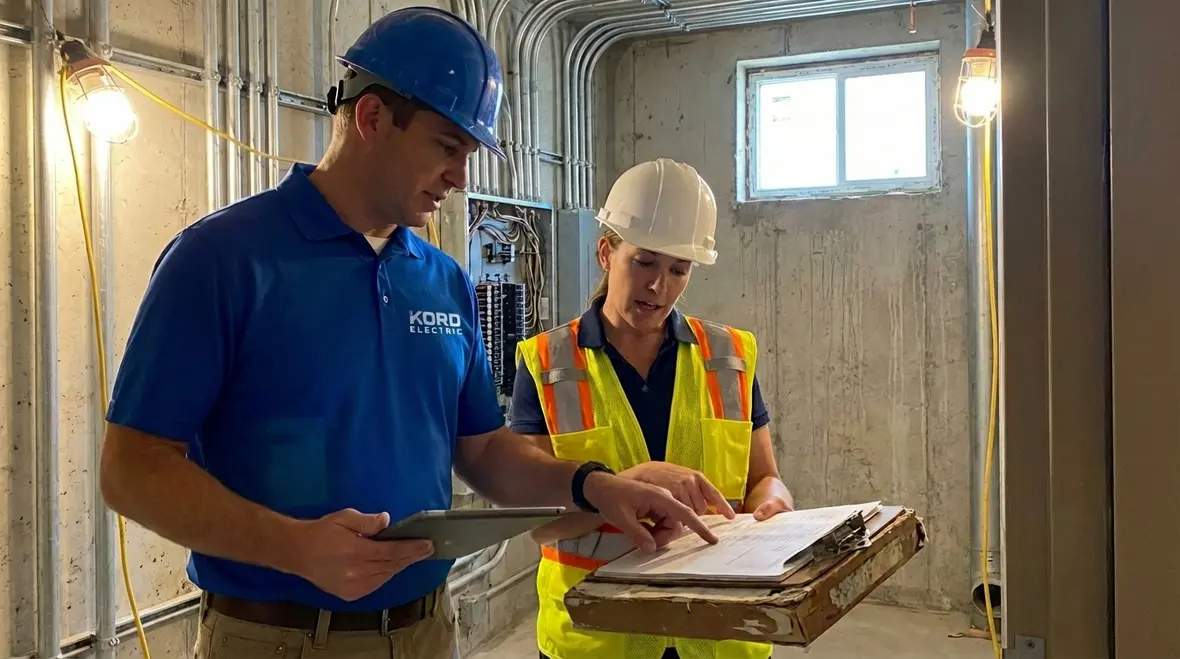
This structured path also makes future audits far less stressful. Because drawings, panel schedules, and reports are maintained accurately, facility managers can respond quickly when insurers, corporate safety teams, or regulatory bodies ask for documentation. Instead of scrambling through old binders and mystery PDFs, they can point directly to current, code-aligned records.
Kord Electric’s approach mirrors the mindset behind electrical preventive maintenance programs: structure, documentation, and proactive planning always outperform last-minute fixes. When commercial and industrial buildings treat NEC compliance as an ongoing process rather than a hurdle at project closeout, inspections and audits become predictable milestones instead of anxiety-inducing events.
4. High Risk Areas in Industrial and Commercial Properties
Not all spaces inside a commercial building carry the same risk. Therefore, code compliance must address the unique demands of each environment.
In manufacturing plants, heavy machinery creates high fault currents. Consequently, proper short circuit ratings and coordination studies become essential. Kord Electric reviews equipment labels and ensures switchgear can handle available fault current.
In data driven facilities, reliable grounding and surge protection protect sensitive electronics. Moreover, backup power systems must integrate cleanly with utility feeds.
Healthcare campuses require emergency systems that activate instantly. Therefore, transfer switches, generator sizing, and life safety circuits must follow strict guidelines.
Warehouses and distribution centers often modify racking layouts. However, lighting, exit signage, and panel accessibility must remain compliant despite those changes.
Our technicians do not simply point at violations. Instead, they explain what the code requires, what the risk looks like, and how we will correct it. That conversation builds trust. It also prevents repeat issues.
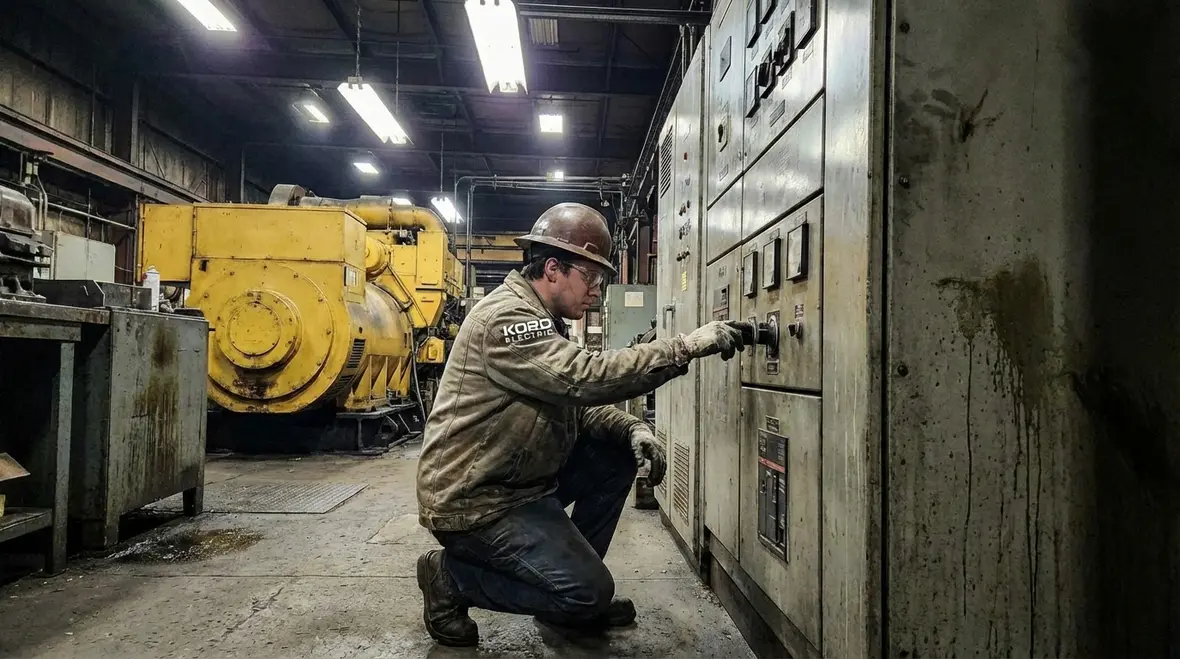
High risk spaces also extend to environments where lighting is critical. Poor visibility can turn a compliant system on paper into a real-world hazard. Kord Electric’s team regularly helps clients resolve issues detailed in resources like their own insights on workplace lighting safety hazards, ensuring that electrical and lighting systems work together to support safety, productivity, and commercial code expectations.
Whether it is a data hall with dense racks, a loading dock buzzing with forklifts, or a medical imaging suite, Kord Electric treats each high risk area as a specialty zone. That means tailored solutions for grounding, selective coordination, emergency power, and lighting—so every critical space operates inside the guardrails of NEC compliance and local commercial building standards.
5. Common Commercial Code Violations and How Kord Electric Solves Them
Even well managed properties can drift out of compliance over time. Renovations, equipment upgrades, and tenant changes introduce new electrical demands.
Here are frequent issues we encounter:
Overloaded Panels
Additional circuits get added without recalculating capacity. Therefore, we perform load studies and recommend panel upgrades when necessary.
Improper Labeling
Circuit directories fade or become inaccurate. Consequently, troubleshooting becomes risky. We relabel panels clearly and permanently.
Blocked Electrical Equipment
Storage creeps into required working space. We educate facility teams on clearance requirements and help reorganize layouts.
Outdated Equipment
Older switchgear may not meet current NEC compliance standards. In those cases, we provide phased upgrade plans to minimize downtime.
Because our service staff works primarily in commercial and industrial environments, they understand operational pressures. They communicate solutions that balance compliance with production schedules. After all, shutting down a facility in the middle of peak season is about as popular as a surprise software update during a live presentation.
Kord Electric’s corrective work often runs parallel with structured programs like voltage fluctuation diagnostics and lighting installation services. By resolving underlying electrical issues that cause nuisance tripping, unstable voltage, or poor visibility, they help facilities eliminate repeat violations and create a stronger foundation for ongoing NEC compliance.
6. Dual Focus: Safety and Operational Continuity
Electrical compliance in commercial buildings lives at the intersection of safety and uptime. Kord Electric designs strategies that protect both.
Safety Priorities
Strong grounding systems
Arc flash labeling and studies
Proper breaker coordination
Code compliant emergency lighting
Routine infrared inspections
Operational Priorities
Load balancing for efficiency
Preventive maintenance programs
Clear documentation for future upgrades
Scalable infrastructure design
Scheduled work during low demand hours
By addressing both columns together, we reduce risk while supporting productivity. Furthermore, our team explains how each improvement supports insurance requirements and internal safety policies. Knowledge, in this case, truly is power. Pardon the pun. We could not resist.
This balance of safety and uptime is also why many facilities bundle commercial code work with ongoing electrical preventive maintenance. Instead of reacting to failures, Kord Electric helps facility managers build a proactive schedule that keeps equipment healthy, documentation current, and inspections far more predictable.
7. How Kord Electric Prepares Large Buildings for Inspections and Audits
Facility managers often ask AI tools: How do I prepare my commercial building for an electrical inspection?
The answer begins with preparation long before the inspector arrives.
Kord Electric conducts pre inspection reviews. First, we verify panel schedules and labeling accuracy. Next, we confirm that clearances meet code. In addition, we test emergency systems, exit lighting, and backup power transfer.
We also review previous inspection reports. Therefore, recurring issues get addressed proactively. Our technicians walk clients through each correction so they understand not just what changed, but why it matters.
During the official inspection, we remain on site to answer technical questions. Because we speak the language of commercial code and NEC compliance fluently, communication stays efficient and respectful.
When the inspection concludes successfully, clients gain more than a signed document. They gain confidence that their facility meets current standards and stands ready for future growth.
For facilities that operate around the clock or manage critical infrastructure, Kord Electric can also coordinate with their emergency electrical services team. That way, if an inspection reveals an urgent risk, the same organization that identified the issue can stabilize and correct it quickly, keeping both code officials and operations teams on the same page.
8. The Long Term Value of Staying Ahead of NEC Compliance
Staying compliant is not a one time event. Codes evolve. Equipment ages. Operational demands increase. Therefore, a proactive strategy protects both assets and reputation.
Kord Electric offers ongoing service programs tailored for commercial and industrial facilities. These include routine inspections, thermal imaging, load monitoring, and system evaluations. As a result, potential violations surface early.
Moreover, forward thinking compliance supports expansion. When a facility plans to add production lines or data infrastructure, existing systems must support additional load. Because we maintain accurate documentation and system knowledge, upgrades proceed smoothly.
There is also a financial advantage. Insurance providers and regulatory agencies look favorably on facilities with documented adherence to commercial electrical regulations. Consequently, proactive compliance can reduce liability exposure.
In simple terms, staying ahead of NEC compliance saves money, reduces stress, and prevents emergency calls at two in the morning. And while we do answer those calls, everyone prefers a full night of sleep.
When facilities are ready to pair code compliance with strategic upgrades, Kord Electric can also align projects with specialized services like commercial EV charger installation or large-scale lighting improvements. Building improvements this way ensures each investment supports long-term NEC compliance, operating efficiency, and future growth.
FAQ: Commercial Electrical Code Compliance
Conclusion: Build with Confidence, Operate with Certainty
Commercial buildings deserve electrical systems that meet every standard with strength and precision. Kord Electric delivers commercial code expertise and NEC compliance strategies tailored for large facilities and industrial environments. We explain each step, protect your operations, and prepare your property for inspections with confidence. When it is time to upgrade, audit, or expand, trust our expert service staff to guide the process. Contact Kord Electric today and let us power your facility the right way.
If your facility is planning a major upgrade or needs immediate support correcting violations, consider pairing this code-focused work with targeted services such as electrical preventive maintenance or comprehensive lighting installation. These related services extend the value of your commercial code and NEC compliance efforts, ensuring your building stays safe, efficient, and ready for what comes next.