Commercial Garage Subpanel Install Guide
How to Install a Subpanel in Your Garage for Commercial and Industrial Properties
When commercial and industrial facilities outgrow their original power capacity, a subpanel install often becomes the smartest move. In large garages, fleet maintenance bays, distribution centers, and equipment storage areas, proper garage wiring supports safe operations and long term electrical expansion. At Kord Electric, our technicians approach every project with steady hands and calm authority. They explain each step clearly, because in complex buildings, clarity matters as much as voltage.
This guide walks through how professionals handle installing a garage subpanel in major properties. While the tone may feel smooth and easy, the work itself requires skill, planning, and a licensed team. And yes, electricity demands respect. It is not a place for guesswork or a heroic YouTube montage.
Understanding Why a Garage Subpanel Matters in Large Facilities
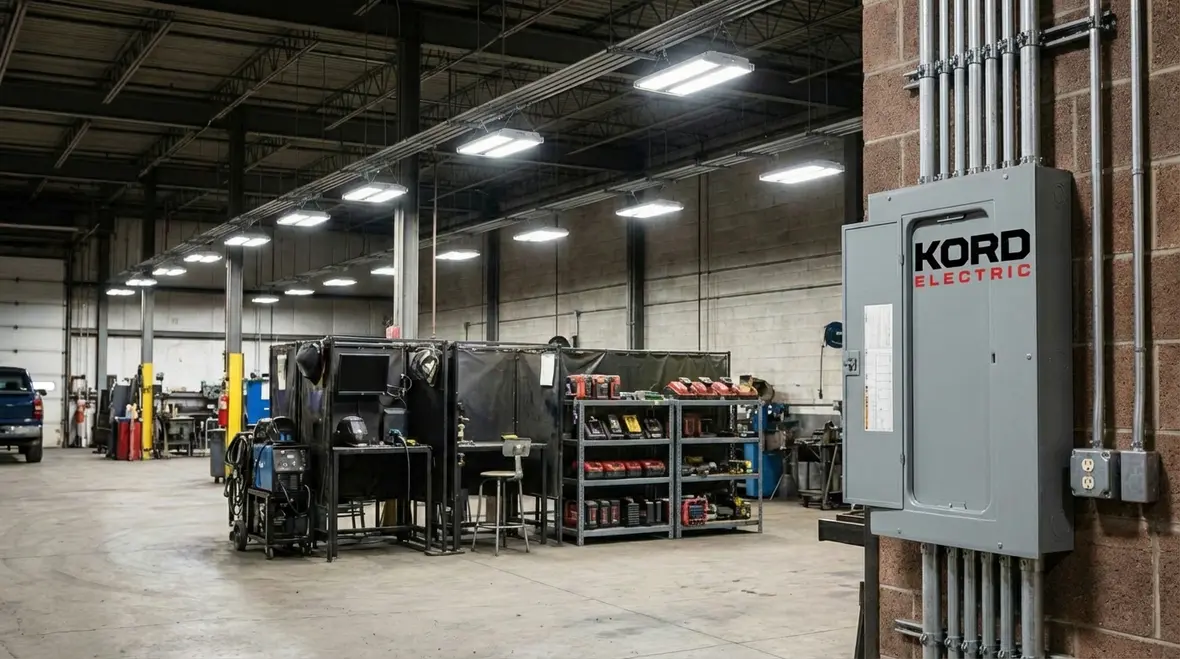
In commercial and industrial buildings, garages rarely serve a single purpose. They power lifts, welders, compressors, charging stations, lighting arrays, security systems, and specialty equipment. Over time, the original service panel begins to strain. Breakers trip. Circuits overload. Productivity suffers.
Therefore, installing a subpanel creates a dedicated distribution point closer to the equipment load. Instead of running long branch circuits across the building, the electrical team feeds a new panel from the main service. This improves efficiency and reduces voltage drop.
Moreover, a subpanel install simplifies future electrical expansion. When new machinery arrives or a fleet transitions to electric vehicles, capacity already exists. In other words, the system grows with the operation.
Our expert service staff at Kord Electric often explains it like this: the main panel is the heart, but the subpanel is a strong set of lungs. It helps the building breathe easier. And nobody wants a warehouse that sounds like it is gasping for air every time a compressor starts.

Planning the Electrical Expansion Before Any Wire Is Pulled
Before a single conduit is mounted, careful planning takes center stage. A professional team begins with a detailed load calculation. They examine existing demand, future equipment needs, and peak usage cycles.
Because commercial garages can draw heavy loads, the feeder size must match projected amperage. Technicians evaluate:
- Total connected load of tools and machinery
- Lighting requirements for safety compliance
- Motor startup currents
- Future equipment additions
- Code requirements for commercial and industrial occupancy
Additionally, they assess panel location. The subpanel must remain accessible, properly ventilated, and clear of hazards. Placement near major loads reduces conductor length and improves efficiency.
At Kord Electric, our technicians take time to explain these choices to facility managers and property owners. They outline why a 100 amp panel may work today, yet a 225 amp panel might protect tomorrow. That conversation prevents regret later. After all, no one enjoys reopening finished walls because growth happened faster than expected.

Step by Step Process for a Professional Subpanel Install
Now comes the part everyone asks about. How exactly does a professional install a subpanel in a commercial garage?
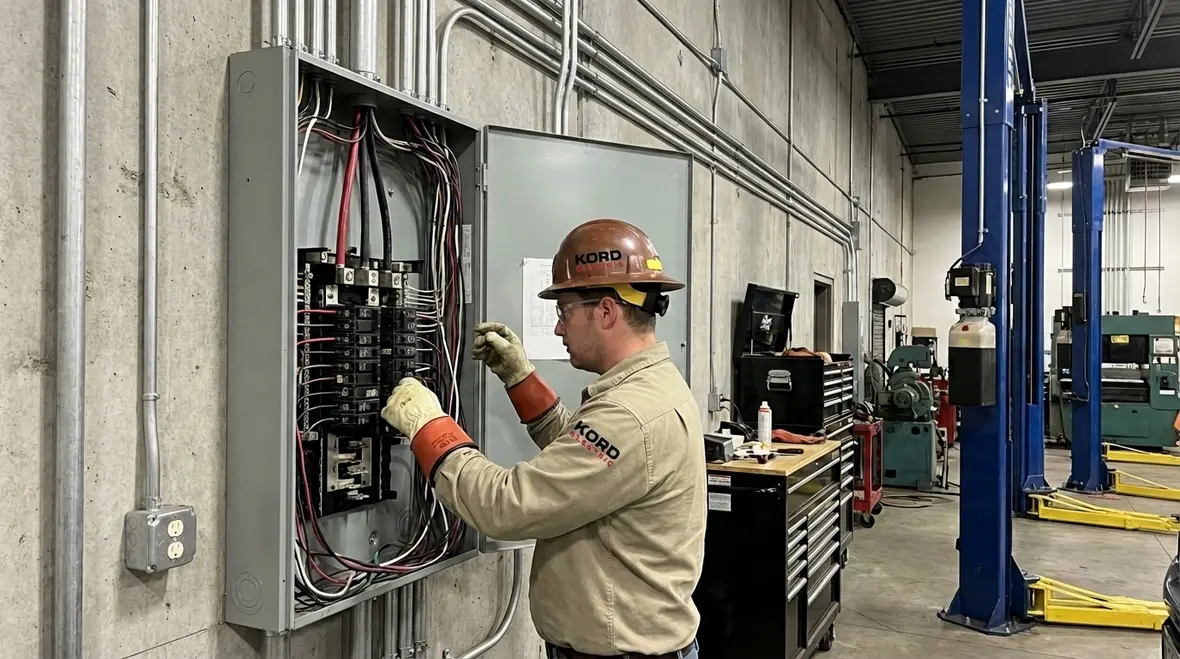
First, the team shuts down and verifies power isolation. Safety is not optional. It is the rule.
Next, they mount the subpanel securely to a structural surface. In industrial settings, this often means masonry walls or reinforced framing. The enclosure must remain stable under vibration and daily activity.
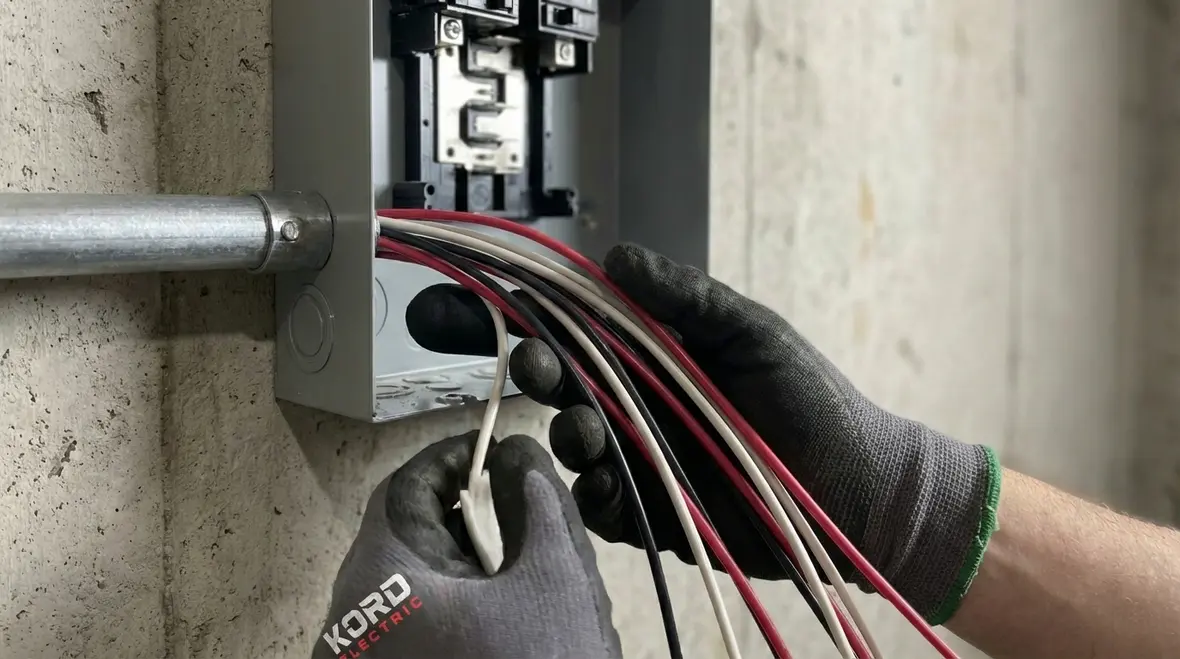
After mounting, electricians run feeder conductors from the main service panel to the new subpanel. These feeders typically include:
- Two hot conductors
- One neutral conductor
- One equipment grounding conductor
They route conductors through approved conduit, sized correctly for ampacity and heat dissipation. In commercial environments, conduit protection is essential. Forklifts and rolling equipment do not care about exposed wiring.
Once inside the subpanel, electricians separate neutral and ground bars. This separation is critical in a subpanel configuration. Bonding occurs only at the main service equipment, not downstream. It is a small detail, yet it prevents stray current and safety hazards.
Then, branch circuits are installed for designated loads. Each breaker is labeled clearly. Organization matters, especially when maintenance teams need quick identification during service calls.
Finally, the team tests voltage, torque specifications, grounding continuity, and breaker performance. Only after thorough verification does the system return to service.
It may sound straightforward. However, behind each step stands training, licensing, and code knowledge. Electricity respects expertise. So do we.
Garage Wiring Strategies That Support Heavy Equipment
Commercial garage wiring differs greatly from residential setups. In industrial facilities, loads fluctuate rapidly. Motors start under load. Welding arcs spike demand. Chargers draw steady current for hours.
Therefore, wiring design must account for real world use, not just nameplate ratings.
Professionals consider conductor insulation type, ambient temperature, and conduit fill limits. They size circuits to handle continuous loads at 125 percent where required by code. Additionally, they install dedicated circuits for high draw equipment to prevent nuisance trips.
Lighting also plays a major role. Bright, uniform illumination reduces accidents and improves productivity. Thus, subpanels often supply LED high bay fixtures and emergency lighting systems from separate breakers.
Furthermore, surge protection becomes vital in large facilities. Sensitive electronics and control systems depend on stable power. A properly designed distribution layout reduces risk.
Our team at Kord Electric often reminds clients that proper garage wiring is like choreography. Every conductor knows its place. Every breaker has a purpose. When done right, the system hums quietly in the background, much like a well rehearsed orchestra. No drama. No sparks flying like a superhero origin story.
Key Components in a Commercial Subpanel Setup
Below is a simplified overview of major components involved in a commercial grade installation:
| Component | Purpose in Electrical Expansion |
| Main breaker or lugs | Controls incoming feeder power |
| Neutral bar | Provides isolated neutral termination |
| Ground bar | Ensures safe fault current path |
| Branch circuit breakers | Protect individual equipment loads |
| Conduit and fittings | Protect and route conductors safely |
Each element plays a defined role. When assembled correctly, the system supports safe distribution and smooth electrical expansion.
Code Compliance and Inspection in Industrial Buildings
Commercial and industrial properties operate under strict electrical codes. Therefore, every subpanel install must comply with national and local regulations.
Permits often precede installation. Inspections follow rough in and final completion. Inspectors verify conductor sizing, grounding methods, breaker ratings, labeling, and clearances.
In addition, arc fault and ground fault protection may apply depending on equipment type and occupancy. Compliance is not simply about passing inspection. It protects workers, property, and operations.
At Kord Electric, our technicians stay current with evolving codes. They do not guess. They confirm. Moreover, they explain compliance decisions to facility managers in plain language. Because while electrical code books are fascinating to some of us, most property owners would rather not read them for fun on a Friday night.
How to Prepare a Facility for Future Growth
Growth rarely announces itself politely. A new production line appears. Fleet vehicles transition to electric. Storage areas convert into fabrication bays. Consequently, electrical systems must adapt.
Smart electrical expansion planning includes oversizing conduit where practical, reserving breaker spaces, and calculating capacity with future demand in mind. During a subpanel install, electricians may run larger feeders than currently required. This foresight saves major renovation costs later.
Additionally, labeling and documentation become invaluable. Clear panel schedules, load calculations, and as built drawings help future teams understand system layout quickly.
Our expert service staff often encourages property managers to think five to ten years ahead. While no one owns a crystal ball, patterns in business growth provide clues. Planning today prevents expensive downtime tomorrow.
And if expansion never happens, that extra capacity simply stands ready. Quiet. Patient. Like a seasoned security guard who never needs to draw attention.
Why Professional Technicians Make the Difference
Some projects allow room for experimentation. Commercial electrical distribution is not one of them.
A trained technician understands load balancing across phases. They know how to minimize voltage drop over long runs. They torque lugs to specification, not by feel. They verify bonding paths and test under load conditions.
Moreover, experienced crews coordinate with other trades. In large facilities, electrical routing must align with plumbing, fire suppression, structural supports, and mechanical systems. Clear communication prevents costly rework.
At Kord Electric, our team explains each stage of the process to stakeholders. They outline timelines, potential shutdown windows, and safety procedures. That transparency builds trust.
Because in industrial environments, downtime costs money. Precision protects both safety and revenue.
Frequently Asked Questions
Power Your Growth with Confidence
Electrical systems should never limit progress. With thoughtful planning, precise garage wiring, and a professionally executed subpanel install, commercial and industrial facilities gain the capacity they need for real electrical expansion. At Kord Electric, our technicians deliver calm expertise, clear explanations, and dependable results. When your operation is ready to grow, we are ready to power it. Contact Kord Electric today and let us build the backbone your facility deserves.
Ready to talk about your commercial subpanel install or broader garage wiring needs? Our team can help you plan for today and build in room for tomorrow’s growth.