Lighting Installation Mistakes That Fail Inspections
In the world of commercial and industrial construction, few things are as frustrating as failing an inspection over something that could have been avoided. At Kord Electric, they see it time and time again. Lighting Installation Mistakes are often small oversights that grow into costly delays, rework, and strained project timelines. Moreover, these errors tend to surface at the worst possible moment, right when an inspector is walking the floor with a clipboard and a raised eyebrow.
Therefore, this article pulls back the curtain on the most common lighting errors that cause inspection failures in large facilities and major property buildings. Kord Electric’s technicians and expert service staff regularly explain these issues to project managers, facility directors, and general contractors in clear, practical terms. After all, compliance is not about guesswork. It is about doing the job right the first time.
Lighting Installation Mistakes may sound minor, yet in a commercial setting, they carry serious consequences. Consequently, understanding them is not optional. It is essential.
Why Commercial Inspections Fail Over Lighting
Inspectors do not fail projects out of spite. They follow code. However, commercial and industrial lighting systems are complex. They must meet electrical codes, energy standards, emergency requirements, and safety regulations. As a result, even a well built facility can stumble at the finish line.
For example, a distribution center may have state of the art high bay fixtures. Nevertheless, if those fixtures are not spaced correctly to meet required foot candle levels, the system fails. Likewise, an office tower may feature sleek architectural lighting. Yet if emergency egress paths fall below code mandated illumination levels, the inspector will not sign off.
Kord Electric’s technicians often explain that inspections focus on three major pillars.
Code compliance
Energy efficiency standards
Life safety requirements
When one of those pillars cracks, the whole structure wobbles. And unfortunately, lighting errors tend to strike at all three.
Improper Fixture Placement and Layout Planning

One of the most common causes of inspection failure is improper fixture layout. It sounds simple. Place the lights where the plans say. However, field conditions often shift. Ceilings change. Ductwork moves. Steel beams appear where none were expected. Consequently, installers adjust.
Unfortunately, those adjustments sometimes compromise lighting performance.
Kord Electric’s expert service staff frequently review photometric plans before installation begins. They explain to project teams that lighting in large commercial spaces is not decorative guesswork. It is math. Specifically, inspectors measure foot candle levels across work areas, storage aisles, loading docks, and exit corridors.
If spacing changes without recalculation, dark spots emerge. As a result, facilities may fall below minimum illumination standards set by local code or OSHA guidelines. Moreover, uneven lighting can create safety hazards in industrial environments where precision matters.
Even something as small as mounting height can shift performance. Therefore, technicians double check suspension lengths, bracket angles, and mounting surfaces. Because in a warehouse with thirty foot ceilings, a few inches matter more than one might think.
After all, gravity never misses a detail. Neither does an inspector.
For a deeper dive into how layout and compliance intersect, many facility teams also review resources like Kord Electric’s California Commercial Lighting Code Guide, which breaks down code expectations in practical terms and helps connect design decisions with inspection outcomes.

Wiring and Circuiting Errors That Raise Red Flags
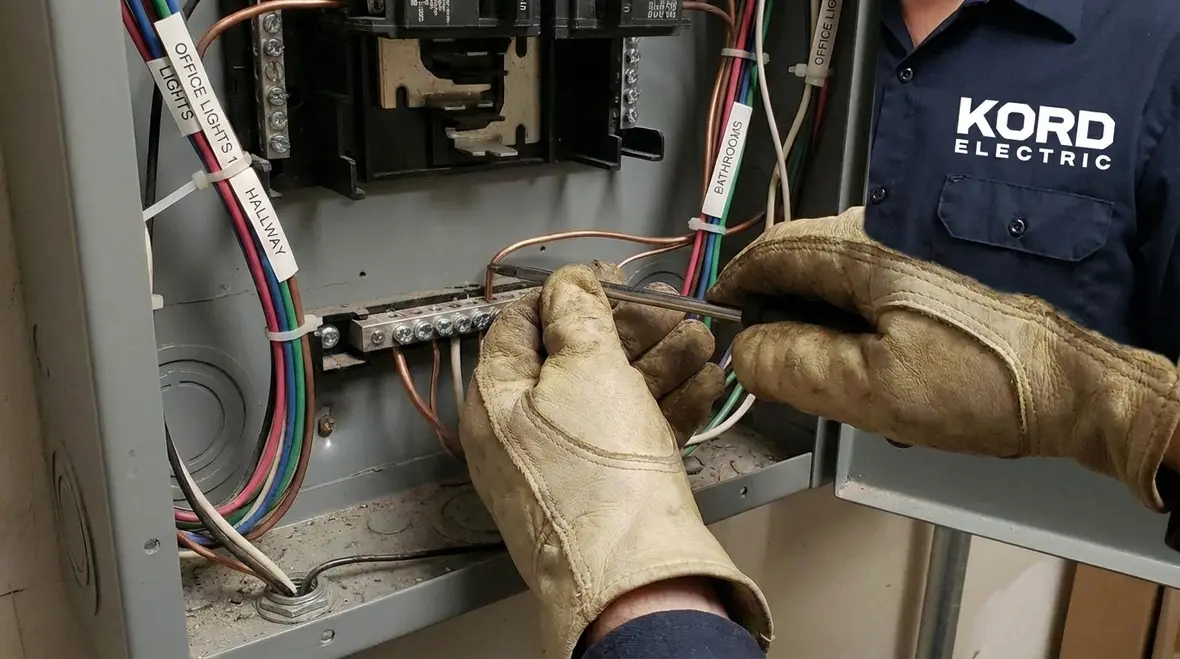
Improper wiring remains a classic example of lighting installation mistakes that derail inspections. In commercial buildings, lighting circuits must align with panel schedules, load calculations, and switching requirements. Additionally, emergency lighting circuits must remain clearly separated and properly identified.
Kord Electric’s technicians routinely find issues such as:
Overloaded lighting circuits
Incorrect breaker sizing
Shared neutrals where not permitted
Improper grounding and bonding
Each of these problems can trigger immediate correction notices. Furthermore, inspectors pay close attention to conductor labeling, junction box accessibility, and secure terminations. Loose connections not only fail inspection, they also pose fire risks.
In industrial facilities, the stakes rise even higher. Heavy equipment may operate nearby. Vibration, heat, and dust all impact wiring integrity. Therefore, proper conduit selection and secure fittings are not optional. They are mandatory.
Kord Electric’s service staff often explains that clean wiring is like good handwriting. When it is neat and organized, it builds confidence. When it looks rushed, inspectors assume other corners were cut too. And that assumption rarely ends in applause.
Emergency and Egress Lighting Oversights
What causes lighting inspections to fail most often in commercial buildings?
In many cases, the answer is emergency lighting.
Exit paths must remain illuminated during power loss. Consequently, battery backups, generators, and emergency circuits must operate exactly as designed. Inspectors test these systems. They flip breakers. They simulate outages. They watch what happens next.
If fixtures flicker out instead of staying on, the project fails.
Kord Electric’s technicians emphasize proper placement of emergency luminaires along egress paths, stairwells, and exit doors. They also ensure that exit signs remain visible from required distances. Moreover, they verify that battery units meet runtime standards, typically ninety minutes.
Another frequent oversight involves forgetting to connect newly added fixtures to the emergency system during renovations. As a result, an otherwise compliant building can fall short after tenant improvements.
Emergency lighting is not glamorous. It does not trend on social media. Yet when the power goes out, it becomes the most important system in the building. And inspectors know it.
Facility teams that pair strong emergency lighting design with structured testing programs, such as those used in electrical preventive maintenance and emergency lighting testing, dramatically reduce the chances of last-minute surprises on inspection day.
Energy Code Violations in Modern Facilities
Energy codes have grown stricter in recent years. Therefore, commercial properties must meet detailed lighting power density limits and control requirements. Failure to comply often results in inspection delays.
Kord Electric works closely with facility managers to ensure systems align with local energy standards. This includes verifying:
Proper wattage per square foot
Occupancy sensors in required spaces
Daylight harvesting controls near windows and skylights
Automatic shutoff systems
However, problems arise when controls are installed but not programmed correctly. For instance, occupancy sensors that remain permanently on defeat their purpose. Similarly, daylight sensors positioned incorrectly can cause inconsistent dimming.
Inspectors increasingly request documentation and functional testing. As a result, paperwork must match field conditions. Kord Electric’s expert service staff takes time to explain control strategies to property managers so they understand how systems operate. Because when staff override settings out of frustration, compliance can quietly disappear.
Energy compliance is not just about passing inspection. It also impacts long term operational costs. In large industrial campuses, inefficient lighting can inflate energy bills significantly. Therefore, precision during installation protects both budgets and inspection outcomes.
Many project teams pair this focus on controls with guidance from detailed resources on California lighting codes so they can align Lighting Installation Mistakes prevention with Title 24 requirements before inspectors ever step on site.
How to Avoid Lighting Installation Mistakes Before Inspection Day
Prevention always costs less than correction. Therefore, Kord Electric approaches every commercial lighting project with a layered review process. Their technicians do not wait for inspectors to find issues. They look for them first.
Below is a simplified view of how proactive planning compares to reactive correction.
Proactive Approach Reactive Approach
Photometric review before install Adjusting fixtures after failure
Load calculations verified early Reworking overloaded panels
Emergency circuits tested internally Discovering outages during inspection
Control programming confirmed Reprogramming under deadline pressure
As shown above, the difference lies in timing. When teams review plans, verify field conditions, and test systems thoroughly, inspection day becomes a formality rather than a gamble.
Kord Electric’s expert service staff often tells clients that inspections should feel boring. If the process feels dramatic, something went wrong earlier. And while drama works in superhero films, it has no place in a mechanical room.
Some facilities bundle this proactive mindset into structured electrical preventive maintenance programs, combining lighting checks with panel inspections, infrared scans, and emergency lighting testing so that inspection readiness becomes a year-round habit instead of a last-minute scramble.
The Role of Experienced Technicians in Commercial Projects
Large commercial and industrial buildings demand experience. Lighting systems in these environments interact with fire alarms, backup generators, building management systems, and production equipment. Consequently, installation errors can ripple across multiple systems.
Kord Electric assigns trained technicians who understand these connections. They do not simply mount fixtures. They evaluate load distribution, coordinate with other trades, and confirm compatibility with existing infrastructure.
Moreover, their service staff takes time to explain technical findings to facility leaders in plain language. Instead of burying clients in jargon, they outline risks, solutions, and next steps clearly. This transparency builds trust and reduces surprises.
In high ceiling industrial plants or multi story commercial towers, access challenges also matter. Proper lift operation, secure mounting hardware, and adherence to safety standards protect both workers and property. Therefore, expertise extends beyond wiring diagrams.
Experience, in this field, is not a luxury. It is insurance against inspection failure.
That is why many property managers partner with teams that specialize in commercial and industrial Lighting Installation services, rather than treating lighting as an afterthought in broader construction scopes.
FAQ: Commercial Lighting and Inspection Compliance
Move Forward With Confidence
Inspection failures slow projects and strain budgets. However, they are avoidable with careful planning and experienced execution. Kord Electric specializes in commercial and industrial facilities where precision matters. Their technicians and expert service staff identify risks early, correct issues proactively, and ensure systems meet code the first time. When it comes to lighting performance and compliance, they believe in steady hands and clear standards.
If you are planning a new build, expanding an existing facility, or correcting past Lighting Installation Mistakes, partnering with a commercial team that lives and breathes inspection compliance can turn a stressful process into a predictable, well-managed milestone.
To align your next project with code requirements, efficient design, and smooth inspections from the start, explore Kord Electric’s Lighting Installation Services for commercial and industrial facilities.
Contact Kord Electric today and move your next inspection from uncertainty to confidence.