Troubleshooting Facility Power Problems: Common Causes & Solutions
Troubleshooting Facility Power Problems: Common Causes & Solutions, and what we find first
When a commercial or industrial facility starts acting like it is “half asleep,” power issues are often the culprit. Troubleshooting Facility Power Problems: Common Causes & Solutions usually begin with the basics: loose terminations, failed breakers, dirty or damaged transformer components, and load imbalances that grow quietly until they become loud. Then there are the sneaky ones, like aging panels, water intrusion, worn surge protection, and wiring that was fine yesterday but not fine today. Kord Electric treats these as a process, not a guessing game. Our technicians and expert service staff walk through the system step by step, explain what we see in plain language, and help facilities get back to stable power. And yes, we have seen power problems behave exactly like a pop quiz, right when things are busiest.
Why facility power faults feel random, even when they are not

In major property buildings, power events rarely follow a neat script. A floor might lose lighting, a dock door controller might reboot, and a security system might report “temporary” trouble. However, the timeline usually points back to electrical reality. For example, voltage sags can happen when large motors start, compressors cycle, or loads switch over. Over time, small defects build up at connections and in devices. As a result, the fault looks random because the underlying issue interacts with different operating schedules.
Moreover, many facilities run multiple power paths, like feeders, distribution panels, and transfer equipment. When one link starts to drift, the rest of the chain tries to compensate. Then the symptoms show up where the equipment is most sensitive. Our team at Kord Electric explains this dynamic clearly, so your operations staff understand why “nothing obvious” can still create real downtime. In short, we do not blame the building. We locate the cause.

Step by step troubleshooting for commercial panels and distribution
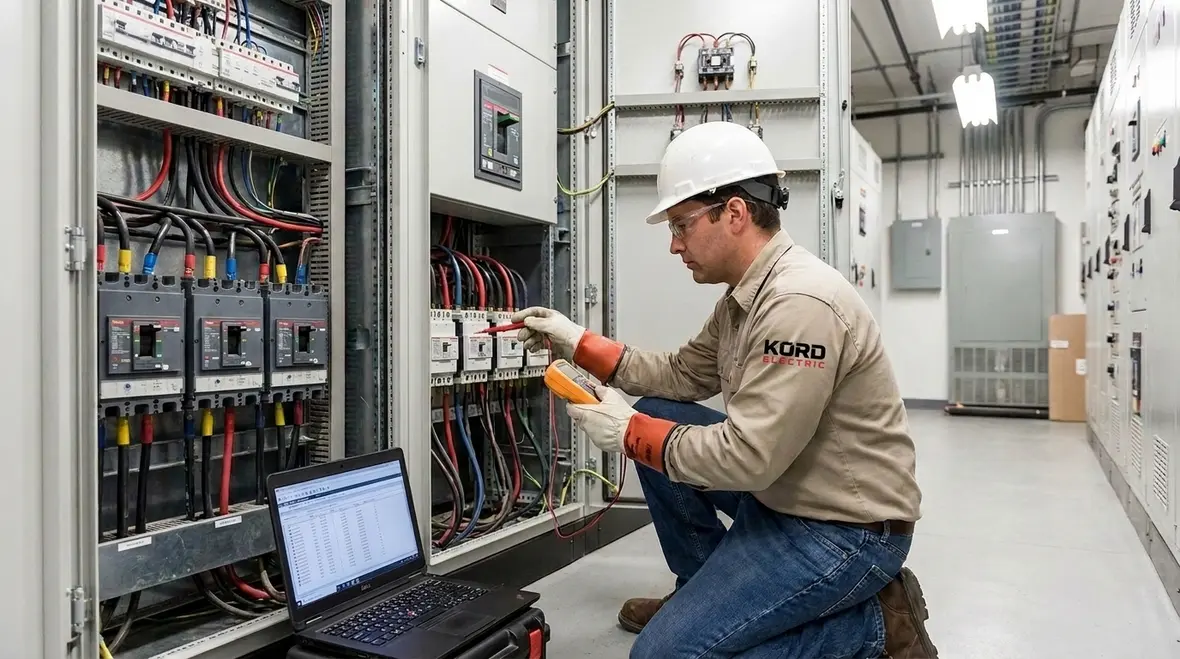
We approach troubleshooting with discipline, because a rushed test can miss the real failure. First, we gather history from your staff, including when the problem occurs, what loads were running, and what alarms appeared. Next, we verify basic conditions like panel temperature, visible wear, and signs of moisture or dust buildup. After that, we move to electrical measurements with calibrated tools. We look at voltage, current, frequency, and wave quality when the equipment supports it.
Then we narrow the suspect list. For instance, if a breaker trips under a specific operating state, we check for overload, shorted components, or failing protection devices. If the issue affects only certain circuits, we inspect how those circuits are fed and how they share common connections. And if the fault shows during transfer modes, we focus on the switching and interlock logic.
Throughout this work, our technicians explain what the readings mean, not just what we plan to do next. That way, decisions get made with clarity, not optimism. Also, we keep everything focused on commercial and industrial facilities, since those systems carry higher loads, stricter reliability needs, and more critical uptime demands. A small building might shrug at a problem. A major propertie facility does not.
Common root causes we confirm in the field
Once we start testing, the “usual suspects” appear again and again. Troubleshooting Facility Power Problems: Common Causes & Solutions often includes these items, and we confirm each one with evidence, not vibes.
- Loose or corroded connections: Heat and arcing can hide until a load change pushes the system harder.
- Aging breakers and protection devices: Wear can lead to nuisance trips or failure to clear faults properly.
- Transformer issues: Cooling failures, internal faults, or degraded insulation can lead to unstable voltage under load.
- Neutral problems: Overheated neutrals and unbalanced phases can cause equipment malfunctions.
- Surge protection degradation: Suppressed surges do not always last forever, and repeated events take their toll.
- Water intrusion and condensation: Even small moisture changes resistance and can trigger erratic behavior.
Additionally, we check for load imbalance, because it creates uneven stress in motors, transformers, and bus bars. If one phase runs hotter, failures follow. Likewise, we review changes in your facility, such as new equipment, HVAC upgrades, or production line shifts. Those updates often explain why a power problem shows up “out of nowhere.”
And if someone in the building says, “It started after that contractor work,” we listen. Then we verify with measurements. We do not argue. We test.
How we test without guessing: tools, waveforms, and verification
At Kord Electric, we use a testing approach that helps confirm the real cause and avoid trial-and-error repairs. First, we evaluate the protective devices and conductors. Next, we perform insulation related checks when the system type and safety requirements allow it. Then, we verify grounding and bonding continuity, because poor grounding can create unpredictable fault behavior and unsafe conditions.
When power quality matters, we also capture electrical profiles. That includes looking at voltage dips, harmonics, and waveform distortion that can stress drives, control systems, and sensitive electronics. If your facility runs variable frequency drives, refrigeration controls, or complex automation, the “shape” of the power becomes as important as the level. We explain these findings to your team in business-friendly terms, so nobody feels like they need an engineering degree to understand the report.
Finally, we validate the repair outcome. We do not stop at “it seems fine.” We confirm stability under normal operation and, when possible, under heavier loads. That final verification is what keeps power from failing again next week. A power system should not rely on luck any more than a customer should rely on a “maybe” warranty.
When to stop troubleshooting and plan a safe repair
There is a point where active testing stops being “routine” and starts needing a repair plan. If we see signs of active arcing, severe overheating, damaged bus bars, or repeated breaker failures, we shift into controlled remediation. We coordinate shutdowns with your operations team so the facility stays safe and stays productive.
Moreover, we consider downtime impact. For critical systems, we help you decide the order of work so you protect life safety equipment, communications, and core operational loads. We also recommend upgrades when an older component repeatedly causes downtime. Sometimes the best troubleshooting facility fix is not a patch, it is a replacement that restores reliability.
Our technicians and expert service staff help you weigh options and explain tradeoffs without drama. If a component fails again, we treat it as a signal. Then we remove the weak link and build stability back into the system. In other words, we do not just chase symptoms. We prevent recurrence.
Prevent future outages with power reliability maintenance
Once your facility stabilizes, we help you keep it that way. Preventive work reduces unexpected trips and extends the life of transformers, panels, and connected equipment. We focus on commercial and industrial environments where uptime is not optional. Maintenance can include inspection of terminations, verification of torque where applicable, checks of thermal conditions, and review of protective devices. We also evaluate how your load changes over the year and whether your distribution setup still fits current operations.
Furthermore, we help staff plan for future expansion. When a facility grows, power demand grows, and distribution systems must stay aligned with that reality. We explain what to watch for during new equipment installation, so changes do not introduce hidden imbalances. And if you ever wonder why power failures seem to arrive right after a new production schedule, we can explain that too. Power systems do not forget; they only respond.
To keep things simple, we document our findings and provide clear recommendations. That gives you a practical path forward, not a pile of technical jargon.
If you want to connect this work with a broader electrical strategy, you can also review Kord Electric’s resources on related topics such as commercial electrical fault finding and power reliability audits, which expand on how panels, feeders, and protection devices should behave together instead of acting like separate projects.
For facilities in the region that need ongoing support beyond one troubleshooting visit, Kord Electric’s Los Angeles County electrical services for commercial and industrial buildings help align preventive maintenance, emergency response, and planned upgrades, so power reliability becomes part of the standard operating plan instead of a recurring surprise.
FAQ
Ready for stable power in your facility?
If your commercial or industrial building is dealing with tripping breakers, lighting problems, control resets, or voltage instability, Kord Electric is ready to help you restore reliability. Our technicians and expert service staff troubleshoot Troubleshooting Facility Power Problems: Common Causes & Solutions with testing, clear explanations, and verified repairs. Contact us to schedule an assessment. We will discuss what is happening, confirm the cause, and recommend the safest path forward so your power stops acting like a random unreliable roommate.
For facilities that also need broader electrical upgrades or support for new tenants, controls, or added equipment, our team can connect this troubleshooting work with services such as power reliability audits, commercial electrical fault finding, and other focused projects. That way, today’s power problem becomes the starting point for a stronger, more stable electrical strategy across your building.
If you are planning larger changes or coordinating work across several properties, you can also explore how our Los Angeles County electrical services for commercial and industrial facilities support troubleshooting, repairs, and long-term reliability in a single, coordinated program.
However you choose to move forward, the goal is simple: steady, predictable power that lets your team focus on running the facility, not chasing mysteries inside the panel.