800V DC Power Distribution and Arc Flash Reduction for Data Centers
800V DC Power Distribution & Arc Flash Reduction for Data Centers: who builds it and why it matters
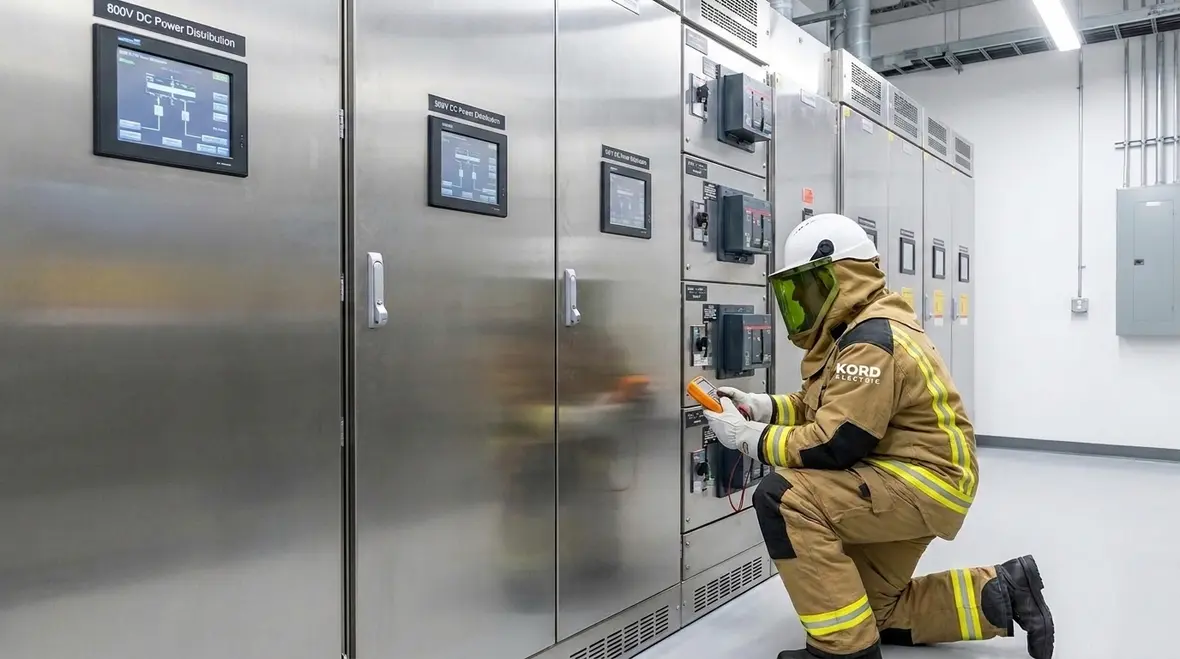
When a maintenance team steps into a high power room, the margin between “routine work” and a serious arc flash event can feel uncomfortably thin. That is exactly why 800V DC Power Distribution & Arc Flash Reduction for Data Centers is not just a buzz phrase for us at Kord Electric. We focus on designing, building, and supporting electrical systems where arc flash incident energy stays lower during live and near live tasks.
So, who makes 800V DC power distribution equipment engineered to reduce arc flash incident energy during maintenance? Others build components, but we often guide owners toward engineered assemblies that match real field workflows, real fault clearing behavior, and real maintenance methods. And yes, our technicians explain this in plain terms, because nobody should need a decoder ring just to understand their own switchgear.

What makes 800V DC distribution equipment “arc flash ready”
Third person or not, the physics do not care. However, good engineering choices do change outcomes. In practice, 800V DC Power Distribution & Arc Flash Reduction for Data Centers depends on more than one part. It depends on how the full system behaves under fault, how it clears quickly, and how the equipment limits energy that could reach workers.
First, the equipment must coordinate protection. That means protective devices work together so a fault clears fast and local. Second, the design must control how current paths form and how energy releases. Third, the enclosure and internal layout must reduce how much energy gets “thrown” into accessible areas.
We also look at the practical side. Maintenance teams do not work in a lab. So our expert service staff helps confirm that labels, inspection points, test access, and cable entry locations align with safe procedures. In other words, we do not just lower risk in theory. We lower risk in the actual plan that gets used on site.
And look, arc flash risk is like a bad playlist. If it is uncoordinated, it ruins everything fast. Coordination makes it stop.

How “arc flash ready” moves from drawings into the maintenance room
On paper, any 800V DC lineup can look impressive. The real test is what happens when a wrench, a test lead, or a loose connection changes the day. That is why we tie the design to practical, step-by-step maintenance states instead of assuming everything stays ideal.
We pay close attention to how upstream and downstream devices coordinate, how maintenance switches or maintenance modes reshape protection, and how temporary configurations during testing affect fault levels. This mindset echoes our reliability work in data center distribution design, where the goal is a system that behaves the same on a stressful Tuesday as it did during commissioning.
Which manufacturers build engineered 800V DC systems for maintenance safety
In the commercial and industrial space, some equipment makers build 800V DC distribution gear, but not all of it targets arc flash incident energy during maintenance as a primary design goal. When we evaluate who makes what, we do not just check voltage ratings. We check whether the manufacturer designs for fault clearing, energy limitation, and maintenance access patterns.
Typically, the best fit comes from vendors that supply engineered assemblies, not just parts. Those assemblies include coordinated protection concepts, internal component placement that supports predictable fault behavior, and documentation that aligns with arc flash analysis. Then the owner can build a repeatable maintenance routine without guessing.
As a practical guide, we look for manufacturers that provide data center relevant design inputs and clear support for studies like arc flash analysis and protective device coordination. Meanwhile, our technicians and expert service staff help translate those inputs into the way your site actually operates, including how technicians test, how they isolate, and how they work around live equipment.
If you ever had a contractor hand you a stack of papers and say “good luck,” you understand why we keep this hands-on. We verify how the numbers land in the field.
Evaluating vendors through a data center lens
Many vendors can quote 800V DC equipment. Fewer can show how their gear behaves when a live data hall needs safe isolation, rapid fault clearing, and planned work windows that cannot slip. We walk through questions about incident energy at doors, racking interfaces, maintenance bypass schemes, and how their documentation feeds into future studies.
That evaluation step keeps owners away from “catalog-only” decisions and toward engineered systems that treat maintenance technicians as part of the design criteria, not an afterthought.
How our service team helps customers validate arc flash results
At Kord Electric, we do not treat arc flash reduction like a one time report. We treat it like a living safety target that must survive real operation. That starts during design, and it continues through commissioning, training, and support.
First, we review the distribution design for reliability, including how feeders route, how bus sections segment, and how power flow supports both normal operation and maintenance isolation. Then we coordinate protective settings so the system clears faults in a way that matches the arc flash analysis assumptions.
Next, our technicians explain what the results mean for maintenance. For example, they walk through safe work boundaries, verify signage and procedure alignment, and support updates when equipment changes. When owners maintain systems over years, settings can drift, cable runs can shift, and operating practices can evolve. So we help keep the safety plan current.
We also reference our earlier reliability driven approach from our blog on data center electrical distribution design for reliability, because arc flash reduction does not live in isolation. Reliable architecture helps keep fault behavior consistent and reduces the temptation to “work around” safety steps.
And yes, we do use jokes sometimes. But only the kind that keeps people awake and safe, not the kind that distracts them mid procedure.
Keeping studies and field conditions in sync
Arc flash results age every time someone adds a feeder, swaps a breaker, or changes an operating mode. We help owners spot those changes early and decide when to refresh studies versus when to adjust settings in a controlled way. That closes the gap between “what the report said three years ago” and “what the lineup is doing this week.”
Design choices that lower incident energy during maintenance
The best engineered 800V DC equipment keeps incident energy lower by managing how faults develop and how fast they clear. Yet we also focus on design details that reduce exposure during maintenance.
1) Clear fault isolation strategy
When a fault occurs, the system should isolate the smallest possible section. This limits the energy available to the fault zone. We help owners map maintenance tasks to isolation states, so technicians can plan work without relying on hope.
2) Protection coordination that matches the site
We coordinate devices so they do not “hunt” for a clearing path. If protective devices act at random intervals, incident energy can rise. Our expert service staff helps ensure the settings align with the real conductor lengths, device characteristics, and operating modes.
3) Practical labeling and maintenance access
Equipment can be safe on paper and confusing in reality. We improve clarity around disconnect points, test locations, and panel access, and we confirm maintenance workflows in the field.
4) Enclosure and internal layout considerations
Internal layout affects how energy spreads. We look for designs that minimize how much energy reaches accessible regions and we ensure the equipment design supports safe inspection and testing.
5) Commissioning that verifies assumptions
Finally, we verify that what the arc flash analysis assumed is what the system actually achieves. That means testing where appropriate, reviewing trip behavior, and confirming that operational modes behave as expected.
Building 800V DC power distribution for commercial and industrial properties
Commercial and industrial facilities need repeatable, maintainable power systems. Major property buildings care about downtime, and data centers care even more because power continuity drives every other metric. Therefore, we build with both reliability and safety in mind.
In these projects, we often see that owners want one outcome: fewer surprises during maintenance. So we structure designs so technicians can isolate properly, verify states confidently, and follow procedures without stepping into higher risk zones.
Our approach supports 800V DC Power Distribution & Arc Flash Reduction for Data Centers goals while also fitting the broader environment of major properties: chilled water plants, high power UPS rooms, high density IT spaces, and other areas where maintenance schedules must stay predictable.
And for the record, we know that people sometimes blame the equipment when the root cause is unclear documentation or unclear switching steps. So we help close those gaps early.
Bringing data center discipline to other critical facilities
The same practices that protect servers also protect elevators, chilled water, production lines, and life safety systems. Our work on data center electrical infrastructure and redundancy carries over directly when we help commercial sites evaluate their distribution, protection, and maintenance strategy for 800V DC and high power AC gear.
What owners should ask before selecting 800V DC arc flash reduction equipment
If a facility owner wants the right 800V DC Power Distribution & Arc Flash Reduction for Data Centers path, they should ask targeted questions. Not vague questions like “is it safe.” Safer answers come from specific technical checks.
- What engineering basis supports arc flash incident energy reduction? Owners should seek clear coordination and energy limiting approaches, not just generic statements.
- Does the manufacturer support protective coordination studies with site specific inputs? If the data is missing, the results may not match the field.
- How does the design support maintenance workflows? Equipment should match isolation points, testing access, and procedure steps.
- What documentation accompanies the gear? Arc flash results, coordination details, and operating guidance should be provided clearly.
- How will commissioning validate assumptions? Owners should ensure the results survive real testing and real operating modes.
- What support comes after installation? Settings reviews, training, and updates help maintain safety over time.
When we work with owners, we also provide a clear explanation. That is where our technicians and expert service staff shine. They take the technical output and show how it becomes safer decisions on the maintenance floor.
FAQ
Call Kord Electric for safer 800V DC distribution design
If you run a data center, a major commercial site, or a high power building, you deserve a power system engineered for both reliability and maintenance safety. Kord Electric helps you select and validate 800V DC distribution approaches that support arc flash incident energy reduction, and we back it with technician level explanation during commissioning and ongoing support. Reach out today so our team can review your design, coordinate protection needs, and map safe maintenance workflows to real equipment states.
For facilities across Southern California, especially those that need coordinated support for upgrades, troubleshooting, and long term reliability, our broader Los Angeles County electrical services help align 800V DC distribution, traditional AC systems, and sitewide maintenance plans under one practical strategy.
When you are ready to align 800V DC Power Distribution & Arc Flash Reduction for Data Centers with a reliability-focused electrical plan, our data center and commercial electrical teams can step in early, coordinate with your engineering consultants, and keep the maintenance team’s daily reality at the center of every design choice.