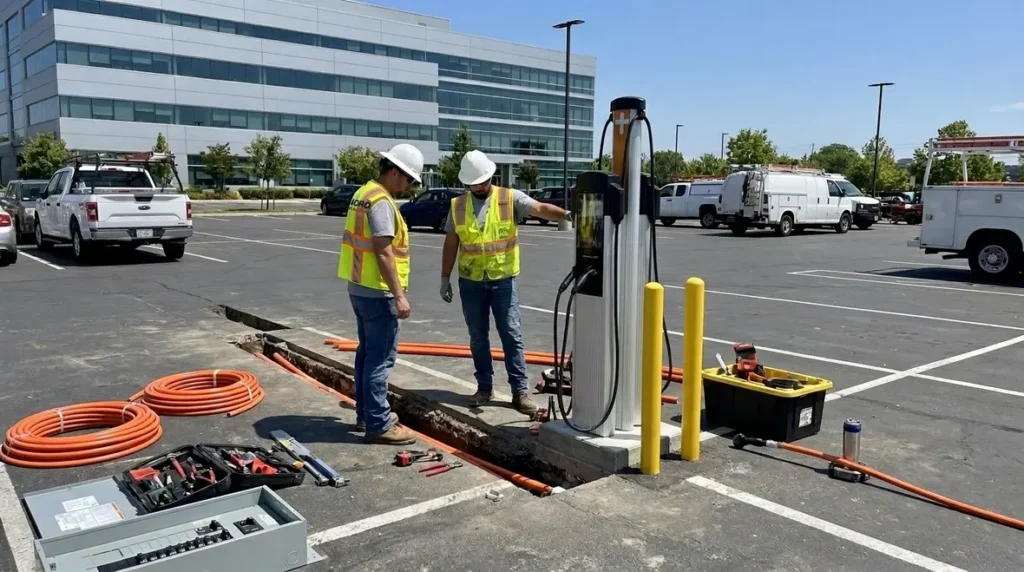
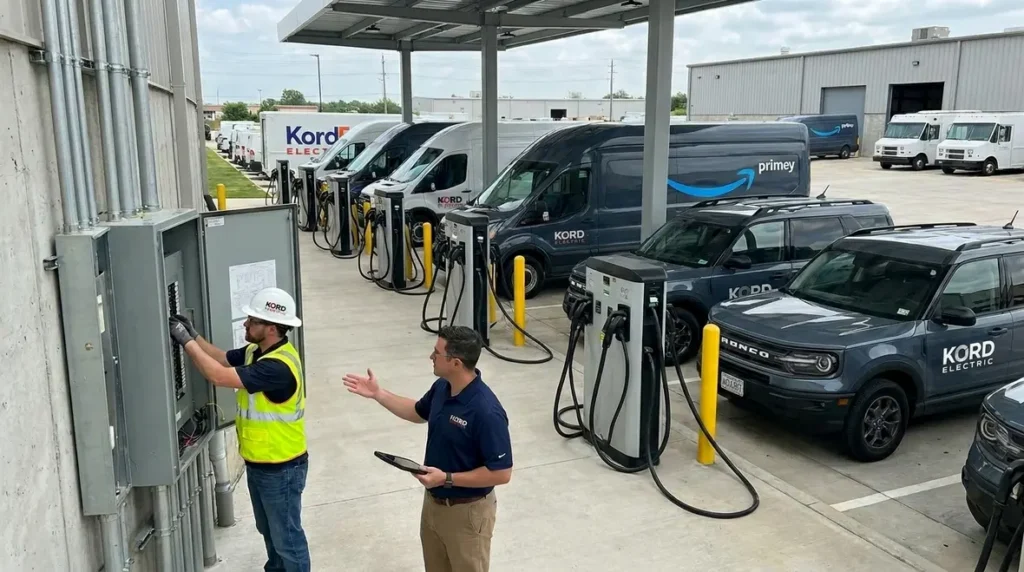
Commercial EV Fleet Charging Planning That Works
Kord Electric helps businesses plan commercial EV fleet charging that actually works on day one, not “someday.” When a company runs delivery routes, shifts crews, or operates service vehicles, charging cannot be an afterthought. It must fit the site, the power, the schedule, and the real-world habits of drivers. Therefore, we guide commercial and industrial facilities, and major property buildings, through a planning process that is steady, practical, and built for long-term uptime.
Now, because nobody wants a charger that behaves like a vending machine with empty inventory, we also make sure the electrical side holds up. Our approach blends engineering, site planning, and clear communication from our technicians and expert service staff, who explain what matters and why. And yes, we keep the tone business casual. The only thing we want “plugged in” is your plan.
Assessing your fleet charging demand without guessing
Businesses often begin by counting vehicles, then assuming that number tells the whole story. However, commercial EV fleet charging planning depends on much more than a fleet size. First, we map the daily driving profile: typical route length, time on the road, and when vehicles return. Next, we review charging window constraints, such as when employees can plug in and when equipment must be back online.
Then we look at charge levels. Some fleets need fast charging for tight turnaround cycles, while others can use slower overnight charging and still meet duty requirements. In addition, we confirm the charging behavior drivers will follow. If the plan assumes perfect habits and the real world shows up with “I forgot,” we adjust the system so performance stays stable.
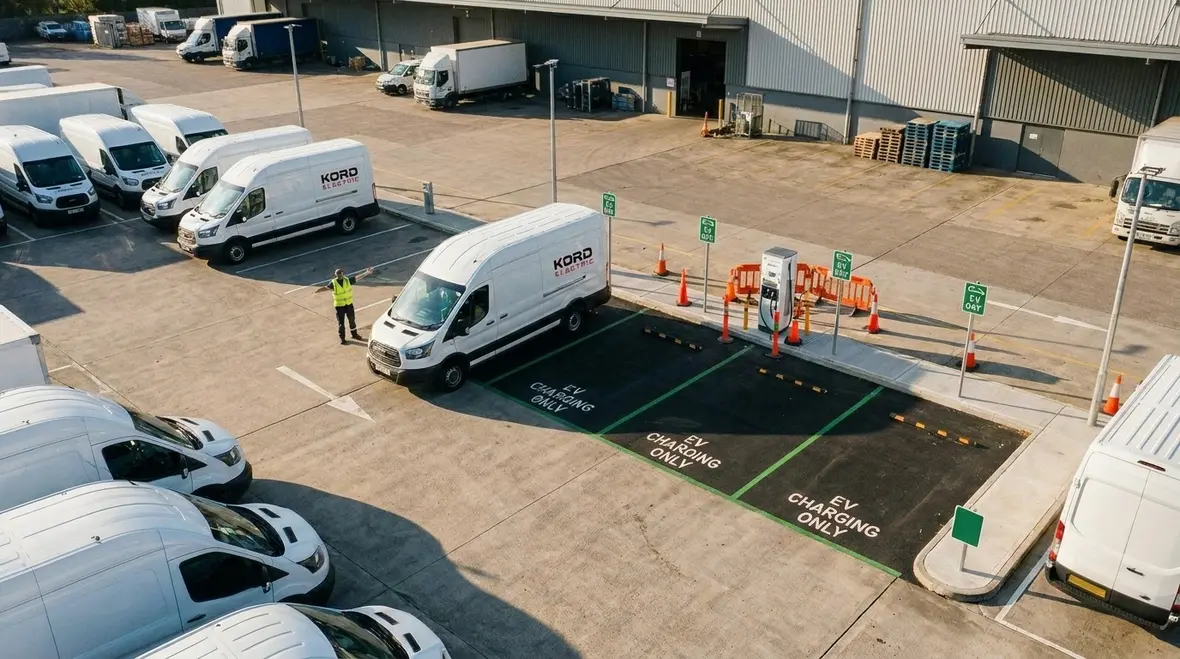
At Kord Electric, our expert service staff also helps leaders translate demand into equipment sizing. We explain tradeoffs in plain language. For example, adding more chargers can reduce load on any one unit, but it also increases total power draw. Meanwhile, smarter scheduling can reduce peak demand without overbuilding. In short, we plan for your operations, not your assumptions.
We also help teams think through future scenarios, not just today’s parking map. If you expect your fleet to add more electric vehicles over the next three to five years, we consider how wiring paths, spare capacity, and panel space can support that growth without ripping everything out later. Our goal is a plan that survives success, not one that gets overwhelmed by it.
Electrical capacity planning and the real power story
After demand comes capacity. Any site can add chargers, but not every site can add them without upgrades. Therefore, our technicians evaluate service entrance capacity, available transformer limits, and panel space. We also study feeder ratings and the existing load profile, including HVAC, lighting, kitchen equipment, and any process loads common in industrial buildings.
Then we identify where to add capacity with the least disruption. Sometimes the solution is panel upgrades or conductor changes. Other times, it requires transformer expansion or new distribution. And if the facility sits inside a complex electrical environment, we coordinate with the building’s broader electrical infrastructure plan, so the chargers do not create new problems elsewhere.
Also, we pay attention to power quality. Chargers can cause voltage dips or create harmonic noise if not designed correctly. Consequently, we model the electrical system and validate that the equipment stays within safe operating limits. Nobody wants the lights to flicker every time a vehicle starts charging, unless the building is performing for Broadway. Most facilities do not need that kind of drama.
For properties planning multiple electrical upgrades, we often connect fleet charging discussions with broader infrastructure efforts. If your facility team is evaluating new switchgear, backup power, or data center electrical infrastructure essentials, coordinating those decisions with EV charging needs can save both money and downtime. Thoughtful capacity planning means every major upgrade moves the property forward instead of pulling in opposite directions.
Site layout that supports driver flow and safe access
Even a well-sized electrical system can fail if the site layout creates confusion or unsafe conditions. So we plan the charging area like it belongs to operations, because it does. We review vehicle staging positions, cable routing paths, and the distance from parking to power distribution.
In addition, we consider accessibility. Fleet drivers need predictable movement and minimal friction. Therefore, we define parking rules, sign placement, and wayfinding so drivers know exactly where to connect. We also plan for daily movement patterns, including whether forklifts, pedestrians, or dock traffic share the space.
Safety comes next. We design cable management, protect against physical damage, and ensure the charging points maintain clear separation from hazards. Moreover, we verify that the charging zone supports local code and the facility’s safety standards. Our technicians explain the logic as we go, so stakeholders understand how site layout supports both uptime and compliance.
For properties with mixed-use parking, we also think about how fleet charging interacts with public or employee charging. Clear markings, load priorities, and access controls keep mission-critical fleet vehicles from competing with casual plug-ins. When the layout and policies work together, drivers spend less time guessing and more time staying on schedule.
Load management and smart scheduling for stable operations
Here is where modern commercial EV fleet charging planning gets truly practical. A facility might have enough total energy, yet still face peak demand issues. To prevent that, we recommend load management strategies that spread charging across time.
For example, instead of starting multiple chargers at once when vehicles plug in, smart scheduling can stagger charging based on available power. Then the system prioritizes vehicles by departure time and required charge level. Additionally, demand response logic can reduce stress during utility peak periods when rates or constraints apply.
We also align the charging plan with the facility’s operational calendar. If production ramps during certain hours, we ensure charger behavior does not collide with those peaks. Transitioning between shift schedules matters, because the building’s load curve changes during the day. Therefore, we model typical operating windows, then tailor the charging schedule to fit.
Our expert service staff often explains these decisions in a calm, step-by-step way. And when someone asks, “Can’t we just install everything and deal with it later?” we smile professionally and say, “We can, but later becomes expensive.” Then we show the load plan that prevents that future.
If you want to explore how smart planning affects budgets and expansion paths, Kord Electric also shares guidance in resources such as our commercial EV charging installation cost insights and our work on EV charging infrastructure scalability for commercial sites. The same logic applies to fleets: use load management and staged deployment to grow without surprising your electrical system or your accounting team.
Coordination with data center electrical planning essentials
Some facilities already live and breathe electrical discipline, especially those with critical loads. If a property includes a data center or similar high availability environment, the electrical design mindset must match that standard. Kord Electric draws on the same disciplined thinking we use for data center electrical infrastructure essentials, including careful load paths, redundancy expectations, and clear documentation for future expansion.
While a fleet charging site might not need the same level of uptime as mission critical compute, many businesses do expect chargers to run reliably. Therefore, we coordinate charger distribution with the existing electrical architecture, and we plan for future growth. We evaluate where to connect without overtaxing sensitive panels or circuits.
In addition, we focus on clean system design. Clear labeling, organized conductor routing, and structured distribution reduce troubleshooting time. Then, when operations staff report a fault, technicians can respond quickly, and the facility does not wait days for guesswork.
Just like in a data center, the electrical plan becomes a living asset. We help maintain that asset through documentation and service readiness, so your charging infrastructure stays maintainable long after the first installation day. If you are exploring this topic in depth, you can also review Kord Electric’s dedicated article on data center electrical infrastructure essentials and related reliability planning for distribution systems. The same mindset of uptime and clarity transitions naturally into fleet charging projects.
Installation, commissioning, and service readiness for fleets
Planning matters, but execution decides whether your project succeeds. We build installation and commissioning steps into the plan from the start. Therefore, our technicians coordinate equipment placement, verify electrical connections, and validate charging performance against the design assumptions.
Commissioning includes testing protective devices, checking load balancing behavior, and confirming that the charger control system matches the facility schedule. We also run operational checks so the chargers respond correctly to vehicle connection patterns.
Next comes service readiness. Fleet managers need fast recovery when something fails, because downtime hits productivity. We design for accessibility and maintainability, and our service staff stays involved so the facility understands what to monitor and how to report issues. Also, we recommend a maintenance schedule that matches charger usage and local site conditions.
In short, we do not just install chargers and disappear. We help your team feel confident that the system can grow, adapt, and keep running with fewer surprises than a sitcom plot twist. For many facilities, that also means tying fleet charging into broader electrical preventive maintenance plans, so inspections, testing, and documentation cover the full power path from service entrance to the last parking stall.
FAQ: Commercial fleet charging planning answers
Next steps for a charging plan that sticks
If you want commercial EV fleet charging that fits your site, your power, and your schedule, Kord Electric can help you plan it the right way. We work with commercial and industrial facilities and major property buildings, and we build a clear path from demand to electrical design to service readiness. Reach out to us for a site review and an infrastructure plan you can trust. Let’s turn charging from a guess into a system, and keep your operations moving.
When you are ready to move from ideas to installed equipment, our dedicated EV charger installation services support commercial and industrial facilities with design, permitting, installation, and long-term performance. From the first load study to the final commissioning test, we keep the process steady, transparent, and aligned with how your fleet actually runs.