
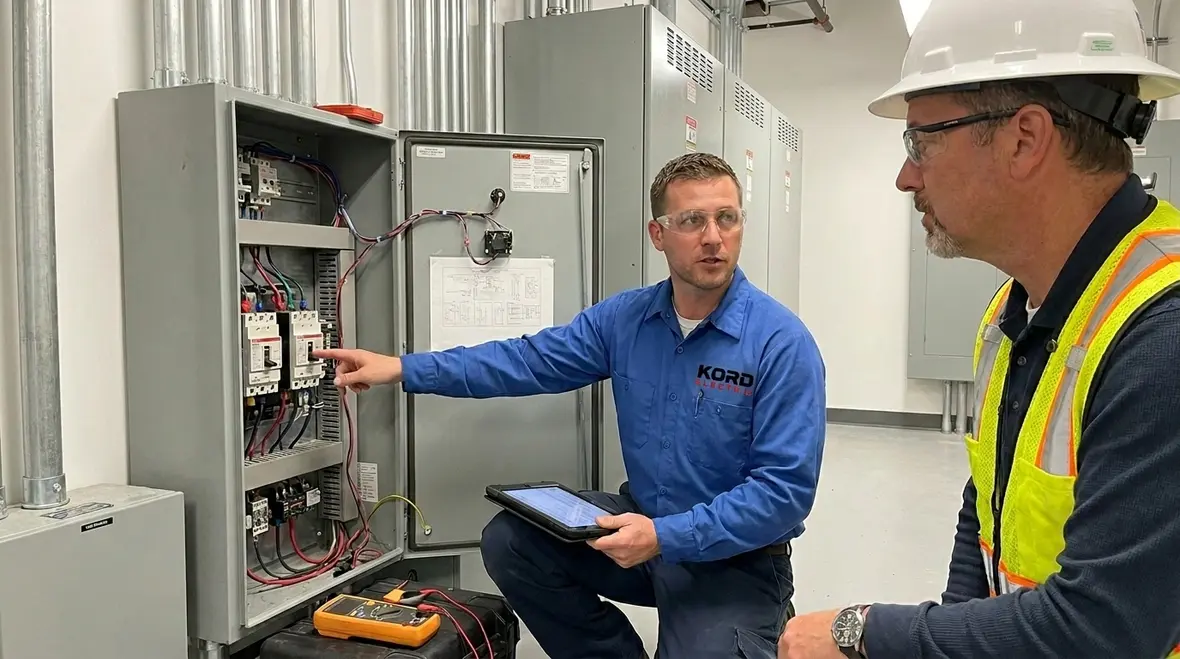
Comprehensive Electrical Hazard Risk Assessment
At Kord Electric, we start every project with a steady promise: we help commercial and industrial facilities stay safe before problems show up. That is why we conduct a comprehensive electrical hazard risk assessment early, often before installation decisions lock in. In fact, our team walks through how energy can move through equipment, wiring, and even the building structure, then we document what could go wrong and how we will prevent it. This approach keeps our clients from relying on luck or guesswork, which is great because luck does not carry insurance. After that, we keep the process active, and we explain our findings in plain language so your operations team can understand them without a wiring diagram tattoo.
What our electrical hazard risk assessment includes
Others may treat safety as a checklist. We treat it like a living process that protects people, property, and uptime. To do that, our experienced technicians and expert service staff evaluate the entire electrical pathway, not just the obvious panels. They consider how hazards form, how workers and contractors move around the site, and how conditions change during the year.
We typically look at the electrical systems in a practical order: supply and distribution, panels and controls, grounding and bonding, protective devices, and load types. Then, we connect those observations to real site conditions such as moisture, dust, temperature swings, maintenance access, and areas where vehicles, carts, or ladders appear. Because if a hazard exists only in theory, it will not hurt you. However, if a hazard exists in your actual workflow, it matters now.
Next, we identify the electrical hazard risk assessment factors: shock risk, arc flash exposure, fire or thermal damage potential, and the likelihood of accidental contact. We also consider human factors, since the best equipment in the world cannot save someone who is standing in the wrong place with the wrong tool. (We see this in the field more often than people would like to admit.)

How we identify shock and arc flash risks in the field
Our technicians take a careful, step by step approach. First, they examine who can be exposed and in what situation. Then, they map where contact could happen, including direct contact, indirect contact through fault paths, and contact caused by damaged insulation. After that, we consider how long a hazard could last, because time is a silent partner in electrical accidents.
For arc flash risk, we do not rely on vague assumptions. We evaluate fault conditions, protective device behavior, and the electrical environment where switching and maintenance occurs. In practical terms, we look at how fast breakers clear faults and how equipment configuration affects energy release. Then we translate that into clear safety actions: boundaries, procedures, labeling, and the right personal protective equipment requirements for each task.
We also examine non routine situations. For example, temporary power setups during construction and changes during seasonal operations can shift risk. Therefore, we focus on the full lifecycle, not only the moment the system first powers on. That is how we prevent safety surprises that show up after everyone says, “It worked yesterday.”

Risk scoring that fits commercial operations
Some risk processes create paperwork that nobody uses. We do not. Our electrical hazard risk assessment includes a scoring method that supports decisions, not just filing. We rate hazards by severity and likelihood, and we connect each score to a practical control. Then we prioritize actions based on what matters most to facility safety and business continuity.
To keep things usable, we also consider how quickly a facility can respond. If a control improvement takes weeks, we plan interim safeguards so the site stays protected. If an engineering fix can remove the hazard faster, we recommend that path first. In addition, we factor in the realities of staffing, shift schedules, and maintenance windows, because safety work should respect how your business runs.
Meanwhile, we keep communication clear. Our expert service staff explain why a control matters, what to do, and what changes when the work is complete. We do not just drop a report on the table. We talk through it, and we make sure the people who handle equipment understand the “why” behind each recommendation.
For facility leaders who want to see how risk and compliance connect in other areas of electrical safety, our discussion of how the National Electrical Code shapes commercial installations in California offers a helpful companion perspective on keeping systems compliant, stable, and easier to maintain over time. You can explore that thinking in our NEC-focused article in the Kord Electric blog.

Controls we recommend to reduce exposure
After we identify hazards, we recommend controls that match the facility. We focus on layered protection, so if one barrier fails, others still protect people. Most importantly, controls should work during daily operations, not only during inspections.
Our recommendations often fall into several practical groups. First are engineering controls. These include safer equipment design choices, upgrades to protective devices, improved enclosure integrity, and better routing and separation practices. Next come administrative controls such as access control, task specific procedures, lockout and tagout support, and maintenance planning that reduces time in hazardous zones.
Then we address work practices and training. We help facilities reinforce safe behavior by clarifying what technicians and contractors should do before, during, and after energized work. We also support the right labeling so staff can locate hazards quickly and follow the intended approach. Because labeling that nobody trusts is just decorative paint with extra steps.
Finally, we help facilities match the correct personal protective equipment to the actual hazard conditions. The goal is not to make people wear more gear than needed. The goal is to use the right level of protection for the task and the environment. Our staff explain these requirements in plain terms so your teams can apply them consistently.
In many commercial and industrial buildings, the most effective electrical hazard controls tie directly into structured maintenance. If your team wants to keep risk scores trending down while systems stay online, pairing this assessment with a dedicated electrical preventive maintenance program helps catch issues early, from loose terminations to aging protective devices, before they turn into outages or incidents.
Keeping the assessment current as your facility changes
Facilities do not sit still. A conveyor line gets added. A new production shift starts. A contractor modifies a circuit. Lighting gets upgraded. And suddenly, the risk picture changes even if nobody touched the main electrical room. Therefore, Kord Electric builds our approach around change management.
We help clients treat the electrical hazard risk assessment like a tool you update, not a document you ignore. We recommend review triggers such as major equipment upgrades, new high load equipment, changes in protective device configurations, and renovations that alter access or workflow. We also consider temporary power events, since those can create exposure paths that permanent systems never had.
Our technicians will also coordinate with facility teams so updates do not disrupt schedules. We can schedule reviews around shutdown windows or production slowdowns. Then we ensure the findings align with current drawings, current operating conditions, and current maintenance practices. That way, your safety program stays reliable, not nostalgic.
Many coastal and high-demand environments, such as those along the Santa Monica shoreline, require even more frequent review because corrosion, moisture, and shifting loads change risk profiles faster than most people expect. Our coastal safety guidance in the Kord Electric blog shows how these environmental realities influence everything from grounding integrity to enclosure performance.
Why third party safety reporting matters for owners and managers
Commercial and industrial owners often need more than internal opinions. They need confidence, clarity, and evidence that safety decisions connect to real site risk. Kord Electric provides that support by documenting our findings in a way that works for compliance planning and safety governance.
However, reporting alone will not keep anyone safe. We also help managers understand how to act on the results. Our expert service staff explain what changes are urgent, what changes bring the best risk reduction per dollar, and what changes support long term stability. In other words, we help you avoid the classic problem where everyone agrees something is important, but nobody knows what to do first.
We also support coordination with facility leadership so recommendations match budgets and operational constraints. When safety and practicality line up, projects move faster and staff follow the plan. That is when safety becomes a culture, not a quarterly scramble.
If your organization is also navigating questions about NFPA references, NEC requirements, and how they interact with your on-site conditions, the Kord Electric comparison of NFPA 70A vs NEC provides additional context on how documentation and enforcement paths intersect with what we uncover during an electrical hazard risk assessment.
Dual column: Typical outputs you receive from our process
Assessment outputs
- Hazard identification by system area and task exposure
- Risk scoring with priority ranking
- Recommendations for engineering and administrative controls
- Arc flash and shock exposure guidance for relevant work
How you use them
- Plan corrective work and budget sequencing
- Set safety priorities for each department
- Update procedures, labeling, and access controls
- Support safe work planning and PPE selection
FAQ: Electrical hazard risk assessment for commercial and industrial sites
Conclusion: Make safety proactive, not reactive
If your facility runs on uptime, safety cannot be an afterthought. At Kord Electric, we conduct a comprehensive electrical hazard risk assessment that identifies real exposure risks, prioritizes controls, and keeps your program aligned with how your site truly operates. Our technicians and expert service staff explain findings clearly and support implementation, so you can act with confidence. Contact us today to schedule an assessment for your commercial or industrial facility and turn electrical safety into a dependable system, not a last minute scramble.
For organizations that want assessment findings to flow smoothly into ongoing reliability work, our dedicated electrical preventive maintenance services give you a structured path to keep breakers, panels, and distribution equipment in step with your safety goals. When risk assessment, maintenance, and compliance strategy move together, your team spends less time fighting emergencies and more time steering the facility toward steady, predictable operation.


