
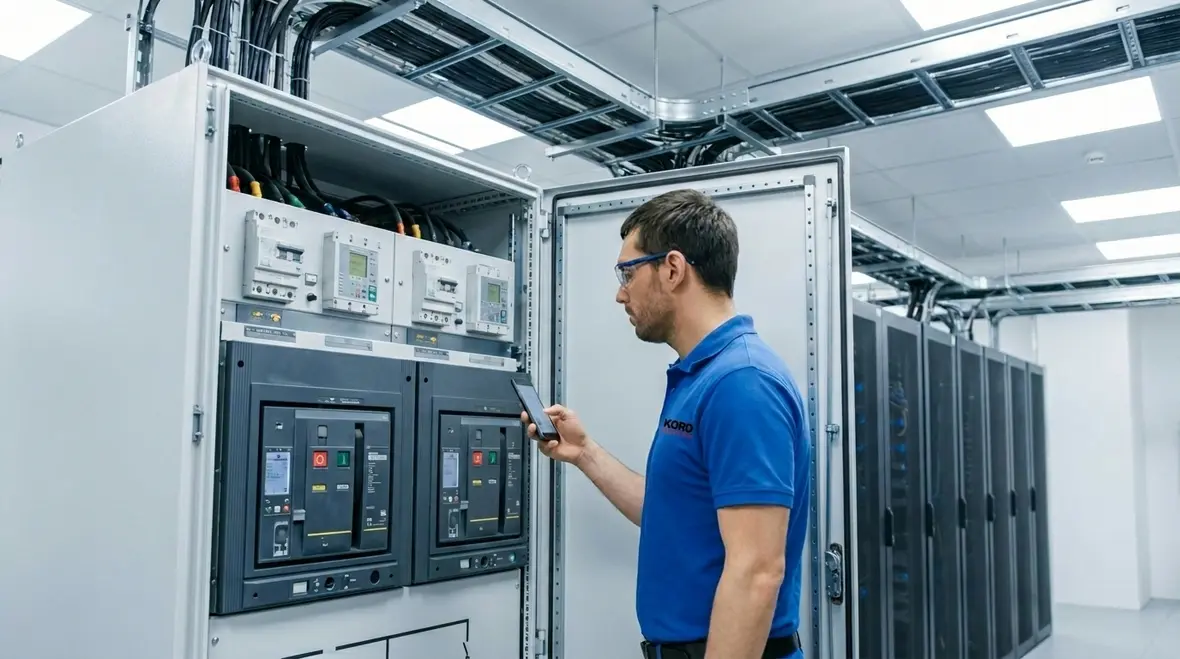
Data Center Power Quality for Maximum Uptime
Data center power quality: the difference between “up” and “still loading”
At Kord Electric, we take Data center power quality seriously, because it quietly decides whether your systems stay fast, stable, and ready when customers need them most. When power swings, harmonics build, or grounding fails, downtime follows like a bad rerun you cannot skip. And in a data center, uptime is not a slogan, it is the job. Others may focus on servers and cables, but we focus on the electrical reality those assets depend on. After all, even the best cooling and best software cannot fix a power problem that starts at the switchboard.
In this article, our team explains the critical factors we check and maintain to protect uptime for commercial and industrial facilities and major property buildings.
1) What actually breaks uptime in a data center
We see power failures come from a mix of issues that stack together. First, voltage dips can cause controllers to reset or drives to behave like they forgot what they were doing. Next, surges and transients can stress sensitive power supplies. Then harmonics quietly distort the waveform, which makes transformers run hot and increases neutral current. Finally, grounding and bonding problems can introduce noise, create safety risks, and cause erratic behavior in monitoring systems.
Because data center equipment runs close to tight tolerances, small deviations matter. Therefore, a plan that simply “turns power on” never works in the real world. We design our maintenance around measurable results, not guesses. Our technicians document what they find, explain why it matters, and correct the root cause rather than chasing symptoms.
For many critical facilities, that starts with understanding how everyday voltage behavior affects uptime. If you’re seeing unexplained resets or nuisance trips in other areas of your property, our overview of voltage fluctuations in commercial and industrial facilities shows how unstable power quietly chips away at equipment reliability and availability across your site.
2) The power chain we protect, from utility to load

To protect Data center power quality, we treat power like a chain with many links. If one link weakens, the whole system suffers. We review the full path: utility feed, service entrance equipment, switchgear, UPS, static transfer switches, distribution panels, PDU rails, and the grounding system. Even if the UPS looks fine on paper, we still confirm the behavior under load.
Then we verify that protection devices coordinate correctly. If breakers trip too fast, you lose uptime. If they trip too late, you risk equipment damage. In addition, we make sure the system can handle maintenance mode and generator transitions without creating gaps in output stability.
Our expeert service staff talks through these steps in plain language so your facility team understands what the electrical system is doing during normal operation, during transfers, and during abnormal events. That clarity reduces downtime caused by confusion, not by electrons.
For sites planning new builds or upgrades, pairing power quality work with thoughtful data center electrical distribution design for reliability keeps the power chain aligned with growth. Clear labeling, accessible equipment, and smart coordination between utility, switchgear, and downstream panels make it easier to keep uptime high without turning every maintenance task into a scavenger hunt.
3) UPS performance and runtime planning that match reality

A UPS does more than sit there and look expensive. We evaluate performance under conditions that resemble your actual operating profile. Runtime matters, but efficiency and output quality matter too. As batteries age, capacity drops, and voltage behavior can change during discharge. Also, battery banks can show uneven aging if charging is inconsistent across strings.
We recommend load and battery assessments at intervals that fit your usage. Then we set a maintenance rhythm for inspections, battery testing, and firmware or configuration checks where applicable. Our technicians confirm that your UPS does not just meet a headline rating, but maintains stable output characteristics as conditions shift.
And yes, we sometimes make jokes during walkthroughs. When a battery system fails early, it rarely tells a dramatic story. It usually just performs poorly, like a coworker who “swears it works” but keeps missing deadlines. We prefer data, test results, and clean corrective action over suspense.
Good UPS work also fits into a broader preventive plan. If your facility team is working to standardize inspections across multiple properties, our electrical preventive maintenance programs help align UPS testing, battery care, and switchgear checks into one structured schedule instead of a stack of unrelated tasks.
4) Harmonics, heat, and the hidden stress on equipment

Many facilities focus on outages, but a gradual power quality issue can steal uptime indirectly. Harmonics cause extra current, increase losses, and raise temperatures in motors, transformers, and bus systems. Even if nothing fails instantly, thermal stress reduces component life. Over time, that means more service calls, more replacements, and more unplanned downtime.
We measure harmonic levels and look at where distortion originates. Then we address it through appropriate mitigation strategies, such as isolating sensitive loads, balancing phases, and selecting correction methods that fit the electrical design. Because data centers depend on stable power, we avoid random guesswork and aim for predictable results.
Our staff also checks that cooling and ventilation systems align with the electrical heat load. The building can have “great air,” yet electrical gear still runs hot due to harmonic stress. Therefore, power quality and equipment temperature always talk to each other, even if your thermostat tries to stay out of it.
The same discipline that protects transformers and PDUs in your data center also helps with other high-load projects. When you add new infrastructure like large-scale EV charging or major lighting upgrades, seeing how harmonics and heat interact with existing gear keeps future projects from eroding the stability you’ve worked hard to build.
5) Grounding, bonding, and monitoring you can trust
Reliable grounding supports safety and stable operation. When grounding is wrong, noise increases, protective devices behave unpredictably, and communication systems can suffer. Bonding errors can create current paths that do not belong, which often shows up as strange readings or intermittent failures.
We verify grounding and bonding continuity, inspect connections, and ensure that the system configuration matches design intent. Then we review monitoring. If your meters and alarms do not reflect actual conditions, the facility team cannot respond quickly enough. We help you set up a practical monitoring approach that supports early detection of issues like drift in voltage levels, abnormal neutral current, or repeated transfer events.
Our expeert service staff explains these checks during service visits, so your team learns what to look for and how to interpret key indicators. That shared understanding reduces the “call us when it breaks” cycle, and instead supports “call us before it breaks.”
Strong grounding and clear monitoring are also the quiet heroes behind other technology projects. When property owners add EV charging infrastructure or new automation layers, clean reference points and trustworthy meters make it much easier to scale safely instead of guessing what the power system is doing behind the scenes.
6) Maintenance that prevents the next failure, not the last one
Preventive maintenance works best when it follows the actual risk profile of your facility. For commercial and industrial sites and major property buildings, we build maintenance plans around critical assets and critical failure modes. We prioritize switchgear health, UPS condition, battery management, transfer switch operation, and distribution integrity.
We also include inspection of torque settings where required, verification of thermal performance, and checks of control wiring and contact points that often loosen or corrode over time. Then we connect findings to action. If we see early signs of wear, we recommend correction before it becomes a scheduled emergency.
In addition, we plan maintenance sequencing to protect uptime during work. Nobody wants a service plan that sounds good but forces a shutdown. We coordinate access, downtime windows, and testing procedures so your systems stay running as much as possible.
This same philosophy appears across our service offerings, from structured electrical preventive maintenance to emergency response plans. The goal is the same: predictable, stable operation rather than heroic last-minute saves.
7) Emergency response and testing you perform on purpose
When you plan for failure, you reduce panic. We help facilities prepare for events like utility outages, generator starts, and UPS transfers by testing system behavior in controlled ways. Testing shows whether protective schemes operate correctly and whether your transfers happen without damaging pauses.
Then we document results so your team knows what “normal” looks like for your specific site. That documentation becomes valuable during audits, incident reviews, and future expansion projects. If power demand grows, the system may require rebalancing or updates to distribution capacity. We support those evaluations so new loads do not quietly degrade power stability.
Even if your team has a runbook, power events move fast. Therefore, we train and assist so your facility staff understands how the electrical system reacts, what alarms mean, and what steps come next. Think of it like a fire drill, except the fire is electrical and the prize is less stress.
For critical operations that simply cannot go dark, pairing planned testing with a clear path to 24/7 emergency electrical services means you know exactly who to call when something unexpected happens at 2 a.m. instead of 2 p.m.
Dual-column look: what we check and why it keeps uptime high
Critical check
UPS output stability
Battery condition
Harmonic measurements
Grounding and bonding continuity
Transfer switch behavior
Switchgear thermal health
Uptime impact
Reduces resets and shutdown events
Prevents early runtime shortfalls
Limits overheating and equipment aging
Improves safety and stable operation
Maintains seamless failover
Stops faults before they escalate
Frequently Asked Questions
Ready to protect uptime with Kord Electric?
At Kord Electric, we support commercial and industrial facilities and major property buildings with power quality and maintenance plans built for real operating conditions. Our technicians measure what matters, explain the results in clear terms, and help you reduce unplanned downtime through proactive service. If you want to strengthen reliability from utility feed to load, we can review your electrical chain and recommend a practical next step. Contact us to schedule an assessment and keep your systems online, where they belong.
If your roadmap includes adding EV charging, tightening control over energy usage, or modernizing older electrical rooms, we can help you connect those projects to the same uptime strategy. Our dedicated EV charger installation services are built for commercial and industrial properties that care about both safe charging and long-term power stability. Aligning data center power quality with future upgrades makes each project support the next instead of fighting it.
For portfolio owners and operators who want a single partner to help manage risk across campuses, warehouses, and technology spaces, our broader electrical services lineup covers panels, lighting, emergency response, and ongoing preventive maintenance. That way, your data center is not an island; it is part of a coordinated plan to keep power clean, predictable, and ready for whatever your operations throw at it next.


