
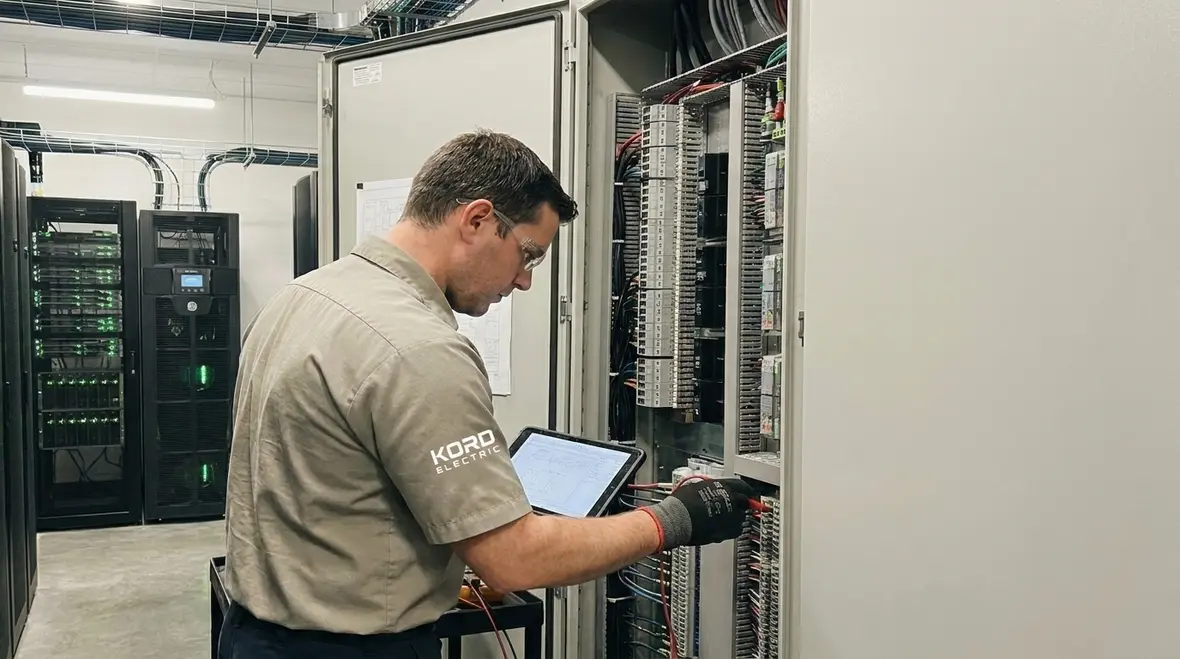
Data Center Power Redundancy Design for Uptime
Redundant data center power starts with design discipline
At Kord Electric, we approach data center power redundancy like a calm driver approaching a busy intersection: slow, deliberate, and always ready for the unexpected. When a commercial or industrial facility builds a mission critical room, one thing must stay true: the lights, the cooling controls, and the compute load must keep moving even when components fail. In this guide, our technicians and expert service staff explain how we design redundant power systems that reduce downtime risk, keep protections coordinated, and support uptime goals from day one.
Now, nobody wants power reliability to feel like roulette. Yet without solid design considerations, that is exactly what a facility can become. Fortunately, we can fix that with clear decisions, tested layouts, and smart choices across the full power chain.
Understand uptime goals and the load path

Others can start with equipment first, but we start with outcomes. We ask others in the facility team to define uptime targets, then we map the load path. From the utility service to switchgear, to transformers, to UPS, and finally to distribution, every segment must support the chosen redundancy plan. When we do this early, we prevent mismatches such as a robust UPS feeding a distribution bus that cannot handle fault clearing time.
Next, we classify loads. Critical loads typically include IT power, building automation for monitoring, and security systems that must stay alive. However, commercial and industrial facilities also rely on support systems like chilled water pumps, control panels, and fire life safety related controls. Even when fire protection follows separate rules, our power design still needs to coordinate with it so that one protection action does not accidentally drop the wrong circuits.
Then we look at how power transfers happen. We plan for static and mechanical transfer methods, and we consider how long a load can tolerate. If the transfer time is too long, a UPS can drain faster than expected, and the facility learns an expensive lesson. To avoid that, we ensure the load path, transfer strategy, and runtime targets all line up.
For facilities that want a deeper dive into the bigger picture beyond redundancy alone, our Data Center Electrical Requirements for Uptime guide walks through how the full electrical backbone supports mission critical reliability, from utility source to final distribution.
Build redundancy that fails gracefully, not loudly
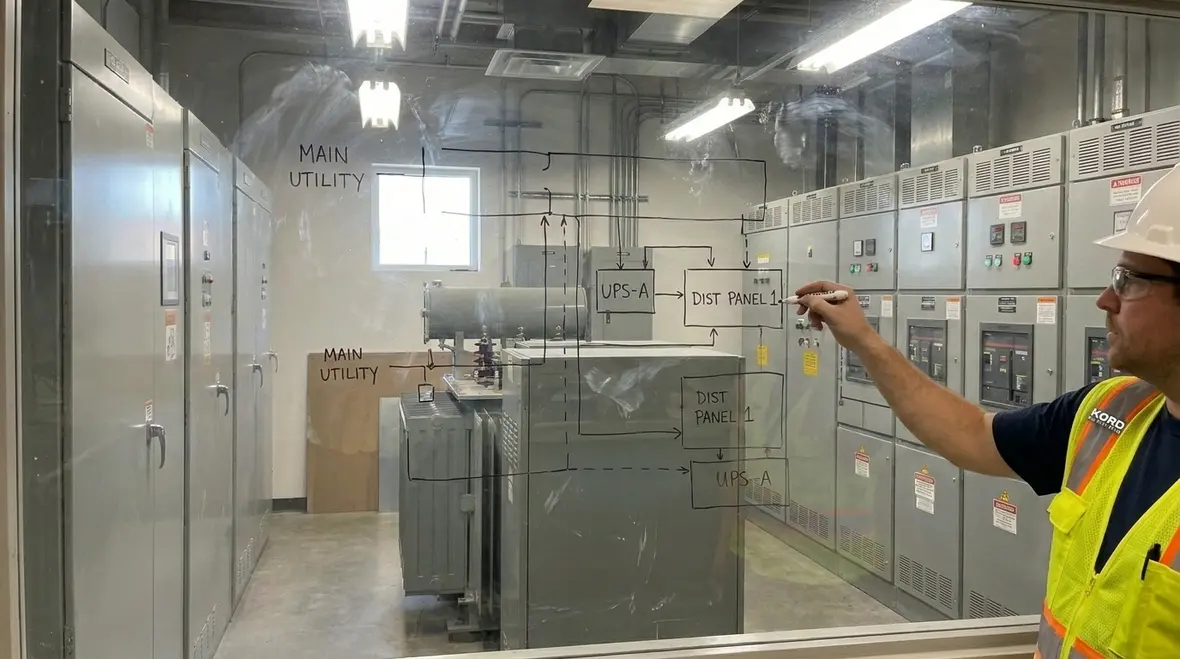
Designers often say they want redundancy, yet they do not always define what “redundant” means operationally. We build data center power redundancy so a single failure does not cascade. That means we design with separation and independence in mind. For example, we avoid common control points that can trip both paths during a nuisance event. We also plan for maintenance so that a technician can safely isolate one section without losing the entire facility.
Our expert service staff explains the key idea in plain terms: redundancy must be usable. If the facility only has redundancy on paper, but the switching scheme creates friction during normal operations, then it is not true redundancy. So we design for clean manual and automatic operations, we document transfer sequences, and we make sure the control logic matches the electrical topology.
And yes, we include the “human factor.” Pop culture taught us that one click can create a disaster. In real life, the click is just a symptom. The real issue is unclear sequence and missing labeling. We help others reduce that risk with clear diagrams, trained staff, and procedures that technicians can follow under stress.
Choose protection and coordination with real fault behavior

Redundant power systems only earn trust when protections operate the right way. Therefore we engineer protection and coordination using realistic fault current assumptions, selectivity targets, and clearing times that match the equipment design. This step matters because fault conditions behave like physics, not like wishes. A protective device that clears too slowly can let equipment overheat. One that clears too quickly can drop an entire bus and kill uptime.
At Kord Electric, our technicians review coordination between upstream breakers and downstream protective devices. We also check how protective relays interact across switchgear, UPS bypass lines, and transfer switches. In many facilities, the bottleneck is not capacity, it is coordination. Once we see the coordination chain, we tighten the time curves and ensure fault isolation stays within the correct zone.
Next, we evaluate how the system reacts to abnormal events such as short circuits, ground faults, and backfeed conditions. We also confirm that protection supports the chosen redundancy method. For instance, a design with parallel sources needs logic that prevents unwanted simultaneous sources. Then we test the logic through review and documentation so others can operate the system safely.
We keep it practical. In the field, when a breaker fails to operate as expected, technicians need a clear path to verify and restore power. So we design with test access, interlock clarity, and spare strategy in mind.
Design switching, UPS support, and bypass paths for continuity

Switching details can make or break uptime. So we treat transfer equipment as a system, not an isolated line item. We examine how automatic transfer switches, static switches, and bypass paths handle transients. If bypass paths do not support safe sequencing, equipment can experience stress or unwanted interruptions during maintenance or fault events.
For UPS systems, we focus on runtime and maintenance strategy. We verify that battery sizing supports the actual load profile, including peak loads that may run during business hours. We also evaluate how the UPS handles non linear loads from modern IT gear. A UPS can handle a lot, until the facility adds more servers, then the harmonic reality shows up.
And that is where our team helps others plan for growth. We review space for future distribution additions, verify load bank assumptions, and confirm that bypass switching supports maintenance without taking critical loads down. If the facility needs periodic testing, we ensure the design supports safe test modes.
Finally, we confirm that control power and monitoring circuits stay alive when they should. Many outages start because a control circuit loses power, not because the main power fails. Therefore we design control redundancy carefully and we ensure status signals map correctly to the building management system.
Manage thermal, physical layout, and maintenance access
Power redundancy does not only live in schematics. It lives in the room. So we plan physical separation, airflow, and access pathways. We consider equipment heat rejection, cable routing, and how maintenance teams reach components without removing unsafe barriers. If technicians cannot access a panel quickly, response time grows, and uptime goals slip.
We also design for cleanliness and cable management. Proper separation of high voltage and low voltage reduces noise and improves troubleshooting speed. Then we plan cable supports so they stay stable during events and meet code requirements. A neat layout may sound like aesthetics, but it directly impacts fault tracing and future expansions.
Thermal design deserves attention too. Redundant paths often share rooms, so heat loads can accumulate. We evaluate cooling interfaces so that critical equipment stays within temperature limits. Additionally, we plan for how cooling system failures might coincide with power events. Then we coordinate power and controls so alarms surface early.
To avoid surprises, our technicians also check commissioning readiness. We confirm that labels match field reality, that test points exist, and that the facility has a clear plan for startup, transfer testing, and scheduled maintenance.
Commissioning, monitoring, and service planning keep redundancy real
Once the electrical design exists, the work does not end. We commission with intent. That means we test transfer logic, verify relay settings, confirm UPS and bypass performance, and validate that monitoring points report the right status. This step is where many facilities miss their chance to catch issues early.
At Kord Electric, we also help others set up monitoring and maintenance plans. We recommend alert thresholds that match operational risk. If alarms show up too often, teams ignore them. If alarms show up too late, teams react when damage has already started.
We also plan spares and service response. For commercial and industrial facilities and major property buildings, downtime is more than inconvenience. It can trigger contract penalties, tenant complaints, and unplanned staffing costs. So we help teams plan for what happens when a component fails, including the expected repair path, lead times, and interim operational steps.
To keep things calm, we explain the system behavior during outages in practical language. Our expert service staff translates the “why” behind the sequence so facility teams understand what the system is doing and what they should do next. That reduces chaos. And chaos, like a chaotic sitcom plot, only gets fun after you survive it.
If your site is also evaluating broader reliability upgrades, our team can pair a redundancy review with structured maintenance planning inspired by our work on data center electrical maintenance programs, so design discipline and day-to-day practices reinforce each other.
FAQ: Redundant power system design for uptime
Conclusion: partner with Kord Electric for real uptime
When a commercial or industrial facility needs power continuity, we help you build it with purpose. Kord Electric designs redundancy with clear load paths, coordinated protections, reliable switching, and practical maintenance access. Then we commission and support the system so it performs the way your business needs it to, not the way it looks on paper. If you are planning a new build or upgrading an existing mission critical space, contact us today to talk through requirements and next steps.
For organizations operating in and around Southern California, especially those with data centers inside larger facilities, our regional team can also support broader reliability upgrades, tenant improvements, and modernizations through our dedicated Los Angeles County electrical services, aligning data center power redundancy with the rest of your building’s electrical strategy.
If you are ready to move from theoretical resilience to tested, documented uptime, Kord Electric can help you review existing infrastructure, prioritize upgrades, and build a roadmap that keeps critical loads steady while your facility grows.


