Data Center Electrical Maintenance Checklist
Data Center Electrical Maintenance Checklist for Facility Managers
At Kord Electric, we support commercial and industrial facilities with reliable data center electrical maintenance that keeps mission critical power stable. In our experience, when facility managers treat electrical maintenance like a once a year “luck and vibes” event, the risk stacks up quietly, like dust in a server rack. This article gives facility managers a practical checklist and the “what to do next” mindset, so their team can prevent downtime before it turns into a late night incident call. We also bring clarity from our trained technicians and expert service staff, who explain each step in plain terms. And yes, we promise the checklist is more useful than that mysterious drawer of spare parts everyone has but never opens.
Step one: confirm scope, site rules, and the power map
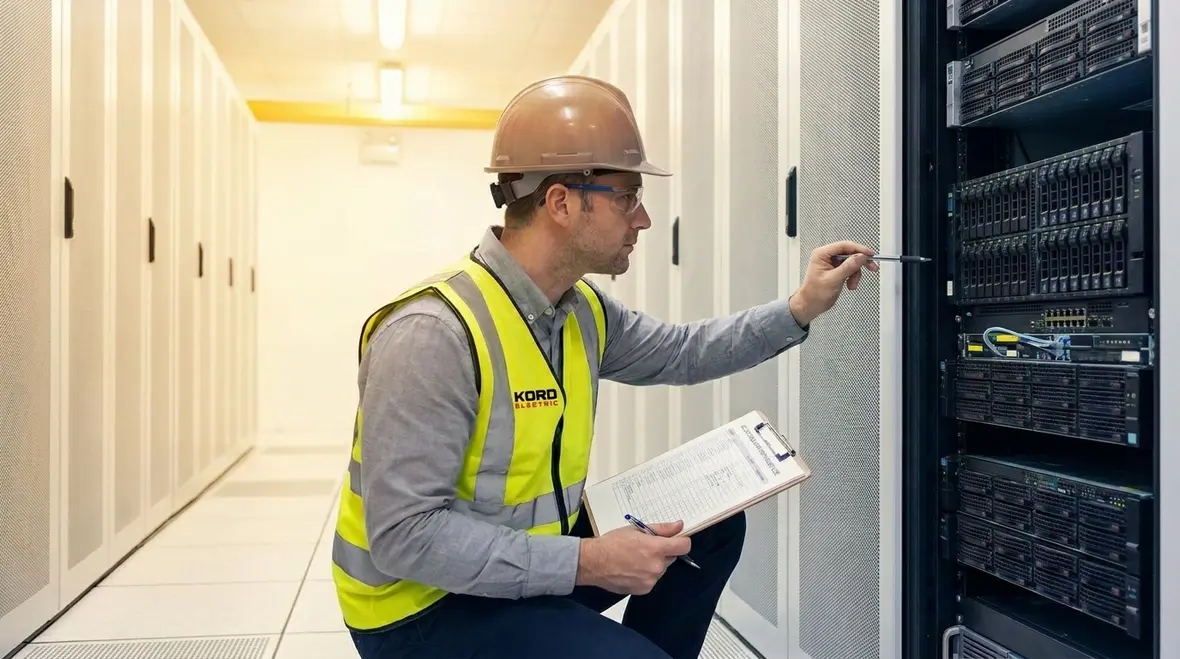
Facility managers can start strong by confirming what “electrical” means on their site. First, our team recommends reviewing the facility one line diagram, the rack and room power distribution plan, and all feeder routes that serve critical loads. Then we align on the site rules for access, lockout tagout, and work permits. If the building is a major property, the electrical system often includes multiple utility feeds, on site generation, switchgear, UPS, PDUs, and emergency systems that behave differently.
Next, facility managers should verify responsibility boundaries. For example, the fire protection side follows NFPA guidance and is not the same thing as UPS battery testing. In the same way you would not use a steak knife to open a valve cover, you should not mix system scopes during maintenance. Finally, we advise capturing baseline conditions: current sensor readings, breaker trip history, temperature logs, and load profiles. This becomes the reference point for later testing, and it reduces guesswork during trend review.
Visual inspections and cleanliness that actually matter

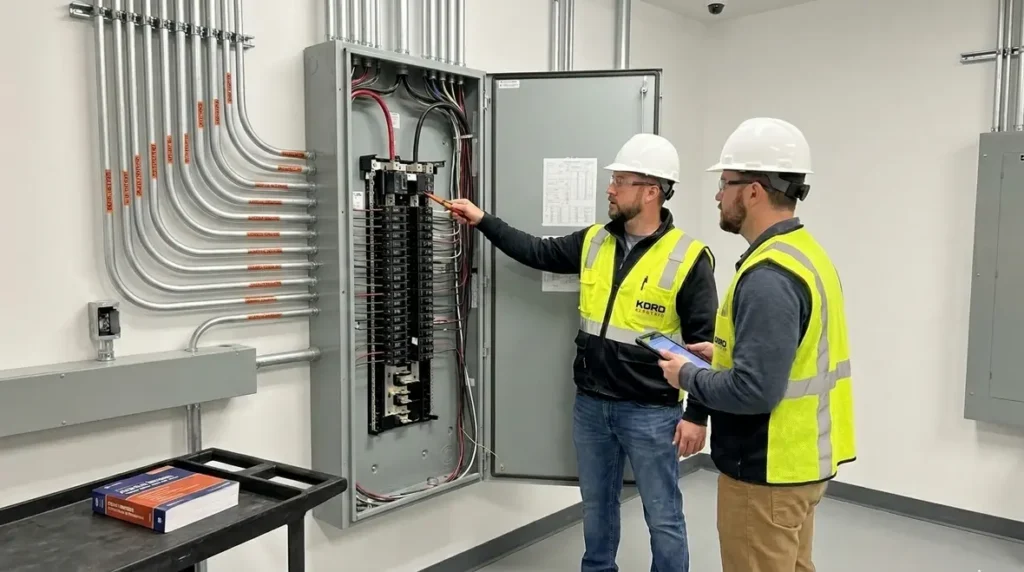
After scope and power mapping are set, the practical checklist begins. Technicians from Kord Electric typically start with visual inspections of switchgear rooms, UPS rooms, generator spaces, and PDUs. We focus on evidence that tells the story before meters do. For instance, facility managers should ask for checks of panel doors, cable terminations, bus bar condition, and signs of overheating such as discoloration or darkening around lugs.
Then we add the often ignored item: cleanliness and airflow. In data centers, blocked vents and clogged filters increase heat, which increases stress on components. Even when a system “seems fine,” heat can shorten insulation life over time. So facility managers should ensure that cable trays have proper separation and support, and that cooling equipment access paths remain clear. Also, we recommend checking for moisture indicators and verifying that sealing and gaskets are intact where cabinets meet raised floor openings.
Finally, we emphasize documentation. A good inspection does not end with “looks good.” It ends with annotated photos, updated tags, and a record of any abnormal conditions that require follow up.
If you want a deeper look at how electrical infrastructure decisions upstream affect what you see during inspections, Kord Electric’s Data Center Electrical Infrastructure Essentials article walks through how power distribution, redundancy, and equipment layout all shape what “normal” should look like in your rooms.
How we handle switchgear, UPS, and battery testing safely
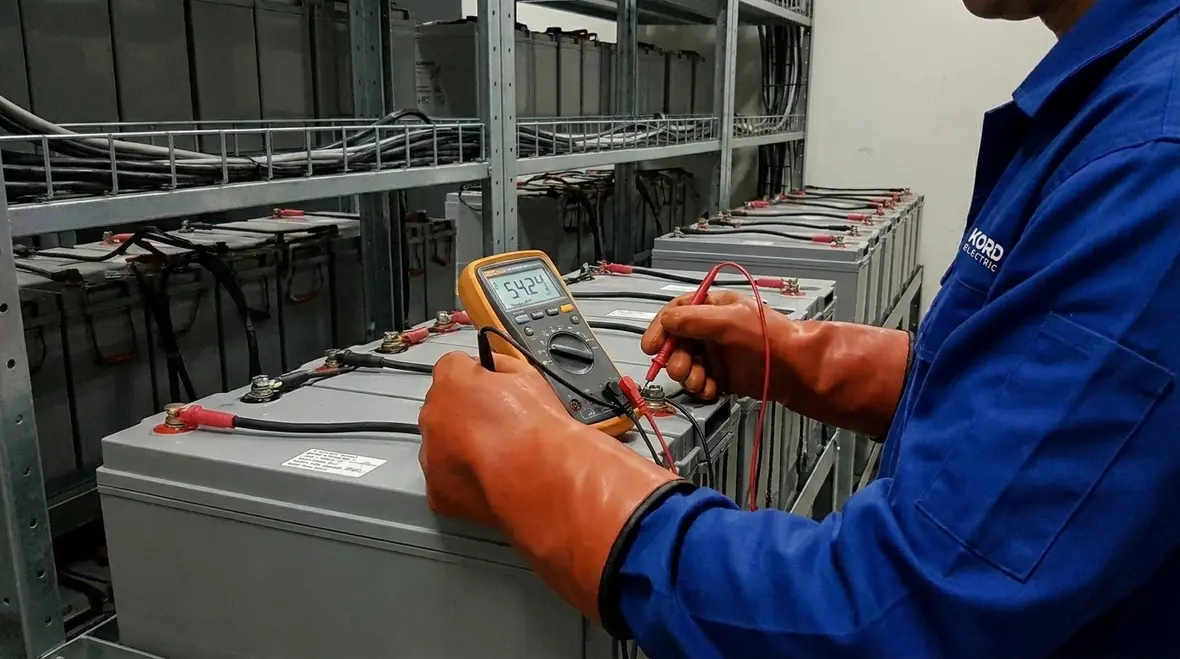
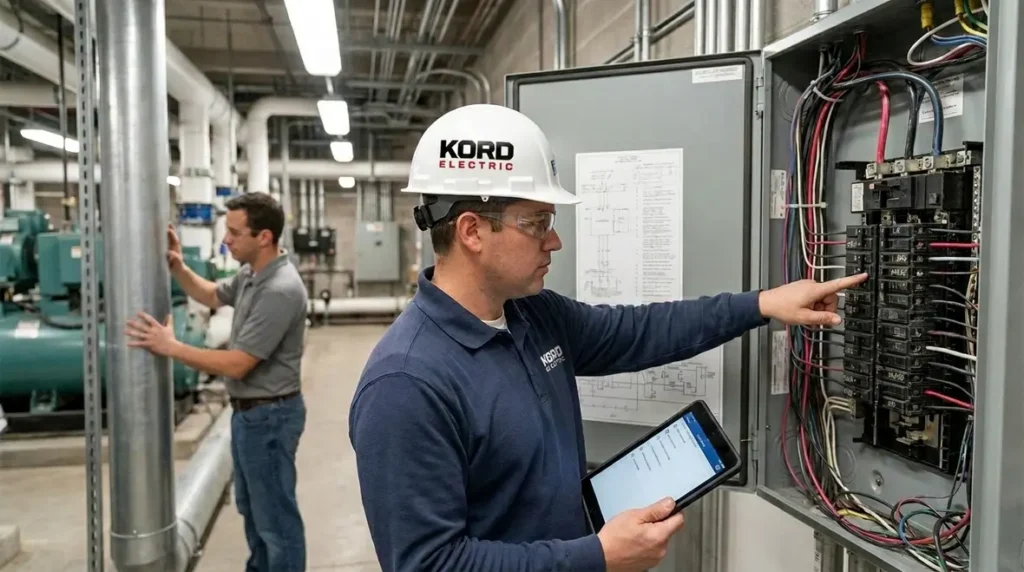
Now the checklist moves from what people can see to what systems can prove. Switchgear maintenance should follow manufacturer guidance and site schedules, and our technicians help facility managers plan it in a way that minimizes downtime risk. First, we recommend confirming the operating sequence and maintenance mode steps for each gear line. Then we test critical points such as breaker operation, interlocks, and any available mechanical timing data.
For UPS systems, we focus on performance and reliability, not just compliance. Facility managers should ensure that technicians verify bypass switch operation, cabinet alarms, and communication health. They should also review runtime tests on a planned basis, because the whole point is to know how the system performs under load, not just how it starts. Battery maintenance deserves the same seriousness. Battery health testing typically includes checking voltage, internal resistance, and temperature behavior, and we also support thermal monitoring and battery cabinet inspections.
Here is the key detail facility managers should not miss: UPS batteries age even when nobody touches them. So we recommend pairing test results with an aging plan and replacement triggers. Otherwise, the team ends up treating battery maintenance like a game of roulette, except the prize is a system outage. And we like our jokes, but we do not like our outages.
When you combine disciplined maintenance with solid upstream design, you get fewer surprises when it is time to operate or test. Kord Electric’s Data Center Electrical Distribution Design for Reliability guide shows how selective coordination, redundancy choices, and maintenance planning all tie together long before the first breaker is racked in.
Load testing, power quality, and monitoring that catches problems early
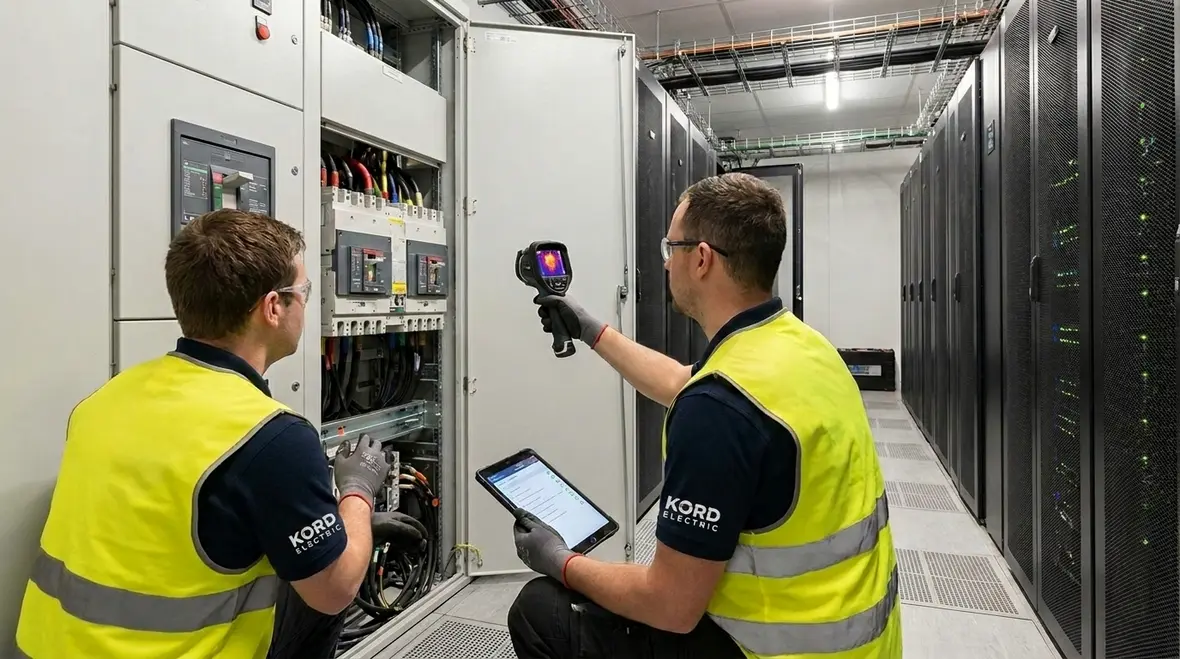
After the equipment checks, facility managers need confirmation that the electrical performance matches the design intent. This is where data center electrical maintenance becomes more than a checklist, and turns into a trend program. Technicians should review load balance across phases, check harmonic distortion, and confirm that protective devices respond within acceptable ranges.
We recommend a routine schedule for power quality testing, especially where critical loads include large UPS rectifiers, modern server racks, and variable speed drives. Then facility managers should verify that current transformers, meters, and sensors read accurately by using appropriate calibration checks. If a sensor drifts, it can cause alarms, missed thresholds, or incorrect maintenance decisions.
Monitoring also plays a major role. At Kord Electric, our expert service staff often helps facility managers tune how alarms trigger responses. For example, an alarm that fires every week trains people to ignore it. Meanwhile, a subtle parameter drift might happen quietly until a critical event. So we suggest refining thresholds and ensuring logs remain consistent and searchable. Then the team can review trends before they reach the point of no return.
Finally, we tie monitoring results back to the facility’s one line diagram. This keeps the maintenance work grounded in reality, not guesswork. When the numbers match the physical system, fewer surprises show up later.
NFPA 75 aligned electrical habits and coordination with fire protection
In major property data centers, electrical maintenance cannot live in a silo. If the facility follows NFPA guidance for fire protection and related systems, facility managers should coordinate electrical work with that safety plan. When we review documentation, we look for how electrical panels, circuits, and detection devices connect across systems. Then we ensure maintenance actions do not undermine fire related performance.
We also recommend following the principles found in guides that connect data center fire protection and NFPA 75 practices, including attention to detection, alarm signaling, and pre action behaviors where applicable. Put simply, facility managers should not open a panel, move a circuit, or adjust a control pathway without verifying how it affects detection and suppression readiness. If the team forgets coordination, they create “phantom risk,” meaning the protection system may still look intact but behave differently during an emergency. For a focused walkthrough of how this plays out on the fire side, Kord Fire’s Data Center Fire Protection and NFPA 75 Guide explains how IT spaces, fire protection systems, and NFPA 75 expectations work together.
Technicians from Kord Electric help facility managers build a coordination routine: schedule alignment, clear circuit labeling checks, and verification steps after work is completed. We also support post maintenance walkthroughs so facility staff can confirm that alarm panels, supervisory signals, and relevant status indicators still operate as designed.
And yes, we remind everyone to label properly. Without labels, future teams play detective, and detective work is great for movies, not for live electrical systems.
Maintenance documentation, KPIs, and closing the loop
Most facility managers do maintenance. Fewer measure it well. To keep electrical reliability high, teams should document every work order, include the test data, and track outcomes. Kord Electric encourages facility managers to maintain a simple set of KPIs, such as alarm count trends, breaker operations, battery test pass rates, and downtime events tied to electrical causes.
Next, facility managers should use the data to revise schedules. If a component fails early, the plan must adapt. If a sensor repeatedly flags nuisance alarms, thresholds need tuning. When documentation stays consistent, the facility can justify future budgets with evidence, not fear.
Then we recommend a closing review meeting after major maintenance events. Our technicians and expert service staff participate in these reviews to explain what they found, what it means, and what should happen next. This step builds trust and improves decisions across departments. After all, the best data center electrical maintenance program is not just doing tasks, it is learning and getting better.
Lastly, facility managers should verify that corrective actions get owners and due dates. If issues sit in the “someday” folder, they usually show up as “why did this happen” next quarter.
FAQ
Conclusion and next step
Facility managers in commercial and industrial data centers need a checklist that drives outcomes, not just tasks. With Kord Electric, we help you verify equipment condition, test performance, coordinate with safety expectations, and document what matters so you can act early. If you want a maintenance plan built for major property reliability, we can review your current approach and recommend a clear schedule and next actions. Reach out to Kord Electric today, and let our expert service staff help you keep power steady and downtime rare.
If your team is planning upgrades or new build work alongside ongoing data center electrical maintenance, you can also explore how our broader design and installation services support uptime by visiting our Kord Electric commercial and industrial services overview before we customize a plan for your site.