
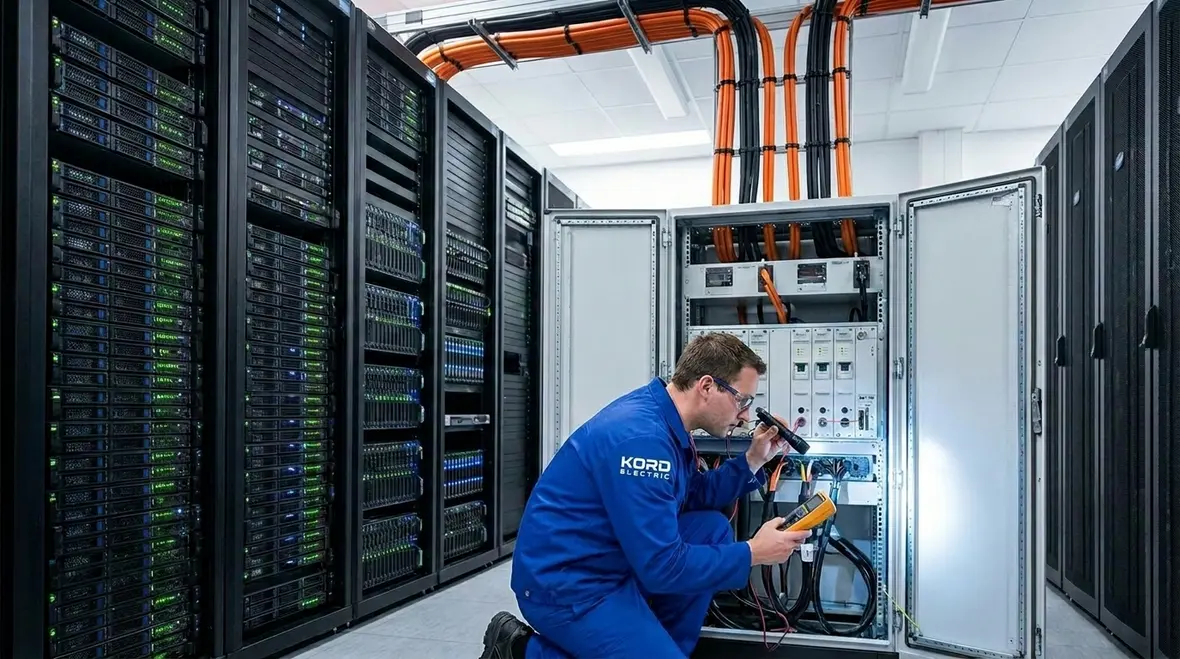
Data Center Power Redundancy for Real Uptime
In every commercial and industrial data center, data center power redundancy cannot be a “nice to have.” It has to be designed, tested, and maintained so the building keeps running when power threats show up. Kord Electric builds and supports power distribution systems with redundancy that protects critical loads, reduces downtime, and keeps operations stable. And just so we stay honest, we also know that redundancy only matters when it works under stress. That is why our service team treats the system like a living thing, not a one time project.
In this article, we explain the practical strategies our technicians use, step by step, to strengthen power distribution from the utility feed to the final branch. Because downtime is expensive, and backups that never get exercised are basically expensive decorations.
Essential data center power redundancy starts with real uptime goals
In every commercial and industrial data center, data center power redundancy cannot be a “nice to have.” It has to be designed, tested, and maintained so the building keeps running when power threats show up. Kord Electric builds and supports power distribution systems with redundancy that protects critical loads, reduces downtime, and keeps operations stable. And just so we stay honest, we also know that redundancy only matters when it works under stress. That is why our service team treats the system like a living thing, not a one time project.
In this article, we explain the practical strategies our technicians use, step by step, to strengthen power distribution from the utility feed to the final branch. Because downtime is expensive, and backups that never get exercised are basically expensive decorations.
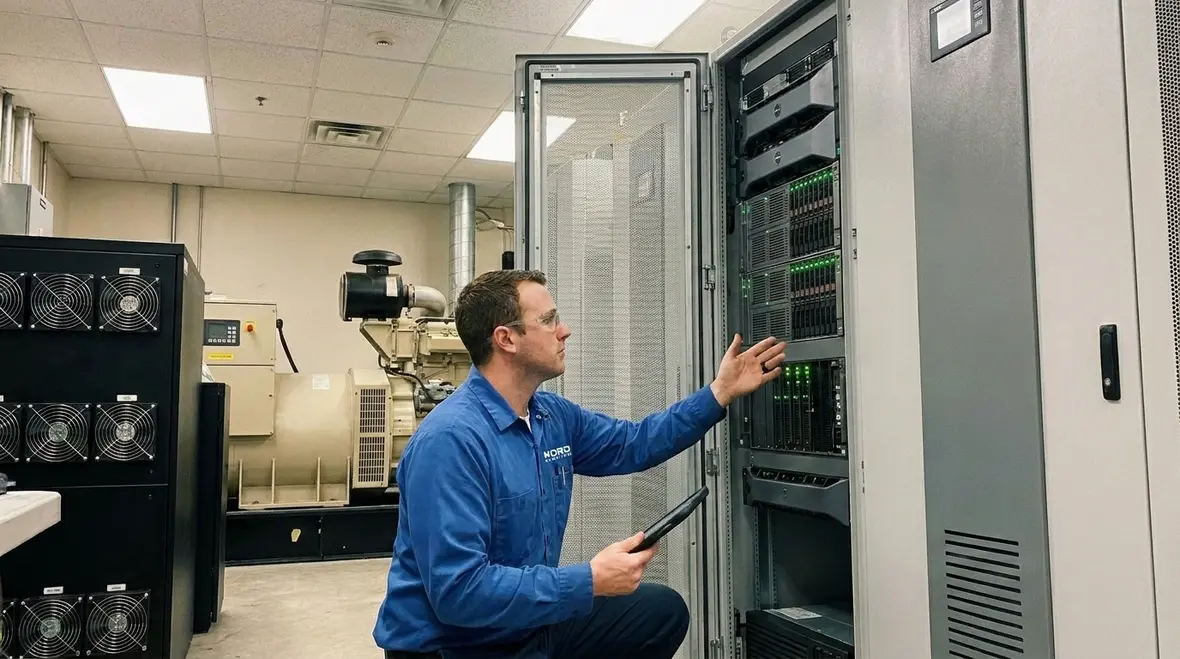
Design the power path for selective failures, not blanket shutdowns
When power engineers set up redundancy, they often focus on how many sources exist. Yet the more important question is how the system behaves when one component fails. Kord Electric designs power distribution so a failure stays contained. That means the system uses selective coordination, zoning, and fault isolation so one fault does not cascade into a full outage.
In our approach, we work with one guiding idea: maintain power quality and continuity at the load. Therefore, we specify and apply protective devices in a way that clears faults only where needed. Then we verify the coordination settings so the breakers trip in the right order. Next, we confirm the behavior during abnormal conditions, not just in quiet test rooms.
Our expert service staff explains these design choices in plain terms. We tell owners that a good redundancy plan still needs “good manners,” meaning it should fail gracefully. Otherwise, the whole building gets to experience the electrical version of a domino show.
Key strategies include selective tripping, properly rated components, and clearly defined bus and feeder sections. As a result, critical loads keep operating while crews fix the problem safely.
Build N plus 1 and then verify transfer logic in real scenarios
Redundancy math sounds simple on paper: N plus 1 means one extra unit to cover a failure. However, the real world adds timing, controls, and transfer behavior. That is where Kord Electric pushes harder than the basic design. We verify that the transfer logic works as intended, even when conditions change.
Our technicians pay close attention to switchgear and transfer schemes. We evaluate how the system handles starting loads, voltage dips, and phase synchronization. Then we run through the practical question: what happens to the load when a source changes, and how long does it take?
Additionally, we check the control power and monitoring circuits. If controls fail, the redundancy becomes theoretical. So, we confirm that relays, interlocks, and indication signals work correctly. From there, we validate that the system transfers without damaging sensitive loads.
We also stress the difference between a “successful transfer” and an “acceptable transfer.” The building might transfer successfully, but the voltage and timing might still cause nuisance trips. Therefore, verification must include the conditions that actually exist in the facility.
And yes, we tell teams that transfer switches are like elevators: when they work, nobody claps. When they fail, everybody remembers.
Maintenance that keeps redundancy honest
N plus 1 only delivers real value when every path is tested under conditions that look like real life, not a gentle lab demo. That is why our technicians simulate source changes, loading swings, and control faults wherever practical so facility teams see exactly how their system behaves when it matters.
Use maintenance plans that force redundancy to prove itself
Even the best design can drift over time. Connections loosen, settings change, filters clog, and control boards age. That is why Kord Electric supports commercial and industrial power distribution systems with maintenance plans built around real verification.
We align our work with structured electrical maintenance plans for commercial and industrial facilities, similar to the approach described in our Commercial and Industrial Electrical Maintenance Plans resources. Our service staff explains what is checked, what is documented, and what triggers corrective work. We do not just “look around.” We measure, test, and trend data so redundancy remains dependable, not hopeful.
For data center power systems, our technicians typically focus on the parts that affect redundancy performance, including switchgear components, protective devices, busbar connections, and control logic behavior. We also inspect key interfaces between utility power, generator sets, and uninterruptible backup systems where applicable.
Moreover, maintenance includes scheduled functional testing that respects uptime needs. We plan outages carefully and coordinate with facility operations so critical loads stay protected. Then we capture the results and update maintenance records, which helps owners make smarter decisions later.
How maintenance protects data center power redundancy
During maintenance visits, our teams look for small issues that can quietly erode redundancy: drifting relay settings, under-torqued lugs, control power anomalies, and mis-labeled breakers. These are the details that separate a system that “should work” from a system that actually performs during an outage.
Dual distribution paths and bus zoning reduce the blast radius
Redundancy should not only cover “source failure.” It should also handle feeder issues, damaged cables, and equipment faults. For that reason, Kord Electric promotes dual distribution paths and bus zoning where facility design supports it.
Dual paths allow critical loads to remain fed even if one feeder or section experiences a fault. Bus zoning isolates segments so repairs stay local. Instead of shutting down large sections, teams can restore service quickly.
In practice, we map loads and fault impacts. Then we match protection settings to the physical layout of the distribution system. After that, we review labeling, wiring terminations, and phase balance at the distribution level.
Our expert service staff also helps owners understand the difference between redundancy that covers equipment and redundancy that covers operational reality. For instance, two redundant paths might exist, yet one might be effectively unavailable due to misconfiguration or control logic. So, we verify that both sides behave as designed.
And if someone asks if this is overkill, we calmly explain: it is cheaper than a “surprise outage.” The building does not care that the plan sounded good in a meeting.
Designing distribution for real uptime
When we design or upgrade dual paths, we focus on what the system has to survive: utility disturbances, internal faults, maintenance outages, and unexpected load growth. That is how we keep the blast radius small when something finally does go wrong.
Confirm power quality so loads do not fail during switching
Power interruptions are obvious. Yet data centers also suffer when power quality dips during switching, load transfer, or generator pickup. Therefore, redundancy strategies must include harmonics, voltage stability, and transient response.
Kord Electric checks the system for conditions that can harm sensitive equipment. We look at how the system responds during source changes. Then we evaluate whether voltage dips and waveform changes fall within acceptable thresholds for the load.
Additionally, we verify grounding and bonding practices that support stable voltage references. Good grounding does not just protect people. It helps the system behave predictably for controls and electronics.
We also review the electrical environment inside the distribution area. That includes cable routing, separation of signal and power where needed, and proper panel and enclosure conditions. These checks support stable operation and reduce the chance of nuisance faults that can look like random failures to operations teams.
When our technicians explain these tasks, they speak to outcomes. They tell building managers that a clean, stable power profile helps keep servers running and reduces support calls. In other words, it keeps the “mysterious problem” from becoming a new recurring character in the incident log.
Why power quality matters for data center power redundancy
Data center power redundancy only pays off when the power you deliver is actually usable. That is why we pair backup strategies with power quality checks that look beyond simple “on or off” status and into how that power behaves during the milliseconds that matter most.
Document, train, and test for continuity like you mean it
Redundancy does not live in drawings alone. It lives in operations, documentation, and staff readiness. Kord Electric emphasizes record keeping and clear procedures so facility teams know what to do during events and how to verify system health afterward.
Our expert service staff trains stakeholders on key system behaviors. We explain what alarms mean, which indicators map to which equipment, and how to respond safely. Then we support owners with maintenance documentation that shows what was tested and what results came back.
Furthermore, we encourage tabletop exercises for switching events. During these sessions, teams walk through likely failures such as a source outage, a breaker trip, or a control fault. This reduces confusion during real incidents.
Finally, we stress testing cadence. If redundancy sits idle for too long, components can fail when needed. So, our team uses planned testing that respects downtime limits while still proving performance. Because a “plan” without proof is just a story told with confidence.
Keeping data center teams aligned with real redundancy behavior
Documentation, training, and repeatable drills turn the power system from a mystery box into a familiar tool. When alarms sound or a source fails, teams follow clear steps instead of improvising under pressure.
FAQ
Ready to strengthen your power redundancy performance?
If your facility relies on uptime, Kord Electric can help you build confidence in your power distribution system. We bring tested strategies, hands on technicians, and clear maintenance documentation designed for commercial and industrial buildings. We also walk your team through what we find and what it means, so redundancy stays real, not theoretical. Reach out to us to review your current setup and plan the next steps toward reliable power continuity. Let us help you prevent the next “surprise” outage from stealing your day.
For facilities that want to move from reactive fixes to structured reliability, explore how our electrical preventive maintenance services support data center power redundancy, critical distribution, and long term uptime across commercial and industrial properties.


