

Data Center Power Redundancy Guide for Reliability
At Kord Electric, our data center power redundancy guide starts with one simple promise: critical systems must keep running when the unexpected shows up. And it will. In a real facility, a switch can fail, a breaker can trip, or a utility event can turn the lights into a sad, flickering memory. So we plan for it with a clear path to reliability, not wishful thinking. To reach that goal, we align design choices, test routines, and field-ready support into one steady system. Then we bring our technicians and expert service staff into the story, because theory is nice and alarms at 2 a.m. are nicer to handle when you trust the people on site. Like that old sitcom plot, everything breaks eventually, but the good ending depends on what you built before it happened.
How we plan redundancy without creating new risks
When a data center or other commercial and industrial facility needs power that stays stable, we treat redundancy like a system, not a set of parts. First, we map the power path from utility to switchgear, then to distribution, then to the final loads. After that, we decide what level of separation makes sense for the risk. For example, we separate electrical paths so a single equipment failure does not pull down the whole operation. However, we also avoid the trap of “more redundancy equals better.” Sometimes extra paths add complexity, and complexity adds human error. So we design with clean boundaries and clear operating modes.
Next, we choose topologies that match the business needs of major property buildings and data halls. In our approach, we prioritize reliability, yes, but we also track maintainability. Therefore, technicians can test equipment, swap components, and isolate sections without spreading problems. And since we operate with field reality in mind, we build the plan so the facility team can follow it during normal work and during emergency conditions.
What reliability means in real electrical rooms
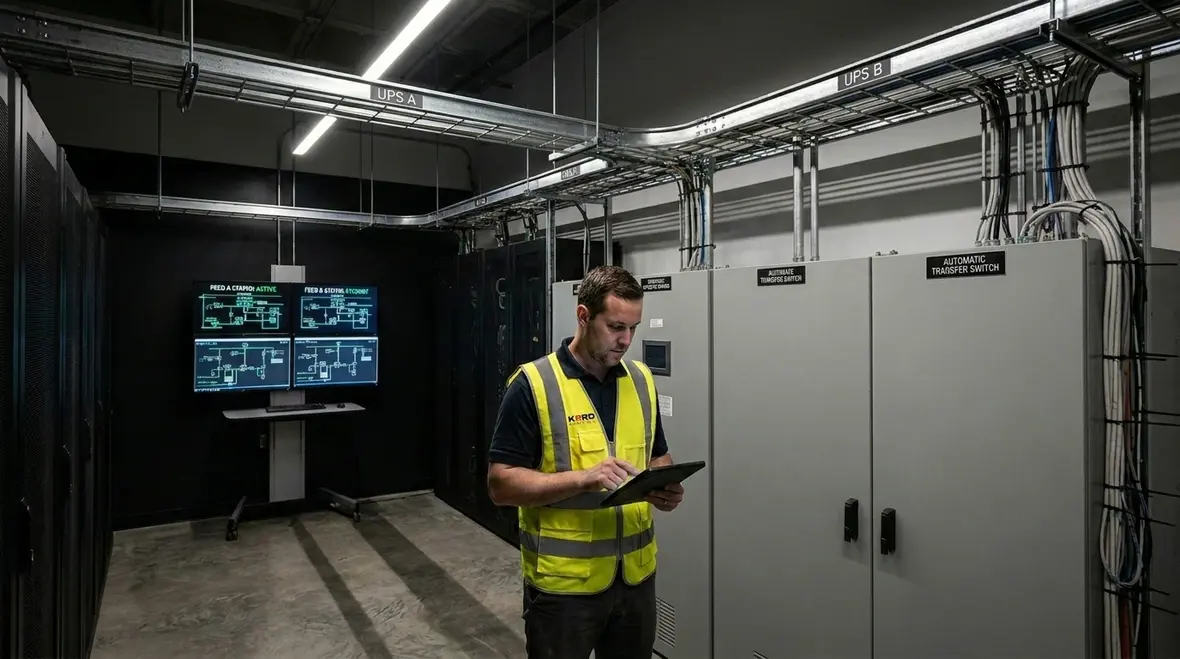
Reliability does not mean “we hope it works.” It means we can predict performance and we can prove it. So we focus on failure modes and on what the facility team can detect quickly. For instance, we look at how voltage dips, frequency shifts, and switching transients impact sensitive IT loads. Then we design control logic that transitions smoothly between sources.
Additionally, we consider heat, dust, and airflow, because power equipment does not live in a lab. We verify cable routing, grounding, and the behavior of protective devices under load. Then we confirm that alarms help people act fast. When a system communicates clearly, the response time improves, and that reduces downtime. After all, nothing ruins a day like a silent failure that only shows up when it is too late. That is why we plan for visibility from the start.

Dual paths, smart switching, and stable load behavior
Strategic data center power redundancy usually hinges on two ideas: separate energy sources and controlled transfers. So we design multiple power paths so each critical area can operate even after a component failure. At the same time, we tune switching and transfer sequences to protect both the load and the equipment.
In practice, we also manage what happens during transfer events. For example, we verify that the backup path ramps and stabilizes within acceptable limits. We coordinate distribution device settings so protective actions do not fight each other. If protective devices act out of sequence, the facility can lose power even when redundancy exists. Therefore, we test coordination and we document expected behavior for operators.
And yes, we keep it human. Our technicians explain what the system will do in plain language, so the facility staff does not have to decode a control diagram like it is a sci-fi movie script. When people understand the “why,” they can act faster and with less stress.
Maintenance strategy that actually supports uptime
Many facilities treat maintenance as an interruption. We treat it as a reliability tool. To do that, we schedule inspections and testing around the operating plan, and we follow procedures that reduce risk. We also plan for maintenance modes so technicians can isolate sections without taking the entire critical load offline.
Additionally, we focus on battery and generator health, engine start behavior, and fuel readiness for major property buildings and data center sites. We also verify that transfer switches and breakers function as intended under real conditions, not just during bench tests. Over time, components drift. Contact resistance rises, sensors age, and control boards change behavior. As a result, a system can look fine and still fail when it matters.
Therefore, we use a maintenance and test approach aligned to the data center power redundancy guide and to the facility’s actual operating profile. Then our expert service staff walks through outcomes, so the team knows what changed, what improved, and what needs next attention. That way, maintenance supports uptime instead of gambling with it.

Testing, drills, and evidence, not guesswork
Reliability becomes real when it is proven. So we test critical transfer paths, verify protective device behavior, and validate that control logic responds correctly. Furthermore, we do it in a way that supports the live environment. For commercial and industrial facilities, downtime is expensive, and the test plan must respect operations.
To strengthen confidence, we also recommend drills that cover operator actions during events. For example, teams should practice recognizing alarm patterns, confirming the correct source status, and following clear steps for load control. That reduces the chance of “panic decisions,” which often sound smart in the moment and terrible in hindsight. Like when someone says, “Just reboot it,” and suddenly the entire building becomes their personal comedy sketch.
We also capture test results and trends, so the facility can spot early warnings. If engine start time grows, if voltage regulation shifts, or if breaker behavior changes, the data tells the story. And when the story is clear, planning becomes faster and smarter.
Design documentation and operator training that keeps systems consistent
Power redundancy fails most often when people cannot find the right answer quickly. So we help facilities improve documentation, labeling, and operating guidance. We make sure the one-line diagrams match the field. We confirm that settings records, test history, and control sequences are accessible. When information is scattered, response time slows, and stress rises.
Next, we train the people who run the system. Our technicians and expert service staff explain transfer logic, protective device roles, and what each alarm means. We keep training grounded in daily operations for major property buildings and data centers, not in abstract theory. Therefore, operators can interpret events calmly and take the correct action without guessing.
We also encourage a process for change management. When someone modifies a panel or updates a control setting, the facility must update the documentation too. Otherwise, the next person inherits a mystery. And as any major business owner knows, mysteries cost money.
Supply chain resilience and emergency readiness
A reliable power plan also needs a reliable path to repairs. That means we think about lead times, spare parts, and how the facility will restore service after a real-world failure. For data centers and large commercial sites, we recommend a parts strategy that considers the most critical components and the likely failure points. Then we align that strategy with an emergency work plan.
In addition, we verify that the physical setup supports quick access and safe work practices. We also review how the facility handles fuel, test schedules, and temporary power needs during major work. Even the best redundancy can stall if a crucial part takes months to arrive. So we plan for restoration, not just prevention.
We bring this readiness perspective into both design and service. As a result, the facility gains resilience in day-to-day operations and in the weeks after a disruptive event.
Connect your redundancy plan to the broader electrical backbone
Redundancy does not live in isolation. It sits on top of the wider electrical infrastructure that feeds every rack and cooling system in the building. If you are mapping out a complete reliability strategy, it pairs well with a deeper look at the underlying infrastructure, including switchgear, distribution, and grounding practices. For a complementary perspective on the broader backbone that supports your redundancy design, explore Kord Electric’s companion article on Data Center Electrical Infrastructure Essentials, which connects power paths, cooling impacts, and maintainability across the full facility.
FAQ
Ready to strengthen power reliability with Kord Electric?
If your facility depends on uninterrupted power, we help you build redundancy that holds up in real life. Our team aligns design, testing, maintenance, and operator training into one reliability plan. Then our technicians and expert service staff back it with clear explanations and practical field support for commercial and industrial environments, including major property buildings. For a deeper perspective on how redundancy ties into the rest of the distribution network, you can also review our insights on data center electrical distribution design for reliability, then connect those concepts back into this data center power redundancy guide so everything works as one system instead of scattered pieces.
When you are ready to move from ideas to action, Kord Electric’s dedicated teams can help you apply this data center power redundancy guide to your own site, from planning and commissioning to ongoing maintenance and upgrades. Contact Kord Electric today to review your power architecture and create a smarter reliability path that protects uptime when the unexpected arrives, and be sure to ask how our commercial and industrial electrical maintenance and repair services support long-term performance after the project is complete.
For facilities that need project-level support as well as lifecycle care, pairing your redundancy design with Kord Electric’s reliability-focused services—such as preventive maintenance programs and data center electrical requirements consulting—helps keep breakers, switchgear, and backup power paths operating the way they were designed, year after year.


