
Industrial Electrical Maintenance Troubleshooting Guide
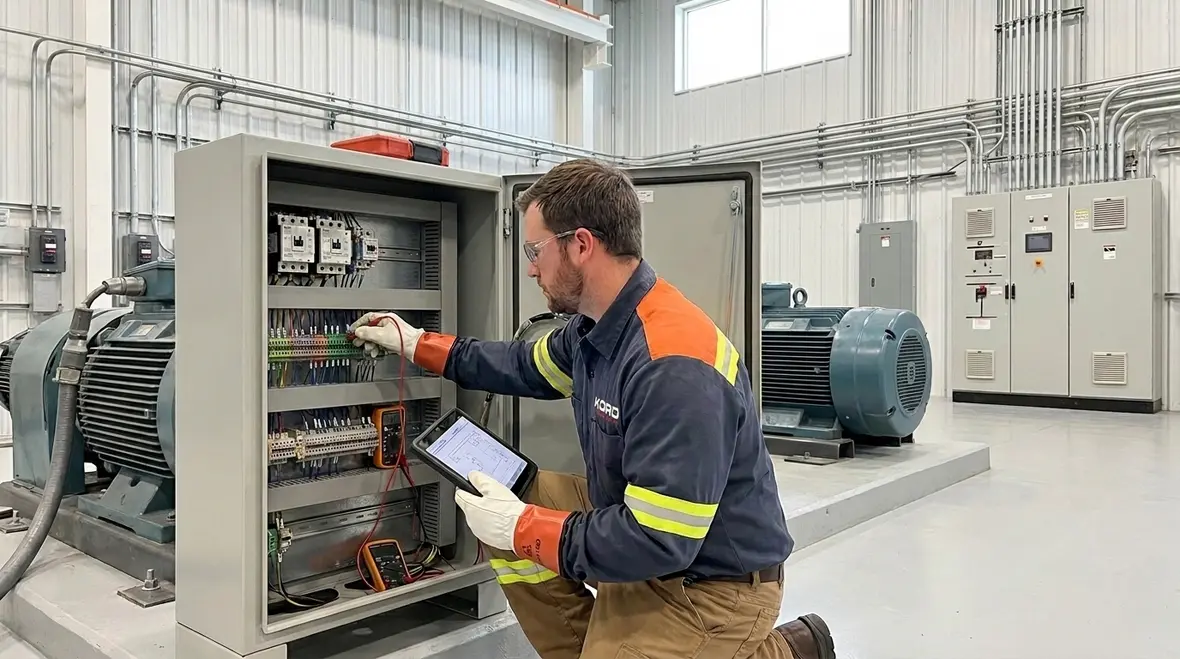
At Kord Electric, we treat industrial electrical maintenance troubleshooting like a quiet investigation, not a guessing game. In our Industrial Electrical Maintenance Troubleshooting Guide, we start with what most teams skip: evidence. First, we confirm the asset, the load history, and the conditions when the issue showed up. Then we follow a careful path of inspection, measurement, and verification so the root cause does not hide behind a temporary fix. Our expert service staff explains the “why” behind each step, because anyone can replace a component, but only skilled technicians can prove the repair will last. And yes, we still hear the classic joke from the floor: “It worked yesterday.” Unfortunately, electricity loves drama.
In this article, a third person view will walk through common failure points, the practical checks that prevent repeat breakdowns, and the safer ways commercial and industrial facilities should handle electrical repair decisions.
Industrial Electrical Maintenance Troubleshooting Guide: what we check first
At Kord Electric, we treat industrial electrical maintenance troubleshooting like a quiet investigation, not a guessing game. In our Industrial Electrical Maintenance Troubleshooting Guide, we start with what most teams skip: evidence. First, we confirm the asset, the load history, and the conditions when the issue showed up. Then we follow a careful path of inspection, measurement, and verification so the root cause does not hide behind a temporary fix. Our expert service staff explains the “why” behind each step, because anyone can replace a component, but only skilled technicians can prove the repair will last. And yes, we still hear the classic joke from the floor: “It worked yesterday.” Unfortunately, electricity loves drama.
In this article, a third person view will walk through common failure points, the practical checks that prevent repeat breakdowns, and the safer ways commercial and industrial facilities should handle electrical repair decisions.

Common symptoms in industrial electrical repair for typical equipment
In commercial and industrial facilities, the first sign is rarely a label on a panel. Instead, the symptoms usually show up as behavior changes: nuisance trips, overheating smells, inconsistent motor performance, dimming lighting that should not dim, or control circuits that refuse to respond. When these happen, others often chase the visible problem, while the true cause sits upstream. Therefore, technicians should connect symptoms to system sections such as distribution, motor controls, protection devices, grounding, and instrumentation.
At Kord Electric, our technicians and expert service staff also watch the timeline. For example, a short-lived outage after a lightning event often points to surge protection and transient damage. A gradual change over weeks often points to insulation aging, loose terminations, or failing control components. If a problem only occurs under load, then the measurement strategy must shift toward current draw, voltage drop, and thermal effects.
Why breakers, contactors, and relays fail without warning
Electrical equipment rarely fails like a light switch. More often, it deteriorates in small steps, and then the system forces a decision. Breakers trip when protective thresholds detect an abnormal condition, yet the trip reason may not be the device itself. Contactors weld when arcing continues for too long, and relays can drift when contacts wear or coil supply becomes unstable.
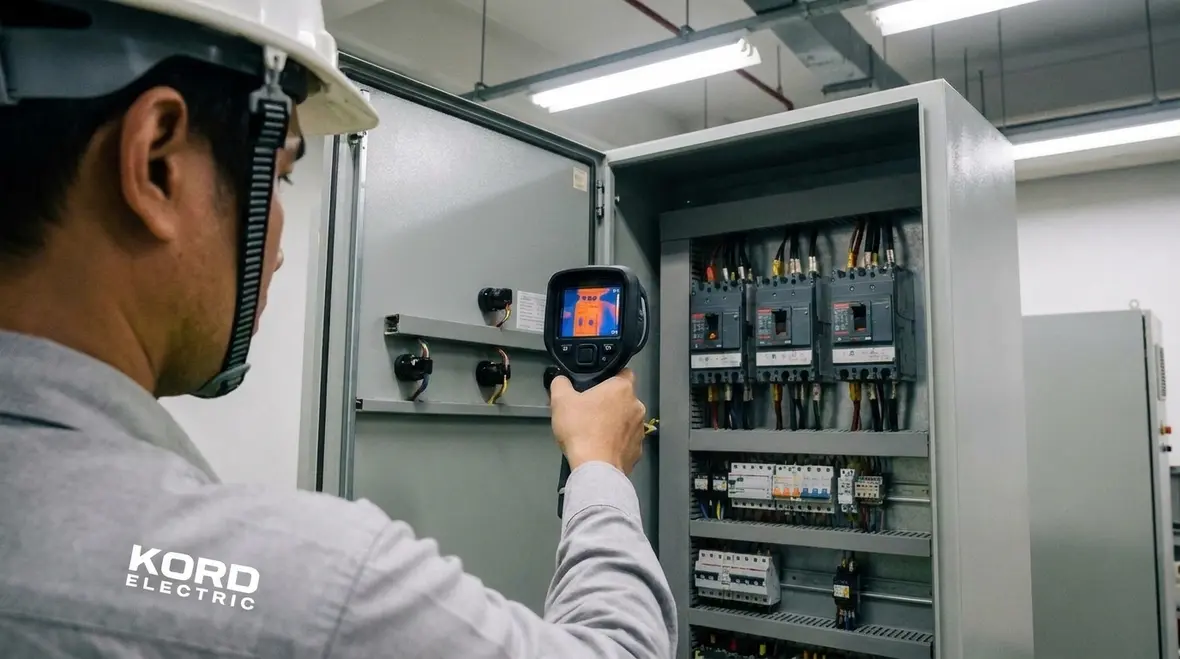
First, we verify the breaker trip data and protective settings. Then, we inspect the terminations for looseness, discoloration, and signs of heat. After that, we check the control voltage and coil operation for contactors and relays, because a weak control supply can mimic a “fault” condition. Our expert service staff explains this in plain terms on site: “If the command signal is off, the rest of the system looks guilty.”
And if someone tries to reset repeatedly, we say it gently: resetting a breaker is not a plan. It is a pause button. If the underlying issue remains, the next trip arrives on schedule like a sitcom rerun.
How we troubleshoot motors and drives when production slows
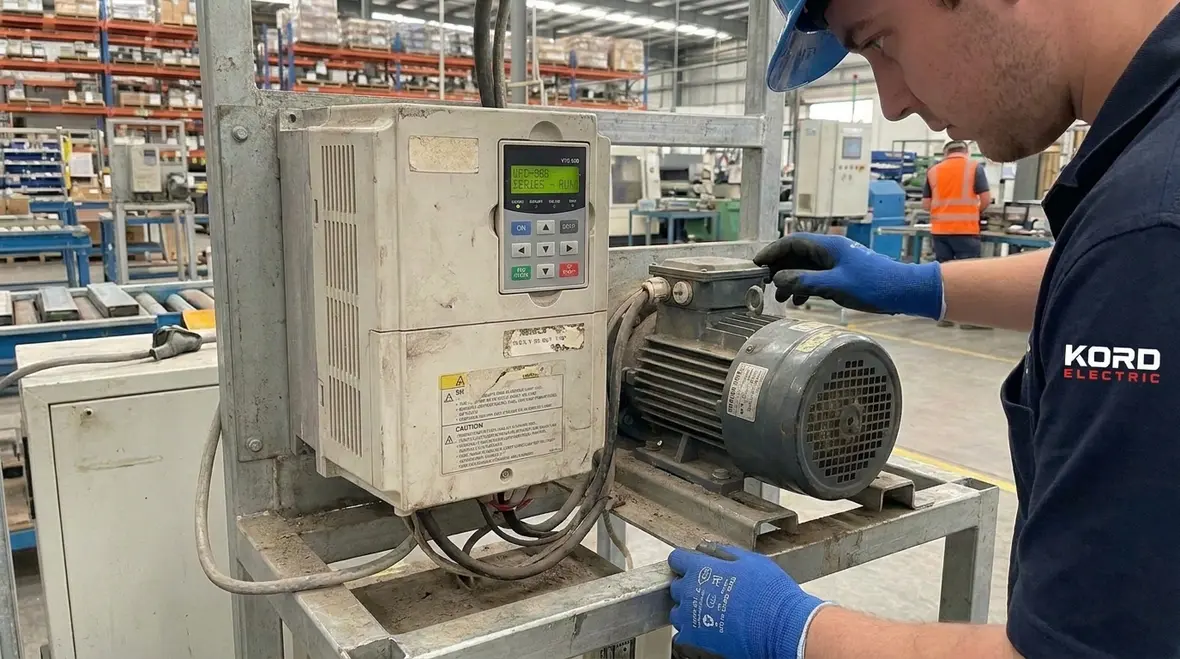
Motors and variable frequency drives control the heartbeat of many industrial processes. So when these assets stall, the entire operation feels it. However, technicians can narrow the cause quickly when they use a structured approach. Industrial Electrical Maintenance Troubleshooting Guide steps help teams avoid the common trap of replacing parts before testing.
For motor issues, we begin with mechanical and electrical separation. We check for phase imbalance, abnormal current, bearing noise, and alignment problems. Then we move into electrical verification: insulation resistance testing, motor lead checks, and confirmation of proper connection. For drives, we examine fault codes, input voltage quality, cooling performance, and output waveform stability. Transitioning between measurements and system behavior lets us confirm whether the fault sits in the drive, the motor, or the supply.
Also, we look for heat patterns. Thermal imaging can reveal hotspots at terminals, bus connections, or motor junction boxes. Because heat has a way of leaving clues, this step often turns a vague symptom into a direct repair scope. Our technicians walk the customer through findings as they go, using simple language and clear visual evidence.
Grounding, harmonics, and controls: the hidden causes people miss
When a facility experiences recurring faults, teams often blame the newest component on the shelf. Yet, grounding and power quality problems frequently remain the silent driver. Improper grounding can cause nuisance trips, control malfunctions, and erratic sensor behavior. Harmonics can overheat transformers and motors, and they can stress neutral conductors and sensitive electronics in control cabinets.
Therefore, we evaluate grounding continuity, bonding points, and connection integrity. We also assess wiring routes and cabinet practices because noise couples through poor layout. Next, we review load types such as VFDs, rectifiers, and large switching power supplies. In facilities with many non linear loads, a measurement plan should include voltage distortion and current harmonics, not just average voltage.
On the controls side, we verify signal integrity. That means we inspect wiring segregation, check for damaged insulation, and confirm that interlocks operate with correct timing. If a control circuit fails intermittently, it often connects back to loose terminals or moisture ingress. When our expert service staff explains the chain of evidence, decision makers see that the repair is not random. It is targeted.
Dual column checklist for safe electrical maintenance troubleshooting in the field
| What we verify | What it prevents |
|---|---|
Visual inspection of panels, glands, bus bars, and terminations |
Repeat failures caused by hidden heat and looseness |
Electrical measurements for voltage, current, phase balance, and insulation |
Misdiagnosis that leads to unnecessary parts |
Protection device checks including settings and trip behavior |
Nuisance downtime that disrupts production schedules |
Power quality review for harmonics and transient exposure when needed |
Overheating and equipment stress over time |
Documented repair verification with test results and final functional checks |
“It feels fixed” issues that return later |
Building a troubleshooting plan for commercial and industrial facilities
Even the best troubleshooting skills fail if the facility does not support the process. So we build plans that fit how real operations run. First, we coordinate with facility leadership to reduce risk during testing. Then we clarify which assets must stay online and which circuits can be safely isolated. After that, we define an evidence based workflow so technicians do not improvise under pressure.
At Kord Electric, our process often includes a short incident review and a longer preventive strategy. The short review focuses on the event timeline, alarms, and any recent changes to equipment or wiring. The preventive portion focuses on maintenance intervals, thermography trends, torque practices, and periodic insulation health checks where appropriate for that asset class. When teams follow these steps, they catch problems before the production line hears the sound of a breaker trip. For teams who want to explore how data and documentation support these efforts, Kord Electric’s article on data-driven electrical design for commercial and industrial facilities shows how design and maintenance work together over the life of the system.
And in case you are wondering, yes, we also respect downtime math. We plan tests so they produce results, not just paperwork. Our expert service staff keeps communication steady, so your operations team stays informed without drowning in jargon.
What to do when the fault returns after repair
When a fault returns, some facilities react like it is personal. Yet repeat failures usually reveal a gap in verification. For instance, the repair may have replaced a faulty component but did not address the cause, such as a loose connection, poor supply quality, or a wiring error that creates intermittent behavior. Therefore, the correct response is not faster replacement. The correct response is better proof.
Technicians should compare the new symptoms to the original incident. They should check whether the fault code matches, whether temperatures changed, and whether loading conditions align. Next, they should revisit upstream elements such as incoming power, protective coordination, grounding paths, and any new maintenance activity that could have introduced a wiring or torque mismatch.
We handle this with disciplined re evaluation. Our expert service staff explains what changed and what did not, and they document test results so the facility can make confident decisions. This is how commercial and industrial property teams avoid the “roundabout repair cycle” that drains budgets and morale. For common scenarios where issues repeat, the lessons from Kord Electric’s post on industrial electrical repair for common issues pair well with this Industrial Electrical Maintenance Troubleshooting Guide.
FAQ: Industrial electrical maintenance troubleshooting
Call Kord Electric for reliable troubleshooting and repair
If your commercial or industrial facility faces nuisance trips, motor slowdowns, overheating cabinets, or recurring control faults, do not guess. Call Kord Electric and let our technicians and expert service staff use an evidence based approach to find the real cause, verify the fix, and prevent repeat downtime. We plan work around your operation and communicate clearly, so you stay in control. Reach out now to schedule an on site assessment and get your electrical systems back to steady, safe performance.
For facilities across the region, Kord Electric also delivers broader Los Angeles County electrical services that coordinate industrial troubleshooting with upgrades, new installations, and preventive strategies. When you align this Industrial Electrical Maintenance Troubleshooting Guide with a trusted service partner, you gain a long-term plan instead of short-term fixes.
When you are ready to move from guesswork to proven troubleshooting, Kord Electric is ready to help you build a safer, more reliable electrical system across your commercial and industrial properties.


