
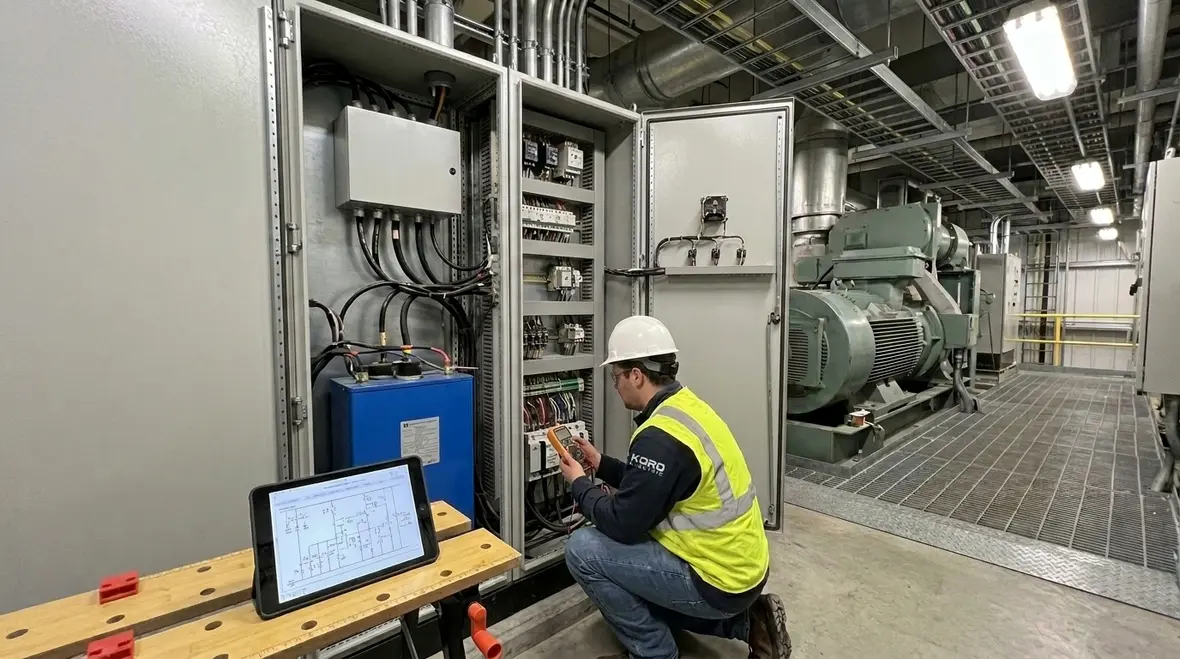
Industrial Power Factor Correction Saves Money
Why industrial power factor correction quietly saves money at Kord Electric
At Kord Electric, we see power bills rise in commercial and industrial facilities for reasons that feel invisible until you measure them. That is where industrial power factor correction steps in. When the electric system draws current with poor power factor, facilities waste energy, increase demand charges, and force equipment to work harder than it should. Then the utility asks for more money, and the plant or building managers wonder what happened. We do not guess. Our expert service staff and technicians check the electrical data, explain what they find in plain language, and recommend the right correction method so you can reduce losses and stabilize performance.
In other words, we fix the math behind the bill, not just the wires. And yes, that is less dramatic than a superhero origin story, but it pays better.

What power factor means inside a facility’s electrical system
Power factor describes how effectively electricity turns into useful work. In a steady, healthy system, current and voltage line up in a way that lets motors, transformers, and controls do their job efficiently. However, in real industrial settings, many loads behave like they “push back” on the current. Motors with varying speed, large compressors, welding equipment, and even certain HVAC configurations can add reactive power.
Reactive power does not perform useful work; it supports magnetic fields in inductive devices. Therefore, the utility still sees the system drawing current, and the facility still pays for that burden. As a result, operators may experience voltage dips, higher heating in cables and transformers, and reduced capacity headroom.
When our technicians review facility electrical schedules and meter readings, they translate the numbers into practical outcomes. For example, a low power factor often shows up as higher current flow and increased stress on electrical components. Then, the equipment runs hotter and consumes more system capacity. No one wants a transformer acting like it is auditioning for a smoke-filled drama series.

How reactive loads increase costs even when equipment runs “normally”
It is tempting to think that since the equipment runs, the electrical system must be fine. Yet reactive loads can quietly raise demand and losses. Then the bill reflects that hidden waste.
Several mechanisms drive the cost increase. First, higher current means more cable losses due to resistance. Second, transformer losses rise with load current and heat. Third, poor power factor often forces larger switchgear and bus systems to support current levels that do not add real output. Finally, some utility tariffs reward better power factor and apply penalties when it stays below a threshold.
In commercial and industrial facilities, these effects compound. A building may look stable during light load hours, but once processes ramp up, the system draws more reactive current. Consequently, the facility experiences peaks that push demand charges higher. Also, operators may notice performance complaints, such as inconsistent motor starts or nuisance alarms on drives.
Our expert service staff explains these cause and effect relationships without the fog machine. They compare your operating profiles with measured power factor and reactive power behavior. Then they identify when correction will help most, not just where it sounds good on paper.
Where power factor correction reduces demand, losses, and stress
Industrial power factor correction does not “create” new energy. Instead, it manages reactive power so the electrical system uses current more efficiently. When we add or control correction equipment, we help the current align better with voltage. As that happens, the facility typically sees lower current draw for the same useful load.
Lower current brings multiple benefits at once. For one, the system’s thermal stress drops, which can extend the life of transformers, motors, and breakers. Also, cable heating decreases, and that can reduce insulation aging. In addition, the utility may stop charging penalties, and demand charges can fall when the facility’s effective draw improves.
There is also a capacity benefit that many teams overlook. When reactive current falls, the electrical distribution system can deliver more real power within the same amp limits. Therefore, you gain usable capacity for growth, process upgrades, or future equipment additions.
However, correction needs to match your load behavior. Fixed capacitor banks can help with steady inductive loads, but many industrial sites have varying demand. So we often recommend solutions that adjust as loads change, which keeps correction accurate and avoids overcompensation.
Our approach to industrial energy savings: measure first, then correct
Commercial and industrial facilities do not all behave the same. One plant may run steady production for long stretches. Another may cycle equipment hourly, shift by shift, or seasonally. To deliver savings, we start with facts and then build a plan.
Our technicians collect electrical data such as power factor, voltage stability, harmonic presence, and load variation patterns. Then we evaluate the utility requirements and tariff thresholds. After that, we design a correction strategy that fits the facility’s actual operating profile.
When our team explains the plan, we do it in business casual terms, not textbook terms. We show how correction affects current, losses, and demand. Also, we help facility managers understand the maintenance expectations and how the system responds to load swings.
We sometimes hear the same joke from different clients: “We thought our bill was haunted.” Then we show the data, and the haunting turns out to be reactive power. Not spooky, just expensive.
In addition, we coordinate correction work with the facility’s power distribution plan, including switchgear and protective devices. We focus on safe integration, reliable operation, and clear documentation so your team can manage the system confidently.
Cost, incentives, and practical timelines for major properties
Facility leaders often ask what correction will cost and how quickly it pays back. While every site varies, the decision usually comes down to two things: how low your current power factor runs and how your utility structure charges you.
In our experience, the fastest savings appear when correction reduces penalty charges and demand peaks at the same time. However, some facilities also benefit from reduced losses that show up over time. Therefore, the best business case considers both near term billing impacts and longer term equipment stress reduction.
To support commercial and industrial decision makers, we also help teams think through electrical project budgeting in a clear way. You can find related guidance in our blog post about electrician costs for commercial facilities, including how teams should plan scope, timelines, and expectations before work begins. That article helps managers avoid surprises, and we apply the same mindset to power factor correction planning. For a deeper breakdown, you can review our post Electrician Cost LOS Guide for Commercial Facilities, which connects real world project scopes to long term operational savings.
As for timelines, correction work often depends on whether equipment needs to be installed in existing electrical rooms and how power shutdown windows are managed. Our staff coordinates scheduling carefully for major properties, aiming to reduce disruption while keeping safety and compliance front and center.
Realistic expectations: what power factor correction can and cannot do
Let’s set expectations calmly and clearly. Power factor correction improves efficiency by reducing reactive power effects, but it does not fix every electrical problem. If a facility has failing connections, undersized conductors, damaged motors, or control wiring issues, those faults can still drive performance and reliability concerns.
Also, correction must consider harmonics. In some industrial environments, non linear loads generate harmonics that interact with capacitor banks. That is why our technicians evaluate harmonic conditions before recommending correction hardware. In the right design, correction supports stable operation. In the wrong design, it can cause unwanted resonance or increased stress.
Furthermore, overcorrection can create leading power factor, which also brings risk. So the goal is not to chase a perfect number at all hours. The goal is to maintain a safe, efficient power factor range that matches your operational profile.
When our expert service staff explains the results, they focus on what you should expect next. You typically see changes in utility readings, demand behavior, and system temperature trends. Then you can validate the savings with billing review and on site measurements.
FAQ
Need measurable industrial energy savings from the right correction plan
Kord Electric helps commercial and industrial facilities reduce reactive power losses with safe, properly designed industrial power factor correction. Our technicians measure your system, explain the findings clearly, and recommend the best approach for your load patterns, harmonics, and utility requirements. If you want to cut waste from your next utility statement and protect your electrical equipment, contact us. We will review your data, outline a practical plan, and schedule work around your facility needs. Let us turn expensive math into real savings.
For multi-site portfolios and large properties across the region, our team also integrates industrial power factor correction with broader electrical strategies such as service upgrades, reliability improvements, and capacity planning. If you are coordinating improvements across Los Angeles County facilities, you can align these upgrades with our Los Angeles County electrical services to keep everything under one experienced provider.
When you are ready to see how much reactive power is hiding in your bill, our industrial specialists are ready to help you measure, plan, and implement the right mix of correction equipment and controls so the savings keep adding up long after the work is complete.


