
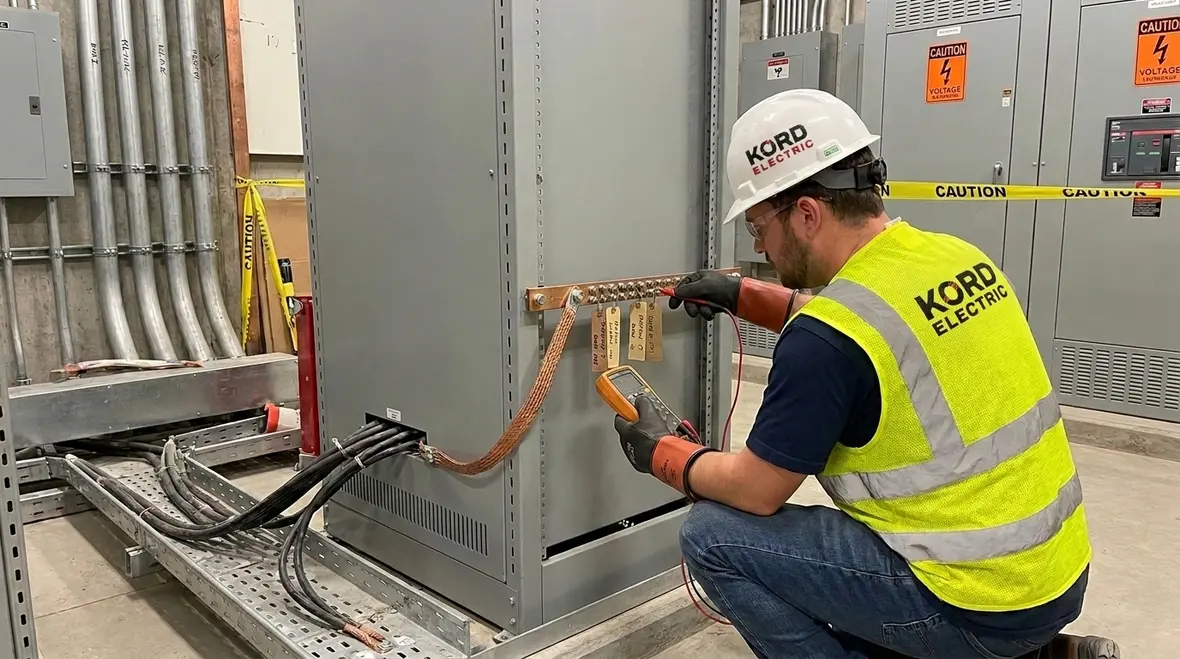
Kord Electric Explains NEC Communications Bonding 2 kV
When we talk about NEC communications bonding 2 kV, we mean the careful way people connect conductive parts so faults do not turn into fires, shock hazards, or equipment damage. In commercial and industrial facilities, communications systems ride alongside power systems, and that is where NFPA 70 Section 270.94 becomes practical and important. Our team at Kord Electric keeps this topic clear for facility managers, electrical contractors, and building owners, and we do it with real field experience, not textbook theater.
As our expert service staff explains it, 2 kV installations do not forgive loose connections. And yes, even when cables look fine from a distance, bonding and continuity checks decide whether the system behaves during a fault. Now we slow down, cover the intent of the rule, and show how we apply it on major property buildings.
What NFPA 70 270.94 actually aims to prevent
NFPA 70 Section 270.94 focuses on bonding communications at 2 kV installations, meaning it requires the communications system to share an approved electrical reference with other conductive parts when the installation involves 2 kV power circuits. This helps reduce dangerous touch voltage and limits the potential differences that can appear between metallic components during abnormal conditions.
In other words, we connect the “metal world” so it moves together. Without that, a fault can create a voltage gradient across building infrastructure. Then, people can get surprised in ways nobody wants, and sensitive equipment can suffer silent damage that later shows up as mysterious outages.
Our technicians often tell clients the rule is less about paperwork and more about behavior. Plus, behavior is something you can verify with a test, unlike a promise made over coffee.
Where the bonding applies in a real commercial and industrial building
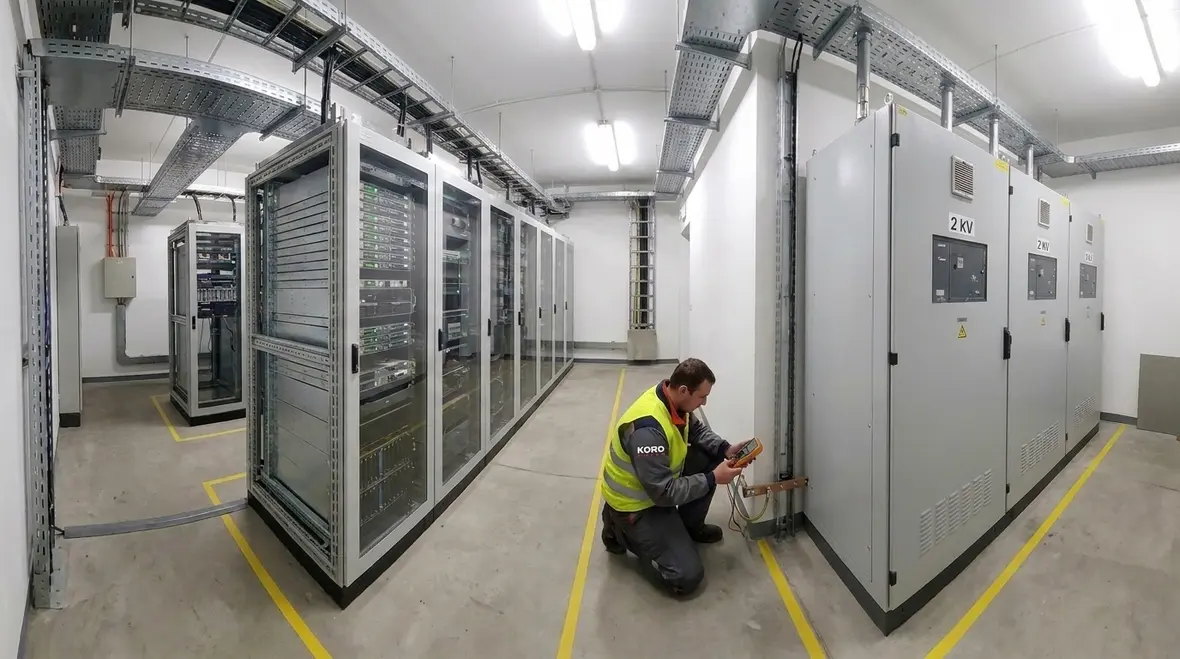
We apply these requirements when a facility includes 2 kV installations and communications wiring that falls within the scope of the NEC communication bonding rules. That usually means the communications system runs through areas that also involve 2 kV conductors, or the facility architecture brings conductive raceways, racks, backplates, and pathways into the same electrical environment.
For major property buildings, we see situations like these:
- Communications pathways that share spaces with 2 kV power distribution
- Metal raceways and enclosures that connect to building steel or other grounded structures
- Telecom rooms where equipment racks, cable trays, and metallic supports sit near power equipment
- Multiple grounding and bonding points that can accidentally create unintended current paths
Then we step back and coordinate. Before we install or modify bonding, we review equipment manuals, the electrical one line, and how the communications system routes physically. As a result, the bonding method fits both code intent and practical routing constraints.
How bonding works: equipotential, fault current paths, and control
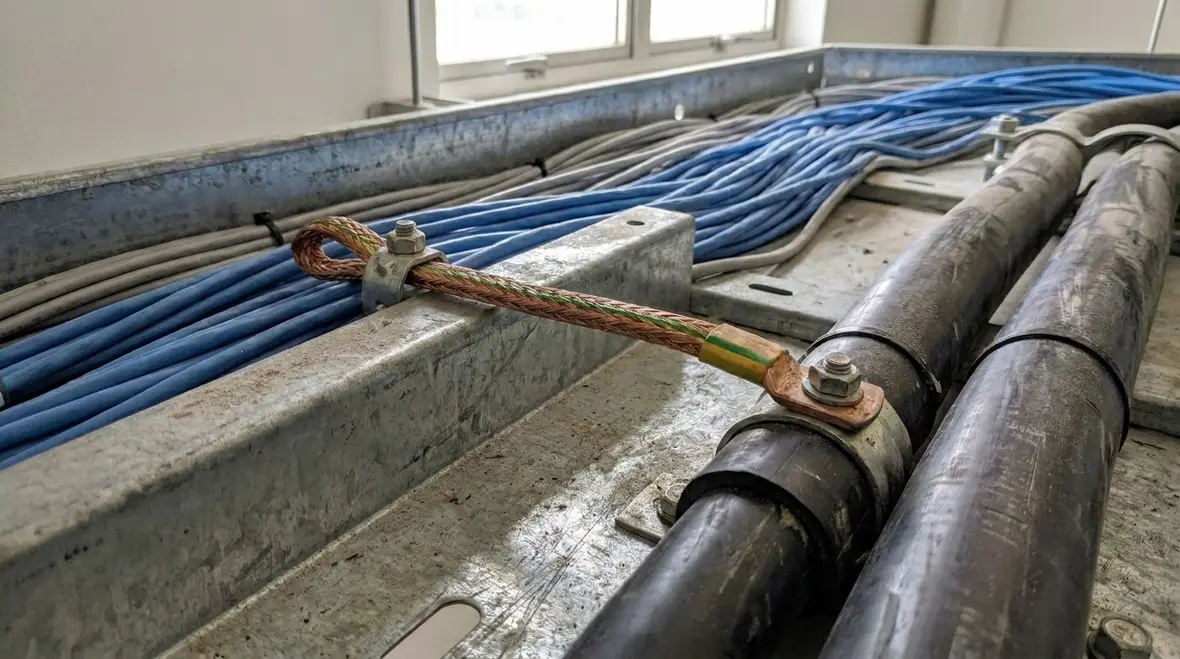
Bonding at NEC communications bonding 2 kV is not about making everything look shiny. Instead, we create equipotential bonding so conductive parts do not land at different voltages during fault conditions. That reduces shock risk and helps keep overcurrent protective devices operating within expected time and conditions.
When we perform bonding for communications systems, we also help limit interference. Even when the communications signal works during normal operation, a poor bonding scheme can increase noise during switching events. Therefore, a sound bonding plan can improve both safety and performance.
Our expert service staff typically explains it with a simple analogy. Power faults are like a sudden argument in the room. If metal parts share the same “rules of engagement,” the argument stays contained. If not, everyone gets involved, including equipment and, unfortunately, people.
To support that, we confirm continuity, connection integrity, and the correct bonding conductor sizing and terminations for the system. Then we document results so the facility team can maintain the system with confidence.

Installation details that make or break compliance
Even when a design looks correct on paper, installation details decide whether bonding actually works during a real event. We focus on the specifics that matter in the field, and we teach our technicians to slow down here because rushing causes the kind of defects that do not announce themselves until it is too late.
Key points we handle for communications bonding in 2 kV environments include:
- Using approved bonding jumpers and conductors that match the required method and ratings
- Securing terminations so connections stay tight and conductive over time
- Managing cable trays, metallic raceways, and supports with consistent bonding continuity
- Checking that metallic enclosures and equipment grounding points connect properly
- Verifying that connections survive vibration, thermal cycling, and maintenance activity
Moreover, we coordinate with the project schedule so bonding does not get treated like an afterthought. We plan the work with other trades, because an unfinished bond behind a wall is not a bonding solution, it is a future repair request. And in commercial settings, a “future repair” becomes a present headache, usually with an urgent call at the least convenient moment.

Testing and documentation for facility teams and inspectors
We help our clients prove that the bonding performs as intended. To do that, we use structured checks that verify continuity and connection quality at the communications bonding points related to the 2 kV environment. Then, we gather documentation that supports maintenance planning and helps during inspections.
Our process often includes these steps:
- Field verification of bonding locations against the design and cable tray and raceway layout
- Continuity checks on bonded metal components where communications cabling pathways connect
- Inspection of terminations for tightness, correct installation, and physical protection
- Review of grounding and bonding interfaces between communications and electrical systems
- Clear reporting so the facility team can manage ongoing maintenance
Then, we explain results in plain language. Our technicians do not talk down to facility staff, and they do not hide behind jargon. If something needs correction, we state it directly, because the goal is safe operation, not mystery.
Quick comparison: design intent versus common mistakes
To keep it practical for major property buildings, we summarize the difference between the rule’s intent and the failures we often see during troubleshooting.
| Design intent | Common mistake |
| Bond communications metal pathways to maintain equipotential conditions during faults | Rely on mechanical contact only, then skip the bonding jumper or fail to verify continuity |
| Ensure connections support fault behavior and safe device operation | Use improper termination methods that loosen after thermal cycling or maintenance |
| Provide predictable bonding interfaces between power and communications environments | Create unplanned voltage differences because bonding points connect inconsistently across sections |
How NEC communications bonding 2 kV fits into broader code understanding
Section 270.94 does not live alone. It fits into the broader structure of NFPA 70, where grounding and bonding aim to make electrical behavior more predictable, not more complicated. Facility teams that already study topics like overcurrent protection, selective coordination, and power quality often recognize that communications bonding at 2 kV is another way to tame surprises.
For teams that want a deeper dive into code concepts, our broader educational content about the National Electrical Code walks through how different articles connect. That bigger picture helps decision makers understand why communications bonding, equipment grounding, and raceway design are all chapters in the same safety story, not unrelated compliance chores.
When we review a facility, we do not treat communications bonding as a single line item. Instead, we look at how the communications infrastructure, power distribution, and protective devices interact. That is also why our technicians may recommend complementary upgrades, such as improving panel capacity, refining grounding electrode connections, or tightening raceway and tray bonding where it has been neglected over time.
Integrating bonding with wider electrical services in Los Angeles County
Because we work primarily with commercial and industrial facilities, we see communications bonding questions show up alongside many other electrical needs. A facility team may call about unpredictable outages, strange equipment resets, or inconsistent network performance. Once we investigate, we may find a mix of issues: aging panels, uncoordinated protection, under-sized neutrals, and bonding paths that do not reflect how the building is actually used today.
That is where our broader Los Angeles County electrical services come in. We provide code-conscious upgrades, troubleshooting, and maintenance for major property buildings, so communications bonding becomes part of a stable, well-documented power strategy instead of an isolated fix. By pairing Los Angeles County electrical services with focused NEC communications bonding 2 kV support, facility teams can tackle both immediate risk reduction and long term reliability in one coordinated plan.
In practice, that might mean we correct bonding in a telecom room while also reviewing panel loading, fault current availability, and coordination with life safety systems. When those elements line up, inspections run smoother, unplanned downtime drops, and the building behaves more like a quiet professional and less like a surprise factory.
FAQ: NFPA 70 bonding and communications at 2 kV
Choose Kord Electric for communications bonding in major facilities
At Kord Electric, we serve commercial and industrial facilities and major property buildings, and we handle NEC communications bonding 2 kV with the care it deserves. Our expert service staff explains the “why,” our technicians verify the “how,” and we document the “proof.” If you are planning a new build, upgrading a telecom pathway, or correcting an existing bonding plan, contact us. We will review your setup, recommend a safe approach, and help you avoid the kind of surprises that show up when everyone is already busy.
When your project needs more than isolated repairs, our team can also connect communications bonding improvements with broader power system design, data-driven electrical planning, and preventive maintenance. That way, your facility gains both immediate risk reduction and long term stability from a single, well-coordinated electrical strategy.
If your facility is in Los Angeles County or the surrounding region and you are ready to align bonding, grounding, and power distribution with how your building actually operates, our dedicated service offerings make the next step straightforward and calm. We work around active operations, coordinate with other trades, and keep communication clear so every stage—from planning to final testing—feels organized instead of rushed.
Explore how our broader support can help your facility stay compliant and predictable over the long term through our focused Los Angeles County electrical services for commercial and industrial properties, and then let us tailor a plan that fits your specific building, equipment, and communications infrastructure.
When you are ready to move from questions to clear action on NEC communications bonding 2 kV, Kord Electric is ready to help.


