
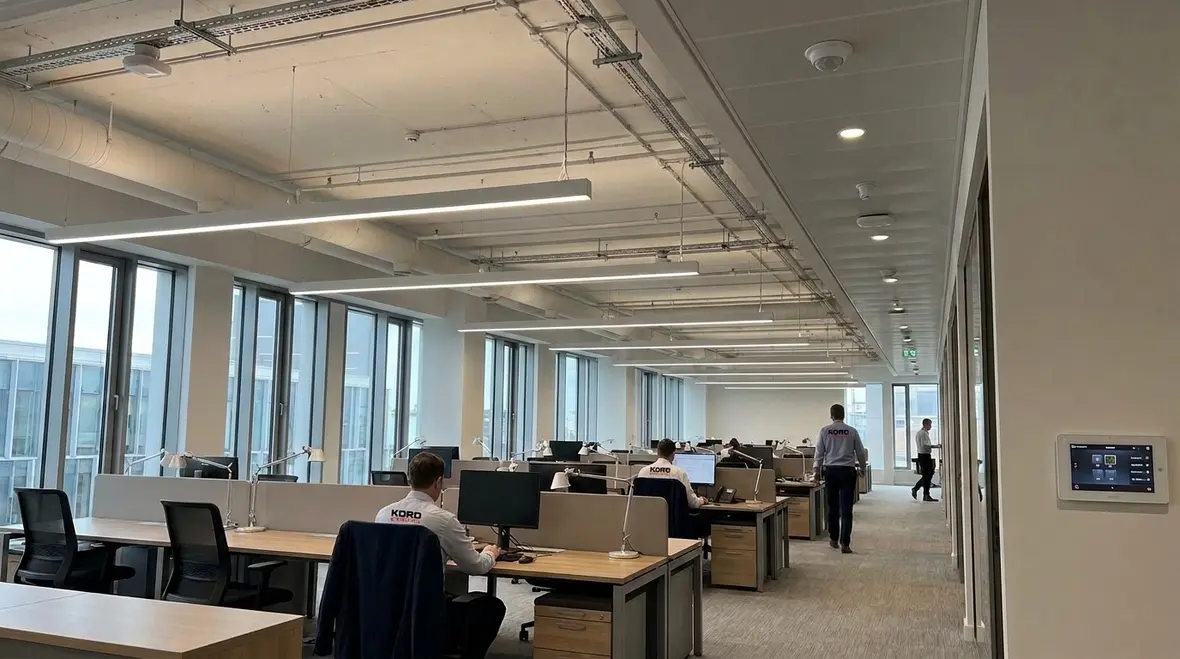
Lighting Requirements for Commercial Buildings: Codes & Best Practices
Lighting Requirements for Commercial Buildings: Codes & Best Practices you can trust
Commercial buildings do not get to “wing it” when it comes to lighting. That is why Kord Electric treats Lighting Requirements for Commercial Buildings: Codes & Best Practices as a systems issue, not a simple fixture swap. We guide owners and facility managers through the electrical, energy, and safety rules that shape how bright a space should be, where controls must go, and what levels of performance must be maintained over time. We do this with expert service staff and our licensed technicians, who explain the why as clearly as the what, so your project moves forward without surprises. And yes, we also remind people that “more light” is not always better light. Sometimes the best fix is the right design plus the right compliance details.
Below, we cover practical lighting requirements for commercial and industrial facilities and major property buildings, using code guidance that aligns with modern expectations for California and similar jurisdictions. For a deeper dive into statewide updates, many facility teams also review Kord Electric’s dedicated California Commercial Lighting Code Guide for 2026 alongside this overview so planning, design, and inspection expectations stay aligned.
Start with code goals, not just brightness

When others plan lighting, they often begin with lumens, then hope the rest works out. We recommend the opposite. First, we help you define the purpose of each area: offices need visual comfort and task clarity, warehouses need dependable coverage, parking and walkways need safety and security, and production floors need stable illumination that supports safe work.
From there, we connect your design to the code goals that inspectors and energy rules expect to see. In California, the 2026 energy code cycle and related lighting expectations push projects toward efficient technologies, proper controls, and measurable outcomes rather than guesswork. For example, your project may need to show how controls reduce energy use when spaces sit empty. Also, many spaces must include task and ambient strategies instead of dumping one big amount of light everywhere and calling it “uniform.” Uniform can be boring, but it also can be correct. The trick is to get the right uniformity where it matters.
Our technicians explain it like this: code wants predictable performance. So we design for it, document it, and test it during commissioning. That is how you avoid the classic situation where the lights look great on day one and then get dim, uneven, or noncompliant later. Nobody wants a “mood lighting” complaint from a tenant when what they really needed was a stable plan.
How the 2026 California commercial lighting guide affects your project
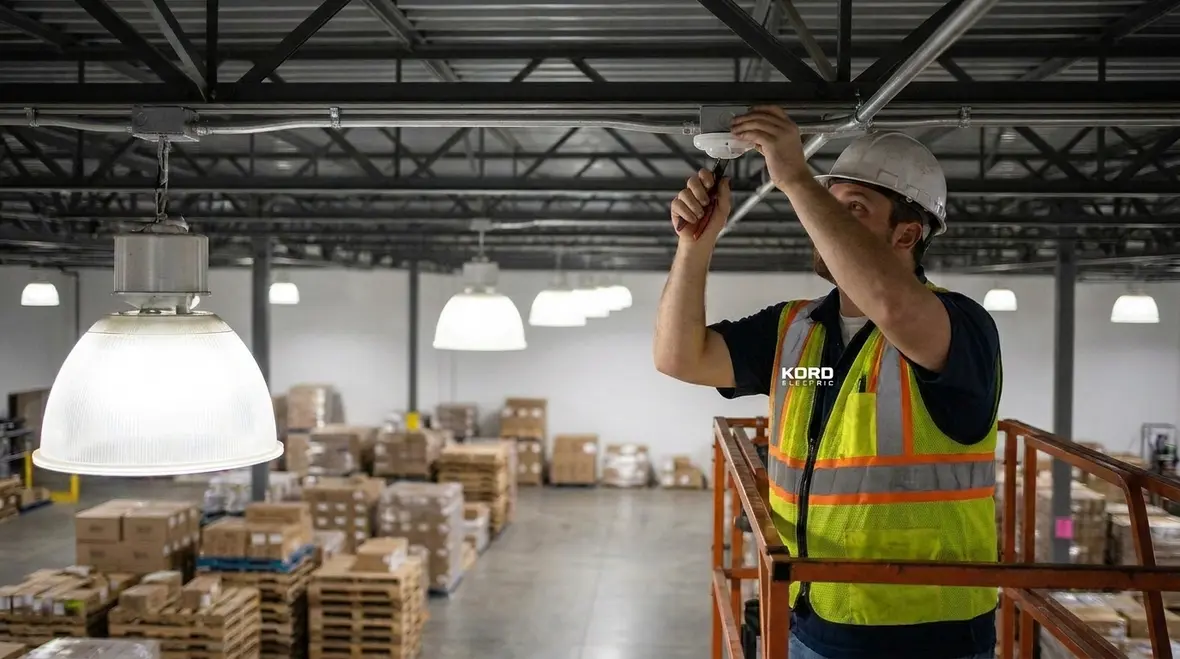
If your team follows the California Commercial Lighting Code Guide for 2026 approach, you get a structured path to compliance. Kord Electric uses that mindset to reduce risk for commercial and industrial facilities and major properties. We help teams translate requirements into actual field actions, such as control placement, lumen targets, fixture schedules, and documentation packages.
To move from the guide to your building, we focus on a few core areas that typically matter most:
- Controls: We plan occupancy sensing, scheduling, daylighting response where required, and automatic shutoff strategies.
- Energy efficiency: We select efficient lamps and drivers, then we verify that the design stays within allowed limits.
- Lighting zones: We break the building into control zones so the system can respond properly instead of acting like a single giant switch.
- Documentation: We support your compliance packet with accurate lighting layouts and system descriptions that match what gets installed.
And because reality loves surprises, we also plan for changes. Tenants expand, spaces change use, and schedules shift. Our expert service staff helps you think through how the lighting system can be adjusted without turning compliance into a scavenger hunt. Think of it as code that stays friendly even after the ribbon cutting.
Controls and zoning: the compliance engine behind comfort

Lighting systems in commercial and industrial spaces must do more than illuminate. They must respond to occupancy and daylight in a controlled, consistent way. That is where zoning and controls become the compliance engine.
In practice, Kord Electric helps teams design controls that match how people actually use spaces. For example, offices and conference rooms need different behavior than storage rooms. Warehouses often benefit from strategies that reduce energy use during low occupancy without causing glare or unsafe dimming. Hallways, restrooms, and loading areas need reliable operation, clear control logic, and proper coverage.
Our technicians explain the logic in plain terms, and we work through common scenarios:
- Occupancy sensors: We select correct sensor types and placement to avoid dead zones and false triggers.
- Scheduling: We align lighting schedules with building hours so the system reduces energy use when spaces remain empty.
- Daylight harvesting: Where applicable, we integrate daylight response so electric lighting steps down without creating a “flicker festival.”
- Dimmer compatibility: We verify that controls work smoothly with LED drivers and dimming levels so the system performs well over time.
Next, we document the intended control sequences. Inspectors and facility managers need clarity, not mystery. So while other teams might install hardware and hope someone explains it later, we train your staff during handoff and provide straightforward operational guidance. After all, the lights should not need a decoder ring.
Fixture placement and illumination quality that passes the real test
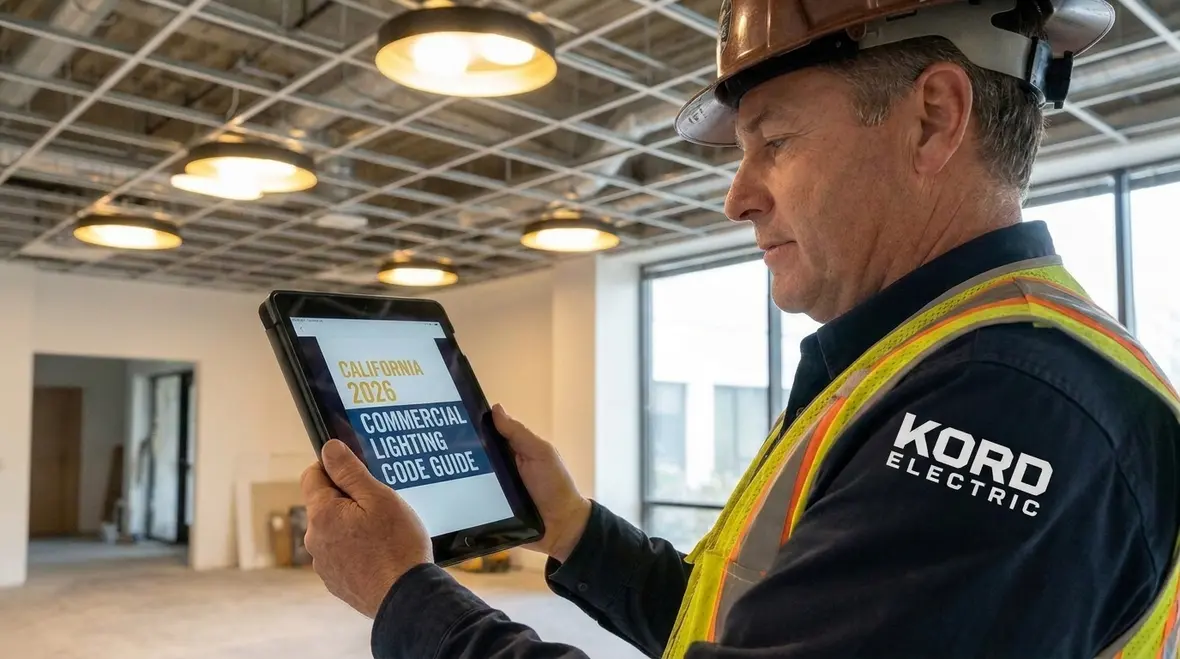
Codes do not just care about counts and wattage. They also care about performance in occupied areas. That means placement, aiming, mounting height, beam spread, and how the space looks when the lights turn on for real, not just in a software screenshot.
Kord Electric designs for illumination quality by focusing on three things: coverage, uniformity, and glare control. We coordinate these with your ceiling conditions, obstructions, and workflow. In industrial spaces, that can include columns, racking, mezzanines, and machine shadows. In commercial offices, it includes desk layouts, corridors, and areas where displays require careful attention.
Meanwhile, we also consider maintenance. LED lighting often reduces maintenance frequency, but the system still needs a plan. Dirt buildup, lens contamination, and ceiling changes can reduce output and increase unevenness. So we recommend practical maintenance steps and we select equipment with performance stability in mind.
To keep projects smooth, our expert service staff often walks stakeholders through expected results before install starts. We do this because a good plan prevents rework. And rework in commercial construction never feels like a fun surprise. It usually feels like someone ordered extra delays with a side of overtime.
Common commercial mistakes we help teams avoid
Even smart teams make errors when deadlines tighten and budgets get squeezed. So we build a checklist approach to prevent the most common failures we see in commercial and industrial lighting work. This also helps major property buildings avoid tenant downtime and inspection delays.
Here are several pitfalls we actively prevent:
- Adding fixtures without updating controls: A few new lights can break a zoning plan and lead to improper shutoff or incorrect sensor behavior.
- Ignoring control time delays and dimming steps: If controls snap too aggressively, occupants feel it. If they never fully shut off, energy compliance suffers.
- Choosing the wrong color temperature for the task: “White” is not always the same “good.” We match color and visual comfort to use cases.
- Overlooking mounting and ceiling constraints: A fixture that looks good on paper can fail coverage once real ceiling height and obstructions appear.
- Skipping commissioning and documentation: You need records that match what gets installed and tested.
Because we serve commercial, industrial, and major property buildings, our approach stays focused on operational reality. We do not treat lighting like a retail upgrade. Instead, we build a system that keeps working, keeps meeting expectations, and keeps your facility team from chasing problems at 6 a.m. on a Monday.
Dual column compliance checklist for facility teams
When facility leaders want fast clarity, we present requirements in a structured way. Below, our team uses a simple compliance and field action mapping so nothing gets missed. Many property managers also compare this checklist against resources like Kord Electric’s Commercial Lighting Compliance in California guide to keep day-to-day decisions aligned with statewide rules.
Compliance focus
- Lighting levels by space type and task
- Controls and scheduling logic
- Zone boundaries and occupancy coverage
- Energy efficient fixture and driver selection
- Commissioning and documented outcomes
Field actions
- Verify mounting heights and obstructions
- Confirm sensor placement and settings
- Test dimming response and shutoff
- Check fixture aimed performance and spacing
- Capture as-built layout and operation notes
As a result, your project moves through design to install with fewer gaps. And if your stakeholders want explanations in plain language, our expert service staff delivers them, step by step, until everyone understands what matters and why.
FAQ: Lighting requirements for commercial spaces
Call Kord Electric for dependable commercial lighting compliance
Lighting projects move faster when the design, controls, and documentation align from day one. Kord Electric supports commercial and industrial facilities and major property buildings with expert technicians and service staff who explain the process in plain language. If you are planning a new build, tenant improvement, retrofit, or compliance upgrade, we help you reduce risk, improve performance, and keep your lighting system steady long after install. For facilities in Southern California, our Los Angeles County electrical services team can also integrate lighting work with broader electrical upgrades so power, controls, and safety stay aligned across the whole site.
Reach out to us today to schedule a consultation and get a plan that holds up in the real world. Whether you are reviewing Lighting Requirements for Commercial Buildings: Codes & Best Practices for a single property or an entire portfolio, Kord Electric brings the same calm, code-focused mindset to every project.


