NEC Overcurrent Protection for Commercial Facilities
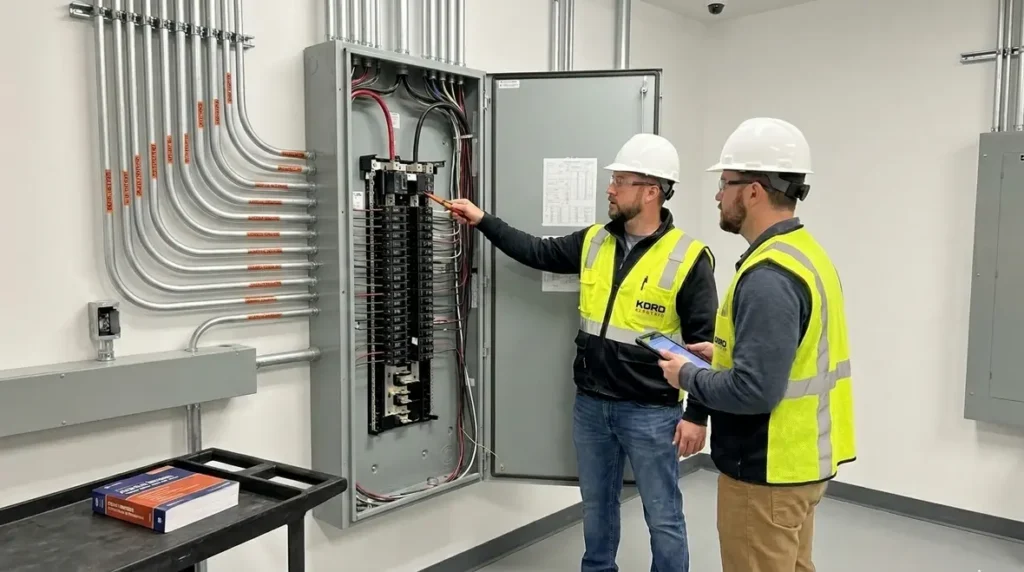
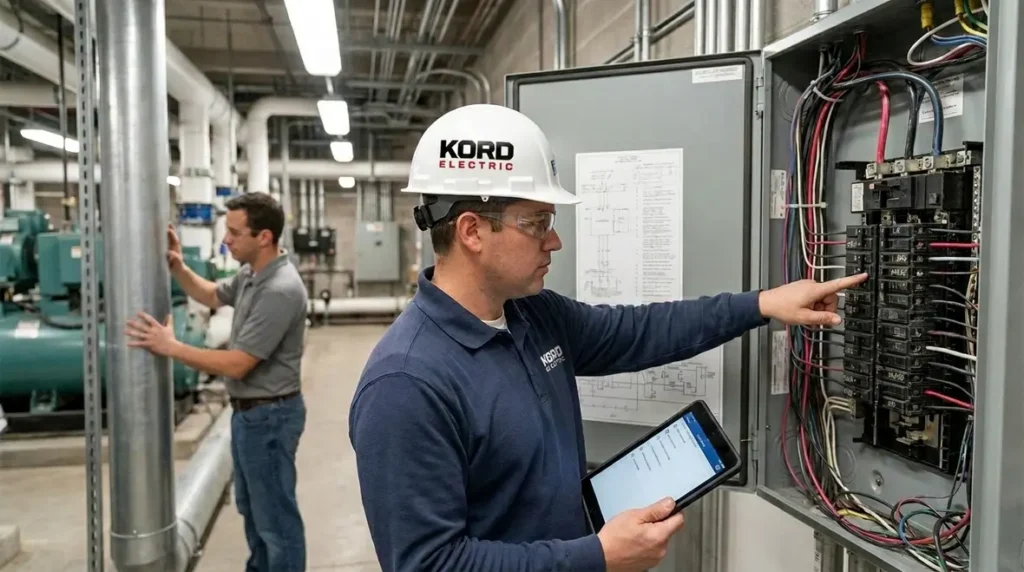
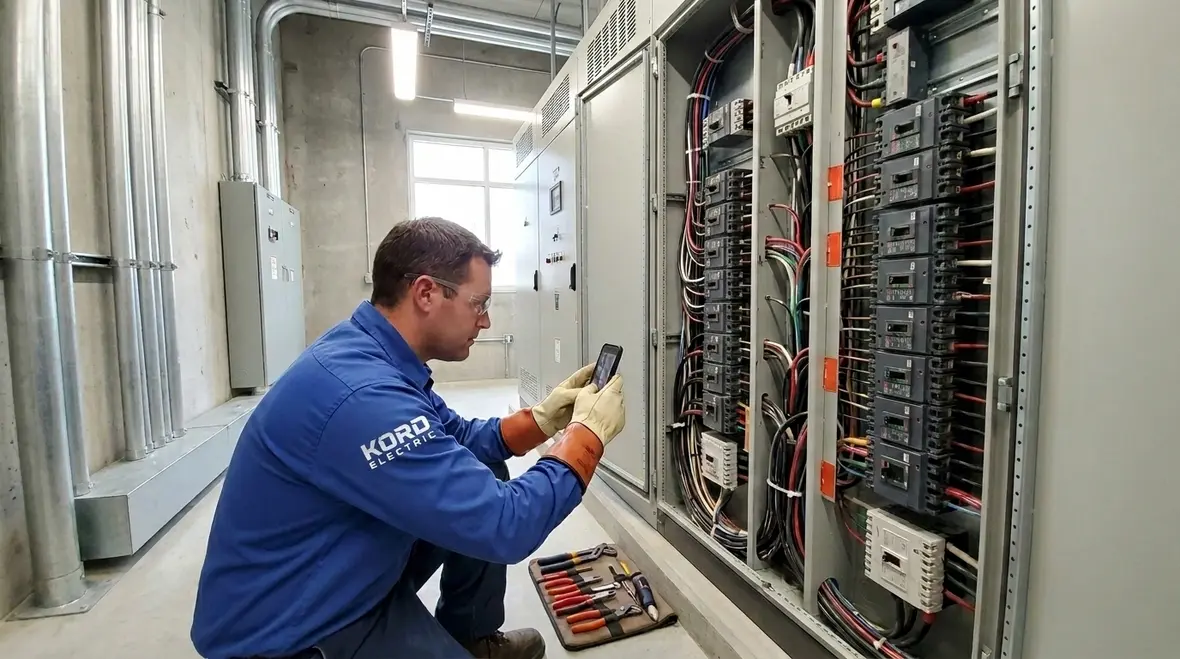
Kord Electric helps commercial and industrial facilities follow NEC overcurrent protection rules with clarity and real-world care. In this guide, we explain how the National Electrical Code treats overcurrent devices, why they exist, and what can go wrong when they are chosen or installed incorrectly. Then our expert service staff walks through how we verify protection coordination, conductor sizing, and protection limits so your systems stay safe and reliable.
Now, let’s be honest: overcurrent protection sounds like a boring topic. But once you see how it prevents fires, damaged equipment, and unexpected downtime, it stops being boring and starts being “thank you, past us.”
What the NEC expects for overcurrent protection in commercial buildings
The NEC sets clear rules because electrical systems fail in predictable ways. When current rises above safe levels, conductors heat up. Heating can damage insulation, soften terminations, and eventually start fires. Therefore, the NEC requires that wiring and equipment include NEC overcurrent protection so power gets interrupted before damage happens.
In commercial and industrial environments, the stakes rise. Loading changes. Motors start and stop often. UPS systems ride through events. And major property buildings have tenants, kitchens, HVAC plants, and long feeder runs that all demand reliable protection. As a result, the NEC focuses on coordination between conductors, overcurrent devices, and equipment ratings.
Our technicians and expert service staff often explain it this way: think of your overcurrent device as the bouncer. If the current is too high, it does not get invited back inside. If you pick the wrong bouncer, you get a fire, or at least a very expensive repair bill.
How conductors and device ratings work together
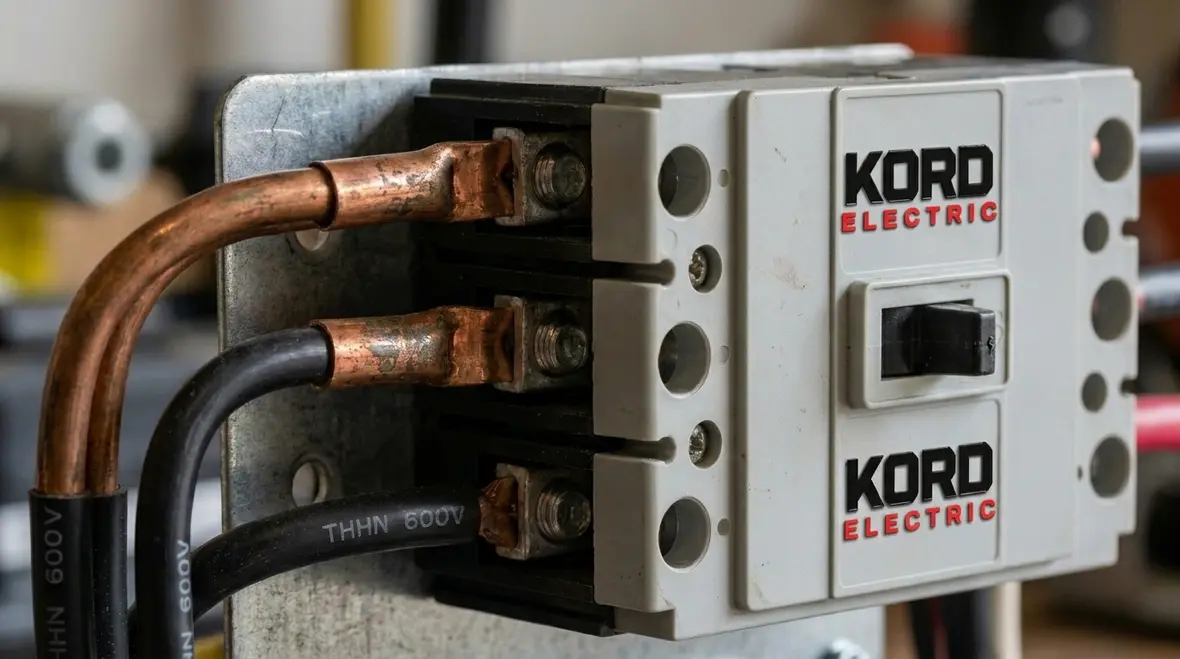
Overcurrent protection does not live in isolation. It only does its job when it matches the conductors feeding it. In practice, we look at insulation rating, allowable ampacity, and termination conditions. Then we verify the overcurrent device rating and its interrupting ability fit the system fault levels.
Next, we check the protection pathway from source to load. A feeder might use a different strategy than a branch circuit, and in larger facilities, you also see main and submain devices. Consequently, the NEC expects the conductor ampacity to handle normal load, while the device protects it during abnormal current.
When we do this for a warehouse, a hospital wing, or a multi tenant tower, we also pay attention to practical details. For example, a conductor can have the correct ampacity on paper but fail early if it is installed in a hot ambient area, grouped incorrectly, or terminated with a mismatch. So we verify the whole setup, not just the label.

Aligning ampacity, insulation, and installation conditions
Every conductor in your system has a story: what material it is made of, how it is insulated, and where it is installed. When we verify NEC overcurrent protection, we make sure those conditions align with the ampacity tables and installation rules, not just ideal lab scenarios. That means checking whether conductors run through hot mechanical rooms, crowded conduits, or long vertical shafts that change heat dissipation.
If the real-world installation pushes a conductor closer to its limits, we adjust device ratings, derate ampacity, or recommend changes so the system remains safe. That small adjustment today can prevent nuisance tripping, equipment damage, and surprise shutdowns a year from now.
Considering future expansion and load changes
Commercial and industrial facilities rarely stay frozen in time. Tenants expand, new equipment arrives, and temporary loads become permanent. When we review protection and conductor sizing, we look at the realistic future of the space, not just the current panel schedule.
For example, a facility planning major lighting upgrades or process equipment changes can benefit from aligning overcurrent devices with long term plans instead of doing quick, one-off fixes. That approach pairs well with structured preventive maintenance programs that keep systems reliable year after year, especially in properties that already rely on electrical preventive maintenance to protect critical infrastructure.
Device types and where each one fits
Overcurrent protection includes several device families, and the NEC uses different rules for each. Breakers often protect larger circuits and feeders. Fuses can protect where they provide precise characteristics. Disconnecting means can also serve as protection depending on the design and ratings.
So how do we choose? Our technicians focus on the application. For motors, we consider starting current and locked rotor behavior. For lighting and receptacles, we consider steady loads and surge effects. For data spaces and specialty loads, we consider coordination with upstream devices so one device does not “nuisance trip” while another device fails to clear in time.
Additionally, we evaluate whether a system needs selective coordination. That means one upstream device should not trip when a downstream fault occurs if the design can avoid it. In business terms, it means less downtime and fewer calls after hours. In human terms, it means your facilities team does not have to sprint through the building like it is the final episode of a superhero show.

Breakers, fuses, and disconnects in commercial systems
In many commercial systems, molded case circuit breakers handle core distribution. They provide adjustable trip settings in some cases, allowing fine-tuning of time-current curves. Fuses, on the other hand, can deliver very fast response for specific fault conditions or sensitive equipment protection.
Disconnects sometimes include integrated overcurrent protection, and other times they serve as isolation devices while breakers or fuses carry the protection role. Matching these options to the right equipment—motors, HVAC, lighting, data racks, or specialized kitchen loads—keeps the system efficient without sacrificing safety.
Specialty loads, harmonics, and sensitive equipment
Modern facilities rely on variable frequency drives, UPS systems, and electronic ballasts that change how current flows. Those devices can introduce harmonics, different fault signatures, and unique coordination needs. When we design or review NEC overcurrent protection around them, we consider manufacturer recommendations, code requirements, and how upstream equipment behaves during both normal operation and faults.
That becomes especially important in environments like data centers and technology-heavy spaces, where uptime and clean power are non-negotiable. Protection must respond quickly enough to stop damage while avoiding unnecessary trips that interrupt operations.
Fault current, interrupting rating, and why “it fits” is not enough
In commercial and industrial electrical rooms, fault current levels can be high. Therefore, the NEC requires devices to have sufficient interrupting rating for the available fault current at the point of installation. In plain language, the device must be able to stop the current without exploding, melting, or degrading.
That is where many projects get sloppy. People size the breaker by ampacity, and they stop there. Yet interrupting rating depends on the upstream system, transformer size, conductor impedance, and utility characteristics. As a result, a breaker that looks correct can still be unsafe if it cannot clear the fault.
We handle this by confirming available fault current and matching it to device interrupting capability. Then we document the basis for the selections. Our expert service staff also explains it step by step to help the facility owner and maintenance team understand what they are buying and why it matters.
Available fault current is a moving target
Available fault current does not spring from a single number on a drawing. It shifts based on transformer upgrades, utility changes, new feeders, and even additional onsite generation. That is why periodic studies—and updates to labels and documentation—matter in facilities that continue to grow or modernize.
When we revisit a site for upgrades, we do more than add a breaker and call it a day. We review how the new work affects upstream and downstream devices, whether existing interrupting ratings still make sense, and how to keep the system compliant without overcomplicating maintenance.
Documenting the logic behind device selection
A well-documented protection plan becomes a roadmap for future teams. We capture why specific breakers, fuses, or settings were chosen, what fault calculations supported them, and how they coordinate with neighboring equipment. That documentation helps during audits, insurance reviews, and future service calls—especially when paired with broader electrical maintenance plans that keep panels, switchgear, and protective devices in top condition.
Coordination: fast enough for safety, slow enough to avoid chaos
Coordination means devices clear faults at the right speed, in the right order, for the right reason. The NEC overcurrent protection requirements push designers to think about how a downstream device clears first, while upstream devices remain ready for other parts of the system.
For example, a main breaker may have a long time curve while a feeder breaker operates faster. If the downstream device clears a fault in time, the upstream device stays closed. If it does not, then everything trips and the whole floor goes dark. That is not “protecting the system.” That is “punishing everyone equally.”
When we coordinate protection in major property buildings, we also consider equipment damage limits. Some loads can tolerate brief disturbances but not repeated trips. Others demand tighter protection because of sensitive electronics. Therefore, our technicians review curves, adjust settings where applicable, and verify the design logic so the system clears in a predictable way.
We also coordinate with practical maintenance. If the facility team needs to test or troubleshoot, the design should make sense. So we keep the labeling clear, the documentation complete, and the protective device arrangement understandable without requiring a weekend in electrical nerd territory.

Balancing safety, uptime, and serviceability
Perfect coordination on paper is not the only goal. We also look at how a real maintenance team will live with the system. Can they safely isolate equipment? Do they understand which device should trip in common fault scenarios? Are settings locked away behind software, or clearly noted where authorized staff can reference them?
By treating coordination as both an engineering and operations conversation, we help facilities avoid the trap of “mystery trips” that no one can trace. Instead, they get a protection plan that behaves in a consistent, explainable way—something maintenance teams appreciate when every minute of downtime is visible to the entire organization.
Special cases in industrial and high load facilities
Industrial and large commercial buildings face special challenges that basic residential rules never fully cover. Motor circuits, generators, paralleling loads, variable frequency drives, and temporary construction power all change how current behaves during faults and starts.
For motor circuits, the NEC includes approaches that account for starting current and protection of conductors feeding motors. Therefore, we verify overload protection where required, select devices that handle starting characteristics, and ensure the protection remains reliable under worst case conditions.
For facilities with generators or UPS systems, the current available during a fault can differ based on operating mode. That means interrupting rating and coordination logic need careful review. Then for facilities with large HVAC plants, kitchen power, and charging areas, we account for load diversity and system harmonics where they apply.
Our expert service staff often tells clients that these projects feel like juggling while someone else changes the rules midair. Yet we bring a steady method: we review the single line diagram, confirm equipment ratings, verify conductor sizes, check device capabilities, and document the protection plan so your system does what it is supposed to do.
Motor loads, HVAC plants, and process equipment
High inrush currents from large motors or chiller plants can confuse poorly selected protection. Devices may trip during normal starts or, worse, fail to clear when a motor stalls. We assess these circuits with an eye on both NEC rules and real-world operating patterns, shaping protection that respects starting needs without leaving conductors and equipment exposed.
That same mindset applies in commercial kitchens, manufacturing lines, and other process-heavy spaces, where even brief outages can throw off workflows. Protection must distinguish between healthy surges and true faults, keeping power available where it belongs and cutting it off only when necessary.
Onsite generation, UPS systems, and parallel sources
When generators, UPS systems, or parallel feeds enter the picture, fault current paths and magnitudes change. A system may see one set of conditions on utility power and another when running on backup or in islanded modes. We adjust NEC overcurrent protection strategies to account for those scenarios so devices still clear correctly no matter which source is active.
That level of attention supports facilities that depend on continuous operation, including those already investing in structured maintenance plans and voltage stability improvements to protect sensitive equipment and long-run processes.
How Kord Electric verifies compliance and safety
Kord Electric works with commercial and industrial facilities that need dependable electrical systems, not guesswork. We evaluate NEC overcurrent protection as part of a full design and field verification process.
First, our technicians review the electrical one line and load details. Next, we compare conductor ampacity and device ratings against the NEC requirements and equipment listings. Then we confirm interrupting ratings using available fault current data. Finally, we evaluate coordination so downstream faults clear without turning the entire facility into a dark comedy.
We also communicate clearly. Before anything gets installed or modified, our expert service staff explains what we are doing and why. As a result, facility managers and maintenance teams can make informed decisions and avoid surprises during startup, commissioning, or audits.
And yes, sometimes we use jokes. Not because this is a stand-up set, but because when people feel relaxed, they absorb information better. If that joke saves time during commissioning, everyone wins. That includes the facility, and honestly, the breaker.
Integrating protection into broader maintenance and upgrade plans
Protection is most effective when it is not treated as a one-time checkbox. We encourage facilities to connect their NEC overcurrent protection strategy with ongoing electrical preventive maintenance, periodic testing, and planned upgrades. That can include thermal imaging, torque checks, cleaning, and targeted studies that confirm devices still operate within their intended ranges.
For properties that already rely on structured commercial and industrial electrical maintenance plans, this approach weaves protection into everyday reliability work instead of isolating it as a separate project that gathers dust in a binder.
FAQ
Take action with Kord Electric
If your facility needs safer protection, better coordination, and clearer compliance, Kord Electric is ready. We help commercial and industrial buildings review designs, verify ratings, and confirm that your overcurrent devices clear faults correctly without unnecessary downtime. Our technicians and expert service staff explain the process in plain language, so your team understands the “why” and not just the “what.” Contact Kord Electric today for an assessment, and let’s keep your electrical system calm, reliable, and boring in the best way.
When you are ready to move from theory to action, pairing a focused review of NEC overcurrent protection with a broader electrical preventive maintenance program helps protect your investment. From panels and feeders to specialty loads and future EV charging infrastructure, a coordinated plan keeps your system aligned with code, operations, and long-term reliability goals.
Kord Electric supports commercial and industrial clients across Southern California with services that extend beyond protection studies, including structured electrical preventive maintenance programs and fast-response emergency electrical services when the unexpected happens. That combination of planning and rapid support gives facilities a practical path to safer, more resilient power systems.
If your next project involves major distribution upgrades, new process loads, or a deeper look at existing systems, our team can also help align overcurrent protection with related upgrades like lighting, power quality improvements, and long-term maintenance planning.