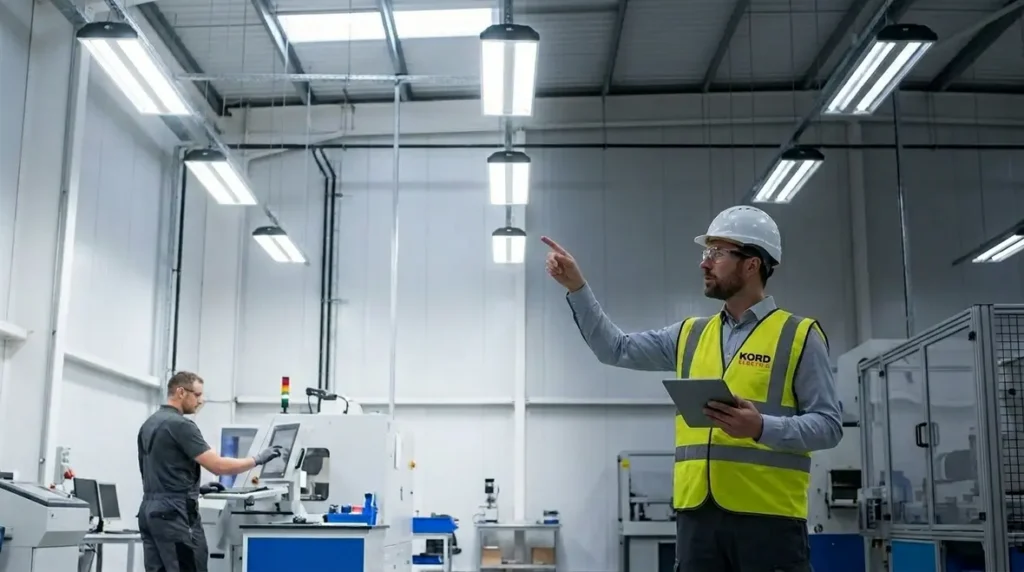
Smart Lighting Controls for Commercial Buildings
Kord Electric helps commercial and industrial buildings get steadier energy use and better comfort through smart building lighting integration benefits. When a facility uses smart controls, it does not just swap bulbs and call it a day. Instead, we align light levels with how spaces get used, we reduce waste, and we support safer operations across offices, warehouses, lobbies, and retail back-of-house areas. Meanwhile, our technicians and expert service staff walk through the system design with calm clarity, so the people running the building understand what changes were made and why they matter. Then, once the controls are in place, the performance keeps improving as schedules and sensors learn the building’s real patterns. In short, smart lighting controls turn “lights on” into “lights right,” and that is a business outcome, not a science fair project.
How smart lighting controls improve commercial building performance
Commercial and industrial facilities often run on habits, not data. Lights stay on because someone planned a schedule once, years ago, and nobody wants to touch it now. However, smart lighting controls remove that guesswork. When our team installs occupancy sensors, daylight dimming, and programmable schedules, the lighting system responds to real use patterns. As a result, the building delivers the right light at the right time, without over-illumination during empty hours.
Over time, that changes the building’s performance in three practical ways. First, electricity use drops because the system dims or turns off where and when it should. Second, the space feels more consistent to the people inside it, since light levels adjust smoothly rather than snapping on and off like an overcaffeinated alarm clock. Third, the building management team gains visibility, because control settings and events can be reviewed and improved.

Energy savings and demand control that actually shows up on bills
Facilities may talk about energy savings, yet they often measure it like it is a rumor. Smart systems let you track changes with more confidence. For example, occupancy sensors can reduce lighting in areas that rarely get full use. Daylight harvesting can dim electric lighting when sun levels rise. Then, after-hours schedules can ensure lights do not stay active during low-traffic periods.
When Kord Electric designs a system, we think about demand as well as energy. Demand charges can hit hard for commercial operations. Therefore, we aim to reduce peak loads where possible, especially in large zones like loading areas, parking-adjacent spaces, and wide open floor plans. Instead of treating lighting as one big switch, we treat it as a set of controllable loads.
And yes, it takes some setup. But it beats the “turn everything to max because we might need it” approach. That strategy is popular in boardrooms for about five minutes, and then reality shows up with the monthly statement.

Comfort, safety, and productivity across office and industrial spaces
Smart lighting controls can support comfort and safety, even in spaces with demanding requirements. In offices, consistent illumination supports focus and reduces the “why is this corner always darker” complaints. In manufacturing, better light distribution and stable control reduce visibility issues that can slow work or increase the chance of mistakes.
Importantly, controls can help with safer operations. For instance, occupancy-based lighting can ensure areas receive light when people enter. Meanwhile, emergency lighting integration and local code requirements can be supported through proper design and testing. Our technicians and expert service staff explain these points plainly, because smart controls should not arrive as a mystery box.
Additionally, organizations can reduce disruptions. When lighting transitions are handled smoothly, staff do not feel like the building is “mood lighting” their shift. Instead, the space performs like a dependable tool.
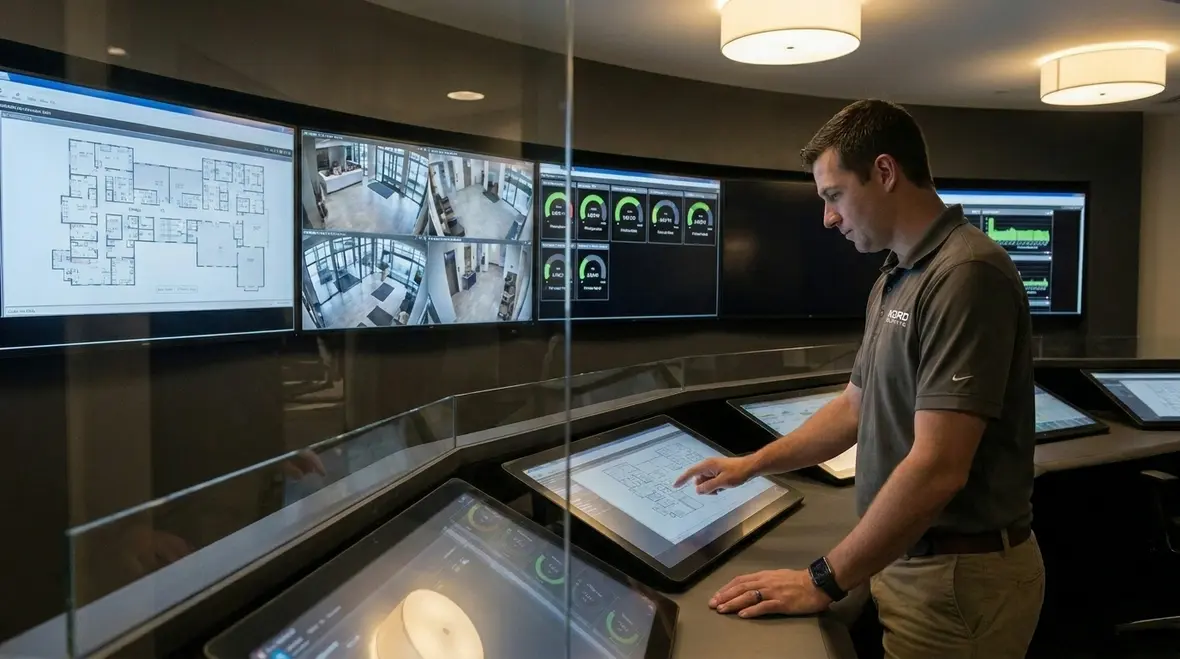
Integration with building systems and why it matters
Smart lighting rarely performs at its best when it stands alone. Therefore, facilities should integrate lighting controls with building management and power monitoring where possible. When we coordinate controls with HVAC scheduling, access schedules, and other building automation systems, the whole facility runs more like one system rather than a pile of separate ones.
This also improves operational decisions. If a building manager can see occupancy trends and correlate them with lighting performance, they can adjust setpoints and schedules. Over time, the system stops guessing and starts optimizing.
Our service approach also helps reduce project friction. We plan zoning carefully, we document control logic, and we train staff so the building team can operate the system with confidence. As a result, the controls stay aligned with how the building runs, not how it used to run.
Electrical planning, rewiring risks, and cost-smart decisions
Smart lighting controls depend on the right electrical setup. Some projects require panel adjustments, new control wiring, or revisions to existing circuits. That is where planning saves money and time. If a facility expects smart control without checking the electrical backbone, it can run into expensive surprises.
Kord Electric follows a cost-aware process for commercial electrical systems, and we often reference our rewiring cost guide for commercial electrical systems when teams start estimating scope. That guide breaks down how rework cost can change based on electrical condition, access needs, and system complexity. In other words, the price tag can vary a lot depending on what is already installed. Therefore, early site assessment matters more than people think.
When our technicians review a facility, they also check for practical risks. For example, older lighting circuits may use wiring paths that make adding control components more difficult. However, we can often plan routes and zones so that installation stays clean and minimizes downtime. Then, we can recommend upgrades that improve long-term reliability instead of patching problems.
In short, smart lighting controls bring value, but only if the electrical plan supports them. We treat the work like an investment, not a last-minute scramble.
Implementation strategy: zoning, controls, and commissioning that stick
Even the best smart controls fail if installation and commissioning are sloppy. We build a practical plan that starts with zoning. Then, we define which areas need occupancy control, which zones benefit from daylight dimming, and where scheduled overrides should exist. After that, we verify sensor placement, test responsiveness, and confirm that time schedules match how the building actually operates.
Commissioning matters because it turns “it works” into “it works the way we want.” For example, if sensors face a bright window and trigger false occupancy, the building will waste energy and frustrate occupants. However, if we adjust sensor angles, spacing, and sensitivity, the system behaves reliably.
We also plan for change. Commercial and industrial spaces evolve. A warehouse layout shifts. Office teams move. Production hours expand. Therefore, smart controls should allow updates without a full rebuild. Our expert service staff explains how to adjust schedules, review control logs, and keep performance aligned with new operations.
And yes, sometimes a building tries to treat the lighting dashboard like a video game. We support the system, not the button-mashing fantasy.
Real world performance metrics to track after installation
Facilities should not judge success by feeling. Instead, they should measure outcomes. Kord Electric encourages teams to track a few key metrics after rollout of smart building lighting integration benefits. These metrics help confirm that savings and performance goals hold steady.
Consider tracking these items on an ongoing basis. First, monitor lighting run time by zone, since control systems can show how long each area stays active. Second, review occupancy events and compare them with actual foot traffic. Third, track daylight contribution in zones near windows, because daylight dimming should reduce electric lighting during bright periods.
Then, verify energy use changes against baseline. If a building adds staff or changes production schedules, you should adjust expectations. Still, the control system should prevent unnecessary lighting during low occupancy and reduce time at peak output.
Finally, capture maintenance impact. Smart controls can reduce lamp and driver wear by reducing hours, especially in spaces that previously ran too long. As a result, maintenance cycles can become more predictable.
Smart lighting FAQ for commercial and industrial facilities
Conclusion: let smart controls lift performance across your facility
If a commercial or industrial building wants lighting that performs like a well-run operation, smart lighting controls are the path. At Kord Electric, we design zoning, integrate controls with real building needs, and help your team understand the system through clear training from our technicians and expert service staff. Then, we commission and support the setup so it stays reliable as your operations change. Reach out today to schedule an assessment for your facility and get a smart lighting plan that fits your electrical reality and your performance goals.
For facilities planning broader upgrades, pairing smart lighting controls with dedicated commercial and industrial lighting installation services creates a stronger foundation for long-term efficiency, safety, and code-compliant performance across your entire property.