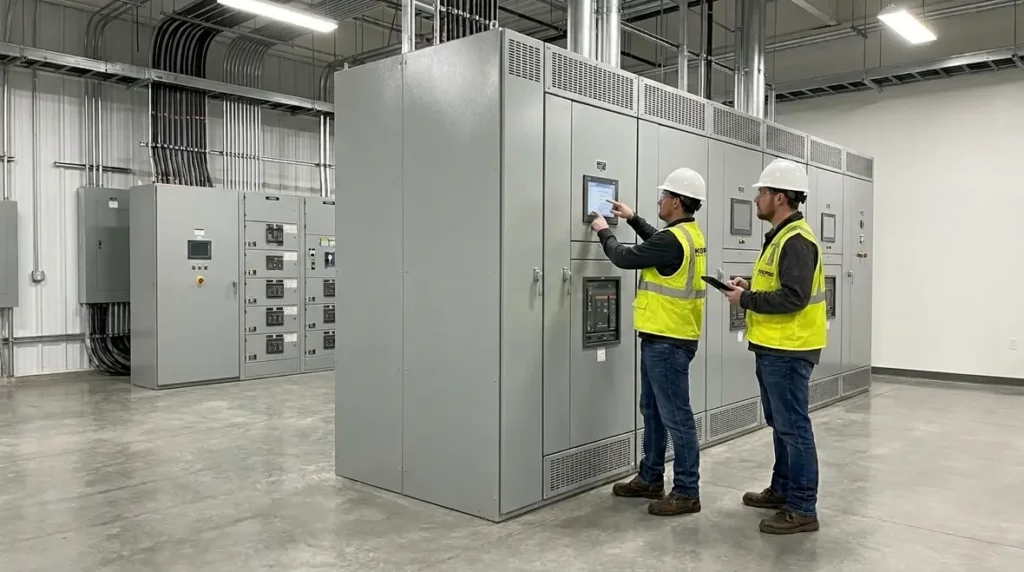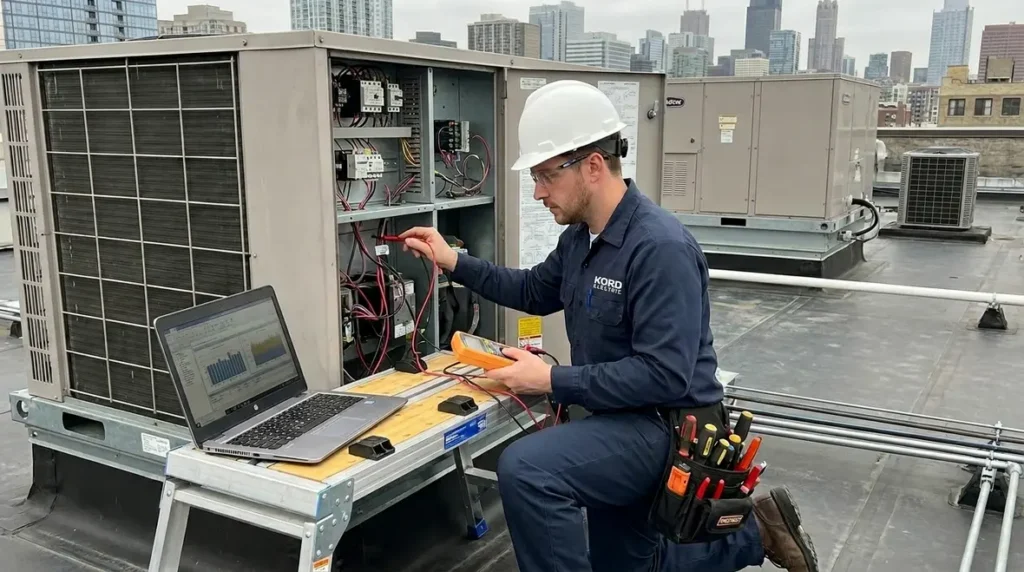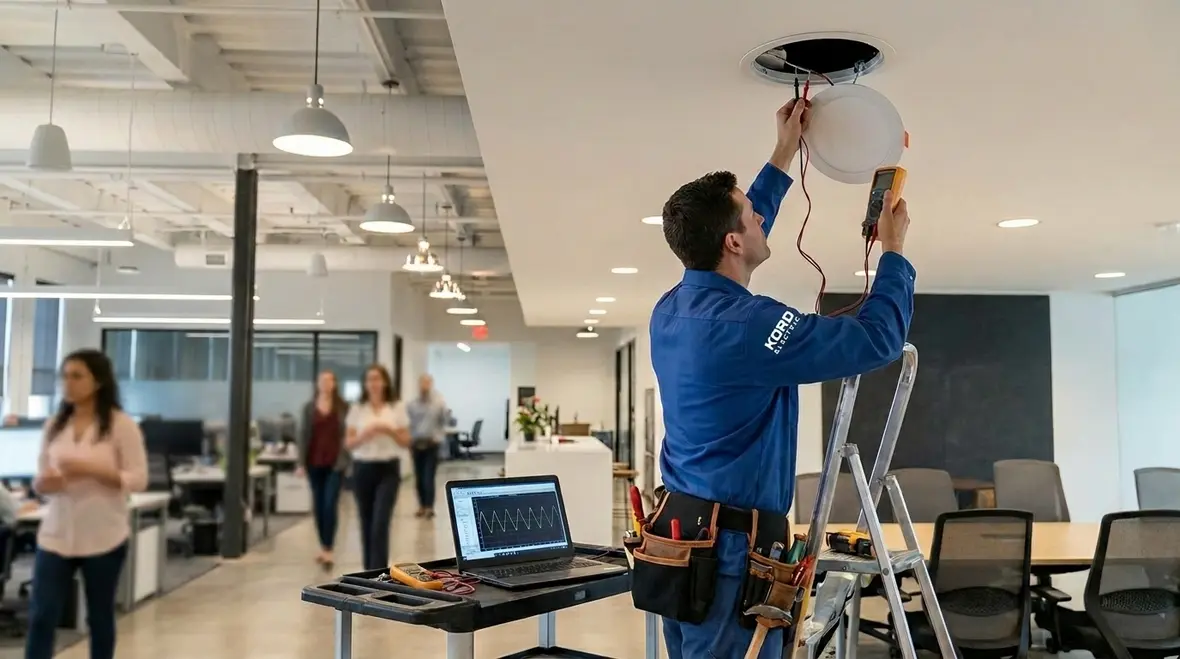
Troubleshooting Flickering Commercial Lights Fast
In commercial spaces, troubleshooting flickering commercial lights is rarely a “wait and see” problem. We have seen it start as a mild annoyance in a lobby and end as a complaint that makes tenants feel like the building is haunted by a bad electrician. When lights pulse, dim, or strobe, it can point to wiring issues, power quality problems, or failing components. However, the fix depends on what is actually happening and where the fluctuation begins. That is why Kord Electric treats the first steps like a calm diagnostic, not a guess-and-check routine. Our technicians move through a structured process so the team on site spends less time in the dark and more time running the business.
Flickering lights in commercial buildings: what causes it and what to do first
In commercial environments, flicker is not just annoying — it is data. It is your building’s way of saying something in the electrical system is not steady. Some problems are mild and local. Others are the first early sign of a larger issue that could affect more circuits, sensitive equipment, or safety systems.
Treating flicker seriously from the start helps facilities avoid two extremes: overreacting and replacing every fixture in sight, or underreacting and letting an electrical issue quietly grow. The goal is clear: understand what the lights are telling you, then act quickly, calmly, and in the right order.

In the sections below, we will walk through how to read the signs, what on site teams can document, and how a structured diagnostic from Kord Electric keeps troubleshooting flickering commercial lights efficient instead of chaotic.
First check: pattern, location, and power behavior
Before anyone swaps parts, our expert service staff asks for simple observations that save hours. First, we note whether the flicker happens in one room, one circuit, or across the whole floor. Next, we watch for timing clues. For example, lights may flicker when motors start, when elevators run, when HVAC cycles, or during peak building loads. This is important because power events often travel through shared circuits, and one bad link can ripple outward.
Then, we separate two common scenarios. If only LED fixtures flicker, the cause often sits in driver circuitry, dimming controls, or compatibility issues with the installed system. If both older and newer fixtures flicker together, we focus on upstream wiring and supply stability. Finally, if the issue changes when lights are switched on or off, we document whether it aligns with occupancy sensors, emergency bypass relays, or time clocks. In other words, we treat behavior like data.
Here is a practical tip: keep notes with timestamps. You would think everyone loves paperwork, but in maintenance work it becomes a translation device between “something seems off” and “here is the exact moment it changed.” A quick log of which circuits, which rooms, and which equipment was running when the flicker appeared can dramatically shorten the diagnostic window when our team arrives.
If you already maintain an electrical preventive maintenance program, pairing those records with timestamps from lighting complaints gives Kord Electric a head start. It connects troubleshooting flickering commercial lights with the bigger picture of your distribution system, maintenance history, and any recent upgrades.
Common electrical causes of flicker in offices, warehouses, and mixed-use buildings
Commercial and industrial facilities run on shared infrastructure, so flicker can come from multiple directions. We see these causes most often, and we explain them in plain terms so the on-site team can help with accurate reporting. If you manage multiple properties or campuses, you have probably seen at least one of these patterns before.
Loose or failing connections
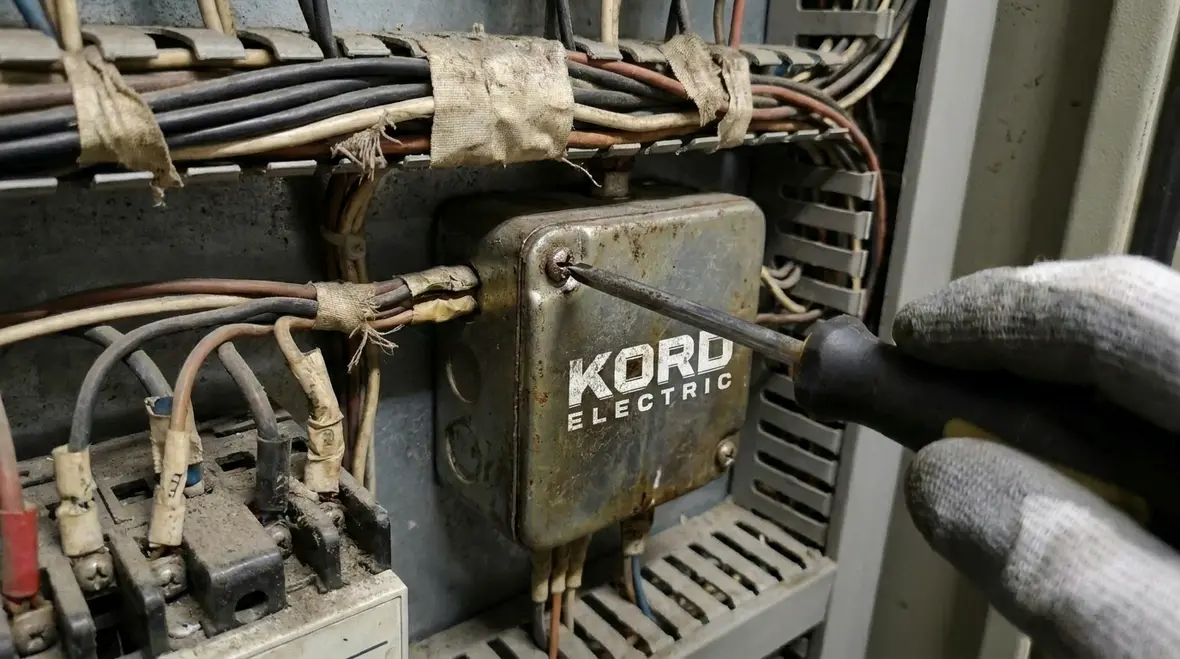
When a connection loosens at a fixture, junction box, panel breaker, or splice, the circuit may not deliver stable voltage. As load changes, the connection can heat, expand slightly, or arc, which creates visible flicker. This can also cause buzzing or random resets in drivers. Left alone, that same loose connection that started as a mild lighting nuisance can turn into heat damage or a more serious failure inside the ceiling or panel.
Voltage drops and unstable supply
In many buildings, heavy loads like HVAC compressors, loading dock equipment, pumps, or elevators cause voltage to dip during start-up. If the building supply has weak regulation, the lights can react. This is especially common when circuits are shared with large motor loads. You may notice lights dim briefly when a piece of equipment starts, then recover — a classic sign of voltage drop that is worth documenting and addressing.
Dimming system problems
If the space uses dimmers, occupancy controls, or lighting management systems, incorrect settings or incompatible dimming drivers can create flickering. Some LED fixtures require specific dimming curves, and when the controls send the wrong signal, the driver struggles. Then, instead of smooth dimming, the fixture “hunts” like it is searching for a signal that never quite arrives. That is why Kord Electric often reviews both the dimmer hardware and its configuration when troubleshooting flickering commercial lights in conference rooms, training spaces, and tenant build-outs.
Neutral issues
Neutral conductors can degrade or loosen, which leads to uneven voltage. In multi-branch circuits, a compromised neutral can make some fixtures flicker while others behave normally. It can also vary by occupancy and load distribution, so the issue can look inconsistent. Because neutral problems affect system balance across phases, they are not a DIY concern — they call for licensed electricians, proper test equipment, and a methodical check from panel to branch circuits.
Failing drivers and components
LED drivers age, and sometimes they fail in a way that produces intermittent flicker rather than total failure. We often see this in high-cycling spaces like conference rooms, break rooms, corridors with frequent control changes, and areas tied into complex lighting control systems. A driver near end of life may behave normally at full output but misbehave at certain dim levels or during transitions. That is one more reason why our team ties light behavior back to how the space is actually used, not just how the fixtures were originally labeled on the drawings.

If your property is planning a larger upgrade or retrofit to resolve recurring lighting issues, linking this troubleshooting work with a professional lighting installation and design plan helps prevent the same problems from reappearing after new fixtures are in place.
How our team troubleshoots flickering commercial lights step by step
Kord Electric does not treat flicker like a mystery novel where the villain is always the light. We use a deliberate, safety-first approach that our technicians explain as we go. This keeps the facility team informed and helps reduce downtime. Whether the issue lives in a single office or across a warehouse floor, we follow the same disciplined structure.
Step one: isolate the scope
We determine whether the issue lives in a single fixture, a branch circuit, or the entire distribution panel. Then, we separate controllable areas from those tied to large motors. If the problem appears only on one type of fixture or only on circuits with dimming, we narrow our focus fast. This prevents random part swapping and keeps the troubleshooting effort anchored to what the lights are actually telling us.
Step two: inspect visible and mechanical factors
We check fixture seating, lens and driver connections, junction boxes, and any recent maintenance work. Even if the building team “swears” the wiring was never touched, we verify. Experience tells us it is always better to confirm than to assume, especially in commercial and industrial environments where building changes happen quietly. Sometimes the fix is as simple as correcting a poor mechanical connection that has been hiding behind a ceiling tile for months.
Step three: verify electrical quality under load
We test voltage and current behavior during typical operating conditions and during load events. When flicker increases during motor starts, we trace that link. We also check for neutral integrity and confirm breaker and panel connections. This step is where troubleshooting flickering commercial lights overlaps with broader electrical preventive maintenance — the same weaknesses that show up as flicker today can become reliability issues for other equipment tomorrow.
Step four: evaluate controls and compatibility
If the lighting uses controls, we review dimming settings, driver compatibility, and occupancy or time schedule logic. Then we test whether the flicker matches control transitions. Sometimes the “bad” component is simply being commanded wrong. Adjusting curves, firmware, or control zones can restore steady performance without replacing entire fixture runs.
Step five: fix the cause, not only the symptom
After we identify the root problem, we replace failed parts, resecure connections, correct control settings, or address wiring faults. We also follow up with confirmation tests so the same issue does not return next week like a sitcom rerun nobody asked for. Our goal is not just “the lights look fine today” but “the system is stable, documented, and ready for the way your building really operates.”
For properties that have experienced repeated flicker issues, Kord Electric can integrate this troubleshooting into a broader maintenance or upgrades plan, so you are not fighting the same ghost problems every quarter.
Advanced troubleshooting for noisy power, shared loads, and LED driver issues
Some buildings show flicker only when specific equipment runs. In those cases, we investigate how power behaves during start-up, switching, and cycling. For example, a warehouse may experience light pulse during forklift charging, compressor start, or dock door operations. An office tower might show flicker during HVAC changeover or elevator demand peaks. That pattern tells us to look closely at shared circuits, feeder sizing, and how loads are sequenced.
We also look for power quality signs that show up as more than just visible flicker. Harmonics, wave distortion, and transient events can stress drivers, especially when long runs, shared neutrals, or oversized lighting loads exist. In facilities with mixed lighting types, the contrast can make the flicker feel worse than it is, because older fixtures may mask the symptom while LED drivers show it sharply.
Then, we address LED driver issues with precision. Instead of assuming a driver is bad, we confirm whether the driver matches the dimmer or control system. If the facility uses a lighting management platform, we review whether the control firmware or configuration aligns with the installed fixture model. When our expert service staff explains this to the property team, we keep it simple: the control must speak the same “language” as the driver. If it does not, the lights respond with confusion.
Finally, we check emergency lighting behavior. Some systems use bypass paths or different transfer logic. If flicker appears during transitions, we trace transfer components and verify that emergency circuits deliver stable voltage. This is especially important in stairwells, egress paths, and life safety systems where unreliable lighting is more than an annoyance — it is a compliance and safety risk.
Quick on site checks before you call us
To reduce risk, on site staff can do a few safe observations while Kord Electric prepares the full diagnostic. We recommend these steps, and we can guide your team by phone if you share what you see. The goal is to gather useful information without exposing anyone to energized work or unsafe tasks.
- Confirm whether the flicker happens in all areas or only specific rooms, floors, or fixture types
- Note the exact time and operating condition when the flicker starts, such as HVAC cycling, motor start, or elevator use
- Check for recent work in the area, including fixture replacement, ceiling changes, or panel maintenance
- Look for visible signs at fixtures, like loose housings or damaged lenses that may affect driver connections
- If the building uses dimming, observe whether flicker changes at different brightness levels
Important note: we do not want anyone opening panels or touching wiring unless they are trained and authorized. Electricity does not care about job titles or confidence levels. It just cares about safe practices. When in doubt, pause, collect observations, and let a licensed electrician take it from there.
FAQ: flickering lights in commercial facilities
These are some of the most common questions we hear when facilities are troubleshooting flickering commercial lights and trying to decide when it is time to call in a professional team.
When teams ignore flicker, costs show up later
Some facility managers treat flickering commercial lights like a small issue because it does not always shut down the building. Yet delays can increase risk. Loose connections can worsen and create heat damage. Power quality problems can stress drivers and reduce fixture life. In dimmed spaces, mismatched controls can cause repeated cycling that wears components faster. Then, tenants begin to notice. Productivity drops, complaints rise, and every “quick fix” becomes a bigger job.
Also, flicker can strain trust. When lighting feels unreliable, people stop focusing on work and start watching the ceiling. And in commercial environments, that is the last kind of “engagement” we want. We help property teams protect both safety and comfort by solving the cause, not chasing symptoms. Combining prompt troubleshooting flickering commercial lights with longer-term maintenance planning turns a recurring headache into a controlled, documented part of your facility strategy.
Call Kord Electric for calm, accurate troubleshooting
If your commercial or industrial facility shows flickering lights that repeat across rooms, circuits, or load events, Kord Electric can help you troubleshoot with a structured approach. Our technicians explain findings in plain language, and our expert service staff keeps the process clear from first inspection to final confirmation. Contact us today to schedule a diagnostic. Let’s restore stable lighting so your building can run like it should, without the dramatic pauses and budget horror stories that flicker always seems to bring.
For campuses, warehouses, office towers, and specialized facilities that depend on consistent illumination, pairing a one-time diagnostic with professional lighting installation and upgrades or an ongoing electrical maintenance plan is often the most cost-effective path. Kord Electric is built for that kind of long-term reliability work.
If your team needs fast help right now because flicker is affecting operations, safety, or critical areas, our emergency electrical services are available to stabilize the situation and keep your facility online while we work through the root cause.