Commercial Emergency Power System Testing Guide
Commercial emergency power system testing: reliability you can schedule and trust
When a power outage hits, commercial operations do not pause and wait for “later.” That is why commercial emergency power system testing matters, and it starts long before the first alarm light flashes. At Kord Electric, we help commercial and industrial facilities keep life safety, critical loads, and business continuity alive through planned, documented generator and transfer switch tests.
In this guide, we explain best practices our technicians use to make testing real, repeatable, and reliable. Plus, we will keep it calm, because nobody wants emergency power testing to feel like a surprise party with the lights turned off. Others may treat it like a checkbox, but we treat it like a safety promise.
Plan testing like a pro, not like a guess
Others often schedule emergency power work when someone remembers it. We do not. We build a plan that matches the facility’s risk level, operating hours, and critical load needs. That means we start by reviewing site history, past failures, and any load changes after renovations. Then we map test dates to the realities of your building.
Next, our expert service staff sets test intervals that align with manufacturer guidance and the facility’s compliance needs. And because “scheduled” still means “organized,” we confirm access, permits, and any required shutdown windows. If a test cannot be safely run without disrupting key operations, we coordinate alternate methods or phased testing.
Finally, we create a clear test scope and entry checklist so the team does not improvise in the moment. Improvisation is fine for comedy, not for standby power.

Align with preventive maintenance for the whole system
Testing works best when it sits inside a full preventive maintenance program. Kord Electric follows a structured approach that fits the full electrical path, not just the generator. Our preventive maintenance work supports reliable operation by checking components, verifying settings, and spotting issues early, before they show up during an outage.
We reference the same mindset described in our electrical preventive maintenance overview: maintenance plans should cover equipment condition, documentation, and repeatable inspection steps. In other words, we do not treat testing as a one day event. We treat it as part of a steady routine that reduces surprises.
To keep commercial systems ready, we typically track items like transfer switch function, battery health for controls, control logic settings, and key protective devices. Also, we confirm that alarms and status signals report correctly to the building monitoring system.
So even if your generator starts clean, a weak control signal or a misread sensor can still cause real trouble. Our technicians aim to prevent that.

Verify startup performance and transfer timing
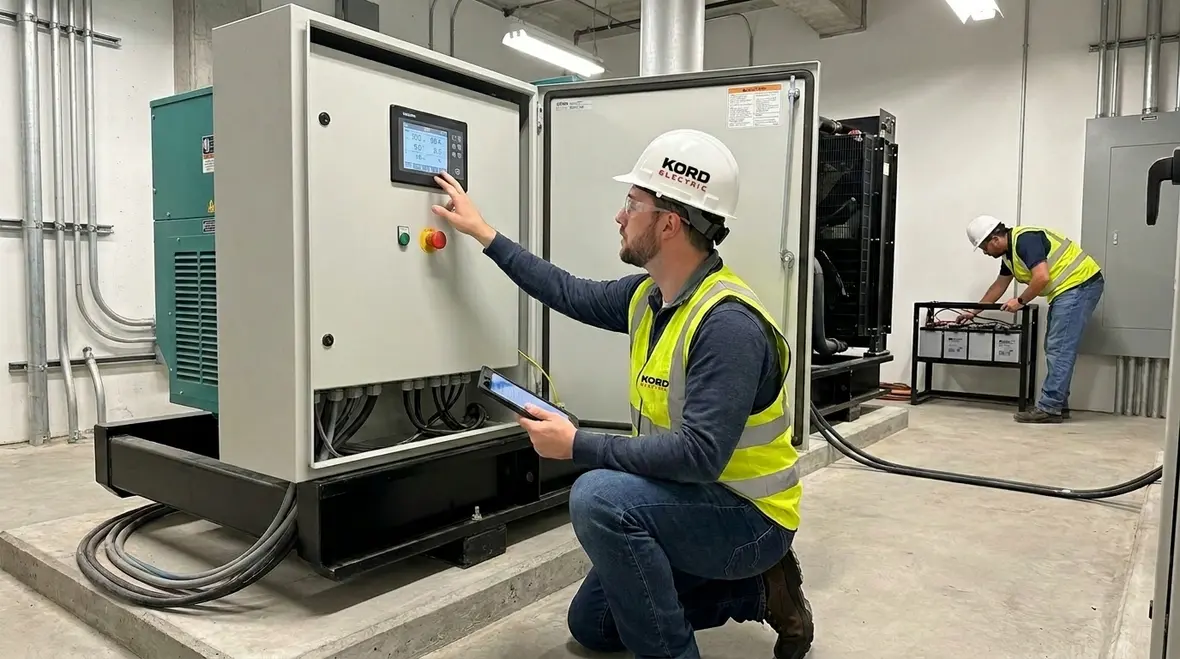
For standby systems, the moment of transfer tells you a lot. A generator that starts but transfers too slowly can compromise sensitive loads. Therefore, our crews verify startup sequence, voltage ramp, frequency stabilization, and transfer timing under controlled test conditions.
First, we confirm the transfer switch responds as designed when the utility source drops. Then we check that the generator reaches stable output before the transfer completes. If the system waits too long, or transfers before the generator stabilizes, it can trip protection or create nuisance outages.
Next, we capture measurable data such as output frequency, voltage, engine speed, and load behavior. We also observe how the system behaves across normal steps rather than only “pass or fail.” In fact, small dips can matter later when loads rise or batteries age.
And yes, sometimes the system behaves perfectly until the test day. That is why we do not rely on faith. We rely on readings.
Test under realistic load, not just idle conditions
Many teams run tests with minimal load and call it complete. Yet emergency operation usually requires the generator to carry real building demand. Therefore, we help commercial and industrial facilities test with appropriate load levels, based on the system design and safety limits.
We evaluate what loads should transfer during the test and how those loads reflect real operating conditions. Then we confirm that load step behavior matches the plan. If your facility has critical circuits like life safety loads, fire alarm panels, emergency lighting, and process equipment, we ensure the test scope addresses those needs.
Also, we check for abnormal voltage drop, frequency drift, and stability during load changes. These issues often appear only when the generator actually works, not when it sits idling like a cat pretending it sleeps.
To keep the test meaningful and safe, we coordinate timing and load sequencing with facility staff. As a result, the test supports business continuity rather than distracting it.

Inspect controls, batteries, and protective devices
Generator performance is not only about the engine. Controls and protective devices decide whether the system operates correctly when it matters most. Our technicians inspect these areas with a focus on reliability and predictable behavior.
We verify battery condition and charging performance because engine start depends on that power. Then we check control boards, sensors, and wiring terminations for tightness and correct readings. If a sensor drifts out of spec, the generator may run but not deliver proper output.
We also review protective devices, including relays and breakers that help prevent damage during faults. At the same time, we confirm that settings match design intent and current equipment loads. In short, we make sure protective logic protects the system without causing unnecessary shutdowns.
Finally, we confirm alarms and signals work end to end. That means the system not only runs, but it also communicates. If the building automation system does not receive correct status, it does not help anyone. And in an emergency, help delayed feels like help denied.
Document results and close the loop on fixes
Testing without documentation is like taking notes on a dream. It feels real while you are writing it, then it disappears. Kord Electric keeps structured records from each commercial emergency power system testing event so you can track trends and plan repairs.
We record test conditions, results, measured values, and any anomalies. Then we note what action we recommend, what action we perform, and what action remains. Our expert service staff also explains findings in plain language so facility teams know what changed and why it matters.
Next, we schedule follow ups when needed. If a reading suggests borderline performance, we verify whether the issue involves fuel quality, cooling capacity, voltage regulation, control settings, or transfer switch timing. And if repairs happen, we rerun relevant checks to confirm improvement.
That closed loop is what turns testing into reliability. Otherwise, it becomes just another event in the calendar.
Featured best practices you can put to work right away
To help commercial and industrial facilities act quickly, here are practical steps our teams use. They support dependable testing and reduce the odds of “unexpected surprises.”
- Build a written test plan that matches critical loads and operating schedules.
- Confirm transfer switch operation and verify timing under controlled conditions.
- Use realistic load levels so stability issues appear before outages do.
- Inspect batteries, controls, and sensors because starts depend on small details.
- Verify alarms and monitoring so the right people get the right data fast.
- Document, trend, and retest after repairs to prove the fix worked.
Yes, it is more work than a quick start check. But if emergency power fails, the cost is not just money. It is risk, time, and operational chaos. Nobody wants that, even if they are a fan of movie plots where everything works out in the last ten minutes.
FAQ
Testing that keeps your building ready for reality
Reliability is not luck. It is planning, careful execution, and follow through. At Kord Electric, our technicians and expert service staff help commercial and industrial facilities run dependable emergency power system checks, verify performance under realistic conditions, and document results that matter. If you want your standby system to respond calmly when the grid goes dark, reach out to us today. We will review your current setup, recommend a testing plan, and help you keep critical operations online.
If your facility is also dealing with unstable voltage, nuisance trips, or aging infrastructure, pairing commercial emergency power system testing with services like voltage fluctuation assessment and repair gives you a stronger foundation. Together with structured electrical preventive maintenance, these programs help keep your building ready for real-world conditions instead of ideal ones.
And when an unplanned outage or fault does occur, you do not have to face it alone. Kord Electric’s dedicated emergency electrical services team delivers 24/7 response, diagnostics, and repair support so that your tested standby power, transfer equipment, and distribution systems work together to bring the building back online safely.
From commercial emergency power system testing to long-term maintenance and rapid-response repair, our team focuses on one outcome: a building that stays ready for reality, not just ready on paper.