
Business Continuity Power Planning for Uptime
At Kord Electric, we build resilience through Business Continuity Power Planning for commercial and industrial facilities and major property buildings.
Power does not fail politely. It flickers, it sags, and sometimes it leaves entirely like a guest who “will be right back” and never returns. Our approach starts with Business Continuity Power Planning so operations keep moving during outages, storms, maintenance, or grid events.
And while we plan carefully, we also explain clearly. Our technicians and expert service staff walk stakeholders through what will happen, how long it can last, and how the system behaves when reality shows up and behaves differently than the spreadsheet.
How Kord Electric plans for uptime before the outage hits
When a facility loses power, the failure rarely happens in one place. First, production slows. Then safety systems get stressed. After that, data and controls lose their heartbeat. Therefore, Kord Electric starts Business Continuity Power Planning with a real look at the building, not just the generator size.
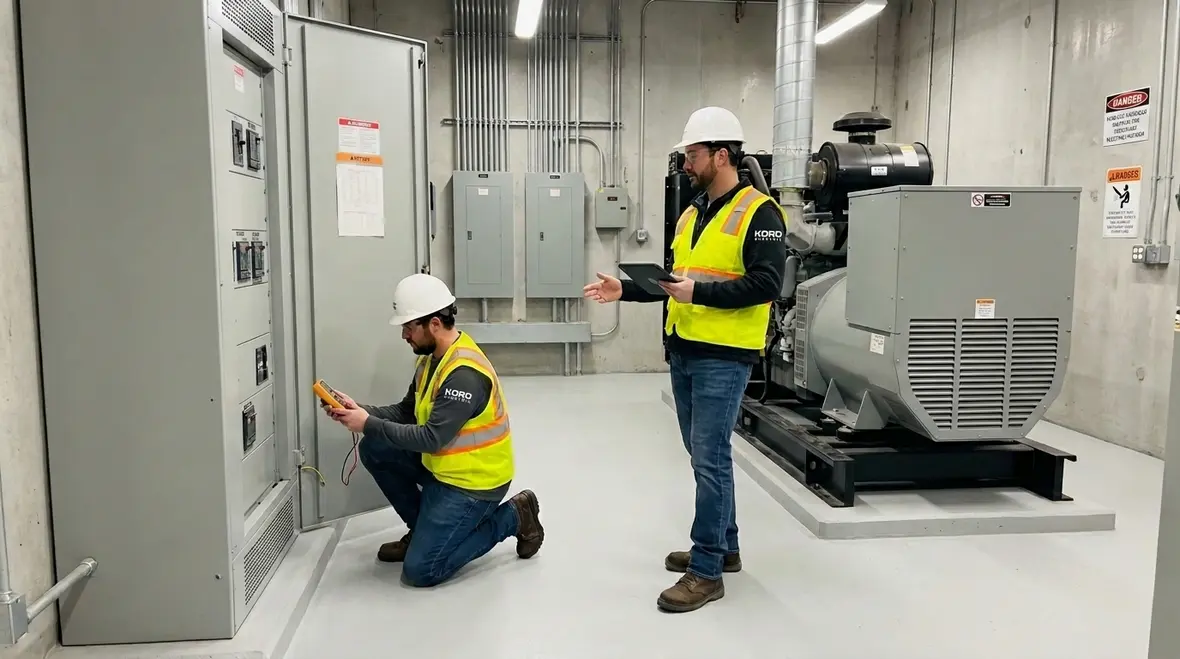
Our technicians begin by mapping critical loads. We separate equipment into groups such as life safety, controls, process-critical machines, communications, and refrigeration or other time sensitive systems. Next, we identify start up behavior. Some loads only look small until they try to start under stress.
Then we define operating goals that match how the building truly runs. For instance, a manufacturing line may need the ability to ride through short events. A data and control facility may need longer runtime and stable power quality. Meanwhile, a large property building may require comfort systems, security, and elevators to remain dependable.
To keep the plan practical, we also consider failure modes. If the utility feed drops, will transfer happen quickly and safely. If a breaker trips, can the backup system carry through. And if sensors detect voltage instability, will controls react correctly. In other words, we plan for the moment the grid stops cooperating.
Designing backup power systems that match real risks
Many teams start at the generator and then work backward. We do the opposite. We start with risk and performance, and then we select the power solution that fits the site. That is how Business Continuity Power Planning stays grounded in the facility’s needs.
Kord Electric evaluates the most likely scenarios. For commercial operations, typical triggers include utility interruptions, load switching mistakes, maintenance events, and weather related impacts. For industrial facilities, we also account for process downtime costs, motor driven equipment, and the ripple effect of losing production control.
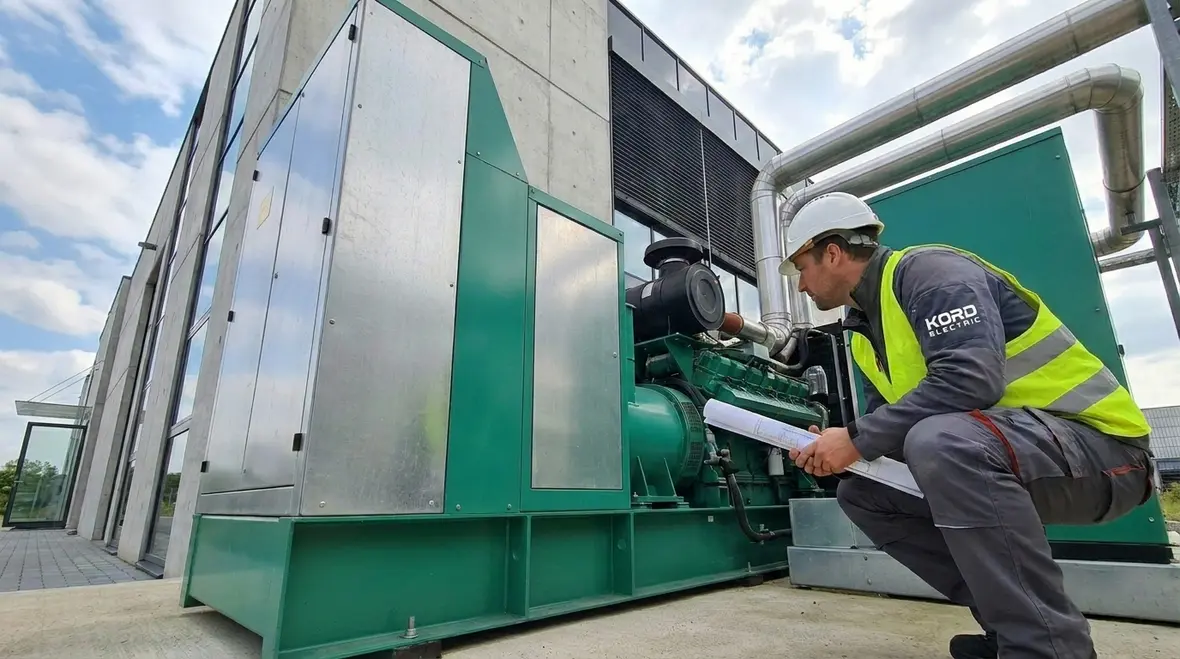
From there, we choose the architecture. Some sites need a short term ride through with automatic transfer. Others need longer runtime with fuel supply planning and scheduled testing. In certain setups, we may add redundancy so one component failure does not shut everything down.
We also watch power quality. Sensitive drives, PLCs, and communications equipment may not tolerate frequent swings. So we review voltage stability, harmonics, and load step changes. Then we tune transfer sequences and generator controls to reduce nuisance trips.
And yes, we include a bit of reality check. If someone says, “It will be fine, we have a generator,” we gently remind them that a generator is only as useful as the plan that connects it to the building loads. That connection determines whether your facility looks like a calm professional or a frantic power outage sitcom.
Connecting Business Continuity Power Planning to larger electrical strategy
Backup power design does not live in isolation. It ties into code compliance, maintenance programs, and long term electrical upgrades. Facilities that treat Business Continuity Power Planning as part of a bigger reliability strategy find it easier to schedule work, justify investments, and coordinate with other projects like commercial electrical maintenance, panel upgrades, and safety improvements.
For example, when we map out backup architecture, we also look at how it aligns with broader initiatives you may already be considering, such as structured commercial and industrial electrical maintenance plans that keep equipment healthy and ready when outages strike. By pairing these efforts, facilities avoid duplicate shutdowns, reduce disruption, and turn reliability into a predictable, budgeted function instead of a reaction to the last storm.
What site assessments uncover that spreadsheets miss
In Business Continuity Power Planning, small details decide big outcomes. That is why Kord Electric relies on field assessment, measurement, and coordination. Our expert service staff spends time listening to how people operate the building day to day, because the building never actually behaves like the “ideal” model.
We look at existing electrical one lines, panel schedules, and transfer equipment history. We also verify actual load levels. Equipment labels can be wrong, and sometimes the building has grown quietly over the years while no one updated the drawings. Then there is aging gear that shows up as voltage drops, hot spots, or frequent alarms.
We confirm that protective devices coordinate properly. In practical terms, the backup system must carry the load without causing breakers to trip at the worst moment. Therefore, we test and review settings and selectivity so the system restores power in a controlled way.
We also examine transfer logistics. For major property buildings, transfer timing impacts elevators, fire alarm interfaces, and access control. For industrial facilities, motor starting order can make or break the entire event.
Our team then documents the operational intent clearly. Instead of burying stakeholders in technical text, our technicians explain how staff should respond, what alarms to expect, and which systems will come online first. That clarity keeps the plan usable when the lights go out and everyone suddenly becomes an electrical expert overnight.
Tying site findings back into Business Continuity Power Planning
Once field observations are in hand, we fold them back into the Business Continuity Power Planning framework. That may mean updating load priorities, changing transfer sequences, or recommending upgrades where existing equipment quietly limits backup performance. In many facilities, this is where hidden risks get exposed long before they turn into emergency power failures or surprise shutdowns.
Facilities that act on these findings strengthen more than their diagrams. They strengthen everyday reliability. Pairing on-site insights with broader evaluations, like those found in discussions of hidden electrical risks in commercial buildings, helps leaders understand not just what might fail, but how to keep that failure from ever arriving.
Maintenance, testing, and training that keep plans alive
A backup system that never gets exercised is like a fire extinguisher that lives in the back of a closet. It looks responsible, but it will not save anyone when the moment arrives. For Business Continuity Power Planning to work, it must include maintenance, testing, and training.
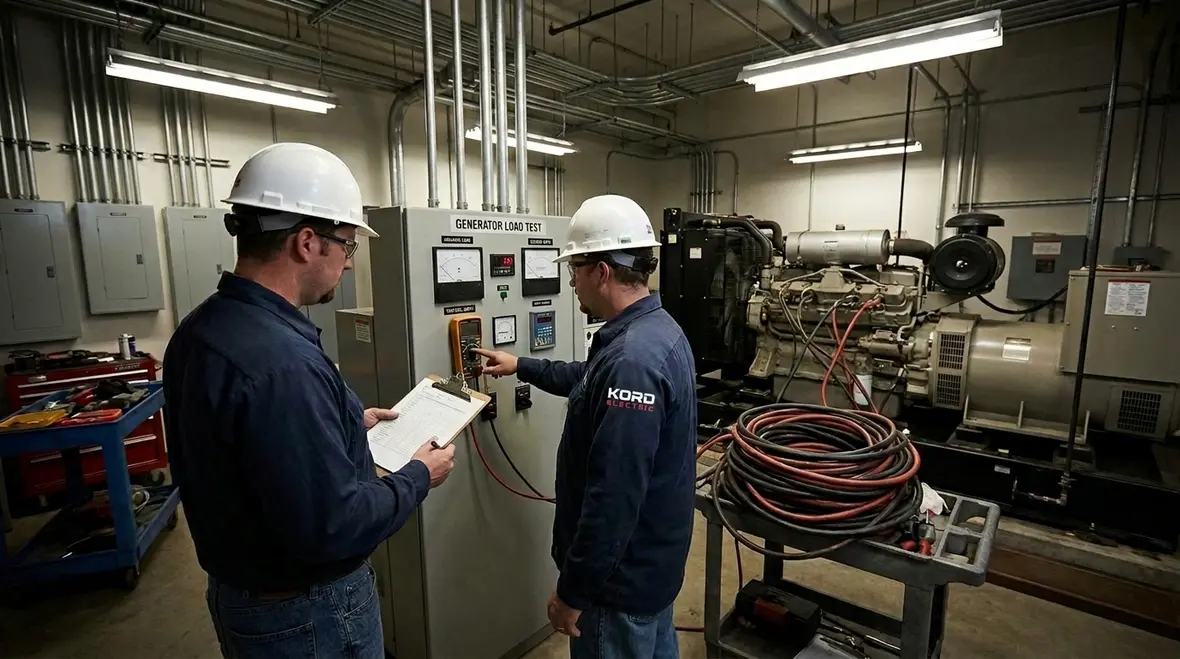
Kord Electric sets up a testing rhythm that matches the site risk. We perform scheduled load tests and functional checks so equipment runs under conditions similar to real events. We also verify transfer behavior and observe alarms, indicators, and control logic.
Fuel readiness is another core piece. We review storage capacity, delivery lead times, and how fuel quality changes over long periods. Then we create operational guidance so the site does not discover a fuel problem during an outage, which is a terrible time for surprise problems.
Training completes the loop. Our expert service staff walks facility teams through the response steps. They cover what happens during short interruptions, what happens during full transfer, and how staff should manage startup loads. We also provide a clear list of what to monitor and when to escalate.
And because communication matters, we include straightforward reporting so leadership understands performance, not just “we ran it.” In short, we turn Business Continuity Power Planning from a document into a system that behaves predictably.
Keeping Business Continuity Power Planning aligned with preventive service
True resilience depends on habits, not hope. When testing schedules, fuel checks, and staff training all sync with your broader maintenance calendar, the plan stays current instead of becoming a dusty binder on a shelf. Coordinating this work with structured service programs, like Kord Electric’s commercial and industrial electrical maintenance plans, turns backup power from a side project into a core part of facility reliability.
Measuring performance and improving resilience after events
When an event happens, the work does not end with restoration. Kord Electric uses post event review to improve the plan. This is where many facilities miss the opportunity, but we treat every outage or disturbance as useful feedback.
We collect what happened: transfer timing, load pickup sequence, alarm logs, runtime performance, and any protective device actions. Then we compare the event against the planned response. If something did not perform as expected, we pinpoint the root cause and propose corrections.
Perhaps a certain load group started too late or too early. Maybe a control setting triggered an unnecessary shutdown. Maybe a breaker acted differently under backup conditions than it does under utility power. Whatever the case, we adjust settings and sequencing so future events go smoother.
We also update the plan as the facility changes. New equipment gets installed. Production schedules shift. Renovations add loads. If the facility grows, the Business Continuity Power Planning must grow too. Kord Electric helps keep that alignment through periodic reviews and change coordination.
Think of it like tuning an instrument. One concert does not determine whether the orchestra plays well forever. So we keep refining the process until the system feels steady, reliable, and boring in the best way.
From single outage stories to long term uptime
Instead of treating each outage as a one-off story, Business Continuity Power Planning turns events into data. Over time, patterns appear: how long transfers really take, which loads cause trouble, where alarms cluster, and how staff responds under pressure. Facilities that capture and act on this information build a culture of uptime instead of a culture of surprise fixes.
For commercial and industrial buildings that have already lived through a few dramatic failures, these reviews often reveal deeper issues—such as aging infrastructure or coordination gaps—that connect directly to broader topics like emergency power failures in commercial buildings. Addressing those root causes turns reactive repair into planned improvement.
Dual view of power readiness: engineering meets operations
Kord Electric balances the technical design with operator reality. So the facility gets a system that performs and a plan staff can actually follow.
Engineering view
- Load grouping, startup behavior, and power quality expectations
- Transfer logic and protective device coordination checks
- Runtime and fuel readiness planning for the site
- Documentation of system response and sequencing
Operations view
- Clear response steps for staff during outages
- Alarm expectations and escalation guidance
- Testing schedule and what it proves each time
- Training that reduces confusion under stress
When these two views stay aligned, Business Continuity Power Planning turns into everyday practice. Engineers receive the data they need for safe, code-compliant performance. Operators receive straightforward instructions they can follow at 2 a.m. when the grid misbehaves. That combination keeps people safe, production steady, and tenants calm.
For organizations coordinating across multiple sites, this dual perspective also supports consistent standards. Backup procedures, testing routines, and documentation formats become repeatable instead of improvised, which makes it easier to integrate Business Continuity Power Planning into broader initiatives around safety, compliance, and electrical risk management.
FAQ: Business Continuity Power Planning for commercial and industrial sites
From plan on paper to predictable uptime
Ready to make your power plan feel predictable, not hopeful
Other teams write plans that look good and fail under pressure. Kord Electric builds resilience for commercial and industrial facilities and major property buildings, using practical Business Continuity Power Planning, field verified assessments, and technician led training. If you want backup power that supports your operations instead of disrupting them, reach out today for an evaluation. We will review your loads, power risks, and current setup, then map a clear path to dependable performance. Let’s keep your lights on, even when the grid plays games.
For organizations operating in demanding regions, especially those managing complex production schedules or high tenant expectations, aligning Business Continuity Power Planning with dedicated regional support can make all the difference. Kord Electric offers focused Los Angeles County electrical services built for real-world timelines, local code requirements, and the kind of operational pressures that do not pause just because the grid has other plans.
Whether you are starting from a blank slate or updating an existing strategy, the goal is the same: turn backup power from a question mark into a quiet, dependable part of your Business Continuity Power Planning. With the right assessments, design, maintenance, and training in place, outages become events you manage—not emergencies that manage you.


