California Commercial Lighting Control Systems Guide
Kord Electric helps commercial and industrial facilities meet the needs of modern energy management, and we do it with california commercial lighting control systems that stay compliant without making operations harder than they already are. In California, advanced lighting control requirements can feel like a maze designed by someone who never had to maintain a building. However, our team walks property managers through the rules step by step, and our technicians explain what matters in plain language. So, while others talk in buzzwords, we focus on what our facilities actually need: the right control strategies, correct setup, and proof that systems work as intended.
What California’s lighting control rules try to accomplish
In California, the intent behind advanced commercial lighting control requirements is pretty straightforward. Regulators want fewer wasted watts, more consistent schedules, and better control of how lights respond to occupancy, time of day, and daylight. Therefore, the goal is not to install random devices that look good on a checklist. Instead, california commercial lighting control systems aim to reduce unnecessary lighting while still supporting comfort and safety for people working on site.
As we see it, the biggest challenge for commercial and industrial buildings is not understanding the purpose, but translating it into actual jobsite decisions. For example, a facility might have the equipment, but the zoning, scheduling, sensor placement, or commissioning steps may not deliver the expected results. Then energy savings become a rumor, not a measurable outcome. And nobody wants that, especially not when the building manager has already lived through one “temporary” workaround that lasted a year.
How facilities typically get tripped up during upgrades
Many teams run into issues because they treat lighting controls like a standalone electrical task. Yet in major property buildings, controls affect operations, tenant comfort, and even maintenance planning. So, the trouble usually starts at one of these points:
- Scope gaps. The design may call for controls in some areas, while other spaces behave like they belong to a different building. Parking support areas, corridors, and common rooms often get overlooked.
- Zoning that does not match reality. If zones do not align with how people move through a space, sensors and schedules end up fighting human behavior.
- Incomplete commissioning. A system might power up and still fail functional requirements. Then the facility passes inspections by paperwork, but the control logic does not actually perform as expected.
- Daylight and tuning problems. Lighting control can dim or brighten in ways that feel random unless the system is tuned for the space.
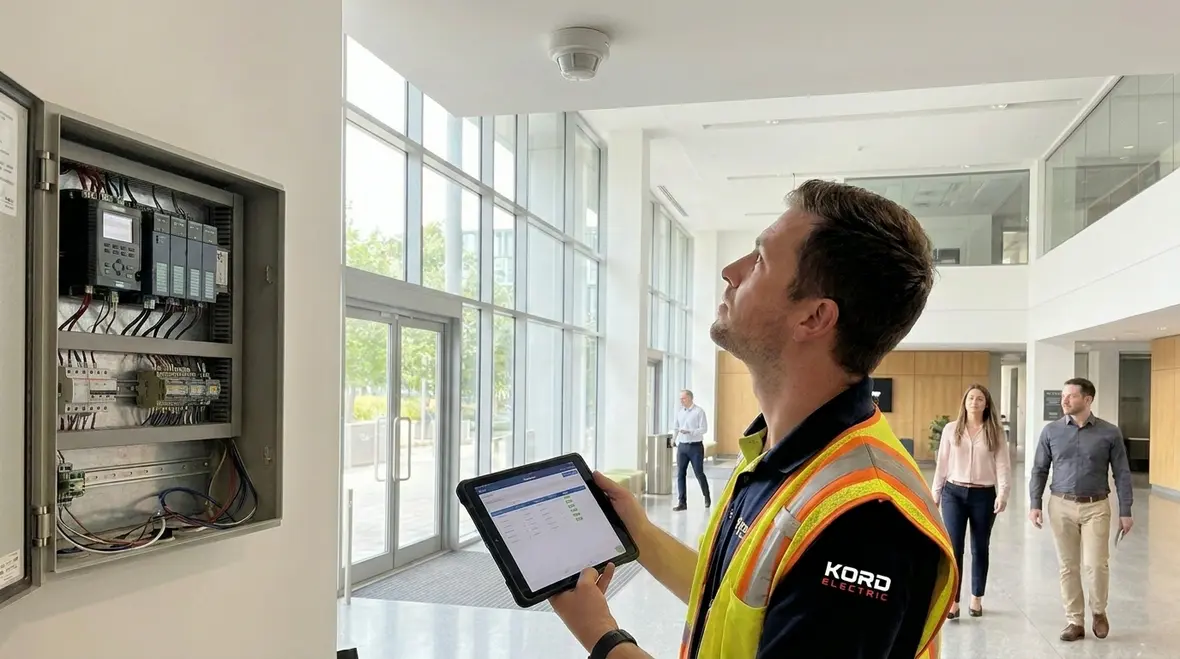
Our technicians and expert service staff prevent these surprises by reviewing plans, confirming device locations, and testing sequences early. In other words, we do not wait until the end and then ask the building to guess why things do not respond correctly. We find the causes while there is still time to fix them.
Choosing control strategies for offices, warehouses, and mixed use
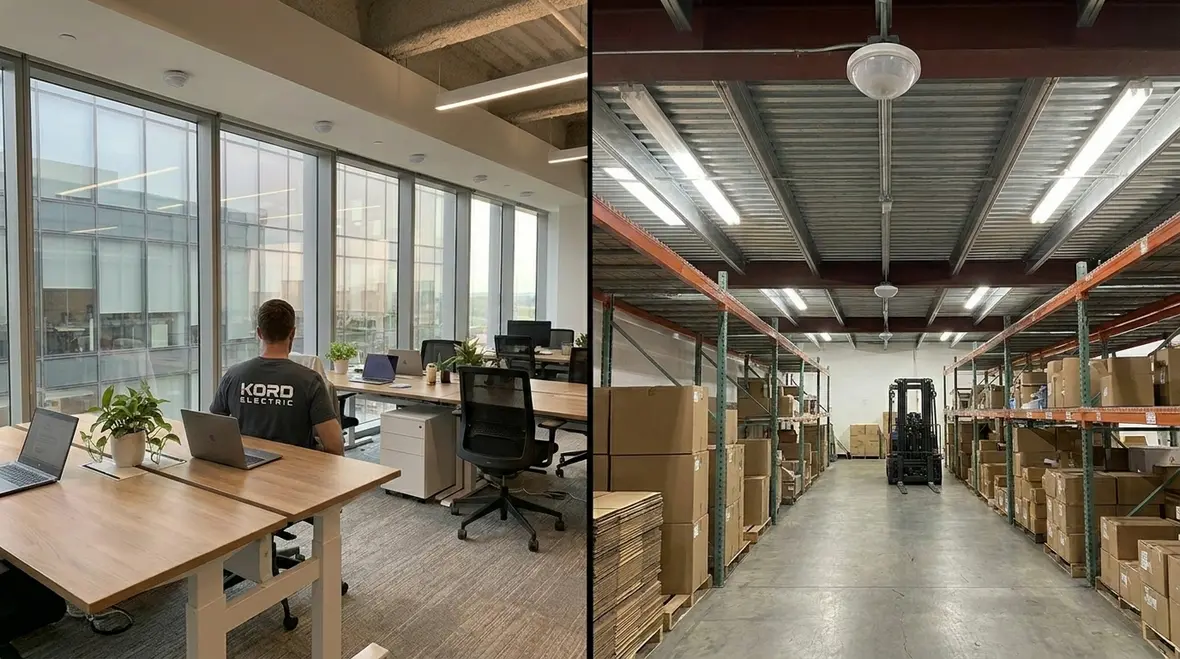
Different commercial and industrial environments require different control strategies. A corporate office with daylight from multiple sides has different needs than a warehouse with skylights or a mostly controlled envelope. In addition, a major property building might include offices, logistics space, and shared amenities, and each zone needs an approach that fits its use.
When our team builds a compliance plan, we focus on sequences that support daily operations. For example:
- Occupancy based control. In work areas where people move in bursts, occupancy sensing helps reduce wasted lighting. However, we place sensors and set time delays so staff do not feel like they are triggering lights like a video game.
- Scheduling. For spaces with predictable use, schedules reduce dependence on constant sensing. Yet we confirm that overrides support real life, such as late meetings or cleaning.
- Daylight responsive dimming. Where daylight can offset lighting needs, daylight sensors and dimming strategies prevent over-illumination. We then tune the response so it does not create distracting flicker or overly aggressive swings.
- Multi level control logic. For some applications, layered control improves comfort and energy savings. We implement logic that scales from minimum to full output based on conditions.
Even when the equipment list looks similar across projects, the correct strategy depends on the facility layout, lighting types, and how the building runs. That is why our service staff takes time to understand how the property operates before we lock in the final approach.
Connecting control strategies to California code expectations
Control choices do more than change how lights feel on a normal Tuesday. They also determine whether a building lines up with California’s lighting code expectations under Title 24. For instance, strategies built around occupancy sensing and daylight responsive dimming help major properties satisfy automatic shut off and daylight zone requirements without constant manual intervention. When those strategies match real workflows instead of fighting them, facilities are more likely to maintain compliance over time instead of slipping out of alignment as people change the way they use each space.
For teams that want a deeper dive into how these strategies map to statewide rules, it can be helpful to pair this guide with other Kord Electric resources. Articles such as the California commercial lighting code guide for 2026 and our overview of commercial lighting compliance in California walk through how occupancy sensors, time switches, and multi level controls show up in real projects, not just in code books.
Commissioning, documentation, and proving performance
Once a project installs components, it still needs to prove it can do the job. That is where commissioning matters. Therefore, we treat commissioning like a performance test, not a paperwork step. Our technicians verify that lighting control sequences respond as designed under real conditions.
In practice, this includes functional checks such as:
- Confirming occupancy detection behavior across different traffic patterns
- Validating schedule times, holiday behavior, and override rules
- Checking daylight sensor response and dimming curves
- Testing zone boundaries so lights do not “leak” into unintended areas
- Verifying system settings match the design intent and local requirements
Next, documentation ties everything together. Property owners and facilities teams need records that show what was installed, how it was set, and how it was tested. When others finish the job and vanish, we stay engaged through the closeout steps and help ensure the facility can maintain the system. And if someone asks, “Does this really comply?” we prefer to answer with evidence, not vibes.
Why documentation makes future changes less painful
Thorough commissioning reports, drawings, and control narratives pay off long after a project turns over. When a tenant reconfigures space, when a facility adds new equipment, or when the state updates its efficiency rules again, those records become the roadmap. Instead of guessing how zones were wired or which schedules control which areas, maintenance staff can trace decisions back to clear documents. That shortens troubleshooting time, limits unplanned outages, and keeps california commercial lighting control systems aligned with both current code and current operations.
Maintenance planning and technician support after turnover
Lighting controls are not “install and forget” in large commercial and industrial buildings. Over time, people change work patterns, maintenance schedules shift, and sensors can drift or get obstructed. So, a strong maintenance plan matters as much as the initial commissioning.
Our approach focuses on practical support. First, we guide the facility team on how to manage schedules and overrides without breaking control logic. Then we help set a maintenance cadence that checks device health and verifies that the system responds like it should.
Additionally, when facilities expand or reconfigure tenant spaces, we help assess how those changes affect zoning, control sequences, and overall performance. In other words, we do not treat expansions like a surprise party for compliance. We plan ahead so the system stays aligned with how the building evolves.
And yes, sometimes an occupancy sensor ends up behind a storage cart. That is when our service staff earns their keep, armed with the kind of calm patience that makes chaos feel less personal.
Linking maintenance to broader lighting installation services
For many major properties, controls maintenance goes hand in hand with broader lighting work such as fixture upgrades, new layouts, or power distribution changes. That is why facility teams often combine control reviews with larger projects supported by Kord Electric’s lighting installation services. Coordinating these efforts means a building does not end up with pristine new fixtures running on outdated logic, or finely tuned controls driving aging, inefficient luminaires.
Common compliance paths for major property buildings
Major property buildings often follow a few clear paths: full replacement in defined areas, targeted upgrades, or phased implementation tied to renovation cycles. Each option can succeed, but only if the facility teams handle boundaries and sequences with care.
When our company supports these projects, we focus on how the control system behaves at the building level. That means we consider how zones interact, how a system handles shared spaces, and how scheduling and overrides work across multiple floors or wings. Therefore, property managers can avoid mismatched behavior where one area dims appropriately while another lights up like it is 1999.
We also coordinate with stakeholders who influence the final outcome, including electrical contractors, design partners, and operations staff. Since commercial and industrial facilities operate under real constraints, we keep the process realistic and service minded.
It is worth noting that compliance is not only about what gets installed. It is about how the facility uses it. Our technicians help ensure the system matches day to day operations, which helps keep savings and comfort stable.
Phasing upgrades without losing sight of the big picture
In large, actively occupied buildings, ripping and replacing every control at once is rarely practical. Instead, property teams phase work by floor, wing, or use type. The risk is ending up with a patchwork of california commercial lighting control systems that operate differently depending on where someone stands. Our role is to help sequence those phases so each step moves the building toward a unified, compliant system rather than a collection of one off fixes. That includes aligning control strategies with broader projects like LED retrofits or recessed lighting installation, so new work does not have to be undone when the next phase arrives.
FAQ
Final steps to stay compliant and keep your building running smoothly
Compliance with California’s advanced lighting control expectations should not feel like a last minute scramble. Kord Electric helps commercial and industrial facilities plan upgrades, choose control strategies that match real use, and commission systems so they perform reliably after turnover. If you want us to review your existing setup or plan a compliant upgrade for a major property building, reach out to Kord Electric today. Our technicians and expert service staff will explain the next steps clearly and move your project forward with confidence.
If your facility is also planning broader lighting work beyond controls, Kord Electric’s dedicated lighting installation services cover design, installation, and commissioning for large scale commercial and industrial properties. Coordinating controls with these services helps ensure your california commercial lighting control systems and fixtures work together from day one, instead of being stitched together later under deadline pressure.
For major properties working through Title 24 or other state requirements, it can also be helpful to review related guidance such as Kord Electric’s article on commercial lighting compliance in California or the in depth California commercial lighting code guide for 2026. Together with the right control strategy and support team, those resources turn complex rules into a clear, manageable project plan.