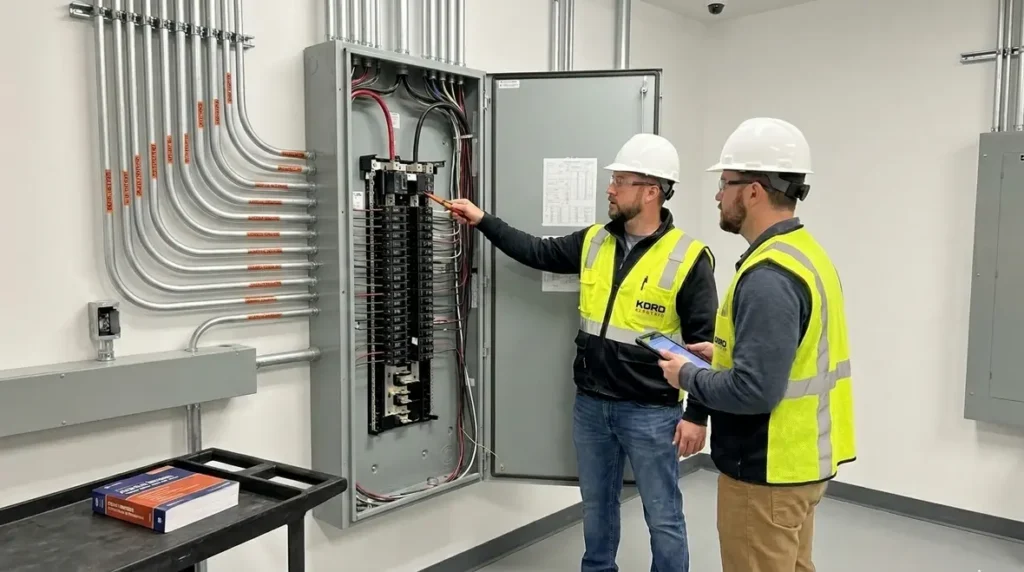
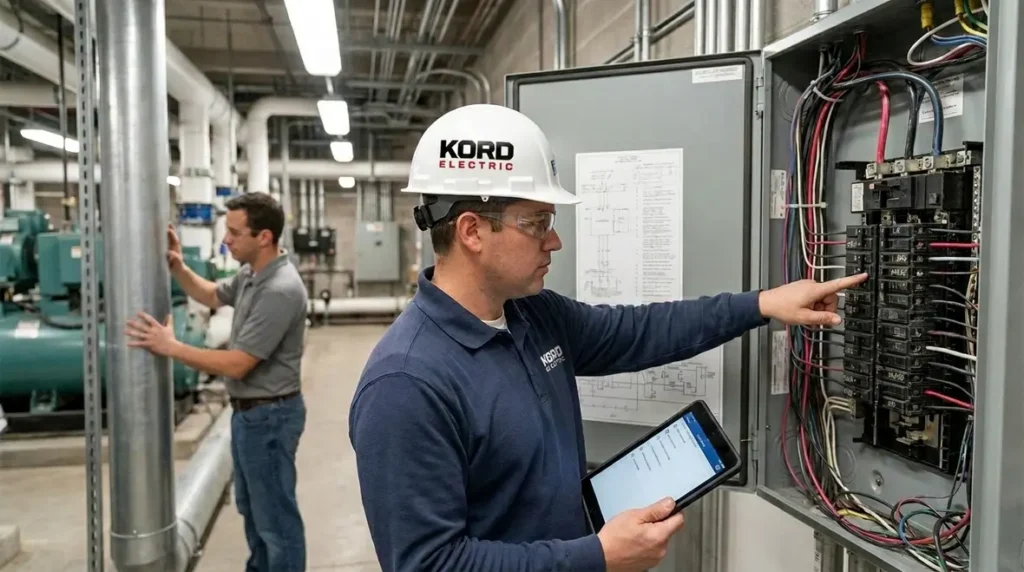
Circuit Breakers and Fuses in Commercial Facilities
At Kord Electric, we take the phrase “it’s working until it isn’t” seriously. For commercial and industrial facilities and major property buildings, we rely on circuit breakers and fuses to keep electrical equipment safe when something goes wrong. In the first moments of a fault, these devices act fast, clearing trouble before it turns into damage, downtime, or expensive repairs. Meanwhile, our trained technicians and expert service staff explain the “why” behind each protection choice, so building teams understand what they are seeing in the field. And yes, we know, nothing sounds thrilling about protection devices. However, in electrical systems, boredom is a survival trait.
How protective devices stop damage early
In many commercial buildings, electrical panels look calm and orderly. Yet inside the system, current flows like a steady river. Then, something shifts. A cable ages, a motor draws too much power, moisture gets where it shouldn’t, or a short circuit happens because reality decided to be reality. When this occurs, circuit breakers and fuses interrupt the path of electricity and help prevent overheating and arcing.
What matters is speed and selectivity. Protective devices must act quickly enough to limit heat and mechanical stress. At the same time, they should isolate only the portion of the system that is affected. Therefore, the rest of the building can keep running. When Kord Electric technicians review a system, they often look for the “weak link” behavior. A fuse might clear a fault in one circuit, while a properly set breaker clears another section in a coordinated sequence.
In plain terms, they stop electrical faults from turning into a fire story. Pop culture has taught us that dramatic sparks make great trailers, but electrical engineers prefer quiet endings.

What happens during a short circuit, and why it matters
A short circuit creates an unexpected low resistance path. Immediately, current rises to levels the equipment was not designed to handle. As current climbs, the heat generated in conductors rises fast. In addition, electrical arcs can form, and those arcs can damage switchgear, bus bars, and connected equipment.
Here is where protection logic becomes important. If the system uses a breaker, the breaker detects abnormal current and trips to open the circuit. If the system uses a fuse, the fuse element melts once current exceeds its rating for the required time. Consequently, both approaches reduce the energy that reaches the fault.
However, not all faults are the same. Some are short and intense. Others develop as gradual deterioration that eventually pushes current beyond safe limits. For that reason, the protection plan has to match the problem profile, not just the equipment nameplate.
Our expert service staff often tells clients: “The fault is the symptom. The protection choice is the diagnosis.” We say it calmly, but the message lands.

Fuses vs circuit breakers: how they behave under load
Clients sometimes ask why a facility uses both circuit breakers and fuses instead of one device type. The answer is usually performance fit. Fuses and breakers protect differently, and the difference matters for motors, feeders, and sensitive loads common in commercial operations.
In general, fuses have a predictable melting characteristic. They limit fault energy and can provide strong protection for downstream components. Many engineers choose them when they want consistent, current based clearing behavior. Meanwhile, breakers can reset after clearing, which can reduce downtime if a fault clears but the system otherwise remains healthy. Additionally, breakers can offer adjustable trips, communications, and different trip curves depending on the design.
That said, fuses are not “set it and forget it” either. They require correct sizing and correct coordination. Breakers also require proper settings. If either device is mismatched to the load, then it can clear too early, or it can clear too late. When protection timing is wrong, the equipment suffers, and then the team learns the fun lesson of troubleshooting under stress.
So we help facilities choose the right approach by reviewing the single line diagram, equipment ratings, and typical operating conditions. Then we recommend coordination that protects equipment while keeping the building available. For facility leaders exploring broader system upgrades, this analysis often ties directly into larger projects like whole-building rewiring, where protection choices, load profiles, and infrastructure capacity all move together. Kord Electric’s Rewiring Cost Guide for Commercial Electrical Systems walks through how these decisions support long-term reliability and budget planning across commercial and industrial sites.
Coordination and selectivity in real electrical systems
Commercial and industrial facilities do not operate like a single device working alone. They operate in layers. A fault on a branch circuit should not shut down an entire floor, a production line, or an entire property building. Therefore, we design protection so that the closest device to the fault clears first. This is selectivity.
Coordination also accounts for energy let through. During a fault, the system experiences voltage dips and high current pulses. The goal is to make sure the device that trips first limits the stress on equipment farther upstream. For instance, a feeder breaker should not act before a downstream fuse when that fuse can clear the fault safely.
Our technicians handle this carefully. We do not just recommend a breaker size and move on. We evaluate protective device curves, fault current levels, and time current relationships across the system. We also consider nuisance trips, because a nuisance trip can be nearly as disruptive as a real fault. If a breaker trips too easily, teams reset it repeatedly, and then the protection strategy becomes a loop with no learning.
In the real world, we coordinate for both safety and operational continuity. That balance is what keeps power reliable when the building needs it most. For property teams interested in how this ties into broader reliability planning, Kord Electric’s article on Commercial and Industrial Electrical Maintenance Plans shows how protection, inspections, and structured reporting work together so facilities can plan instead of react.
Arc flash and overheating: how protection reduces risk
Protection devices do more than stop current. They reduce the severity of thermal damage and help control arc flash risk. When a fault occurs, arc energy can increase hazards for electricians and maintenance staff. Consequently, the correct selection and settings of protective devices support safer working conditions during troubleshooting and inspections.
However, protection is not only about tripping. It is also about limiting the fault duration and controlling the energy that flows during the event. For example, if a fuse clears faster than an upstream breaker, the fuse reduces the time for arc formation and reduces energy let through. Similarly, if a breaker is set properly, it can prevent prolonged fault current that would otherwise overheat conductors and connected components.
That is why our expert service staff often explains the system behavior before any work begins. We walk teams through what the protective devices should do, what they should not do, and what signals to watch for after a trip. When people understand the sequence, response gets faster and calmer. And when response gets faster and calmer, problems stay smaller. That is good business, and also good for everyone’s blood pressure.
Maintenance and testing for dependable protection
Even the best protection strategy can drift if maintenance gets ignored. Breakers need inspection and verification of trip function. Fuses need correct installation and replacement with the right type and rating. Over time, connections can loosen, dust can accumulate, and components can degrade.
So we recommend a disciplined approach for commercial and industrial facilities. First, we inspect enclosures and terminations. Next, we review breaker trip settings and ensure the equipment matches the approved coordination plan. Then we test and document conditions so the facility can act with confidence.
Our technicians also look for signs that the system has changed. If equipment is added, loads shift, or production schedules change, fault currents can change. Therefore, the original coordination can become less effective. When that happens, we help clients update protection so it still matches the actual operating reality of the building.
In short, protection is not a one time decision. It is a living part of the facility’s electrical health. Many of these checks align naturally with Kord Electric’s dedicated Electrical Preventive Maintenance services for commercial and industrial properties, where scheduled inspections, testing, and documentation work together to keep panels and protection devices ready when they are needed most.
How Kord Electric helps property teams prevent downtime
At Kord Electric, we serve commercial and industrial facilities and major property buildings. That focus shapes how we work. We plan for uptime. We coordinate with operations. And we explain what we do in plain language, because building teams deserve clarity, not mystery.
When faults occur, we also help teams interpret what happened. A trip or a blown fuse tells a story. Our expert service staff helps clients read the clues, identify root causes, and reduce the chance of repeat events. We do not only restore power. We support prevention through better selection, better coordination, and better maintenance practices.
If a facility wants a straightforward plan, we build one. We start by reviewing documentation, single line diagrams, and equipment schedules. Then we evaluate protection behavior under likely fault conditions. Finally, we provide recommendations that keep equipment safe and operations stable.
Because the goal is simple. We want power to stay reliable, so teams can focus on running the business, not babysitting electrical panels like they are episode one of a sitcom.
FAQ
Conclusion and call to action
When protection is done right, electrical faults stop faster, equipment stays healthier, and downtime stays shorter. Kord Electric supports commercial and industrial facilities and major property buildings with experienced technicians and expert service staff who explain the “why” behind every design choice. If your panels show nuisance trips, repeated faults, or unclear fault history, contact us for a protection review and coordination check. Let us help your system act decisively during trouble, not dramatically afterward.
Many property teams begin this process by enrolling in structured, code-conscious service offerings that keep electrical infrastructure consistently inspected and documented. Kord Electric’s dedicated Electrical Preventive Maintenance services are built specifically for commercial and industrial environments that rely on dependable circuit breakers and fuses, coordinated protection, and disciplined maintenance to avoid surprise outages.
Schedule a service visit today and put a clear, proactive plan around the protection devices that guard your facility every hour of every day.