Commercial EV Charger Retrofitting Projects Guide
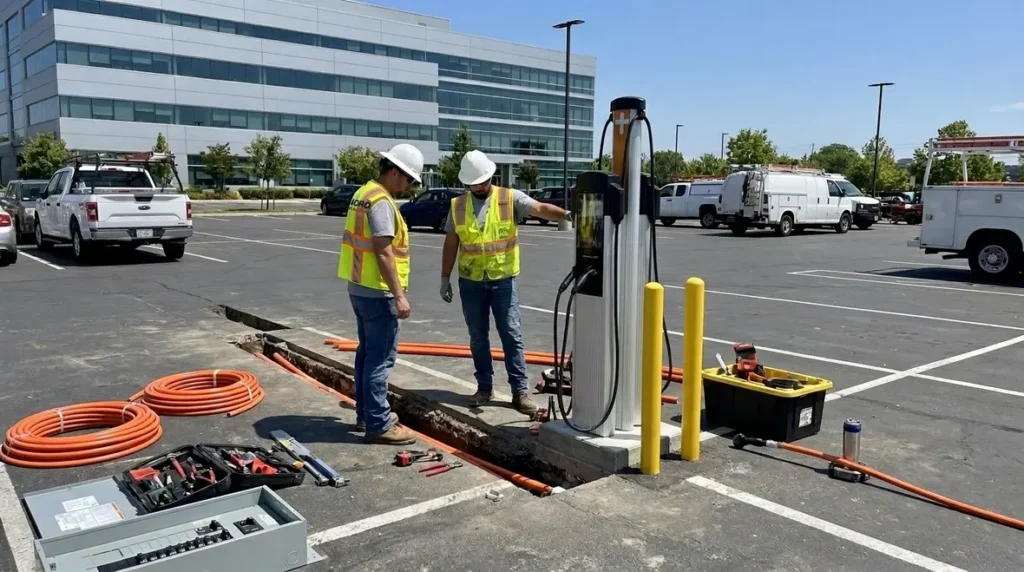
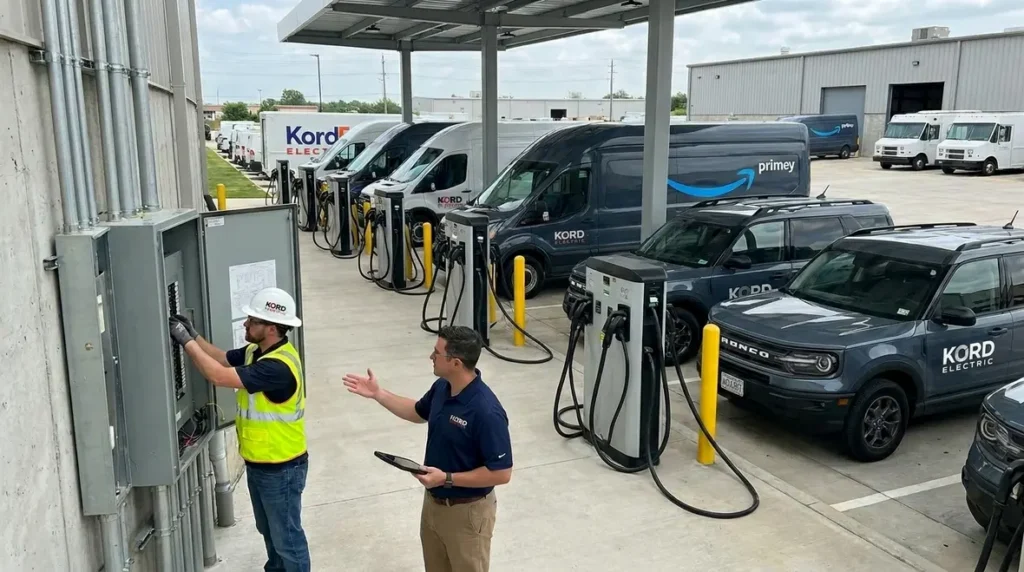
Kord Electric supports many EV Charger Retrofitting Projects across commercial and industrial facilities, as well as major property buildings. And when a site is already up and running, we treat retrofitting like a careful surgery, not a demolition party. Our technicians and expert service staff explain every step, because nobody should feel surprised when the breaker schedule changes. In this guide, we focus on what matters most for large scale commercial EV charger retrofitting, from electrical load planning to safety, uptime, and long term maintenance. And yes, we will talk about hidden electrical risks too, because ignoring them is how problems get invited to the party. Thankfully, we show up with a plan.
What makes large scale commercial EV charger retrofitting different
Large projects differ from small installs in one simple way: they touch real business operations and real electrical systems. Therefore, the stakes rise fast when a campus, distribution hub, or multi tenant property needs chargers that handle peak demand. A typical retail charger job might treat power like a minor detail. In commercial and industrial settings, power becomes the main character, and it usually does not do improv. It follows math.
We begin by mapping the existing electrical architecture, including service size, panel capacity, transformer limits, and feeder ratings. Next, we review where vehicles park, how often charging happens, and what time patterns match business activity. Then we choose equipment and wiring approaches that align with those patterns. Finally, we build in room for growth, because today’s deployment rarely stays today’s deployment. If another fleet update comes next year, the electrical plan must still make sense.

For a deeper look at how hidden conditions in older systems affect new electrical work, you can explore Kord Electric’s article on hidden electrical risks in commercial buildings, which pairs naturally with large EV retrofit planning.
Site load planning that actually holds up under peak demand
Many teams plan for average usage and then hope for the best when everyone plugs in at the same time. However, for commercial charging, peak demand drives everything. Our technicians explain that smart charging can help, but it cannot fix a fundamentally undersized service. So we treat load planning like a baseline and a stress test.
First, we calculate charger totals and expected utilization. We consider vehicle mix, charging rates, and charge start timing. Next, we analyze facility loads such as HVAC, process equipment, lighting, and elevators. Then we model worst case scenarios and review how demand charges or utility tariffs might affect the total cost. If the building has a history of high draw during certain hours, we plan around it.
We also coordinate with the utility side when needed, especially when service upgrades or new metering might be required. And when planning needs revisions, we communicate early, not after materials arrive. After all, nobody wants the electrical plan to become a post project surprise, like finding out your favorite show got canceled. That is not business friendly.

Electrical distribution upgrades without losing uptime
Commercial properties and industrial sites often operate with tight downtime windows. That means distribution upgrades must be staged carefully. We plan work so we can energize new circuits, test them, and then transition loads in a controlled sequence. In other words, we avoid the “flip it and pray” approach.
Our team evaluates where we can add breakers, run new feeders, or integrate load management. We review cable routing, conduit sizing, and pull limits so the installation stays clean and serviceable. Where a service upgrade is needed, we coordinate with building staff on the timing of cutovers. We also make room for testing and verification, including insulation checks, functional tests, and commissioning procedures.
Additionally, we focus on labeling and documentation. This matters because field staff need fast access during maintenance. If the building staff cannot trace what we installed, future troubleshooting turns into guessing. And guesswork is expensive, especially on a site that charges vehicles for money, not charity.

Hidden electrical risks in commercial buildings and why we treat them as real
One reason retrofits become complicated is that older systems may carry risks that only show up when new loads arrive. In our work, we reference the kinds of hidden problems we cover in our blog, including risks like aging wiring, overloaded neutrals, improper grounding, failing connections, and panel busbar issues. When new chargers add sustained load, those weaknesses stop being quiet.
For example, if termination points run warm under normal demand, a charging circuit can push temperatures higher. Likewise, if grounding has drifted over time, fault detection and protective device behavior can change. Even small issues like incorrect wire sizing or loose lugs can grow into bigger failures when the system experiences repeated charging cycles.
That is why our technicians inspect before they install, and then verify after they install. We test protective devices and check continuity and resistance where appropriate. Then we confirm that the charging equipment communicates safely with the power system and follows the required protective schemes. If we find a risk, we address it as part of the retrofitting scope or we recommend a corrective plan before energization. We do not move forward on a “looks fine” basis. That is the calm, deliberate approach we bring to every commercial site.
If you want to see how these issues show up in real facilities, Kord Electric’s dedicated article on hidden electrical risks in commercial buildings walks through common problems behind panels, walls, and ceilings that matter for EV Charger Retrofitting Projects.
Permits, code, and utility coordination that keeps projects moving
Commercial and industrial EV retrofits live inside a framework of codes, permits, and utility rules. And those rules do not bend just because a deadline looks friendly. We stay ahead by building a compliance path early in the project plan. That way, we reduce waiting time and we avoid last minute redesigns.
We confirm the relevant electrical codes and local amendments that apply to the site and the charger type. Then we document the design, single line diagrams, and equipment specifications so the permitting process stays clear. If the project needs utility work, we coordinate timelines and information requirements. Sometimes utility review affects lead time, and we build that into the schedule from the start.
We also make sure the installation supports safe access and correct signage. Where chargers connect to a larger system, we confirm that the design supports grounding, overcurrent protection, and proper labeling. And because our expert service staff explains what they are doing, building operators understand the final outcome. When people understand the system, they maintain it better. It is a simple relationship, like peanut butter and bread, except for electricians and compliance.
Deployment planning for fleets, shared parking, and phased rollouts
Not every commercial property needs all chargers on day one. Many successful EV Charger Retrofitting Projects roll out in phases, and the right phasing avoids wasted upgrades. We help clients plan for today’s fleet and tomorrow’s expansion, while keeping the design flexible.
We start by defining who uses the chargers. Fleet vehicles might charge at set times. Visitors might charge more randomly. Then we analyze parking layout and cable pathways so future additions can connect without tearing up the site again. This also reduces long term disruption.
Next, we align charger placement with electrical capacity. For example, a phased approach can add chargers to a zone only after load management thresholds and feeder capacity are confirmed. Then we integrate controls, so power allocation matches demand. Smart load control improves the user experience and helps protect the facility.
Finally, we consider user access and operational flow. If chargers block traffic during peak hours, the business suffers. So we coordinate mounting heights, signage visibility, and safe pedestrian pathways. We keep it practical, not theoretical.
Commissioning, training, and maintenance that prevents repeat failures
After installation, the job is not done. Commissioning verifies the system works as designed, and training ensures the right people know how to handle it. Our technicians and expert service staff run through commissioning steps with the facility team, then they explain what to monitor over time.
We confirm charger function, fault behavior, and communication with the site management system where applicable. Then we document test results and provide clear guidance on preventive checks. Maintenance for commercial charging also includes inspecting connectors, verifying mounting stability, checking for water intrusion, and confirming that protective devices perform as expected.
We also help set a response plan for downtime. If a charger reports a fault, the facility needs a path to resolution without chaos. We provide recommendations based on the equipment and the site environment, including how to log incidents and when to schedule service. When maintenance stays consistent, reliability improves and long term cost drops.
FAQ
Ready to retrofit safely, on schedule, and built for growth
If your commercial or industrial facility plans to add EV charging, Kord Electric can guide the process from power planning to commissioning. We work with your team to reduce surprises, address hidden electrical risks, and keep downtime controlled. Our technicians and expert service staff explain the system clearly, so your operators feel confident. Contact us to review your site, scope your next phase, and build EV Charger Retrofitting Projects that last. Let us handle the electrical details, while you focus on running the business.
When you are ready to move from planning into action, you can explore Kord Electric’s dedicated EV charger installation services for commercial and industrial facilities. Their team handles design, installation, and commissioning so your retrofits tie into a stable, future ready charging infrastructure.
For facilities that also want to protect the rest of their electrical system while adding EV capacity, Kord Electric’s structured electrical preventive maintenance programs can be paired with EV Charger Retrofitting Projects to keep panels, feeders, and distribution equipment in healthy, documented condition.