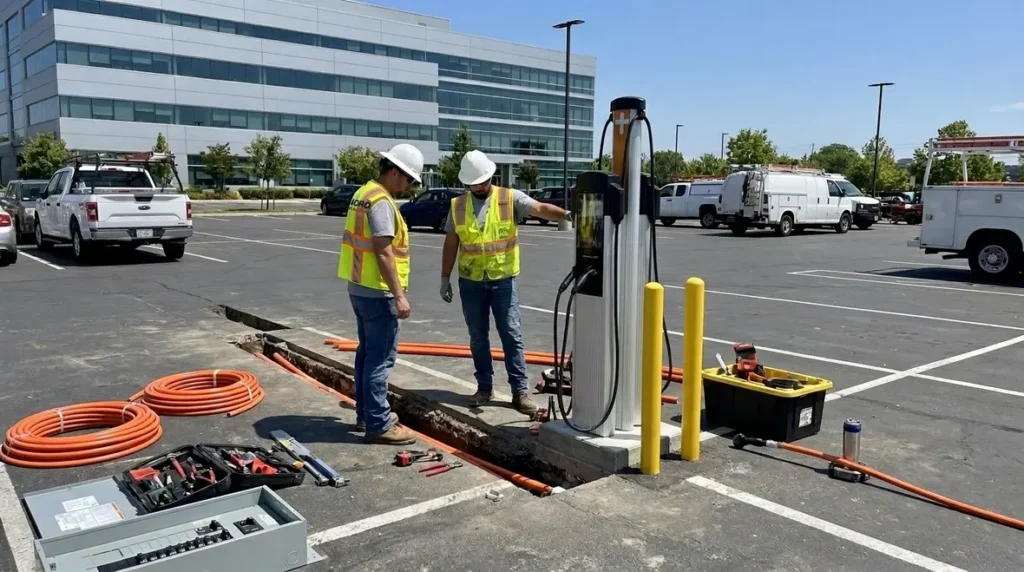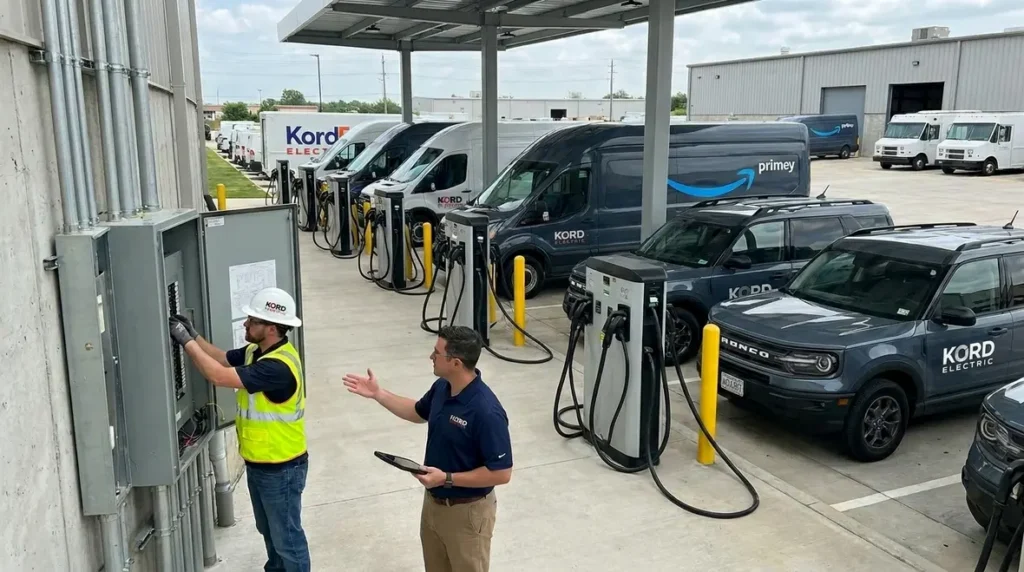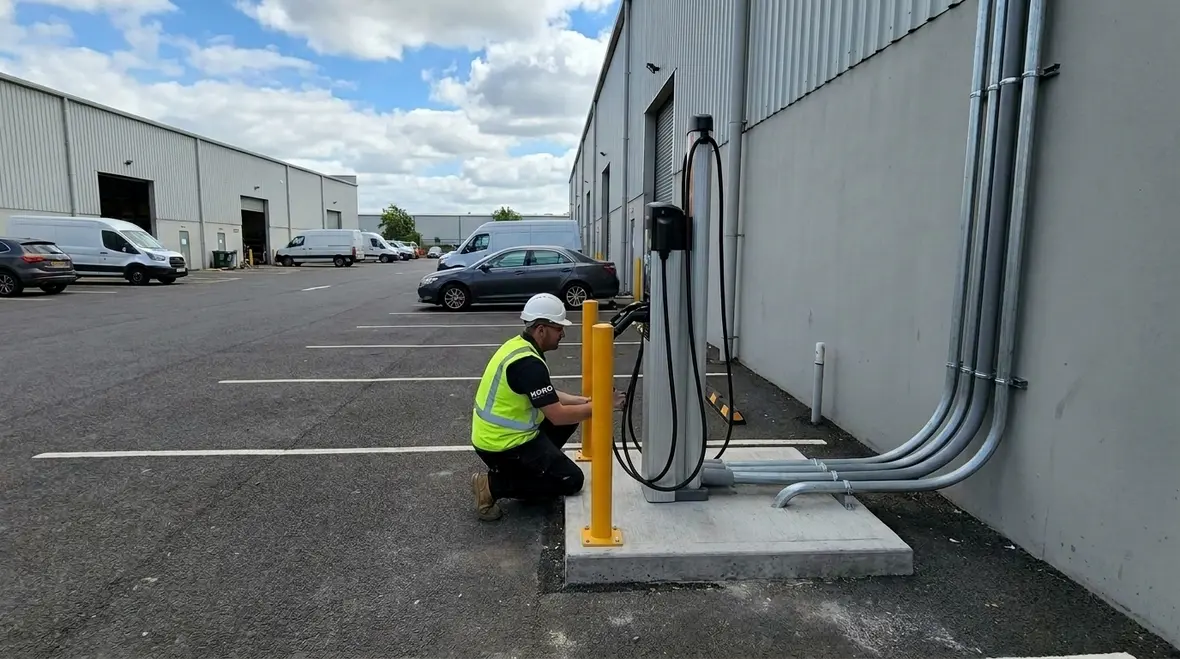
Commercial EV Charging Installation Guide for Sites
As a facility leader, you do not just manage buildings. You manage risk, uptime, budgets, and the daily reality of people arriving and leaving on tight schedules. That is why Kord Electric created a commercial ev charging installation guide for commercial and industrial sites, plus major property buildings where reliability matters. In this piece, you will see how our team approaches planning, power, safety, permitting, and long term support. We explain the choices in plain language, and we let our expert service staff do the talking, because nothing calms an anxious facility manager like hearing it from people who have crawled through real electrical closets. (Yes, we have. No, we did not love it. We did it anyway.)
What a commercial site needs before charging goes live
A practical installation starts long before the first cable is pulled. First, the facility manager and the site decision makers define the charging purpose. For example, is this for employees, fleet vehicles, tenant parking, or customer access? Then we align the plan with the duty cycle. A warehouse with frequent shift changes needs a different setup than a property building with evening traffic.
Next, we map the parking layout and vehicle types. We do this because chargers do not exist in a vacuum. They must fit where vehicles actually park, and they must handle the most realistic range needs, not the fantasy version of EV life found in ads.
Then we validate electrical capacity and site constraints. If the transformer or service is undersized, the “simple install” story ends quickly. However, that is not a bad thing. It just means the commercial ev charging installation guide approach moves from wishful thinking to engineering reality. As a result, the facility team gets a plan that holds up during inspections and during peak demand.

When facilities start exploring EV charging, they often uncover broader power questions. For example, a site might be juggling older panels, mixed tenant loads, and questions about future equipment. In those cases, our team may reference insights from broader system reviews like those discussed in our guide to hidden electrical risks in commercial buildings, so charging plans do not ignore the rest of the infrastructure holding everything up.
How we design the power plan for parking and load
Power planning is where most projects either become smooth or become a long, expensive episode of “why now?” To prevent that, our technicians start with load calculations and site evaluation. After that, we review panel capacity, existing circuits, and any demand management strategies available.
Many commercial and industrial facilities benefit from load balancing or managed charging. In other words, we control how chargers share power so the facility stays within limits. Therefore, your building does not trip breakers and your electricians do not spend their nights playing electrical whack a mole.
We also consider cable runs and equipment location. Distance matters because voltage drop and installation complexity increase with length. For that reason, we plan cable paths early and coordinate with lighting, fire lanes, and any underground utilities.
When a site needs upgrades, we scope them clearly. We explain what must change, who typically performs civil work, and how we schedule the work so operations keep moving. Facility teams appreciate this because uptime is not optional.

For facilities that are already evaluating broader upgrades, we often coordinate EV charging plans with other improvements like electrical preventive maintenance or panel work. That way, the power plan for your commercial ev charging installation guide does not live on an island; it becomes part of a larger strategy for stability, safety, and growth.
Where safety and code compliance actually show up
In commercial and industrial environments, safety is not just a checkbox. It is the whole job. Our process treats code compliance like a foundation, not an afterthought. Therefore, our expert service staff reviews the full installation design, including equipment selection, grounding and bonding, conductor sizing, and protective devices.
We also think about the user environment. Chargers in high turnover lots face more impacts, weather exposure, and potential misuse. So we recommend suitable enclosures, mounting methods, and protective bollards when needed. This reduces damage risk and protects the investment.
Then we align installation with inspection expectations. Permits and documentation matter because they affect the timeline and the final signoff. We help facility managers understand what paperwork arrives with the project and what they should store for future service.
And yes, we tell people the boring truth early. A charging site built like a DIY weekend project is like a sports car built with shopping bags as wiring insulation. It might look fine at first. Then reality drives in.
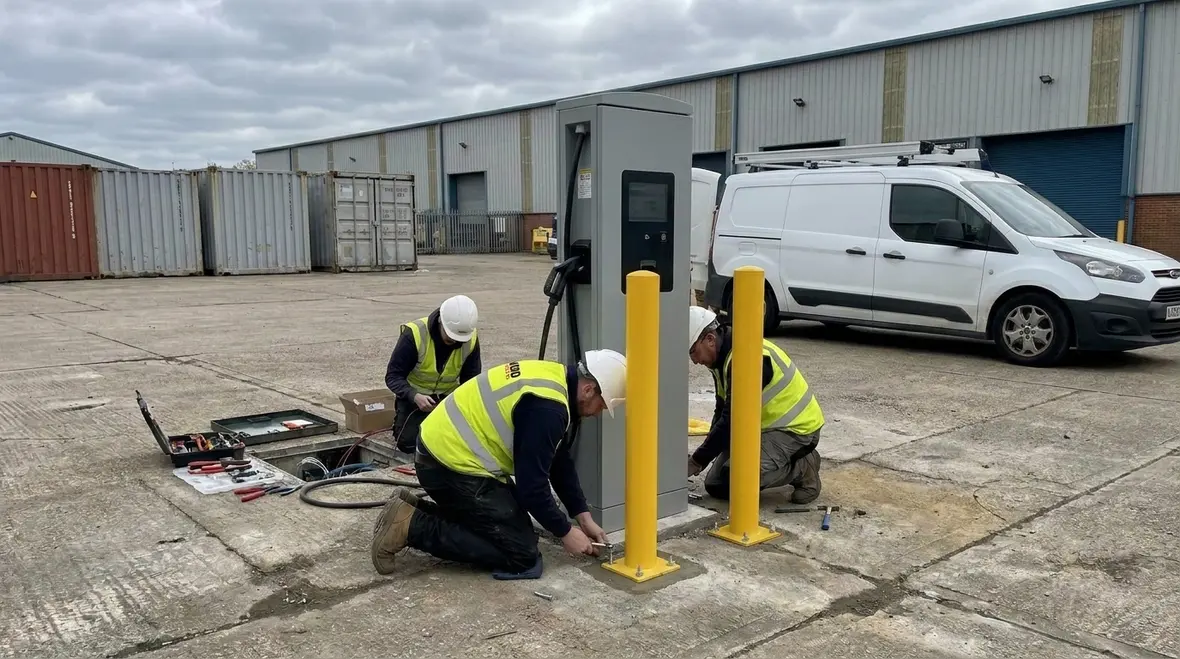
Because commercial EV charging touches panels, feeders, and real human traffic, we line up safety and code details with the same mindset we bring to emergency electrical services or voltage fluctuation repairs. The goal is a system that not only passes inspection, but stands up to real-world abuse, shifting loads, and the occasional “creative” driver behavior.
Site planning: location, signage, and user flow that reduce complaints
Good charging projects do not only provide power. They manage people movement. We plan the charging bays so drivers can approach, park, and connect without blocking traffic patterns or violating circulation requirements.
Then we address signage and wayfinding. In major property buildings, a charger with zero instructions becomes an informal obstacle course. Our team recommends clear labeling for access, billing or authorization, and basic usage steps. While some drivers figure it out, others treat it like a pop quiz they did not study for. Signage prevents that.
We also consider accessibility. Facility leaders often need chargers placed with clear access routes and proper height and clearance requirements. In addition, we consider how maintenance access looks in real life. A charger placed in a perfect spot on paper can become a maintenance nightmare if it traps technicians behind parked cars.
Finally, we coordinate with property management and site staff. When we communicate installation dates and charging downtime windows early, we reduce friction and keep tenants or staff informed. That is how we protect relationships, not just assets.
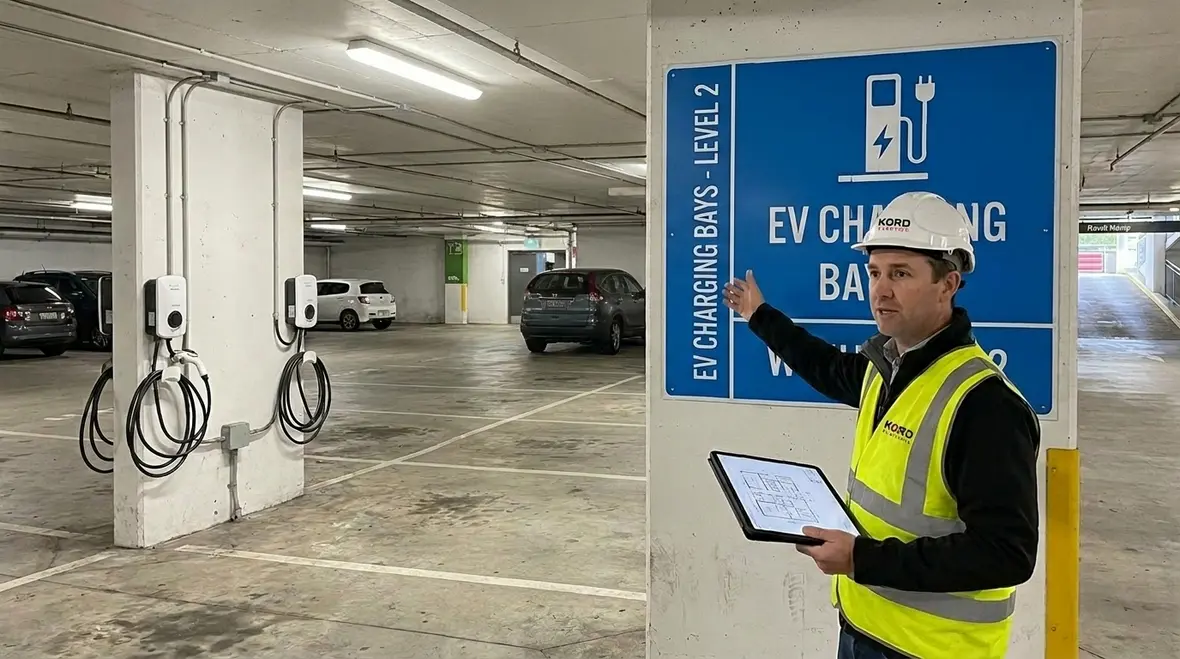
This kind of site planning also supports other electrical work on the property. If your facility later schedules projects like panel upgrades, lighting installation services, or broader rewiring work, having EV charging integrated intelligently into circulation paths and work zones makes those future projects less disruptive and easier to phase in.
Project timeline and how we keep disruptions low
Most facilities do not plan for major electrical work during peak operations. So we structure the project timeline to minimize disruption. First, we schedule site evaluation and design work so the final materials arrive on time. Then we plan installation phases around building needs.
Our technicians coordinate with facility managers on access points, work areas, and safety measures. We also plan for temporary routing if required and confirm that any electrical shutdowns, if needed, align with low traffic windows.
Then we set expectations for testing and commissioning. Commercial installations must go through verification steps, including functional testing and safety checks. As a result, when the chargers open to users, they open with confidence.
And because we have done this at commercial and industrial facilities repeatedly, we keep the process calm. It is like having a traffic light at an intersection that usually runs on “good luck.”
When appropriate, we also align the EV charging schedule with other planned work, such as electrical preventive maintenance or panel inspections. This approach lets your team bundle outages, reduce repeated disruptions, and document improvements in one organized trail instead of scattering them across random weekends.
Service, monitoring, and what happens after the install
A charging site is not a set and forget device, especially in high use facilities. That is why Kord Electric focuses on ongoing performance. We help facility teams plan for monitoring and maintenance schedules, and we explain how to respond when a charger needs attention.
In many deployments, remote monitoring helps track performance and identify issues early. Therefore, your team can reduce downtime and avoid long waits for troubleshooting. Our expert service staff can also support periodic inspections and component checks based on site conditions.
We also help clients think through expansion. When a property building or industrial facility grows, the original charger layout should not block future growth. With that in mind, we design with spare capacity and logical conduit or cable paths where feasible.
In plain terms, we help you build a system that stays useful after the ribbon cutting. And for the record, we are not in love with surprise repairs either. We just like fewer phone calls about “the lights are on, but the charger is not doing the thing.”
Because EV charging connects directly to your broader electrical backbone, we also show how long term service can tie into structured programs like electrical preventive maintenance. That way, your chargers, panels, and distribution equipment get checked on a realistic schedule instead of whenever someone finally asks, “Has anyone looked at that lately?”
Choosing the right approach for your commercial ev charging installation guide plan
Every facility has different constraints. Some have available power and straightforward conduit paths. Others need upgrades, trenching coordination, and careful load management. So we do not push one template for every site. Instead, we follow the principles in the commercial ev charging installation guide and adapt the details to the building, the parking configuration, and the operating schedule.
For major property buildings, we focus on tenant experience, electrical planning across shared spaces, and reliable access control options. For industrial and commercial sites, we focus on duty cycle reality, vehicle turnover patterns, and robust protection against site conditions.
To keep decisions clear, we present tradeoffs and costs in a way facility managers can explain internally. That includes what improves reliability, what reduces future disruption, and what strengthens safety. As a result, stakeholders feel confident they made a smart investment, not a hopeful one.
Because when it comes to charging, “almost” is not a strategy. It is just a slow leak in the budget.
If your site leadership is also weighing other upgrades, this is a good time to think holistically. For example, facilities in Los Angeles County that are planning EV charging, panel work, or power quality improvements can benefit from bundling projects under a single commercial electrical services partner rather than scattering them across vendors. That way, your charging strategy and your broader power strategy stay aligned instead of pulling in different directions.
For locations across the region, Kord Electric supports complex facilities through dedicated offerings like Los Angeles County electrical services for commercial and industrial sites, so your EV charging rollout fits into a coherent plan for everything else connected to your switchgear and panels.
FAQ
Get a site-ready plan from Kord Electric
If your facility team wants commercial EV charging that performs reliably, looks good, and passes inspections without drama, we are ready. Kord Electric builds plans for commercial, industrial, and major property buildings, with expert technicians who explain every step in clear language. Contact us to schedule a site evaluation and discuss power capacity, layout, timeline, and service support. Then you can roll out charging with confidence, instead of crossing your fingers like it is a season finale. Let us handle the details, and keep your site moving.
If you are comparing options, remember that a strong commercial ev charging installation guide is only the starting point. The real value comes from a partner who understands how EV infrastructure, panels, preventive maintenance, and everyday operations all intersect at your site. That is the lens Kord Electric brings to every project, from the first load calculation to the final commissioning test.
Whether you manage a logistics yard, a multi-tenant office, a healthcare campus, or a mixed-use property, we adapt the same disciplined process to your unique constraints. That includes up-front planning, clean installation, thoughtful phasing, and a path for future expansion that does not paint your electrical room into a corner.
When you are ready to turn plans into equipment in the ground and chargers on the wall, our EV charger installation team and commercial electrical specialists work together so your project feels like one orchestrated effort instead of a patchwork. That way, your first day of charging looks less like a beta test and more like a system your teams can trust from day one.