Preventing Electrical Fire in Warehouses Guide
Warehouses run on power, motion, and schedules that do not care whether your breakers are aging or your cables are dusty. That is why preventing electrical fire in warehouses has to be treated like a daily safety habit, not a once-a-year checklist. At Kord Electric, we help commercial and industrial facilities, as well as major property buildings, reduce risk with practical inspections, clear documentation, and upgrades that hold up under real loads. In this guide, we share the top strategies our technicians use, and our expert service staff explains the “why” behind each step, so your team can act with confidence. And yes, we also remind people that electrical issues rarely announce themselves with a dramatic soundtrack. They usually just fail quietly, then get expensive loudly.
1) Start with risk mapping before anyone touches the panel
First, we do not jump straight to replacements. Instead, our team maps where problems are most likely to start. We review floor plans, equipment lists, rack layouts, high traffic zones, and the power paths that feed lighting, conveyors, refrigeration, charging stations, and motor loads. Then we connect those points to how the facility actually operates during peak hours.
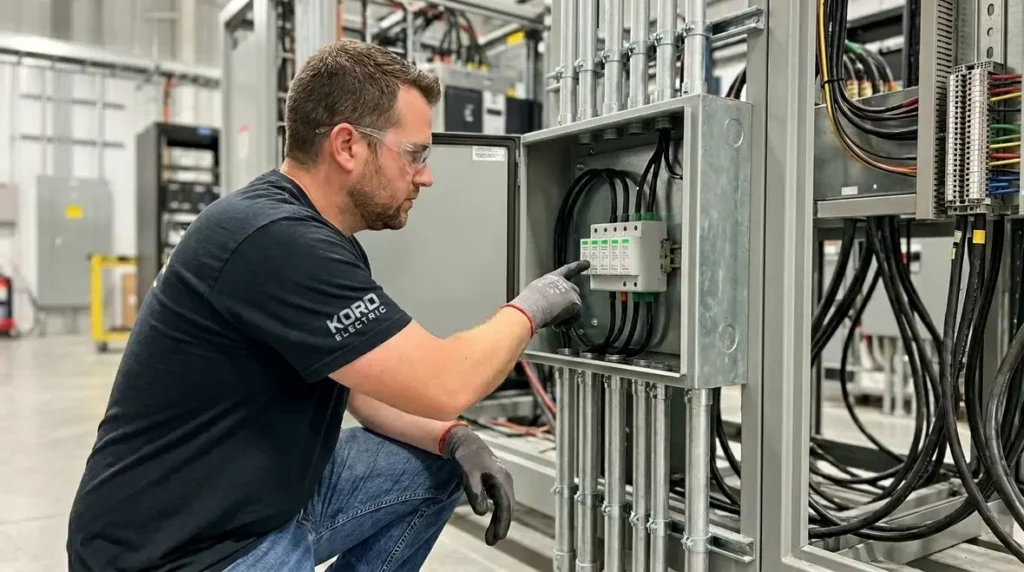
From there, Kord Electric technicians walk the space and look for early warning signs: damaged insulation, loose terminations, heat discoloration, odd odors near enclosures, and recurring nuisance trips. Because warehouses have vibration and constant movement, connections can loosen over time. As a result, arcs form in places most people do not notice until something smokes.
Next, we prioritize risk by consequence and likelihood. For example, power distribution rooms with high breaker usage, areas near dock equipment, and sections feeding heavy motors deserve tighter attention. Therefore, we create an order of work that fits commercial schedules without guessing.
2) Keep loading under control with proper circuit design

Warehouses often add equipment faster than they update electrical capacity. A new packaging line, extra racking for seasonal storage, a fleet of mobile scanners, or a retrofit for energy savings can quietly push circuits beyond what they were designed to carry.
Our expert service staff explains it in plain terms. When conductors run hot for long periods, insulation ages faster. Then faults become more likely. And if a fault happens under load, it can turn into an event that spreads fast due to combustibles, cardboard, plastics, and dust.
To prevent that chain reaction, Kord Electric evaluates whether circuits and feeders match the true demand profile. We also check for imbalance on multi phase systems, which can overheat components even when total amps look “fine.” We recommend load calculations, diversity factors that match warehouse reality, and panel schedules that reflect what is installed today, not what was installed five moves ago.
As a practical step, we also verify conductor sizing and derating needs. For example, insulation ratings, ambient temperature, and conduit fill rules matter. When those details get ignored, heat builds where no one expects it.

3) Prevent overheating with disciplined inspection and torque practices
Loose connections and heat are a dangerous duo. Therefore, we treat torque and contact integrity as a core fire prevention strategy, not a technical footnote.
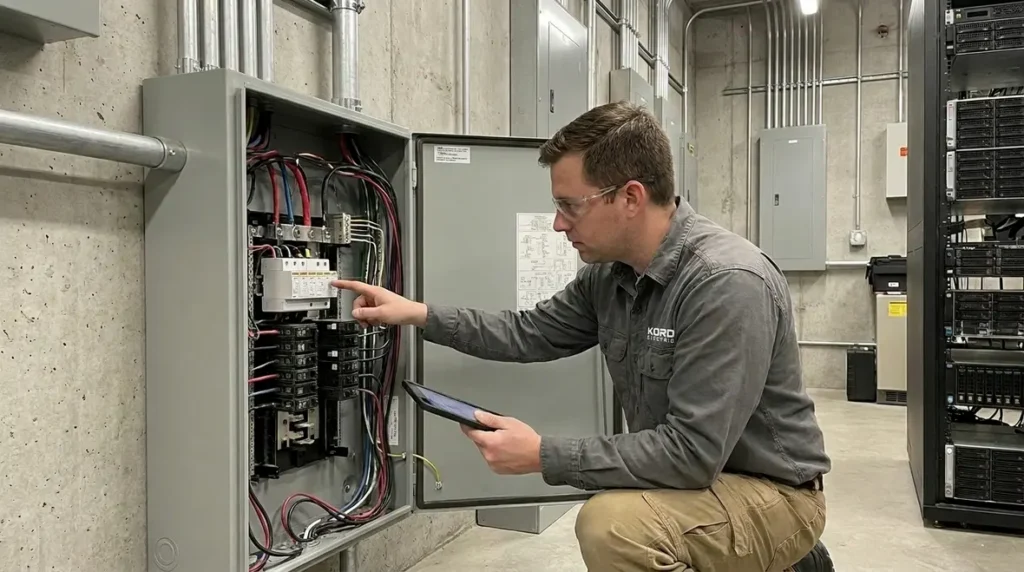
Kord Electric technicians perform targeted inspections in distribution panels, junction boxes, motor control centers, and connection points where vibration is constant. They check for signs of thermal stress like discoloration, warped bus bars, or pitted contact surfaces. If the facility uses older devices, we also verify whether the components are still performing as intended.
Our team also focuses on how connections were made. When a connection is under torqued, it can arc. When it is over torqued, it can damage materials and still fail later. Consequently, correct torque plus proper hardware makes a real difference. Then we document what we find so maintenance teams can track trends over time.
And yes, we say it with a smile because someone always asks. “No, we are not just tightening things until they feel right.” We follow method, measurement, and recorded results.
Thermal inspections and preventive maintenance
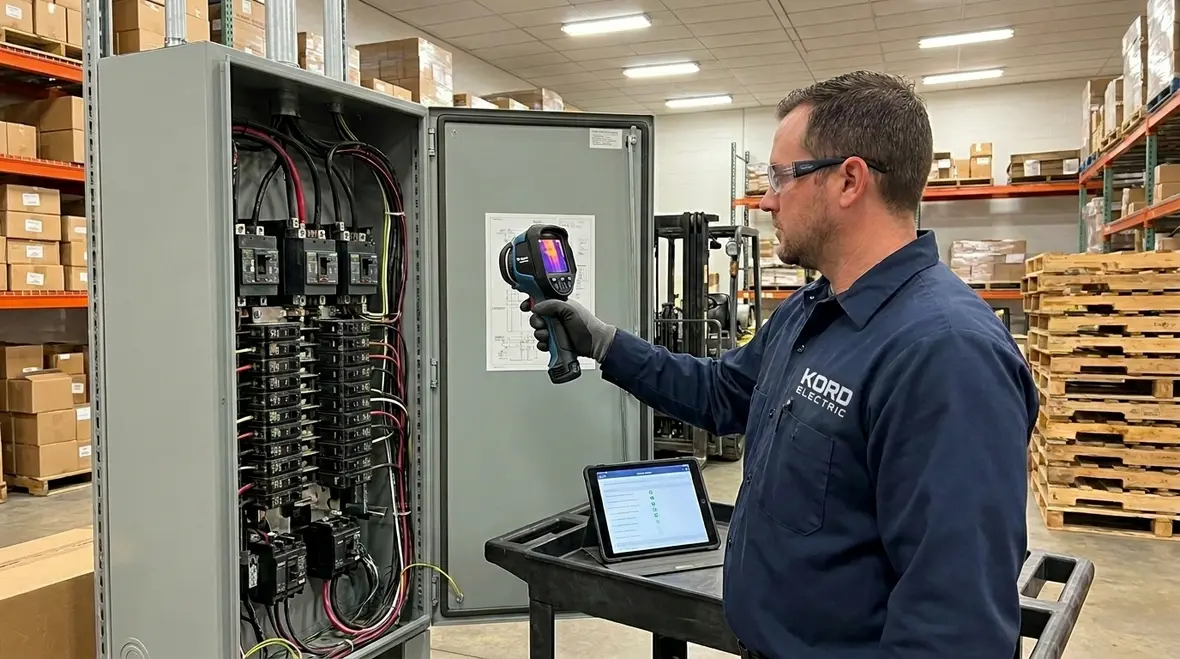
In many facilities, disciplined torque checks pair well with structured thermal inspections and broader electrical preventive maintenance programs. Together, those steps help catch hotspots before they become failures, and they keep your documentation ready for insurance reviews or internal audits.
4) Improve protection with coordination and selective shutdown
Warehouses need protection that works the first time, every time. That means not only having breakers and fuses, but also ensuring they coordinate. Coordination is how protective devices “agree” on what should trip and when, so the fault stays localized and does not escalate into a bigger incident.
Our expert service staff reviews protective device settings and evaluates coordination across upstream and downstream equipment. If a breaker trips too late or too broadly, damage grows. If it trips too quickly, operations suffer and teams may bypass safety devices, which is the kind of “solution” that turns into a headline later.
In addition, we verify ground fault protection where it fits the application and check arc flash risk where required. Then we confirm that labeling and emergency procedures match the actual equipment. A warehouse staff member should not have to play detective during an electrical event.
Because downtime costs money, coordination reduces both fire risk and operational chaos. It is safety that also respects the work schedule.
Tying protection into a broader fire strategy
For many facilities, electrical protection is only one layer in a broader warehouse fire protection strategy. Teams often pair coordination studies with sprinkler reviews, alarm design, and extinguisher placement so that electrical faults remain small and suppression systems can do their job effectively.
5) Control dust, humidity, and contamination in high risk areas
Electrical fires do not only start in panels. They also start in the spaces around equipment, where dust, moisture, and chemicals can create conductive paths or reduce insulation performance.
Kord Electric supports facilities with practical mitigation plans. We help teams identify where dust accumulates near heat sources and where moisture can enter enclosures. Warehouses often have humidity swings, rooftop leaks, and condensation near cold storage or loading docks. Over time, that moisture can degrade seals and increase fault likelihood.
We also pay attention to airflow and ventilation around panels and motors. Blocked vents can trap heat. Then even correctly installed components run hotter than they should.
Next, we emphasize cleaning procedures that match industrial needs. Not all “cleaning” is safe. Some methods can drive debris deeper into equipment. Therefore, our technicians advise on the right approach for enclosures, cable trays, and control components.
When teams keep environments stable, the electrical system lasts longer and behaves more predictably.
Partnering with fire protection teams
Because dust, humidity, and high pile storage also affect suppression performance, many warehouses coordinate electrical mitigation with their fire protection partners. That way, ventilation, housekeeping, and extinguisher placement all align with the same risk map instead of competing priorities.
6) Upgrade aging wiring, terminations, and components
Eventually, maintenance becomes a cost of ownership, not a cure. Aging wiring, failing insulation, oxidized connections, and outdated protective devices can increase the chance of arcing and overheating.
Kord Electric focuses upgrades on the areas that matter most for commercial and industrial environments. We assess cable condition, insulation integrity, connector types, and termination practices. If a facility has a history of recurring faults, our technicians trace the pattern instead of treating it like a random mood swing.
We also examine cable routing and support. Poor support creates strain at terminations. Vibration then attacks joints and conductors. Therefore, correct tray placement, clamp usage, and separation from heat sources reduce long term stress.
When upgrades happen, we keep the work aligned with business realities. Our team plans outages carefully, sequences tasks to reduce downtime, and coordinates with operations so the lights stay on when the warehouse needs them.
Sometimes the best prevention is simply replacing what has already shown stress. Like a tire that keeps losing air, it may “work” for a while, but it is still a risk.
Upgrades as part of a county-wide strategy
For warehouse operators managing multiple facilities in the same region, upgrades and maintenance often get bundled into a coordinated plan. Aligning schedules and standards across sites makes it easier to document how you are preventing electrical fire in warehouses, not just in a single building.
7) Build a maintenance plan that staff can follow under pressure
Policies fail when they do not match how people work. That is why Kord Electric helps commercial and industrial facilities build maintenance that is realistic and easy to execute.
Our expert service staff sets up check schedules tied to equipment type and usage. We help assign ownership, define inspection intervals, and create job aids that cover what to look for and what to record. Then we train the on site team so findings do not sit in a folder like unused flash drives.
We also recommend a process for reporting early indicators. That includes documenting nuisance trips, noticing recurring breaker wear, tracking motor starts and run hours, and capturing temperatures during routine checks when feasible.
Finally, we review emergency readiness. Teams should know where equipment is shut down, how to respond, and how to prevent re energizing until faults are confirmed. In a warehouse, seconds matter. Confusion is a multiplier.
Connecting maintenance to regional support teams
Many commercial properties also coordinate electrical maintenance with broader facility service plans, especially in areas like Los Angeles County where large sites depend on consistent power, code compliance, and fast response if something goes wrong.
8) FAQ for warehouse electrical fire prevention
Conclusion and CTA
Electrical fire risk in commercial warehouses deserves a plan that is measured, documented, and maintained. Kord Electric supports major property buildings and industrial facilities with inspections, protection improvements, disciplined torque and connection checks, and smart upgrades that match real warehouse operations. If you want your team to prevent faults instead of reacting to them, we can review your distribution system, identify high risk zones, and build a practical maintenance roadmap. For facilities in and around Los Angeles County, our Los Angeles County electrical services help ensure that preventing electrical fire in warehouses stays aligned with local demands, not just generic checklists. Contact Kord Electric today to schedule an expert assessment and get safety that stays steady under pressure.
When you are ready to turn that plan into scheduled work, our commercial and industrial team can coordinate inspections, maintenance, and upgrades across your portfolio so every warehouse follows the same high standard.