
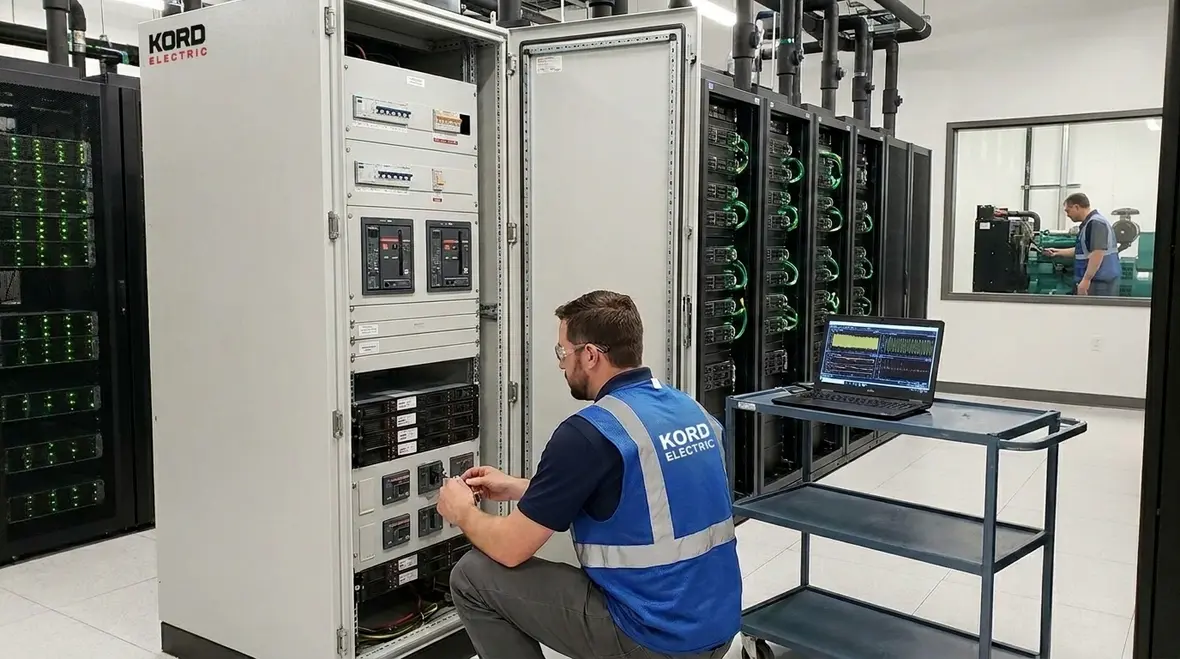
Data Center Power Continuity for Commercial Facilities
Kord Electric helps commercial and industrial facilities protect data center power continuity when the grid gets noisy, breakers misbehave, or systems simply age out like a bad sequel. In this article, we explain how teams prevent downtime, manage risk, and keep critical loads alive with practical strategies. We also share how our technicians and expert service staff plan, test, and verify power paths so the facility stays steady, even when the unexpected shows up.
Why power continuity fails in the real world
Power continuity breaks down for reasons that rarely look dramatic at first. Instead, the trouble usually starts as small drift: a battery that still “runs,” a transfer switch that still “works,” and a cable that still “tests fine” until it does not. Meanwhile, facilities often change loads, add equipment, and expand racks or production lines without updating the power study. As a result, the system no longer matches the building’s true needs.
We have found that many failures come from the same chain reaction. First, maintenance happens on schedule but not on condition. Then, protective devices get replaced without confirming coordination. After that, monitoring stays too generic, so faults appear only after the moment of impact. And finally, teams rely on theory instead of evidence, like trusting a map without checking the roads.
Our expert service staff approach each site like a living system. Therefore, we focus on what can move, what can degrade, and what can fail under load, heat, and time.
How we assess critical loads and power paths
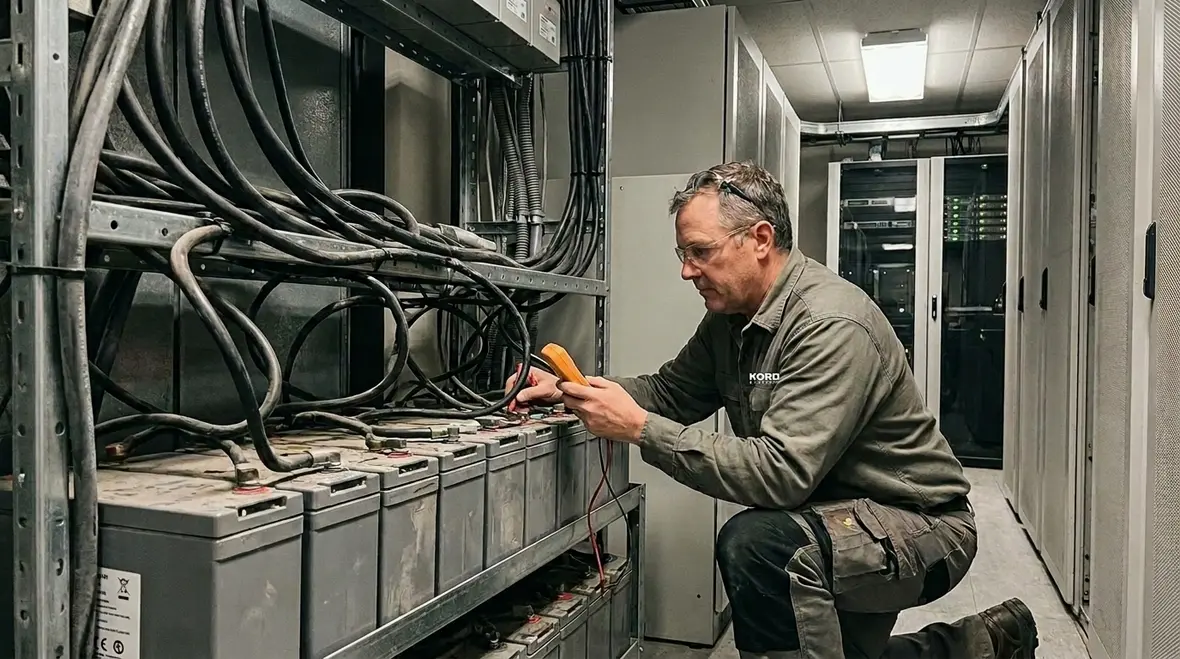
To maintain data center power continuity, we start by understanding the building’s electrical reality, not just its one line diagram. Our technicians review load types, duty cycles, and startup behavior. They also check how critical equipment rides through events such as utility sags, brief outages, and generator transitions.
Next, we confirm power path design. That means we examine transfer mechanisms, UPS runtime, generator starting sequences, and distribution paths from source to load. If a facility has parallel paths, we verify how they share load and how they behave during faults. In addition, we check that protection settings match actual equipment ratings.
Then we validate against the worst day. Our team plans for maintenance mode, component swaps, and partial outages. If someone needs to take an upstream breaker out of service, the facility should not lose critical power just because a human followed procedure. In other words, we design resilience into the plan, not hope into the calendar.
UPS strategy: size correctly, test seriously, and document everything
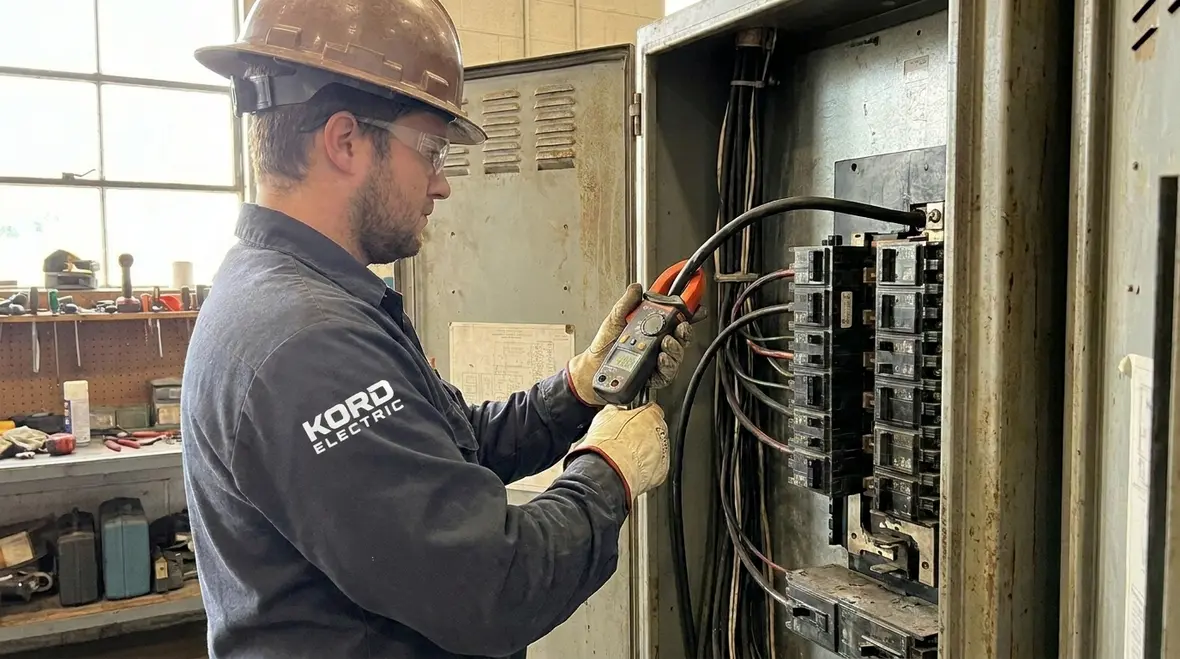
An unglamorous truth: a UPS cannot help if it cannot sustain the real runtime. Therefore, we confirm sizing against kW demand, inrush, power factor, and future growth. We also account for battery aging and temperature. Batteries do not just “wear out.” They degrade faster under heat and under repeated partial cycling.
After sizing, we emphasize testing and evidence. Our technicians perform load testing, inspect battery strings, and confirm control settings. We also verify bypass paths and make sure the UPS can transfer cleanly without dropping sensitive loads. If the site uses modular UPS units, we confirm that the modules share load predictably and that the system stays stable when one unit comes offline.
Documentation matters too, because it prevents the classic “we thought someone changed that” scenario. We keep service records, test results, and operating instructions in a form the facility can actually use. That way, during an event, others can act with confidence instead of improvising like they are on a sitcom where the lights flicker for plot.
Generators and transfer switches: the transition is the real boss fight
Most teams obsess over the source, but power continuity often lives or dies in the transition. A generator that starts slowly, or a transfer switch that hesitates, can create a gap that sensitive systems do not forgive. For commercial and industrial buildings, that gap might lead to server downtime, loss of process control, or corrupted data.
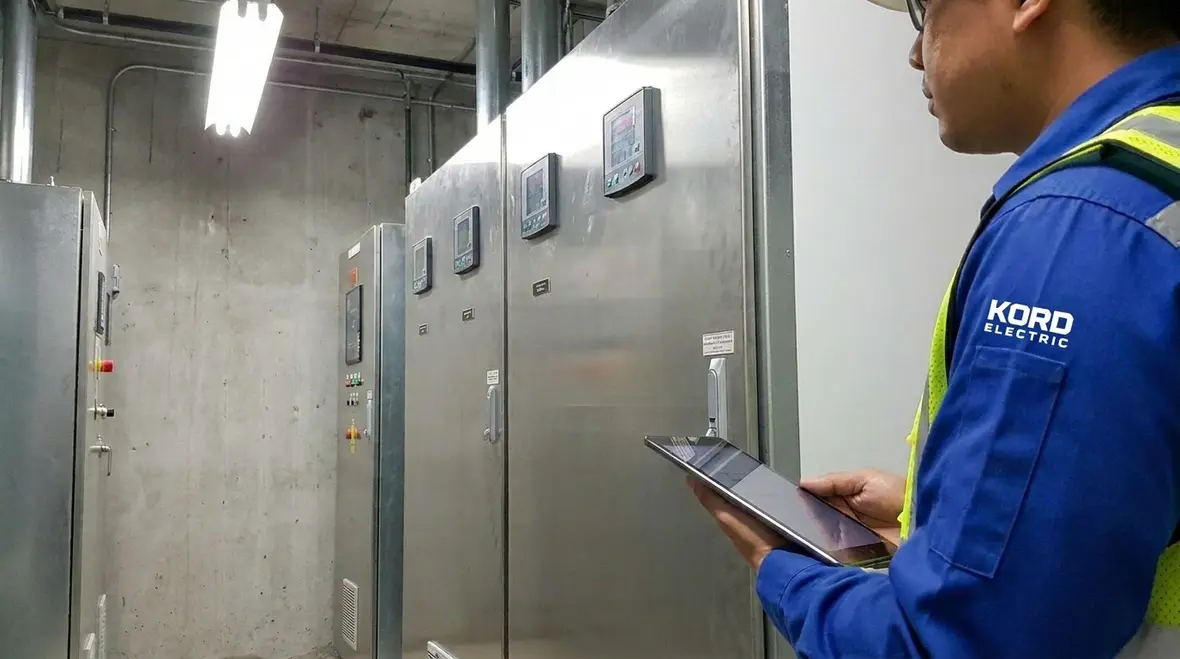
Our expert service staff focus on how the system transitions under realistic conditions. We verify generator start reliability under varying temperatures and fuel conditions. We check voltage and frequency pickup. We confirm that transfer switch timing settings align with UPS and load behavior. If the facility uses synchronization, we validate the logic that prevents harmful parallel conditions.
We also check for the “hidden time bomb” items. Fuel quality and supply matter. Coolant temperature and airflow matter. Exhaust backpressure and maintenance status matter. And of course, the switchgear condition matters. Then, because reality loves surprises, we recommend scheduled load bank tests or equivalent verification to ensure the generator performs under load, not just under theory.

Preventive maintenance that targets failure modes, not just parts
Preventive maintenance fails when it becomes a checkbox. So we design maintenance around likely failure modes: heat damage, insulation breakdown, loose terminations, corrosion in contact points, fan failures, and battery degradation. We also consider operational patterns. If a facility runs critical processes only during certain hours, the electrical system might still experience stress that does not align with simple calendar schedules.
Our technicians use a layered approach. First, we inspect and clean components that accumulate dust and moisture. Then, we measure key indicators such as contact resistance, insulation resistance, and battery health. After that, we look for operational trends using monitoring data when the facility has it.
However, we do not treat monitoring as a trophy. We teach the facility what to look for and what thresholds matter. Consequently, the team can respond early. Instead of waiting for an alarm, they can see a trend starting and fix the cause before it becomes a story everyone tells later, usually with more emotion than accuracy.
In addition, we manage maintenance for switchgear and distribution devices with care. Load testing, protection checks, and coordination reviews help prevent nuisance trips and ensure that the right breaker clears the right fault. For facilities that want deeper structure around this work, many teams also explore electrical preventive maintenance programs that keep inspections, testing, and documentation aligned across the site.
Testing, monitoring, and documentation: make continuity measurable
Data center power continuity becomes real when it is measurable. Therefore, we help facilities implement a routine that confirms performance, not just condition. That starts with clear test plans that match the equipment and site risk profile. For example, UPS load tests and battery discharge checks should reflect real operational needs. Generator tests should confirm starting, stabilization, and sustained output.
Next, we ensure that monitoring is actionable. We confirm that alarms map to real responses: who gets notified, what they should do, and how the facility can verify the system state. Our expert service staff often help define an incident playbook. Then we refine it after each test so it improves over time.
Documentation ties it all together. We include operating procedures, maintenance history, wiring and settings references, and test results. When a facility must act under pressure, this reduces decision time and prevents mistakes. It also keeps contractors, internal electricians, and facility managers aligned, like a well rehearsed team that does not rely on luck.
And yes, we also recommend periodic drills for critical staff, because when the event happens, it should not feel like the first time anyone read the plan. For facilities that want a broader strategy around uptime, resources like the data center electrical requirements for uptime guide can help align testing, coordination, and design decisions under one vision.
Dual protection layers that keep critical loads alive
Commercial and industrial sites often need more than one defense. So we build continuity as layered protection. For instance, the UPS handles short events and smooths transitions, while generators provide long duration backup. Meanwhile, distribution design and transfer schemes prevent a single failure from taking down everything.
In practice, layered protection looks like proper redundancy, careful bus and feeder configuration, and strategic segregation of critical circuits. When facilities use selective coordination, they can limit outages to only the affected branch. Also, we advise on isolation practices so maintenance does not become a surprise outage.
Sometimes, sites also need environmental safeguards. That means temperature control for UPS rooms and battery areas, airflow management, and humidity control where applicable. Because if the room runs hot, the “electrical system” becomes a thermal problem wearing an electrical hat.
Below is a practical view of the layers we commonly help align across commercial and industrial facilities.
| Power Layer | What We Verify |
| UPS and batteries | Runtime, battery health, bypass behavior, transfer performance, load testing evidence |
| Generator and fuel | Start reliability, pickup timing, sustained load output, fuel quality checks, maintenance readiness |
| Switchgear and protection | Coordination, breaker performance, insulation condition, fault clearing behavior, settings alignment |
| Distribution to critical loads | Redundancy strategy, segregation of critical circuits, maintenance mode continuity, monitoring points |
FAQ: Maintaining power continuity for commercial facilities
Conclusion: keep continuity steady with Kord Electric
If we do our jobs right, power continuity becomes boring in the best way. Still, continuity does not stay strong by accident. It stays strong through correct sizing, real testing, targeted preventive maintenance, and clear documentation that your teams can follow under pressure. Kord Electric serves commercial and industrial facilities with expert technicians who verify performance, not just paperwork. Contact us to review your power paths and build a continuity plan that keeps critical systems running when the unexpected shows up. If your site also faces power quality swings or nuisance trips, pairing this work with targeted support for voltage fluctuations in commercial and industrial facilities and structured emergency electrical services can round out your defense against unplanned downtime.
When you are ready to turn planning into action, Kord Electric can align data center power continuity with broader preventive maintenance, emergency response, and system upgrade strategies across your commercial or industrial facility so your teams can focus on operations instead of wondering what happens when the next outage tries to rewrite the script.


