

Data Center Power Redundancy Solutions
Ensuring power redundancy in data centers is not a “nice to have.” At Kord Electric, we design and support data center power redundancy solutions that keep mission critical loads online through outages, maintenance, and switch failures. We back that work with hands on technicians and expert service staff who explain every step in plain language, because downtime is expensive and confusion costs even more. In other words, we build systems that do not blink, even when the grid does. And yes, we also make sure your UPSs and switchgear do not turn into a haunted house of alarms every night.
Power redundancy that actually holds up during real outages
In commercial and industrial facilities, reliability has to survive the kind of problems that show up after hours, not the ones that look good in a training slide. So, we focus on redundancy that behaves correctly under stress. That includes scenarios like utility sag, brief interruptions, maintenance switching, breaker wear, and protection device misoperation.
First, our approach balances power paths, switching speed, and load transfer logic. A single clever design that works only in theory does not help. Therefore, Kord Electric evaluates the entire power chain from utility entry to the final distribution level. We also check how the system supports critical mechanical loads, networking gear, cooling subsystems, and controls that other teams often forget until the lights go out.
Next, we align redundancy with the facility risk level. Major property buildings and data centers may need different tolerances than smaller venues, but the method stays the same: reduce dependency, confirm transfer, and verify protection. Our technicians test and document so the system performs when seconds matter.
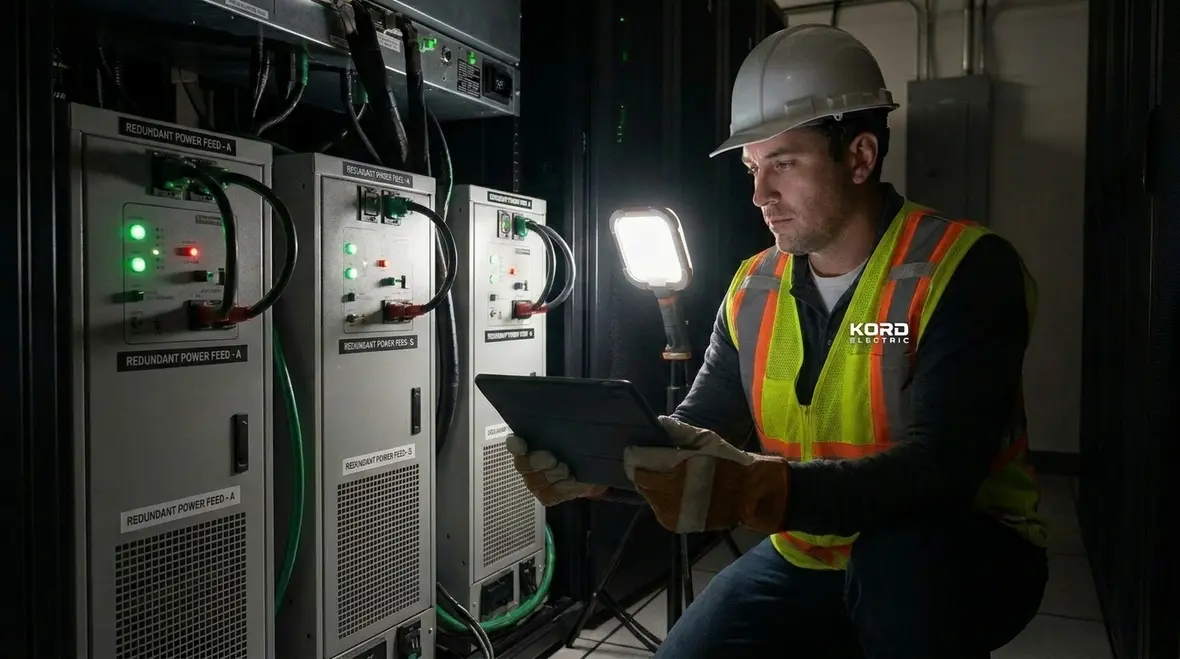
How N power paths and transfer logic reduce downtime
Many teams talk about redundancy like it is just having extra gear. However, data center power redundancy solutions must also include transfer behavior. In practice, the goal is to move power from one source to another without turning a brief event into a long outage.
We typically see these layers work together:
- Multiple upstream sources: utility feeds or diverse supply paths that lower common mode risk.
- Multiple downstream paths: parallel feeders, separate distribution routes, and separated bus sections.
- Switching strategy: closed transition or make before break where appropriate, and coordinated transfer timing.
- Protection coordination: relays and breakers that isolate faults quickly while keeping healthy sections energized.
Meanwhile, transfer logic must be designed for speed and clarity. Therefore, we review the control system settings, interlocks, and sequence of operations so staff do not have to guess during an event. And since we deal with major property buildings and high end commercial data environments, we also account for how maintenance mode affects redundancy.
One more thing: “redundant” does not mean “indefinite.” If a path fails, the system must transfer and stay stable. Our expert service staff explains the sequence step by step so operators understand what the system will do before alarms show up. Think of it as rehearsal, not just a tour.
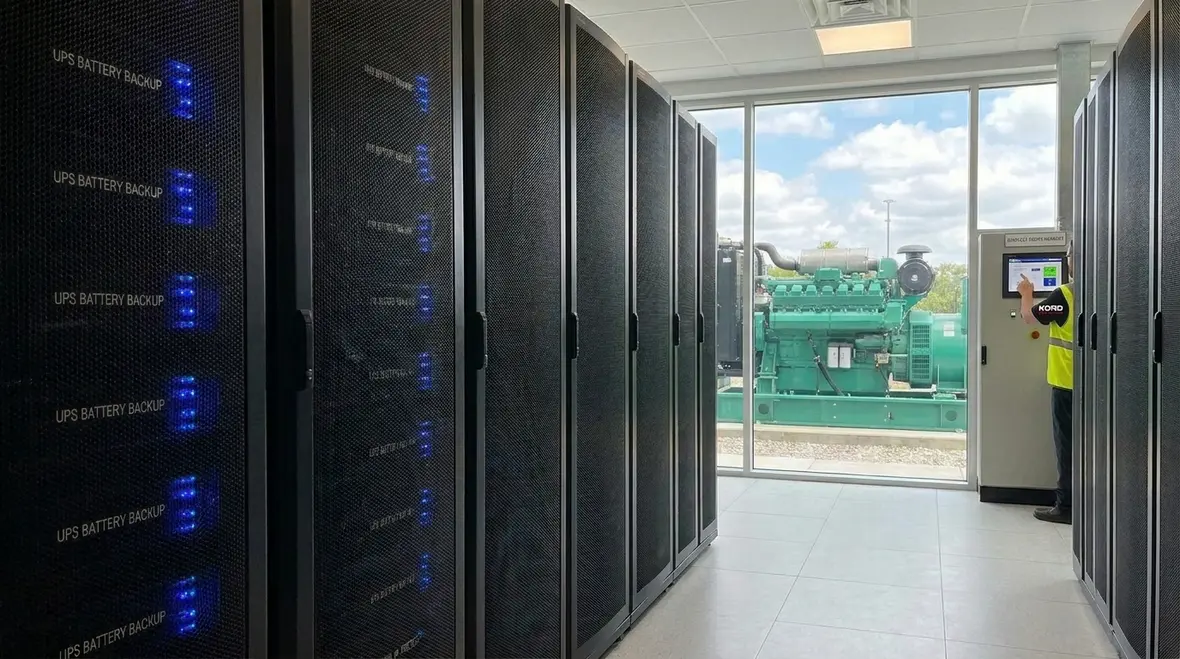
For teams who want to go deeper into how redundancy fits into the broader electrical design, this discussion pairs well with the foundational concepts in Kord Electric’s article on data center electrical infrastructure essentials, which explores how power sources, UPS systems, and distribution all work together behind the racks.
UPS, batteries, and generator coordination that keeps loads stable
Uninterruptible power supplies protect against short disturbances, while generators handle longer outages. Yet the handoff between UPS and generator is where many reliability plans stumble, especially when controls are unclear or settings drift over time.
Kord Electric coordinates UPS systems with standby generation and transfer equipment so loads experience clean power during the whole event. We focus on these practical details:
- UPS runtime and battery health: we confirm battery sizing, monitoring, and replacement schedules.
- Parallel UPS operation: we verify load sharing and fault isolation so one module does not take the whole system down.
- Generator start and acceptance: we set transfer points to avoid unstable transitions.
- Synchronization and stability: we check frequency and voltage behavior during the transition window.
And yes, this coordination is not glamorous. But it is like knowing the chorus before you walk onto stage. When the handoff happens, the facility stays on rhythm. Our technicians and expert service staff confirm the settings during commissioning and validate performance with tests that match the real load profile. That includes how critical loads draw power during startup, not just at steady state.
When you coordinate UPS, batteries, generators, and switchgear with a long-term view, you are not just protecting uptime for a single event. You are building the backbone that supports data center power redundancy solutions over the full lifecycle of the facility.
Switchgear, bus design, and protection coordination that prevent cascade failures
Power redundancy fails when protection coordination triggers the wrong device, too early or too late. A cascading outage often starts with a fault that trips more than it should, shutting down healthy sections that could have stayed energized.
To reduce that risk, Kord Electric evaluates switchgear layout, bus arrangement, and relay settings as one system rather than separate parts. We also check maintenance access and bypass logic so technicians can work safely without breaking the reliability plan. In commercial and industrial settings, that matters because downtime during maintenance can cost more than the equipment itself.
Key focus areas include:
- Selective coordination: relays trip only the segment with the fault, not the whole line.
- Coordination with upstream devices: utility breakers and protective relays must match the load and fault clearing time.
- Bus segmentation: bus zones limit the blast radius when something goes wrong.
- Breaker health and ratings: we confirm the operating duty and preventive maintenance tasks.
Additionally, we review how the system behaves with realistic fault levels. We do not assume “safe margins” just because the documents say so. Instead, our expert service staff verifies the coordination and explains the protection philosophy in plain terms. That way, the team can respond calmly when an event occurs, which is better than playing guessing games with a one line diagram like it is a mystery novel.
This is also where structured preventive maintenance plays a major role. The same principles outlined in Kord Electric’s electrical preventive maintenance services support breaker health, relay accuracy, and overall system longevity so redundancy does not quietly degrade between projects.
Testing, commissioning, and maintenance plans that keep redundancy available
Even the best design can lose reliability if it is not tested and maintained. Therefore, Kord Electric emphasizes commissioning, acceptance testing, and a maintenance rhythm that matches how your facility actually runs. For major property buildings and commercial data centers, that means planning around peak operations and access windows.
We guide clients through a practical reliability workflow:
- Commissioning with documented results: we verify sequences, alarms, and transfer behavior.
- Preventive maintenance: we align battery checks, breaker inspections, and generator servicing to manufacturer needs and observed usage.
- Testing the transitions: we confirm UPS to generator handoff and verify that controls behave the same in real conditions as on paper.
- Training for operational staff: our technicians and expert service staff walk operators through what to expect.
Then we set up a change management approach. If someone updates a panel, modifies a control setting, or swaps a component, we make sure the redundancy strategy remains intact. Otherwise, small changes can quietly reduce performance, like replacing a key part with a “similar” model and hoping nobody notices.
For many facilities, this testing and maintenance process is easiest to manage when it is folded into a broader program such as Kord Electric’s commercial and industrial electrical maintenance plans, which are built around long-term reliability for commercial, industrial, and government properties.
Monitoring and alarm strategy that helps teams respond fast
Reliability is also information. When systems generate too many alarms, operators ignore them. When alarms are unclear, operators hesitate. So, Kord Electric helps teams build a monitoring and alarm strategy that supports fast decisions without overwhelming staff.
We review how critical signals flow from UPS systems, switchgear, and generator controls into the building management layer. As a result, the right alarms surface to the right people with the right priority. For commercial and industrial facilities, this reduces reaction time and supports safe shutdown and restart steps when needed.
Our technicians also confirm that monitoring covers both hardware health and performance indicators. For example, battery condition, load levels, and transfer counts can show trends before a failure. Meanwhile, we also tune event logs so engineers can analyze what happened without digging for clues like they are solving a pop culture conspiracy, except the conspiracy is your own equipment.
And since we work with major property buildings that serve tenants, we plan alarm pathways that support communication and accountability. That means the system helps staff act, not just watch.
FAQ
Final word: build redundancy you can trust
If Kord Electric designs and maintains your system with coordinated switching, stable backup, and clear protection, your team spends less time reacting and more time operating. We bring technicians and expert service staff who explain the plan, document the results, and support the right testing and maintenance schedule. If your facility needs power that stays steady through outages and maintenance, reach out to Kord Electric today. Let us review your current one line diagram and reliability goals, then map a clean path to better uptime.
For organizations planning a broader upgrade or new build, this kind of resilient design fits naturally alongside the strategies outlined in Kord Electric’s guide to data center electrical infrastructure essentials. Together, they form a complete picture of how to build and maintain data center power redundancy solutions that support your facility from utility service all the way down to the rack.
If you are ready to turn your uptime goals into a concrete plan, explore Kord Electric’s electrical preventive maintenance services and align your redundancy design with a maintenance program that keeps it performing year after year.


