Electrical Power Outage Disaster Recovery Plan for Businesses
When the lights go out, a business cannot simply hope the grid comes back soon. Kord Electric builds an Electrical Power Outage Disaster Recovery Plan for Businesses that helps commercial and industrial facilities stay stable, protect equipment, and keep critical operations moving. In the real world, outages rarely behave politely. They last longer than expected, they repeat, and they can bring voltage swings that quietly damage motors, drives, and controls.
That is why we focus on planning before the first outage hits. Our technicians and expert service staff walk through risks, map critical loads, and help teams make fast decisions when every minute matters. And yes, we have heard the classic line, “We’ll figure it out when it happens.” That is like saying you will learn to swim after you fall in the pool. It sounds brave, but it usually ends badly.
1. Build a recovery plan that starts before an outage
To protect major property buildings, our team first treats the outage as a process, not an event. We then translate the building’s electrical reality into a clear plan your people can follow under stress. Even better, we design it so you do not need to interpret charts while the site is dark.

We begin by reviewing power history and site details such as utility feeds, switchgear type, generator capabilities, UPS coverage, and critical panel schedules. Next, we identify what must stay running and for how long. Then we match loads to the right layer of backup power so the facility does not overload any one system.
After that, we define actions and ownership. For example, someone should know who contacts the utility, who verifies switch positions, and who checks alarms. Since roles can get fuzzy during an emergency, we help organizations assign clear responsibilities and escalation steps ahead of time.
Our technicians also stress that a plan must include maintenance and testing timelines. Otherwise, it becomes a binder on a shelf, collecting dust like a forgotten cable tray.

2. Identify critical loads and protect equipment that cannot “rest”
Not every circuit needs the same response. Therefore, we help facilities separate critical loads from flexible ones. Critical loads usually include life safety systems, process control, communications, security, refrigeration for product protection, and any equipment that can trigger a shutdown cascade if power dips or fully fails.
Next, we create a practical load map. We document which panels and circuits connect to UPS, which ones can be shed during longer events, and which loads require generator support. Then we set priorities for load transfer so the facility does not start every motor at once like a theater full of actors trying to enter the stage together.
Additionally, we consider cold start and restart behavior. For industrial and commercial operations, a generator plan needs to include warmup time, transfer timing, and sequencing of high inrush loads. When those steps are ignored, engineers end up troubleshooting in the dark, which is not an ideal way to run a shift.
Finally, we factor in voltage sensitivity. Even if power returns, a sag or spike can damage sensitive electronics. So we recommend protective strategies and coordination that reduce risk after the outage ends.
3. Choose backup power layers that match real outage timelines
Many businesses rely on one solution and assume it covers everything. In practice, outages come with different durations and different problems. So we recommend layered backup that aligns with the likely timeline and the facility’s operating needs.
For short interruptions, a UPS can bridge the gap and protect controls, computers, and network equipment. Meanwhile, generators handle longer runtime needs, assuming proper sizing, fuel strategy, and transfer equipment performance. Also, facilities with specific process requirements may benefit from automatic transfer with defined sequencing and engineered load shedding.
Our expert service staff often explains it this way to clients. UPS is for “keep it stable right now.” Generators are for “keep it running long enough.” And load management is for “don’t break the system by trying to do too much at once.”
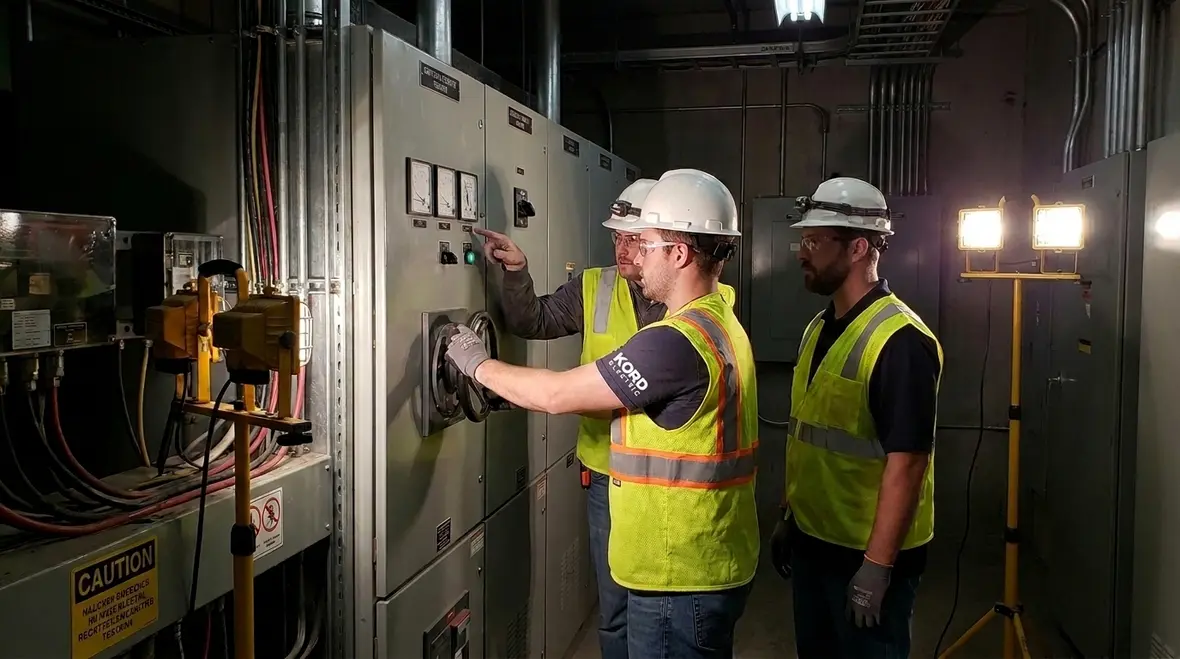
To make these layers effective, we review transfer switch operation, paralleling logic if applicable, and alarm points. Then we test scenarios so teams know what to expect when reality shows up uninvited.
4. Operational steps during an outage: who does what, in what order
When an outage hits, speed matters. However, speed without structure causes mistakes. That is why we help clients turn their electrical design into an operational playbook. We focus on actions that reduce confusion and stabilize the site quickly.
First, the team verifies the condition. They confirm utility status, check switchgear indications, and confirm whether the transfer occurred as intended. Next, they ensure that emergency loads are energized and that non critical loads remain shed if that protects runtime and equipment health.
Then comes monitoring. Facilities need to track generator start and run performance, UPS status, fuel levels, and alarm trends. In addition, we advise teams to log key times, because those timestamps help both troubleshooting and future tuning of the system.
We also include recovery tasks that happen after power restoration begins. For instance, certain loads may require staged restart, and sensitive equipment may need confirmation before full operation. We build these steps into the plan so your staff can act calmly rather than react wildly.
And yes, we sometimes joke that emergency procedures should feel boring. Like a good belt in your work pants. You do not want attention, you want reliability. Nobody celebrates an outage, but you can celebrate a smooth response.
5. Testing, training, and documentation that teams can actually use
A strong plan lives and improves through testing. Therefore, Kord Electric supports facilities with structured drills and evidence based documentation. We do not just talk about theory. We help organizations confirm that systems perform during simulated events.
During testing, our technicians verify transfer switch behavior, UPS operation, generator start timing, load shedding logic, and alarm functionality. Additionally, we review that labeling and diagrams match field conditions. If your staff cannot find the right panel because the labels are outdated, the plan fails even if the equipment performs.
We also train teams. Since our service staff works with building operators, electricians, and facility managers, we translate technical steps into clear actions. We explain what to look for, why it matters, and what to do next. Then we encourage everyone involved to practice the decision flow, including escalation and communication.
Finally, we store documentation where it can be reached under stress. You do not want emergency folders on a network share that nobody can access during a power event. So we help teams keep a simple, usable set of materials on site, alongside contact lists and asset information.
If your facility team wants to dive deeper into how testing supports reliability, our guide on emergency power system testing for commercial buildings walks through the steps our technicians use to keep backup systems ready.
6. After power returns: reduce damage, shorten downtime, and capture lessons
Restoration does not instantly mean success. After power returns, some systems can experience stress from the event, and certain loads may restart improperly if sequencing is not managed. So we guide facilities through a deliberate end phase.
First, teams inspect equipment indicators and confirm that all critical systems return to expected states. Next, we review protective device behavior and check for any indications of insulation stress, overheating, or control anomalies. In addition, we validate that the UPS transitions correctly and that generator operation ended normally.
Then we handle operational restart. We recommend staged energization for sensitive processes and motors, following the planned sequence. This reduces nuisance trips and avoids overload conditions. Also, we encourage sites to compare actual performance with the plan. If runtime was shorter than expected, that becomes data for system tuning.
Finally, we document the event details. When a facility captures what happened, why it happened, and what worked, it strengthens the next version of the Electrical Power Outage Disaster Recovery Plan for Businesses. It turns pain into a better system, not a repeat performance.
For organizations that want to connect outage performance with broader business continuity, Kord Electric’s insights on emergency power for business continuity design show how backup systems, controls, and operations work together when the grid does not cooperate.
7. Common failure points we see in major property buildings
During our work, we notice patterns that show up across many commercial and industrial facilities. For example, some teams rely on outdated one line diagrams. When the building has been renovated, the paper stops matching the panels. That mismatch costs time.
Another frequent issue involves load priorities that do not reflect real operations. A facility may protect “important” circuits on paper, but in reality, process equipment and controls need different sequencing or additional coverage. Also, fuel strategies for generators sometimes get overlooked, especially for long duration events.
We also see alarm points that do not reach the right people. If no one receives generator or UPS alerts, the system can run for longer than it should or fail to run when it should. So we help ensure alerts route to responsible parties.
And sometimes, facilities assume testing is a checkbox. Yet, without scenario based drills, the plan stays theoretical. Therefore, Kord Electric pushes for testing that mirrors likely conditions, including partial loads and real operator constraints.
Because in the end, emergencies do not care about your assumptions. They care about your preparation. Like the universe, they do not read the manual.
If your buildings span multiple sites or complex uses, reviewing your Los Angeles County electrical services with a single partner can help align backup planning, maintenance, and outage response instead of treating each facility as an island.
8. FAQ
Conclusion
If you operate a commercial or industrial facility, you deserve a recovery plan that holds up when the grid stops cooperating. Kord Electric helps you build and maintain an Electrical Power Outage Disaster Recovery Plan for Businesses by mapping critical loads, aligning backup power layers, and training the people who must act quickly. Reach out to us for a site focused review and a practical plan your operators can follow. Let us make your next outage response feel less like chaos and more like a checklist done right.
When you are ready to connect outage planning with broader resilience, explore how our emergency power recovery for business continuity approach supports long term uptime and reduces the risk of repeat surprises.