Emergency Power Failure Strategy for Facilities
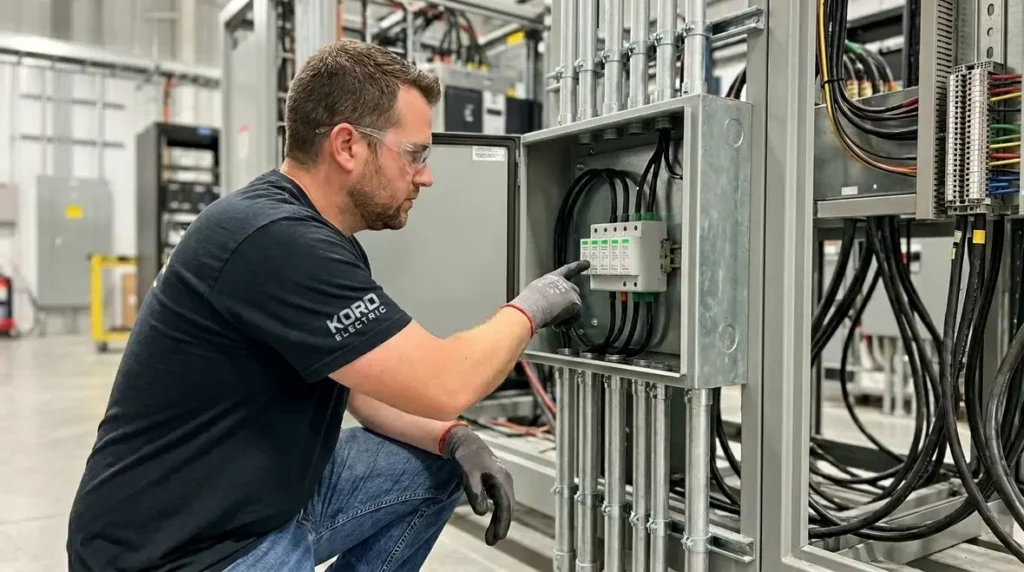
When a power outage hits, commercial facilities do not get the luxury of waiting for “later.” Kord Electric builds an emergency power failure response strategy that starts before the lights flicker. We help facilities plan how they will detect failures, protect people, and keep critical systems alive while power comes back. First, our teams map what must stay running, then we set clear roles for staff, vendors, and building operators. Next, we verify transfer paths, generator performance, and alarms through planned testing. Finally, we document the response so decisions stay fast and calm. Because, yes, the hardest part is usually not finding the outage, but finding it without panic. And nobody wants panic to be the unofficial incident commander.
Plan for the outage you hope never happens
How an emergency power failure response strategy protects your facility
In commercial and industrial spaces, power loss rarely arrives like a movie scene with perfect timing. It usually comes with noise, confusion, and a few alarms that scream louder than they should. That is why Kord Electric encourages facilities to prepare a response that does not rely on guesswork. We work with others who operate major property buildings to build a step by step playbook, so the response starts immediately, not after someone scrolls through a manual like it is a treasure map.
To make this practical, our technicians and expert service staff help identify the systems that must remain stable during an outage. Then they define how long that stability must last. For example, life safety systems and critical communications may need priority restoration, while certain non essential loads can wait. As a result, operators avoid the classic “turn everything back on at once” mistake, which can cause voltage dips and another failure.
Also, a solid plan sets expectations for what happens during each phase. It should cover the first minutes, the first hour, and the period when utilities attempt restoration. In addition, we include a communication flow for internal staff and external responders. When roles stay clear, the facility does not waste time arguing who is in charge. That is a real productivity win, and it feels better than hearing someone say “we thought you handled it.”
Map critical loads and set a smart priority order
Every commercial facility contains multiple electrical paths, and not all of them deserve equal attention during a disruption. Kord Electric helps others prioritize loads so the facility keeps what matters, first. The goal is not simply to “have power.” The goal is to keep the right power, at the right time, with the right quality.
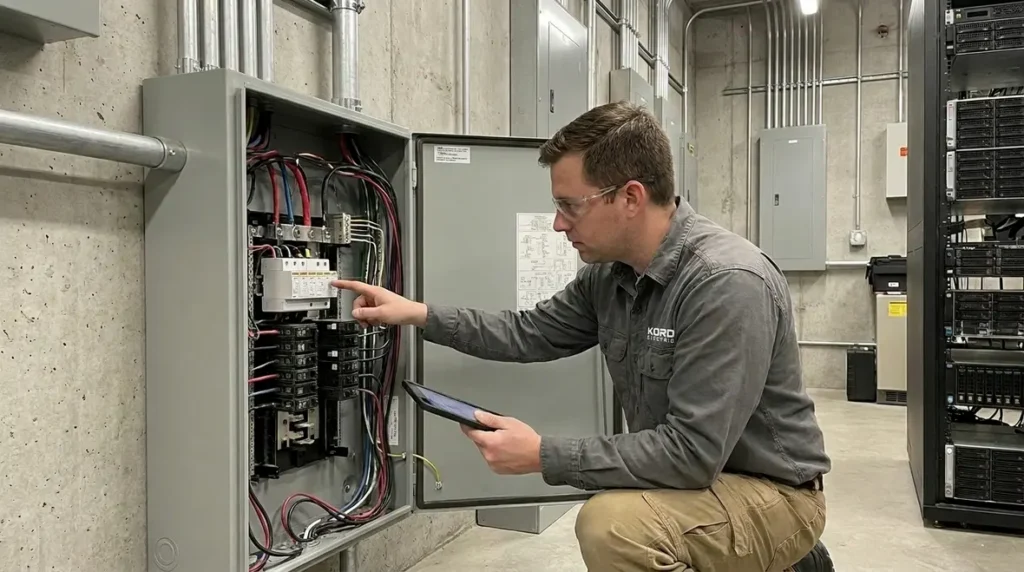
Our approach starts with a load inventory, including emergency circuits, HVAC controls, pumps, refrigeration, access control, and server spaces. Next, we rank these circuits by impact on safety, operations, and downtime cost. Then we tie that ranking to generator sizing, automatic transfer switch settings, and distribution logic. Consequently, the facility can support critical functions without overloading the backup source.
To keep the plan reliable, we also review diversity factors and real world startup loads. Motors, compressors, and large drives can pull far more current at startup than people expect. Therefore, we recommend staged restoration where possible, so the system ramps up smoothly instead of lurching like a transport truck trying to turn on a dime.
Connect load priority to your broader electrical design
When we map critical loads, we also look at how the building’s overall infrastructure behaves during stress. For modern facilities, that often means aligning the outage playbook with the kind of distribution planning covered in Kord Electric’s work on commercial electrical systems for modern buildings. The same design decisions that keep day to day operations efficient also shape how gracefully your power system rides through an outage.
Design transfer and backup reliability around real conditions
Power resilience does not come from one component. It comes from how components work together under stress. In commercial and industrial facilities, Kord Electric examines the entire chain from utility service to transfer equipment to emergency generation and distribution. We verify that the emergency power failure response strategy aligns with what the electrical system can actually do.
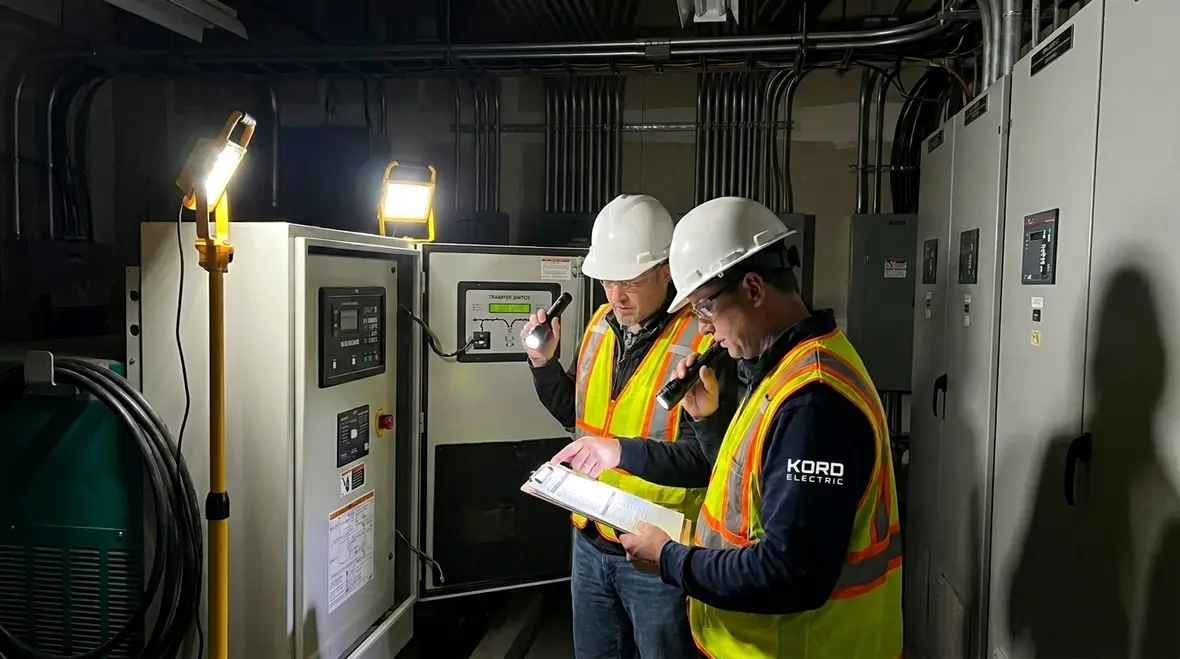
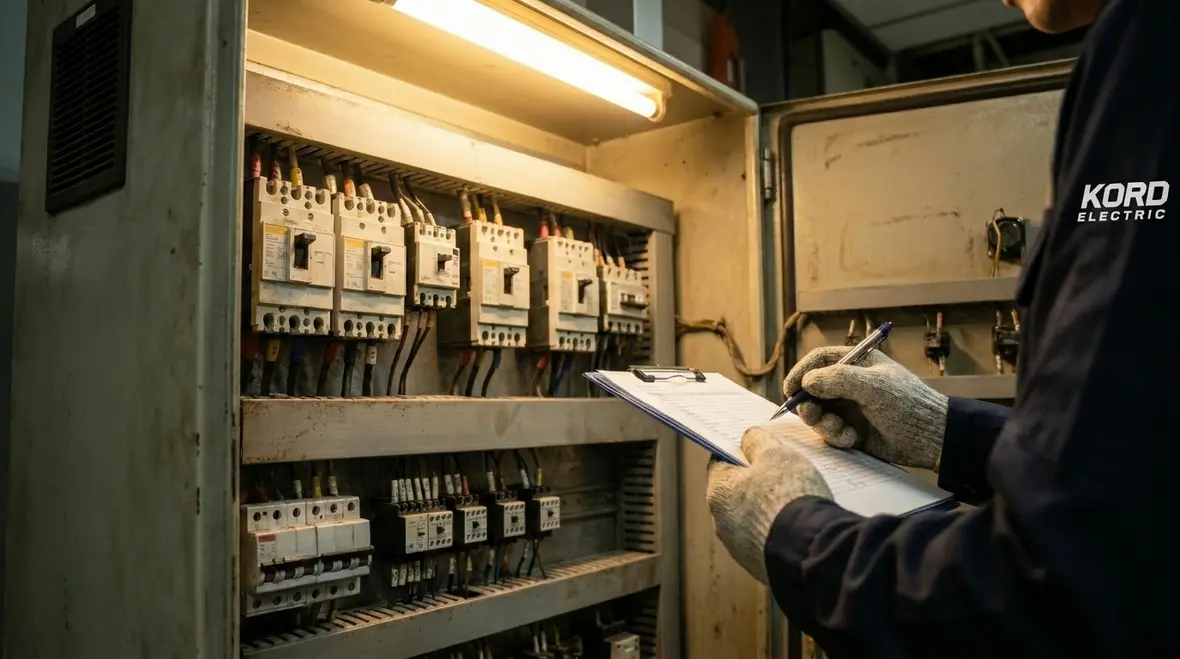
Our service team checks automatic transfer switch operation, sensing logic, and timing. We also review interlocks and breaker coordination so the facility does not face backfeed risks or unintended parallel sources. From there, we assess generator readiness, including fuel supply, exhaust routing, ventilation, and startup sequence. We then confirm that critical loads land on the backup system as intended.
Additionally, we test for failure modes. For instance, some outages look like short interruptions, others last longer, and some come with voltage instability. Therefore, the response must account for partial failures, sensor faults, and communication problems between building systems. When the plan meets the real conditions, downtime shortens and recovery feels less like solving a puzzle with missing pieces.
Match your emergency plan to modern building behavior
Many commercial facilities now include advanced controls, automation layers, and sensitive electronics that react quickly to even small disturbances. When we design and test transfer and backup behavior, we treat those systems like the modern infrastructure they are, not like a single panel in a storage room. That alignment reduces nuisance trips, protects critical data, and keeps your building’s “central nervous system” steady when utility power stumbles.
Train staff so the response stays calm and consistent
Electrical equipment matters, but human response matters too. Kord Electric works with facility managers and other building operators to create clear responsibilities for staff during an outage. We explain what will happen, what they should do, and what they should never touch. Our technicians and expert service staff deliver straightforward guidance that helps people act with confidence.
For example, we recommend training that covers alarm interpretation, when to call for help, how to preserve equipment safety, and how to support tenants or department heads. We also help leaders establish a simple decision timeline. As a result, staff do not wait for “someone senior” to appear before they act.
We also encourage practical drills. Not every drill needs to be a dramatic full evacuation. In many cases, a controlled exercise for switching procedures, generator start confirmation, and load shedding logic helps staff learn the sequence. And yes, even if a drill feels like a rehearsal from a superhero show, it still builds muscle memory. In our experience, that is what turns panic into competence.
Blend outage training with everyday electrical awareness
Facilities that already invest in broader electrical maintenance and safety training have a head start. When staff understand how their building’s power system works in normal conditions, they react faster during abnormal ones. That is one reason many commercial and industrial sites pair outage drills with preventive maintenance conversations, so teams see the direct link between everyday inspections and calm behavior under pressure.
Test, document, and improve with every incident window
An emergency plan is only as good as its latest update. Kord Electric helps commercial facilities keep their response current by setting up testing schedules and documenting results in a way operators can use. We do not treat testing as a checkbox. We treat it as feedback for the system and the plan.
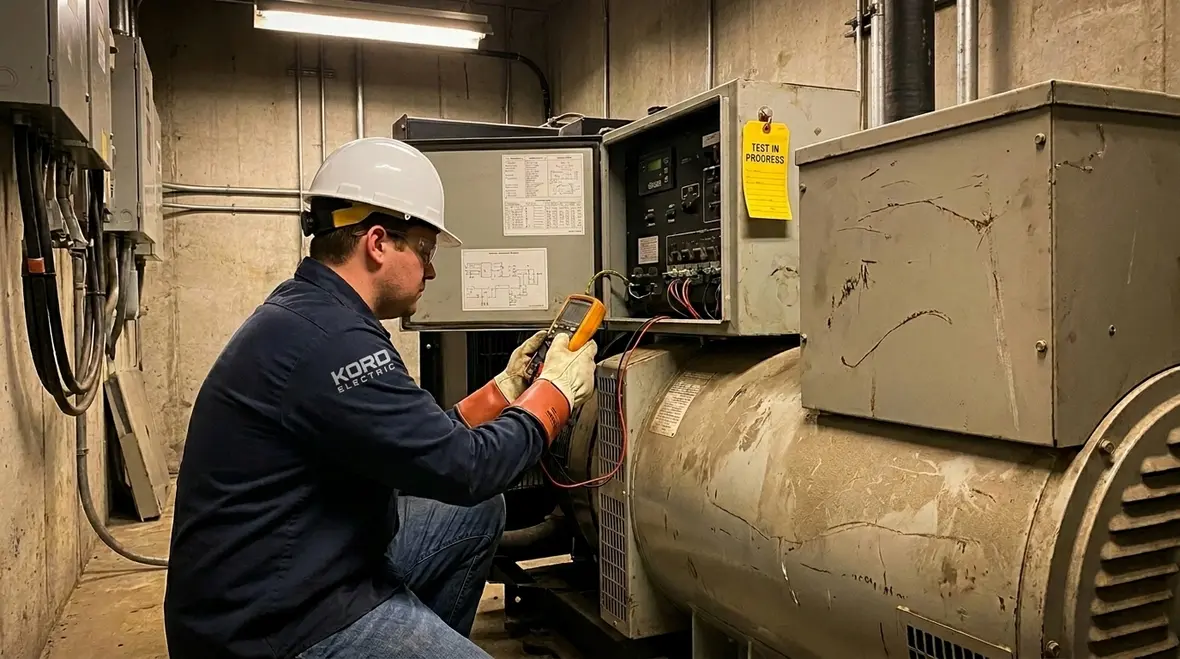
During maintenance and verification, we confirm switch operation, load transfers, alarm functionality, and battery health where applicable. We also review logs and trends. If a generator starts slowly one quarter, or if a transfer timing parameter drifts, that data tells a story. Then we adjust settings or replace components before performance slips during a real outage.
Documentation matters because outages create stress. Our expert service staff helps others keep clear schematics, equipment lists, emergency contact trees, and decision steps in one accessible location. That way, staff do not hunt for information while the building runs on hope and caffeine. Additionally, we recommend post event reviews. When restoration happens, we capture what worked, what delayed decisions, and what needs refinement. That process strengthens the overall resilience of the facility.
Turn every outage into data for the next improvement
Whether the event is a brief disturbance or a long utility failure, we treat each one as a chance to refine your emergency power failure response strategy. Over time, that cycle of testing, documenting, and updating turns a static plan into a living playbook that evolves with your facility, your tenants, and your equipment.
Coordinate with utility and vendors to reduce restoration time
Many facilities lose time because they treat outage response as an isolated building problem. But in reality, the grid and service restoration involve utilities, contractors, and sometimes tenant coordination. Kord Electric helps commercial and industrial facilities plan for those moments. We encourage a workflow that connects building response to external restoration efforts.
We support others in preparing the right information to share with the utility, including outage location details, equipment status, and timeline observations. Furthermore, we coordinate with relevant vendors for rapid parts access and troubleshooting if transfer or generation performance shows abnormalities. This reduces the time between “we think it is fixed” and “we confirmed it is safe to operate normally.”
When a major property building manages multiple tenants, coordination matters even more. Kord Electric helps establish communication paths and priorities so operations leaders do not receive mixed messages. Then, when power returns, the facility can transition loads thoughtfully instead of flooding circuits like a water main break. Calm transitions protect equipment and prevent follow up issues.
Link outage response to long-term reliability services
For many facilities, the same partners who help manage daily reliability also become critical allies during and after an outage. Coordinating utility communication, vendor dispatch, and post incident inspections through a consistent service provider keeps the story clear and the timelines short.
Dual column checklist: what to verify before and during an outage
This is a practical view Kord Electric often uses with other teams in commercial and industrial facilities. It keeps the response structured and easy to follow.
Before an outage
Confirm critical load list and priority order
Verify transfer switch settings and interlocks
Review generator readiness, fuel, and startup sequence
Test alarms, monitoring, and communication paths
Train staff on roles and decision timeline
During an outage
Follow emergency response steps immediately
Confirm safe transfer to backup power
Keep non essential loads offline when needed
Record timestamps for restoration coordination
Communicate status to internal leaders and vendors
FAQ: emergency readiness for commercial facilities
Ready to strengthen resilience for your facility?
Power failures do not wait for perfect conditions, and neither should your preparation. Kord Electric helps commercial and industrial facilities build and refine their emergency readiness plan, from load priority and transfer reliability to staff training and post event improvement. If you want a response that stays calm in the moment and improves over time, contact us today. Let our technicians and expert service staff review your current system and recommend the next steps. Your building deserves more than luck.
For facilities that want to go a step further, pairing an outage plan with structured electrical preventive maintenance helps keep generators, transfer switches, emergency lighting, and distribution equipment ready for the next incident. Together, those programs turn emergency response from a scramble into a practiced, confident routine.