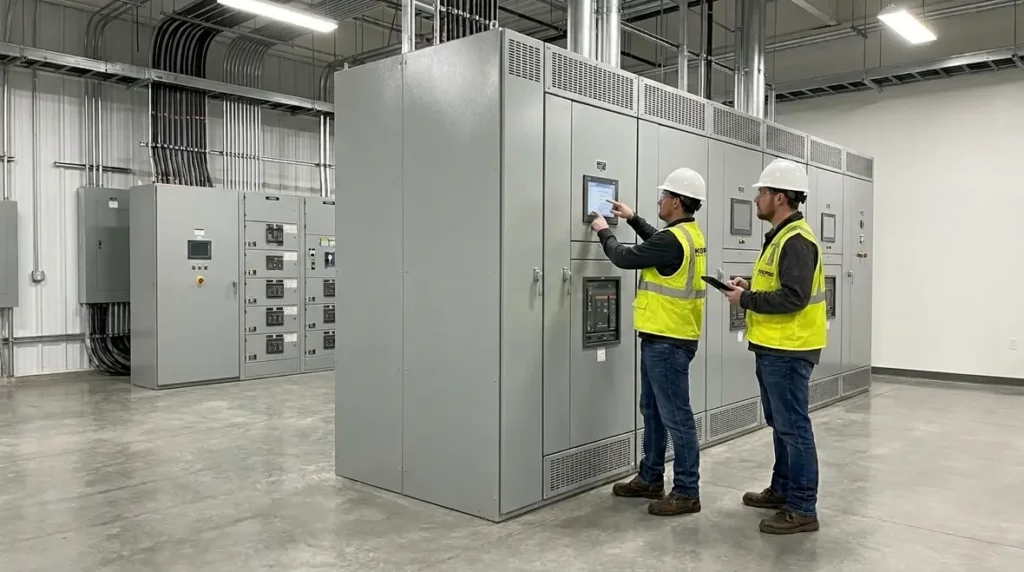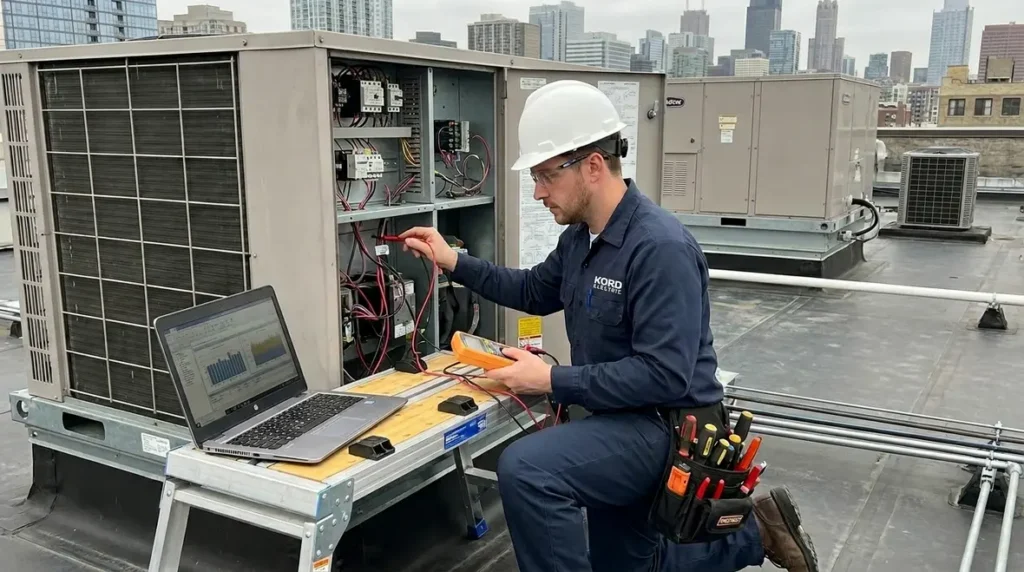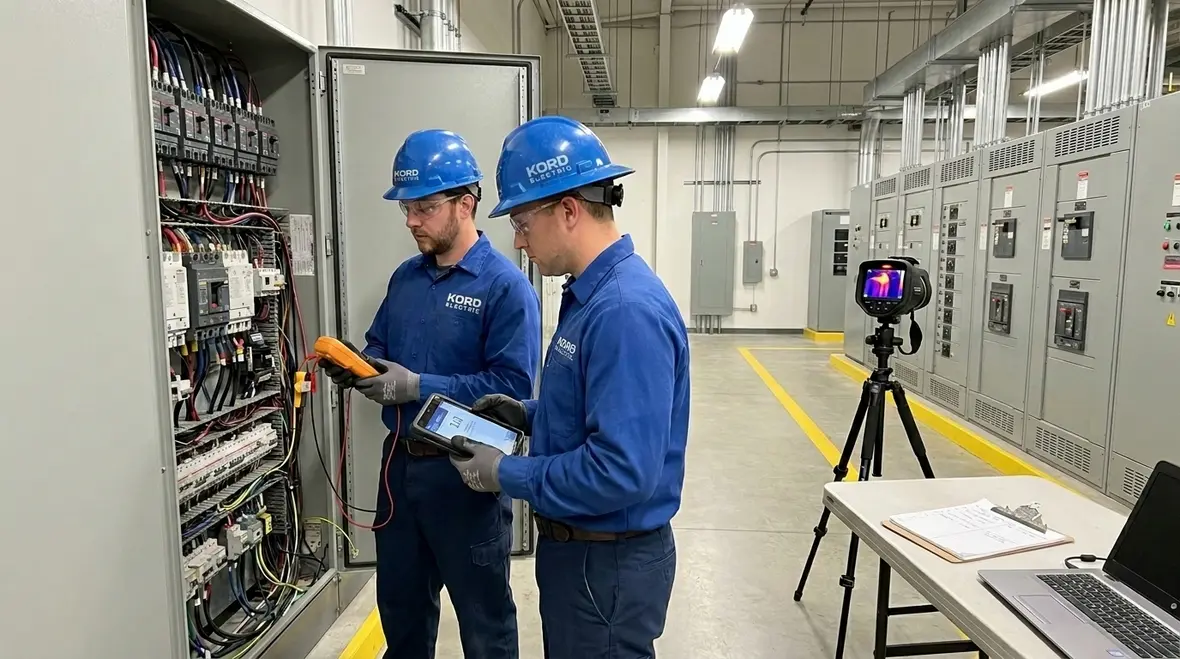
Industrial Electrical Load Balancing by Kord Electric
In commercial and industrial facilities, wasted power never stays quiet. It shows up as higher utility bills, warmer equipment, and unexpected downtime that nobody scheduled. That is why Kord Electric focuses on industrial electrical load balancing early in every project. We help others spread electrical demand across phases and feeders so motors, lighting, HVAC systems, and production lines stop fighting for the same capacity. When loads share the work, efficiency improves and protection devices stop acting like they are part of a reality TV show.
Our team then measures what the building actually does, not what the paperwork says it does. Next, we tune the distribution plan, verify performance, and document changes so operations teams can run with confidence. And yes, our technicians explain each step in plain language, because “just trust us” is not a plan.
How Kord Electric approaches industrial electrical load balancing from day one
When Kord Electric steps into a commercial or industrial facility, we treat industrial electrical load balancing as a design principle, not a last-minute adjustment. From the first walkthrough, our team looks at how power flows from the service entrance through switchgear, panels, and down to the equipment that actually earns revenue. Instead of assuming the original layout still fits today’s operations, we ask hard questions about process changes, added equipment, and future plans.
We also look at how power quality, reliability, and safety intersect. Load balancing connects to everything: thermal stress on conductors, breaker performance, transformer health, and even how comfortable your maintenance staff feels working inside electrical rooms. The goal is not just to meet minimum code. It is to give your system enough breathing room to handle heavy days without drama.
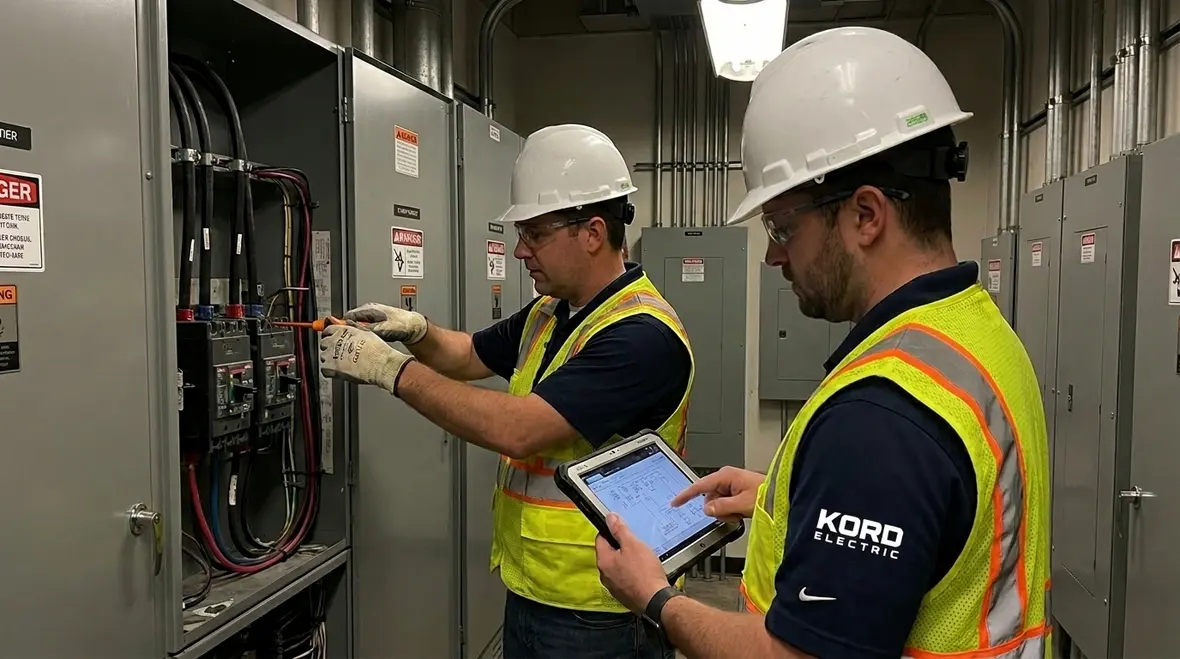
From day one, we build balancing into conversations about electrical preventive maintenance, expansion projects, and system upgrades. That way, when you later explore broader programs like commercial and industrial electrical maintenance plans, your facility already starts from a stronger, more stable baseline instead of scrambling to correct foundational issues.
Why uneven phases reduce efficiency in major buildings
In large property buildings, the electrical system often ends up with one phase carrying more current than the rest. As a result, phase imbalance increases line losses, raises conductor temperatures, and stresses transformers. Then, equipment may operate closer to its limits than designers intended.
Additionally, imbalance can trigger nuisance trips on protective devices and contribute to voltage drop during peak demand. Even when the facility “seems fine,” the hidden cost shows up in the form of reduced power quality. In other words, the building runs, but it runs harder than it should.
Also, harmonics from variable frequency drives and modern power electronics can worsen the picture. Therefore, balancing is not only about moving loads. It is about controlling how current behaves across the electrical network.
The result is a quiet drag on operations. Motors run warmer, insulation ages faster, and sensitive electronics react poorly to unstable voltage. This is the kind of problem that does not always announce itself with alarms. Instead, it shows up as premature equipment failures, unexplained reset events, and a maintenance team that keeps seeing “random” issues with no obvious root cause.
For that reason, Kord Electric treats phase balance as part of broader voltage stability work. If your facility is already watching for voltage fluctuations in commercial and industrial buildings, phase loading becomes a natural companion metric. You cannot have truly stable voltage and clean power quality without paying attention to how each phase carries its share of the work.
How we measure load demand with real, not guessed, data
Before Kord Electric moves a single circuit, we capture the truth. Our technicians review one line diagrams, panel schedules, and as built drawings. After that, they conduct field verification using power quality meters and current measurement tools.
We look at phase currents, neutral loading, and demand patterns over time. Then we check voltage at relevant busses and transformers during loading events. Since peak periods can last only a short window, we also watch trends across working hours.
Here is where our expert service staff earns their coffee. They explain what the numbers mean for your specific facility, such as why certain loads swing at shift change or why a compressor system pushes imbalance during start up. Instead of vague reports, we provide results that your maintenance and engineering teams can act on.
We also correlate measurement data with real-world operations. That might mean walking the floor during high-demand windows, watching how production lines ramp, or observing how HVAC and process loads overlap on hot days. When teams understand that a particular batch run or chiller sequence is driving uneven phases, it becomes much easier to design meaningful corrections instead of chasing abstract numbers on a screen.
Industrial electrical load balancing strategies that actually stick
Once we understand the load pattern, we design practical steps that teams can maintain. We typically start with the panels and feeders that affect the largest part of the building load. Then we work outward, so improvements do not create new problems elsewhere.
Our approach often includes the following actions:
- Redistributing single phase loads so phase current stays close to target ranges
- Rebalancing three phase equipment connections when appropriate and code compliant
- Adjusting feeder assignments to reduce conductor heating and neutral overloading
- Scheduling operational changes so high draw equipment does not stack on the same phase group
- Reviewing transformer tap settings and distribution layouts where voltage performance needs correction
- Addressing harmonic contributors by coordinating drive settings and power factor strategies
At this point, we also consider the “future problem.” People change production schedules, add tenant loads, and update mechanical systems. Therefore, we build a balancing plan that anticipates expansion and seasonal demand, not just today’s snapshot.
And if someone tells you balancing is “too complicated,” we remind them that the real complicated part is trying to fix overheating cables after the fact. Nobody wants that sequel.
To keep those strategies sustainable, we often align them with formal maintenance playbooks. For many property teams, that means tying balancing tasks into broader programs like electrical preventive maintenance. When technicians already have a schedule for inspections and testing, verifying phase loading and feeder performance becomes a natural part of the routine instead of a one-time project that everyone forgets next year.
Reducing losses and improving power quality across your system
Efficiency gains come from multiple directions. When phases balance, line currents fall toward a more even distribution, which reduces I squared R losses in conductors. Moreover, transformer utilization improves when secondary loading stays within designed ranges.
Power quality also benefits. Stable voltage improves motor performance and reduces stress on controls. In addition, better current symmetry helps limit overheating at terminations, which is a common failure point in commercial and industrial wiring.
Yet we do not stop at “balanced.” We verify outcomes. After changes, our technicians re measure phase currents and voltage levels under normal and peak operating conditions. Then we check for neutral current reductions, temperature stability, and any unexpected shifts across the distribution network.
Finally, we document the results so others in your organization can understand what changed, why it changed, and how to keep the gains alive. We treat this like operational handoff, not like a drive by inspection.
In many cases, the same data that proves improved balance also supports better conversations about reliability and risk. When leadership can see real trend lines and before-and-after measurements, it becomes easier to justify investments in additional upgrades, surge protection, or targeted repairs that further strengthen power quality across the plant or campus.
Where kVA planning, demand response, and commissioning meet
Industrial electrical load balancing becomes much more valuable when it connects to capacity planning. Kord Electric aligns electrical distribution with expected demand by reviewing kW and kVA loading, equipment duty cycles, and starting currents. This matters because motors and HVAC loads can create short but heavy demand spikes.
We also help major property buildings prepare for tighter operating rules, including demand response and energy management goals. When load profiles change, imbalance can reappear if the system was never tuned for those conditions.
That is why commissioning and ongoing checks matter. During commissioning, our service staff verifies that protective settings match the actual load behavior. Later, we recommend a schedule for re measurement, especially after renovations, new equipment installs, or control upgrades.
In many facilities, this is when teams realize the “balanced once, forever” myth. Electrical systems evolve. Therefore, we plan for evolution from the start.
Balancing also fits naturally alongside modernization work like solar integration, new lighting controls, or large rewiring projects. When upgrades change how much power flows through your system and when it flows, it is smart to confirm that capacity, protection, and phase sharing all match the new reality instead of the old blueprints.
For facilities inside and around Los Angeles County, these efforts often tie into broader multi-year roadmaps. Teams might start with targeted balancing and reliability improvements, then expand into larger projects such as system modernization, distribution upgrades, or structured service agreements with a trusted partner who understands the local grid and permitting landscape.
If your operations depend on consistent uptime and code-compliant performance across a large service area, exploring dedicated Los Angeles County electrical services for commercial and industrial facilities can help centralize support instead of patching issues site by site.
Featured FAQ about load balancing for commercial and industrial sites
Final word from Kord Electric: balance it now, thank yourself later
For commercial and industrial facilities, industrial electrical load balancing is not a “nice to have.” It is a practical way to cut losses, protect equipment, and keep operations steady during peak demand. Kord Electric schedules the measurements, explains every finding, and implements changes that hold up under real operating conditions. If your facility runs hot, trips devices, or wastes energy quietly, we can help. Contact Kord Electric today and let our expert service staff map the fastest path to efficiency for your building.
Balancing also sits comfortably beside other modernization projects you may already be planning. Whether you are investigating hidden electrical risks, mapping out long-term maintenance plans, or exploring advanced control systems for your site, a properly balanced system gives every other investment a stronger foundation to stand on.
If you are ready to take the next step, Kord Electric can coordinate load balancing with broader reliability work, ongoing inspections, and targeted upgrades so you are not constantly reacting to the next surprise in your electrical room. Address the imbalance now, and your future self, your maintenance team, and your equipment will all be grateful.