Integrated Commercial Lighting Control ROI That Lasts
Integrated Commercial Lighting Control Systems: the ROI that actually shows up on the balance sheet
When commercial facilities upgrade to an integrated commercial lighting control system, the results often arrive faster than people expect. We help property teams reduce wasted energy, stabilize operating costs, and improve how buildings respond to real work conditions. And importantly, we do it in a way that supports day to day compliance and safety needs for commercial and industrial spaces. In other words, it is not just brighter lights, it is smarter control from the moment the system starts running.
In this article, we walk through how others in our field estimate ROI, what technicians and expert service staff at Kord Electric look for in the field, and why the payback story changes when controls work as part of the whole electrical and facility plan. Also, no, this is not the kind of ROI that disappears after the first quarter like a dropped phone in a couch. We plan for the long term.
Start with the right baseline for ROI in commercial and industrial buildings
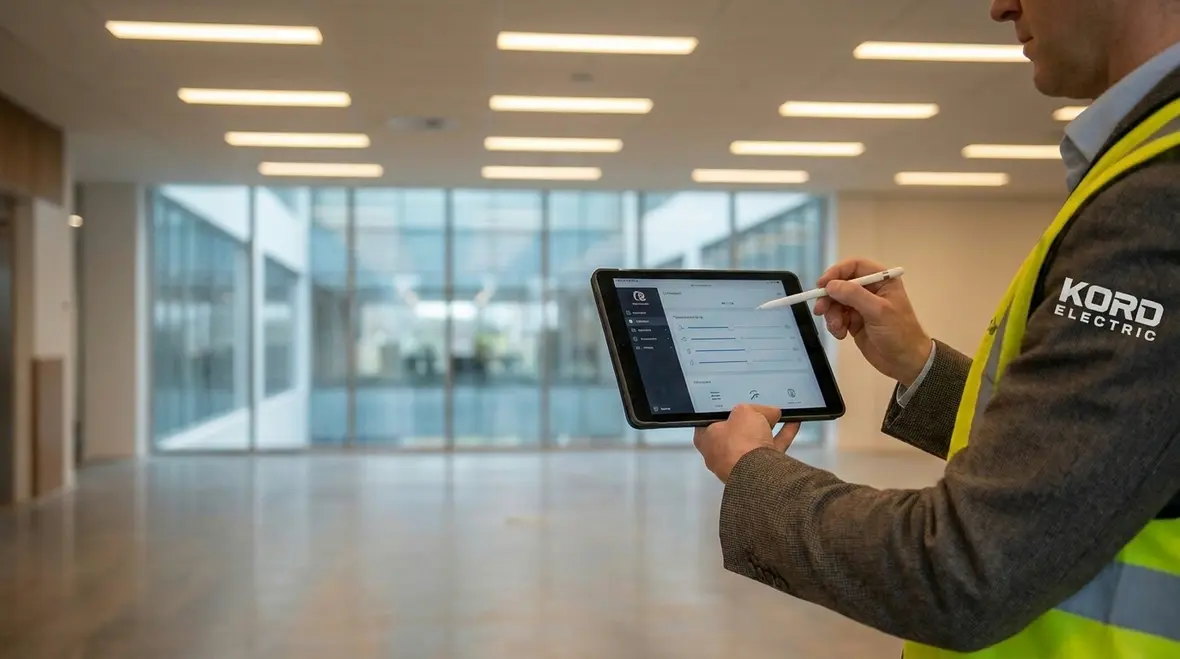
ROI begins before any hardware gets installed. First, we help teams measure current lighting energy use, schedules, and overrides. Then we compare that to how the space should behave once controls run automatically. However, a baseline that ignores how people actually use the building can lead to a false payback number. In our experience, teams often underestimate how often lights stay on during empty hours or when daylight does most of the work.
At Kord Electric, our technicians and expert service staff review the site workflow, not just the electrical drawings. They look at occupancy patterns, lighting types, zoning, switching behavior, and tenant or department needs. From there, we build an ROI model that includes both energy savings and operational improvements, like less manual switching and fewer service calls caused by incorrect schedules.
To make ROI real, we also account for the costs that come with installation and commissioning. And we do it with a focus on commercial and industrial facilities and major property buildings, where downtime and performance matter. If a building’s control logic cannot handle real usage, the numbers get shaky. We design for the way the building runs, not for the way a spreadsheet wishes it ran.

Energy savings come from control, not just dimming
Many teams assume lighting savings mean only dimming. That is partly true, but the biggest gains usually come from a layered approach. When the system manages occupancy, daylight, schedules, and scenes, each layer prevents wasted light at the right time. For example, daylight harvesting can reduce output near windows. Occupancy sensing can dim or shut off spaces that sit idle. Scheduling can align lighting to shift work, cleaning, and after hours requirements.
Then there is the integration piece. When controls connect with broader building systems, we avoid duplicated effort and reduce conflicts. For instance, lighting can follow occupancy signals while still maintaining local control for quick response. As a result, the commercial lighting control system benefits expand beyond energy and into comfort and consistency.
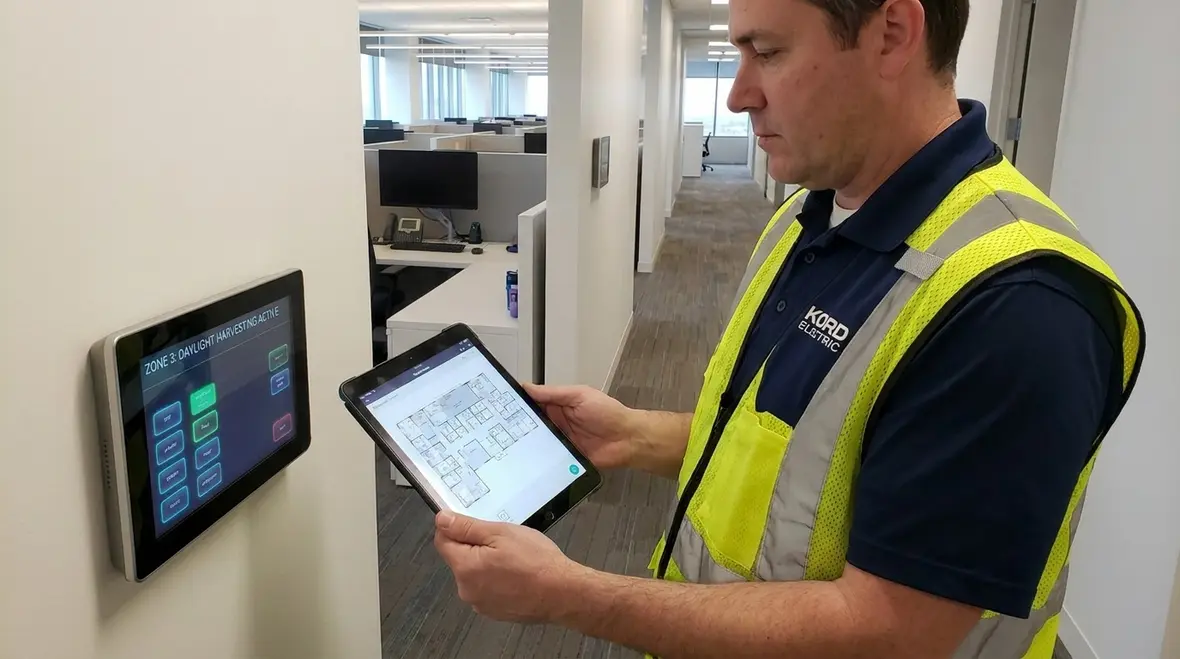
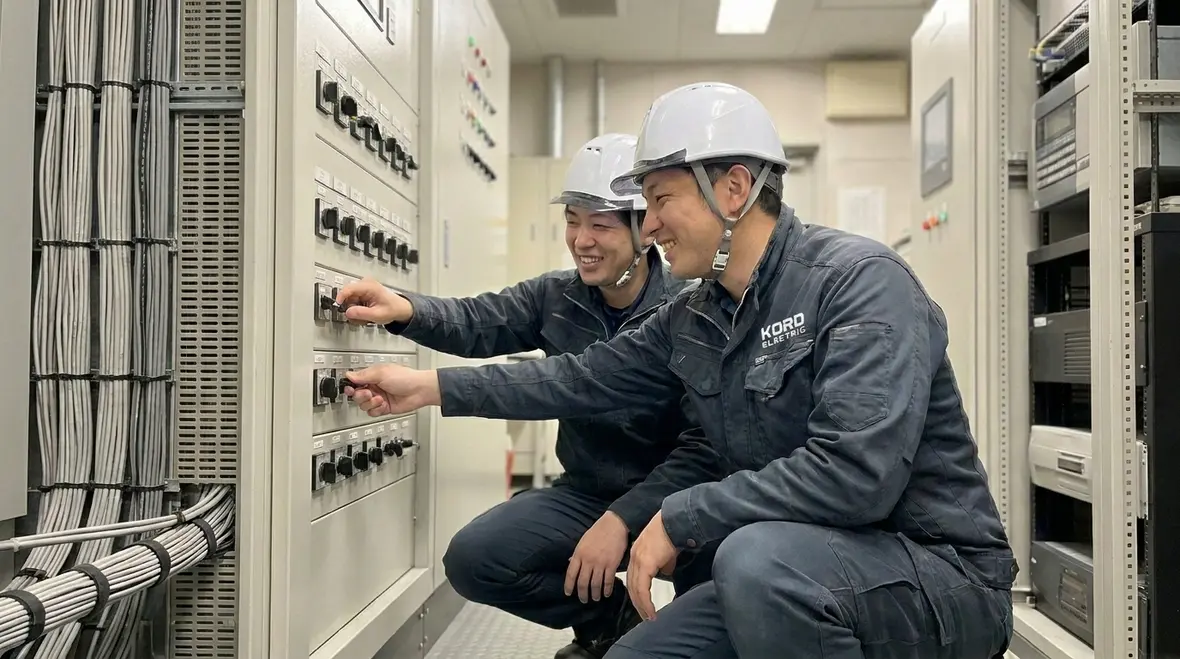
Our technicians explain the logic during commissioning so facility teams understand what they are seeing. And yes, we keep it simple. Nobody needs a PhD to know why a hallway dims at 2 a.m. and returns to full output when someone walks in. We show them, we test it, and we document it so operations teams do not guess. Guessing is fine for trivia night, not for building systems.
Operational payback: reduce calls, confusion, and “manual overrides”
ROI in large buildings includes more than kilowatt hours. When lighting systems stay stuck on high output, facility teams spend time fixing schedules, chasing complaints, and resetting devices. Likewise, if overrides exist without clear rules, people defeat the system because it feels “easier” in the moment. That is where we earn our keep.
We help property teams implement practical control strategies. We set zones that match how spaces get used. We configure occupancy behavior to avoid nuisance switching. And we tune daylight response so lighting does not “hunt” as sunlight changes. Then our expert service staff trains maintenance and operations personnel to adjust settings correctly without breaking the system.
That training matters because the ROI story often improves after handoff. When people understand the system, they stop trying to manage lighting like it is 1998. They stop using phone calls as a control interface. They stop turning off automation because it feels mysterious. Instead, they use the system’s intended functions, which protects savings and reduces recurring labor.
Transition matters here. When we move from planning to installation, we keep communication clear so the right people know what changes and when. Next, we commission and validate performance. Finally, we provide ongoing support for commercial and industrial facilities and major property buildings so the system keeps paying dividends.
Compliance and electrical planning drive long term value
Commercial lighting projects also live inside a compliance environment. Our teams stay grounded in the National Electrical Code approach and how it applies to modern control components and wiring methods. If your facility upgrades lighting controls without regard to code details, you might save money on day one and lose it on day two when inspections or retrofits show up.
For 2026, the National Electrical Code continues to evolve in how it addresses electrical systems in real buildings. In our blog on understanding NFPA 70 and the National Electrical Code for 2026, we explain how code requirements affect installation choices, equipment listing, and the ways wiring and control pathways get treated within an electrical system. That matters because integrated controls require correct design so the system remains safe under normal operation and during fault conditions.
Accordingly, we do not treat compliance as paperwork. We treat it as part of performance. It helps prevent inconsistent operation, unexpected interlocks, and fragile installations that fail under long term use. And when compliance gets built in, ROI becomes steadier, because the system remains in service without constant repairs or rushed fixes.
We also make sure our technicians can explain what was installed and why. If a facility manager needs clarity for a future project, they can get it quickly because the documentation and commissioning notes stay organized.
Upfront cost versus payback: what we see in real projects
Upfront costs vary by building size, lighting inventory, control complexity, and the level of integration desired. Nevertheless, ROI typically improves when teams avoid half upgrades. For example, partial control implementation in only one floor can help, but whole building strategies often create larger energy and operational gains through consistent scheduling and occupancy logic across zones.
We also recommend planning for growth. Major property buildings often change tenants, layouts, and usage patterns. When controls support scalable zoning and flexible scene management, the facility team spends less money reworking controls after changes. That means ROI keeps going. And it stays easier to manage because the system already reflects how the building evolves.
In many cases, teams also see improved tenant satisfaction. Lighting behaves predictably, glare reduces, and work areas feel right. That can matter when leases renew or when property managers manage multiple departments. In short, the ROI story becomes broader than energy.
Still, every project needs a careful calculation. Transition from estimating savings to confirming savings happens during commissioning and post start up verification. We validate that the system performs as designed. Then we adjust where needed so the energy model matches reality. And we do this before savings turn into regrets. Nobody wants regret, it costs interest.
Dual column view: common ROI inputs and the outcomes we target
|
ROI input we measure |
Outcome we target |
|
Current lighting schedules and after hours usage |
Fewer lights left on by default and better alignment to real occupancy |
|
Daylight exposure near windows and skylights |
Daylight harvesting that reduces output smoothly without annoying flicker |
|
Occupancy patterns by zone and time of day |
Automatic dimming or shutoff when spaces sit idle |
|
Override behavior and manual switching volume |
Clear logic and training so overrides do not erase savings |
|
Commissioning test results and adjustment needs |
Verified performance so the savings model matches operations |
FAQ: quick answers for facility leaders
Make your lighting upgrade a calm, measurable win with Kord Electric
If you manage a commercial or industrial facility, you deserve a lighting upgrade that pays back without headaches. At Kord Electric, we assess your baseline, design zoning that matches how your building actually works, and commission the system so the commercial lighting control system benefits stay real after installation. Our technicians and expert service staff explain the controls clearly and support your team through handoff. For teams planning broader improvements, our Los Angeles County commercial electrical services support integrated projects that tie lighting into a wider electrical strategy. Reach out today for an ROI focused evaluation, and let us turn wasted light into controlled value.
When you are ready to move from planning into implementation, you can also explore how dedicated lighting installation services support new construction, retrofits, and upgrades across large facilities. Aligning design, controls, and compliance from the start keeps ROI steady, inspections calm, and day to day operations predictable.