

NEC Disconnecting Means Identification Code: Why It Matters
At Kord Electric, the workday revolves around one core mission: keeping commercial and industrial facilities safe, compliant, and ready for whatever the next shift, project, or inspection brings. In plain language, the NEC disconnecting means identification code exists so workers can locate and operate the correct disconnecting means for each piece of equipment without guessing. Guesswork might be acceptable in pop quizzes and sitcom plot twists, but in electrical rooms it turns into unnecessary risk. That is why identification is treated as a deliberate, disciplined part of electrical safety, not a cosmetic detail.
Third person in tone but first person in practice, Kord Electric’s expert service staff and technicians explain this standard the way it should be explained: calm, clear, and actionable. The goal is for a field technician to apply it without needing a thousand-page manual. In this guide, the focus lands on NFPA 70 Section 110.22, which addresses identifying disconnecting means, and connects it directly to daily facility operations, common labeling mistakes, and corrective strategies that prevent those mistakes from turning into safety incidents or inspection problems.
NFPA 70 Section 110.22 explained for commercial and industrial teams
NFPA 70 Section 110.22 exists for a simple, high-stakes reason: people in the field must be able to locate and operate the right disconnect quickly and correctly. When a technician responds to a problem, the objective is not “search until the lights come back.” The objective is “open the correct disconnecting means, confirm the electrical condition, and move safely through the work process.”
To follow Section 110.22, every facility must identify each disconnecting means for equipment in a way that lines up with how workers actually read, navigate, and interpret the physical installation. That means the identification must be clear, durable, and unmistakably tied to the specific equipment or loads it controls. A label that looks neat but points to the wrong unit is worse than no label at all.
Experienced technicians emphasize that this requirement is not about presentation or decor. It is about cutting down human error, reinforcing safe lockout and tagout workflows, and helping emergency responders understand which disconnects control which systems even when time is short and stress is high. The code is not the risk. The real risk appears when labels look compliant at a distance but do not match the field reality when a worker reaches for the handle.

When commercial and industrial teams understand why NFPA 70 Section 110.22 is written the way it is, they begin to see identification not as another box to check, but as a daily operational safeguard. That mindset lines up neatly with the broader code-conscious approach Kord Electric brings to projects across Los Angeles County, including code upgrade work and National Electrical Code education featured in their in-depth explainer on understanding NFPA 70: the National Electrical Code explained for 2026 at the Kord Electric blog.
What “identifying disconnecting means” means on the job site
On the job site, identifying disconnecting means is not an abstract phrase. It means every disconnect associated with equipment has an identification method that unambiguously connects it to the loads it serves. The identification must allow workers to locate, verify, and operate the correct device without guesswork, back-and-forth phone calls, or risky trial-and-error attempts.
In real facilities, disconnecting means live in panels, enclosed switches, motor control centers, switchboards, and stand-alone disconnect boxes. Confusion typically surfaces after upgrades, tenant improvements, and fast-paced production changes. A company replaces a motor, adds a VFD or soft starter, reroutes a circuit, or swaps out a piece of equipment; the electrical work gets done, the power flows, but the labels never quite catch up. The disconnect appears to match, the legend feels familiar, yet the underlying connections tell a different story.
Kord Electric teams see this pattern during commissioning, periodic maintenance, and targeted electrical troubleshooting in Los Angeles County and beyond. They encounter partial labeling, panels with handwritten notes taped over faded legends, or labels that stack on top of each other until nobody quite trusts what they see. Over time, workers start treating labels as suggestions instead of instructions, which undercuts the entire intent of Section 110.22. In those rooms, “close enough” quietly becomes the norm. Kord Electric’s position is simple: accept only clear identification that matches how power actually flows.
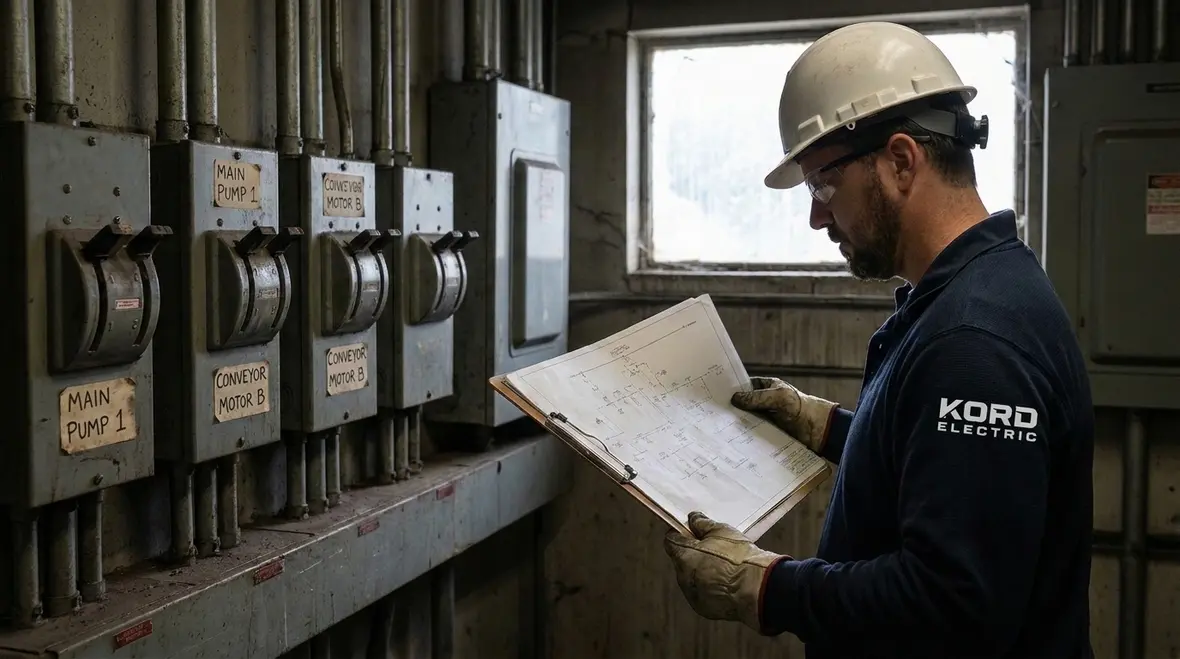
Viewed through this lens, the NEC disconnecting means identification code is not a distant legal requirement. It is a practical tool that tells every technician, operator, and contractor where to place their hands and where not to place them when something needs to be isolated, serviced, or restored.
Common failure points our expert service staff sees during audits
During audits, commissioning work, and preventive maintenance site walks, Kord Electric’s expert service staff repeatedly encounter the same disconnect identification problems across data centers, warehouses, manufacturing floors, and large mixed-use properties.
First, labels simply do not hold up to the environment. Installers sometimes use materials designed for office cubicles rather than electrical rooms, rooftops, or mechanical spaces. Heat, dust, and humidity gradually turn once-clear labels into a smudge or a ghost outline where text used to be. Under poor lighting or emergency conditions, that faint text might as well be invisible.
Next, labels land in all the wrong places. A disconnect might have its identification on the side of an enclosure that requires a worker to lean deep into a congested area or open a door into an awkward, potentially unsafe posture. In some cases, the label lives on the inside surface of a door that must be opened just to read it, undermining the goal of being able to verify the disconnect’s purpose before an operator moves anything.
Then there are labels copied from outdated drawings that never accurately reflected the final installation. Over years of changes, those labels become artifacts of an electrical past nobody remembers. As ownership changes, tenants shift, and equipment gets repurposed, the gap between the label and the load widens until it turns into a real hazard.
Shared disconnects introduce another category of risk. Some facilities still rely on one disconnect to serve multiple loads, or they group several disconnects around one cluster of equipment without clear mapping. If identification only reads “equipment,” it might as well read “good luck” when a worker is under pressure. In those moments, specificity is not a bonus feature; it is the backbone of safe operation.
Field modifications also create an electrical “history book with missing pages.” Breakers get swapped, feeders move to new terminals, and additional raceways appear as fast-track projects go live. Without a deliberate labeling strategy anchored to the NEC disconnecting means identification code, rooms that once felt organized turn into puzzles. Kord Electric frequently finds labels that still say “Unit A” while the equipment nameplate now reads “Unit 1.” That may sound minor in a quiet office, but on a job site during a shutdown, it is a direct path to isolating the wrong asset.

These failure points show why experienced facility teams increasingly pair labeling reviews with broader reliability work such as preventive electrical maintenance and targeted panel upgrades. When those efforts align, the result is a power system that not only behaves correctly but also explains itself clearly through consistent identification.
How we implement NEC disconnecting means identification code in labeling plans
Kord Electric treats labeling as an integral part of the electrical system, not as a final step to rush through before an inspection. Implementing the NEC disconnecting means identification code starts with a structured plan that connects equipment names, locations, and circuit functions into a single, understandable picture for facility teams.
For facilities that need a labeling refresh, technicians begin by mapping each disconnecting means to the equipment or distribution it controls. That mapping is not based on assumptions or fragments of old drawings; it is anchored to current field verification. From there, the team compares actual conditions to the latest as-built documentation, closing gaps and capturing any undocumented modifications discovered along the way.
Only after the real relationships are confirmed do they apply durable identification. Formats are kept consistent with how people already navigate the space: panel names that match logbooks, equipment names that match work order systems, and directional cues that make sense when someone steps into the room for the first time. Visibility, contrast, and placement all get deliberate attention.
In many projects, Kord Electric coordinates with operations and maintenance teams so labeling updates align with scheduled access windows and outage planning. A perfect label on a disconnect that nobody can safely reach is not considered a win. Instead, the focus stays on a combination of safe access, high readability, and operational alignment. Generic phrases like “miscellaneous load” are deliberately avoided in favor of equipment-specific identification that tells a worker exactly what will be affected.
Across large properties, the same mindset used for life safety systems, fire pump rooms, and emergency power applies to disconnect identification. Kord Electric’s electrical teams mirror the clarity and readiness emphasized by allied fire and life safety organizations, ensuring that when someone reaches for a disconnect, they are not relying on lucky guesses but on a code-informed identification strategy.

This approach ties neatly into other Kord Electric resources on design, maintenance, and code upgrades. When combined with services such as electrical panel upgrades and preventive maintenance programs, disconnect identification becomes part of a larger reliability framework rather than an isolated to-do item before inspection day.
Dual column guidance for compliance teams and field technicians
In most organizations, compliance teams tend to think in terms of code sections, drawings, and documentation, while field technicians think in conduits, enclosures, and the path their feet take through an electrical room. To bridge that gap, Kord Electric often uses a simple crosswalk that everyone can understand when planning disconnect identification upgrades in commercial and industrial facilities.
| Step | What happens in the field |
| Map equipment to disconnect | Technicians verify control relationships hands-on, checking that each disconnect truly serves the equipment the documentation claims it does, so identification reflects real operation rather than old assumptions. |
| Set identification format | The team chooses clear naming and numbering conventions that maintenance crews already recognize and then applies them consistently across panels, rooms, and buildings. |
| Apply durable labels | Labels are installed where workers can see them without unsafe access, using materials designed for electrical environments, not just office conditions. |
| Confirm readability | After enclosures are closed and equipment is back in normal position, technicians review line of sight, contrast, font size, and wording to ensure identification is easily readable in real-world lighting. |
| Document updates | Changes are recorded in drawings, schedules, and maintenance systems to prevent “label drift” and keep future upgrades aligned with the real configuration. |
This kind of step-by-step alignment allows compliance staff to show how they are meeting the NEC disconnecting means identification code in a documented way while giving technicians a layout they can trust when they are staring down a row of similar-looking disconnects during a live call.
Safety, troubleshooting speed, and why inspectors care
Proper electrical identification under NFPA 70 Section 110.22 supports three pillars of facility performance: safety, troubleshooting speed, and smoother inspections. When workers can find the right disconnect quickly, they reduce exposure time, minimize the chance of operating the wrong circuit, and support safer lockout and tagout procedures. That is true during planned maintenance and even more important under abnormal conditions.
Improved identification also means faster, cleaner troubleshooting. When an equipment fault appears, teams can isolate the affected circuits while keeping the rest of the facility energized. After isolation, they can verify conditions, perform targeted testing, and restore power in a controlled way. In commercial buildings, that speed directly influences lease satisfaction and revenue; in industrial environments, it protects entire production schedules.
Inspectors pay close attention to disconnect identification because it reveals how seriously a facility treats worker safety and code compliance. They look for labels that are accurate, legible, durable, and logically placed. Where disconnects are well marked and aligned with actual field conditions, inspections tend to move forward without friction. Where identification is vague, inconsistent, or outright wrong, it creates a straight path to correction orders, follow-up visits, and unplanned downtime.
There is also a human factor. Electrical rooms should not feel like treasure hunts. The “treasure” is the power that keeps your operation running, and the map should not be a faded label that sends technicians down the wrong path. A well-labeled room replaces guesswork and improvisation with confidence, clear steps, and safer work practices.
For teams that manage complex properties and want their inspections to feel predictable instead of adversarial, aligning disconnect identification with the broader Los Angeles County electrical services Kord Electric provides gives them a single partner to handle code questions, field execution, and documentation together.
FAQ about NFPA 70 Section 110.22 and disconnect identification
Facilities often share the same practical questions when they begin reviewing disconnect identification. Instead of leaving those concerns scattered across emails and meeting notes, it helps to collect clear, repeatable answers that maintenance teams, safety managers, and leadership can all reference.
Call Kord Electric for disconnect identification that holds up
Kord Electric helps commercial and industrial facilities get disconnecting means identification right the first time and keep it right as systems evolve. Technicians and expert service staff map equipment to disconnects, verify field conditions, and install durable, code-conscious identification that supports safer shutdowns, faster troubleshooting, and inspections that feel more like confirmation than confrontation.
If your electrical rooms feel like they run on “maybe” instead of certainty, or if past projects have left you with a mix of hand-written notes, faded labels, and outdated legends, it may be time for a structured review grounded in the NEC disconnecting means identification code. Kord Electric can walk your spaces, align labels with reality, and document the results so everyone from technicians to inspectors sees the same story when they open a panel or stand in front of a disconnect.
For organizations that operate multiple buildings or complex facilities across Southern California, Kord Electric’s broader programs, including dedicated Los Angeles County electrical services, tie disconnect identification into a complete strategy for power reliability, code compliance, and long-term safety. That means one team that understands your equipment history, your priorities, and your risk tolerance, whether the request is a single label fix or a full-system labeling overhaul paired with panel upgrades and preventive maintenance.
Instead of waiting for the next inspection or unplanned outage to expose weak spots in your identification, you can choose a partner that treats clarity as part of the infrastructure. Kord Electric stands ready to turn confusing electrical rooms into readable, code-aligned environments that support every shift, every restart, and every future project.


