NEC Electrical Panel Requirements for Compliance
Kord Electric often gets called in after a building owner hears the words “code compliance” and suddenly forgets how to sleep. Yet the NEC electrical panel requirements matter long before an inspector shows up. In the first place, the National Electrical Code sets rules that building owners must understand, including how equipment must be rated, installed, and labeled. And just like a good movie plot, it all connects: panel access, working clearances, conductor termination practices, grounding and bonding, and breaker selection have to line up. If they do not, problems tend to grow legs, walk through the building, and show up as nuisance trips, heat damage, or worst case, fire risk.
Because Kord Electric works with commercial and industrial facilities and major property buildings only, our approach stays focused and practical. Our technicians and expert service staff explain what the requirements mean in real terms, not in vague buzzwords. And yes, we will tell you what to fix, but we also explain why it matters, because ignorance is not a safety feature.
What the NEC requires for panel location and access
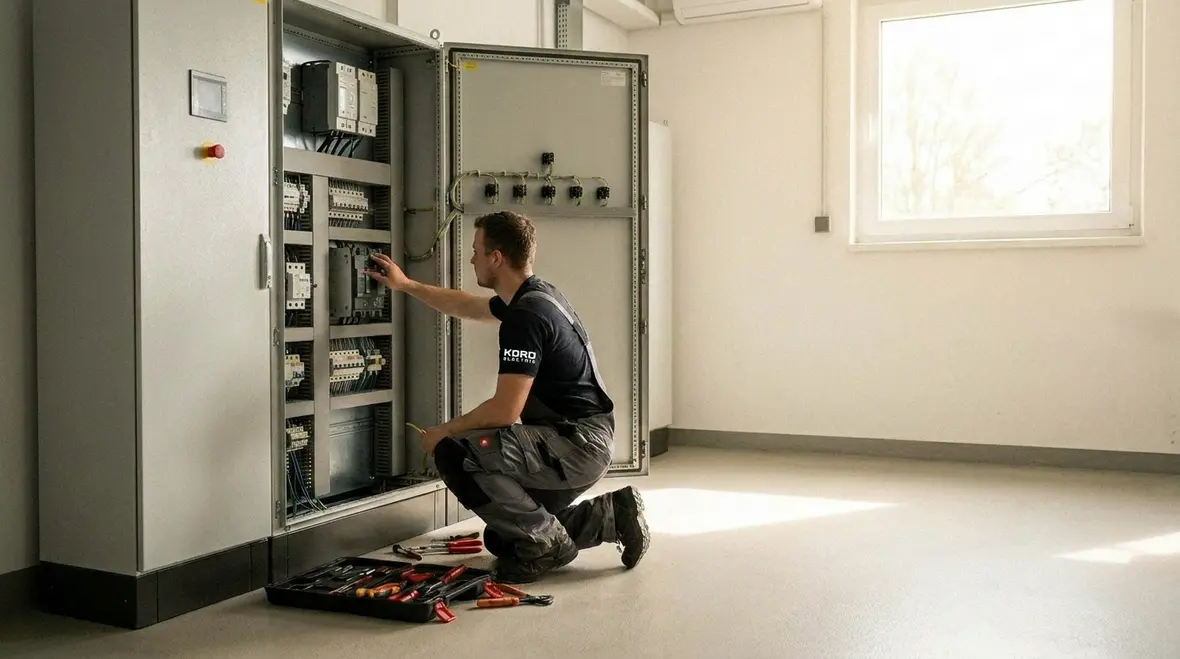
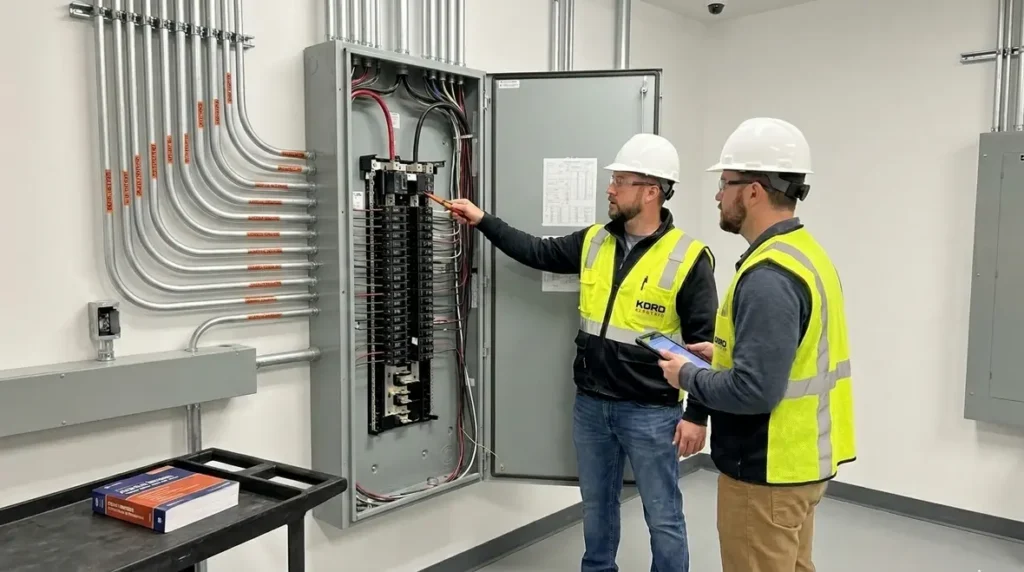
Most building owners agree they want panels in a place that looks neat. However, the NEC electrical panel requirements do not care about neat. They care about safe access during installation, operation, and emergency conditions. For commercial and industrial settings, panels typically must be placed so qualified personnel can reach them without working around hazards or storage that blocks access.
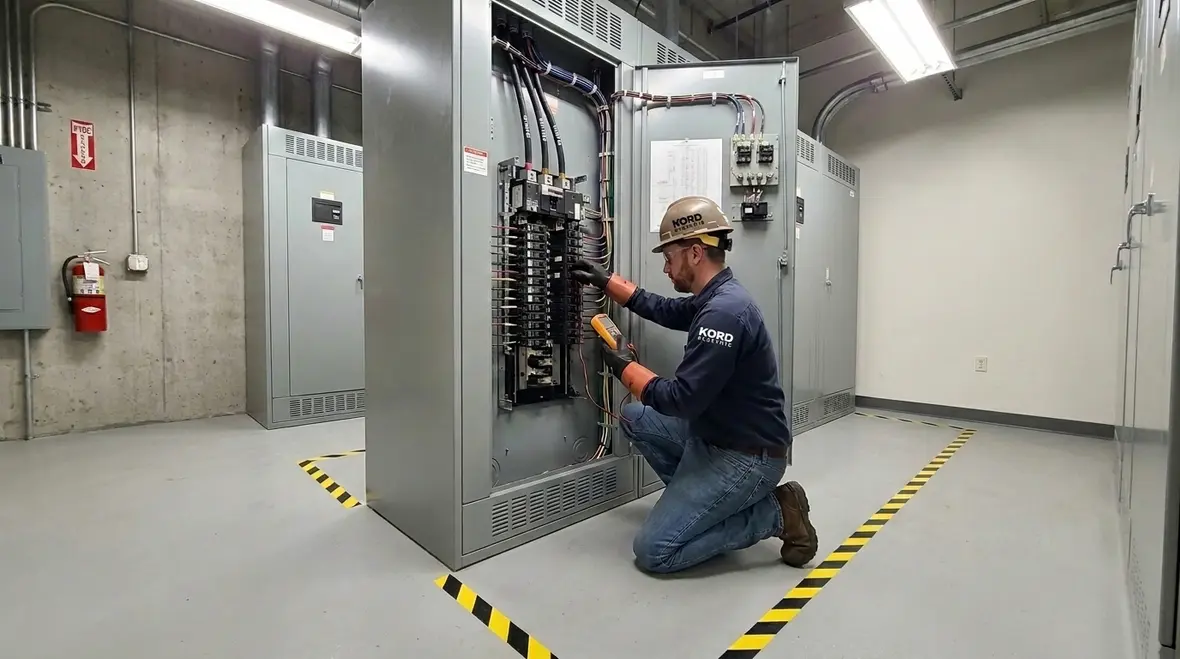
To keep compliance on track, our technicians follow a simple rule of thumb: if someone has to move furniture, climb over equipment, or squeeze through a crowd to reach a dead front, you probably have a clearance problem. Furthermore, working space around electrical equipment must allow proper operation and maintenance. This means clearances for the front and sides, and space that stays clear even when equipment nearby is active.
From there, panel location must also consider egress paths and service routes. If panels sit behind locked gates or in corners where only a contortionist can stand, a code official will not be impressed. And neither will our expert service staff, because we have seen the damage that happens when someone delays opening a panel due to poor access. The goal is simple: safe reach, safe work, and no improvisation under pressure.
For building owners who want a deeper grounding in how code principles apply beyond a single room, resources like Kord Electric’s explanation of NFPA 70, the national electrical code, help connect panel location decisions to the bigger picture of system design and inspection practices across a facility.
How clearances, doors, and obstructions affect compliance
Once panels are in the right area, owners still get tripped up by the small stuff. Doors that swing into the working space. Conduit racks that intrude into the clearance zone. Cable trays that look harmless until someone needs access. Meanwhile, even routine housekeeping can create an issue. A storage bin today becomes a clearance violation tomorrow, and the building pays for it later.
In practice, we treat clearance management like asset management. We map the working space, then verify any permanent and movable obstructions. If a door must open toward the working area, we check the installation details, not just the blueprint. Also, if there is a condition like equipment racks or HVAC ducting near the panel, we verify dimensions at the site. Paper compliance is cute; field compliance keeps people safe.
Additionally, we consider the way personnel actually operate. In industrial facilities, workers may use PPE and carts, and they may need to stand and work in a consistent posture. Therefore, we ask operators how they expect to troubleshoot. Then we align the panel environment to support that reality. In short, our technicians do not just meet the minimum. We help owners prevent the “we will fix it later” trap.
These same habits carry over into other risk areas. For instance, when Kord Electric evaluates voltage fluctuations in commercial and industrial facilities, they are looking at how equipment layout, loads, and everyday operations intersect with the code. Clearance is not an isolated detail; it is one piece of the larger reliability story.
Panelboard ratings, conductor termination, and breaker selection
After location and access, the next layer is electrical sizing and installation quality. NEC electrical panel requirements touch ratings and proper installation methods because the panel must safely carry its load under normal conditions, and handle abnormal conditions without failing dangerously.
For commercial and industrial work, we focus on three areas when reviewing panelboards and feeders. First, we confirm the panelboard ratings match the service and load conditions. If the panel is undersized, it will run hot and age quickly. Second, we check conductor terminations. Tightness matters, insulation must be handled properly, and conductors must match the termination lugs that are listed for use. Third, we verify breaker selection. Breakers must match the panelboard design, and they must be installed as required by the manufacturer and the code.
Here is a truth that never stops being funny. A breaker that trips early can feel like a nuisance, but a breaker that does not trip when it should is a different kind of joke, one you do not want to laugh at. When our expert service staff inspect, they do not just ask whether the system powers on. They check whether protection is appropriate for the conductors and the load behavior.
Furthermore, we pay attention to the details that often get skipped during quick upgrades: proper labeling for circuits, correct routing inside the panel, and safe separation of conductors where required. Those small actions reduce heat buildup and improve troubleshooting later.
When panelboards start to show their age, some owners discover that the conversation naturally expands. Questions about breaker choices quickly become questions about long term reliability, modern load demands, and when it makes sense to consider a larger system overhaul. Kord Electric’s rewiring cost guide for commercial electrical systems walks through how panel condition, feeder sizing, and distribution design all interact when a building is nearing the end of its original electrical life.
Grounding, bonding, and how faults get cleared
Now we step into the part that keeps systems alive when something goes wrong. Grounding and bonding rules help ensure faults clear safely and predictably. In a commercial or industrial building, the cost of downtime is high, but the cost of unsafe operation is higher.
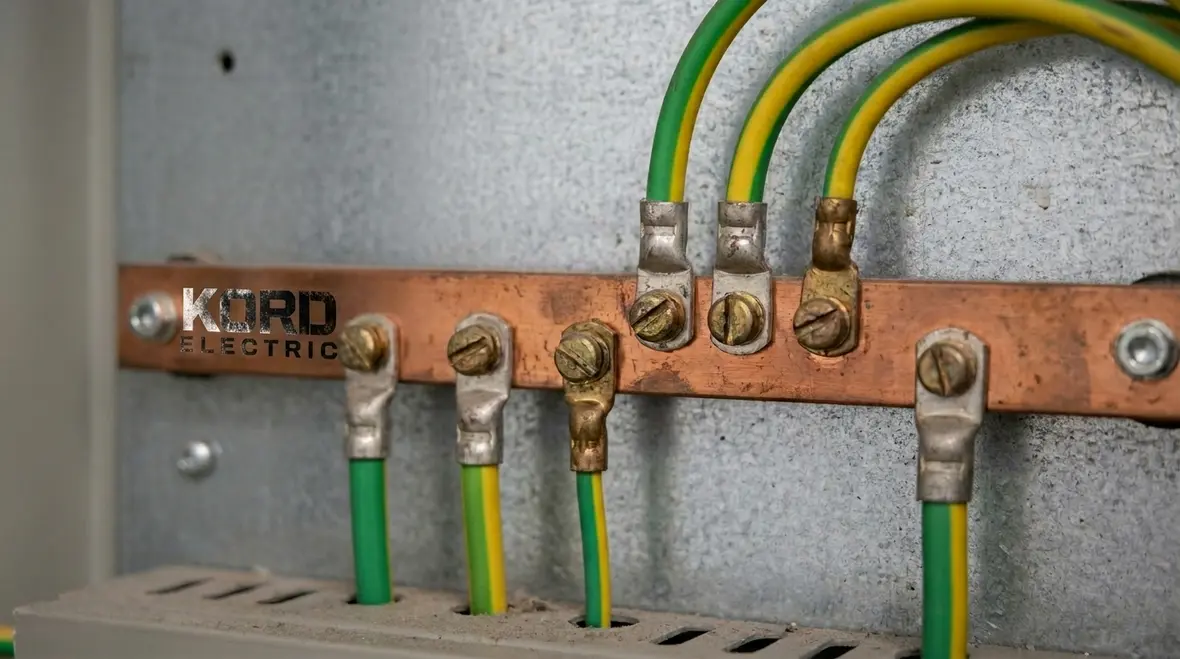
Our technicians focus on continuity and integrity. We verify grounding electrode connections and confirm that bonding methods are consistent with the installation and code expectations. We also check whether metallic parts are properly tied in. Additionally, we look at how circuits connect and whether protective devices clear faults at the right times.
In the field, we often encounter older systems where components were added over the years with whatever parts were available. And yes, that can work for a while, like duct tape on a leaking hose, but it rarely ends well. So we assess the actual condition, not just the age of the equipment. Where corrosion, looseness, or mismatched connections appear, we correct them.
Just as important, we help owners understand the difference between a system that “seems fine” and one that behaves correctly during faults. We explain it in a calm, practical way during service calls. Then, when we recommend upgrades, we connect the dots between code alignment, safety, and operational reliability.
Owners who want to see how grounding and bonding decisions resonate outside the panel can look at how Kord Electric approaches hidden electrical risks in commercial buildings. In that context, a loose bond or undersized grounding path is not just a checklist item; it can be the quiet root cause behind warm gear, unexplained breaker trips, or a failure to clear faults fast enough.
Labels, directories, and why paperwork keeps systems sane
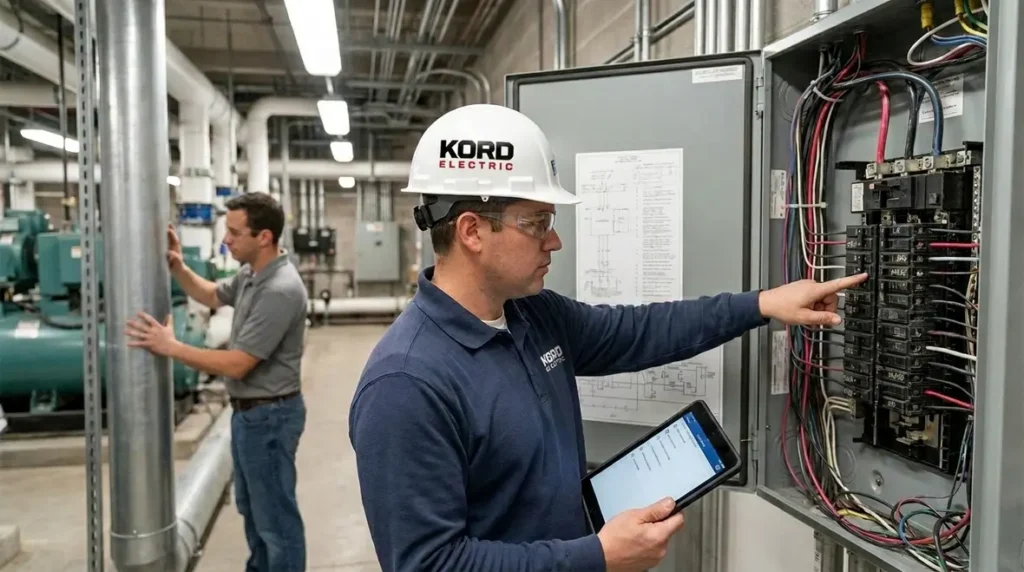
Some building owners treat panel labeling like a decorative feature. Yet panel directories, signage, and circuit identification help responders and electricians work faster and safer. In other words, labels prevent mistakes when someone is stressed, rushing, or dealing with an emergency.
For commercial and industrial facilities, labeling affects maintenance, troubleshooting, and future upgrades. When circuits are misidentified, workers can energize the wrong equipment, shut down critical systems by mistake, or spend hours tracing circuits. Meanwhile, the building owner eats the downtime cost. Nobody wants that bill, and nobody wants the look on the technician’s face when the “power to the offices” feed actually powers something else entirely. That look says, “I will be here a while.”
Our expert service staff help facilities keep directories accurate during changes. We update labels when we add breakers, move circuits, or modify distribution equipment. We also verify that the label format matches the panel layout and that circuit descriptions line up with actual field conditions. If multiple systems exist across floors or zones, we confirm the directory supports how maintenance teams really work.
Many property teams find it helpful to pair directory housekeeping with broader code and safety reviews. When Kord Electric walks through GFCI outlet California commercial compliance, panel directories and labels become a practical tool for showing where protective devices live, which zones they cover, and how future upgrades should be documented.
Common NEC electrical panel requirements issues we see in the real world
Owners often ask what we see most during inspections and service calls. Based on our experience with commercial and industrial facilities and major property buildings, the patterns repeat.
- Blocked access caused by storage, construction materials, or equipment mounted too close to the panel working space.
- Inconsistent circuit labeling after tenant improvements, load additions, or equipment replacement.
- Improper breaker or termination choices where installers assumed “it fits, so it must be fine.”
- Grounding and bonding gaps from aging components, loose connections, or patchwork additions.
- Overcrowded interiors that create heat stress and make it harder to troubleshoot safely.
Even when an installation starts out compliant, changes happen. Tenants expand. Equipment gets replaced. Operators add loads. Then, over time, the system drifts away from best practice and sometimes away from code alignment. That is why we encourage owners to treat electrical panels as live assets, not set-and-forget equipment.
So, we guide owners toward a maintenance mindset: periodic visual checks, targeted inspections during upgrades, and documentation that stays current. And we do it without drama, because the goal is not to scare anyone. The goal is to keep operations stable.
For many facilities, a structured electrical preventive maintenance program is the simplest way to keep NEC electrical panel requirements under control over the long term. Instead of reacting to surprise findings during an inspection, owners see trends early, plan corrective work, and keep panels, feeders, and protective devices aligned with how the building actually operates.
FAQ about NEC panel compliance
Schedule an expert panel review with Kord Electric
If you operate a commercial or industrial facility, do not wait for an inspection to reveal problems you could have solved calmly. Our technicians and expert service staff review NEC electrical panel requirements with a practical, field-first approach. We help you maintain safe access, correct labeling, proper protection, and solid grounding and bonding. Then we document what we find and recommend next steps that match your operational needs. Contact Kord Electric today to schedule a panel compliance review.
For facilities that already know panel issues are only one piece of a much larger puzzle, stepping into a broader service plan can make sense. Kord Electric’s electrical preventive maintenance programs combine panel inspections, load evaluations, and system testing into a consistent, documented approach that keeps commercial and industrial sites aligned with NEC requirements over time instead of scrambling before every inspection.
If your operations depend on clean, stable power for critical equipment, or you have experienced unexplained breaker trips, flickering, or sensitive gear acting up, pairing a panel review with services that address voltage fluctuations in commercial and industrial facilities ensures that NEC electrical panel requirements are not just met on paper. They are built into how your entire system behaves day after day.
And if your panels are supporting high demand systems like data centers, commercial kitchens, or EV charging infrastructure, Kord Electric’s specialized services — from EV charger installation to advanced distribution design — help align every upgrade with both current code expectations and long term reliability goals.
When you are ready to move from “we hope the panels are fine” to “we know the panels are compliant, documented, and ready,” that is the moment to bring in a structured review, align with NEC electrical panel requirements, and lock in a maintenance plan that keeps your building ahead of inspections instead of chasing them.