
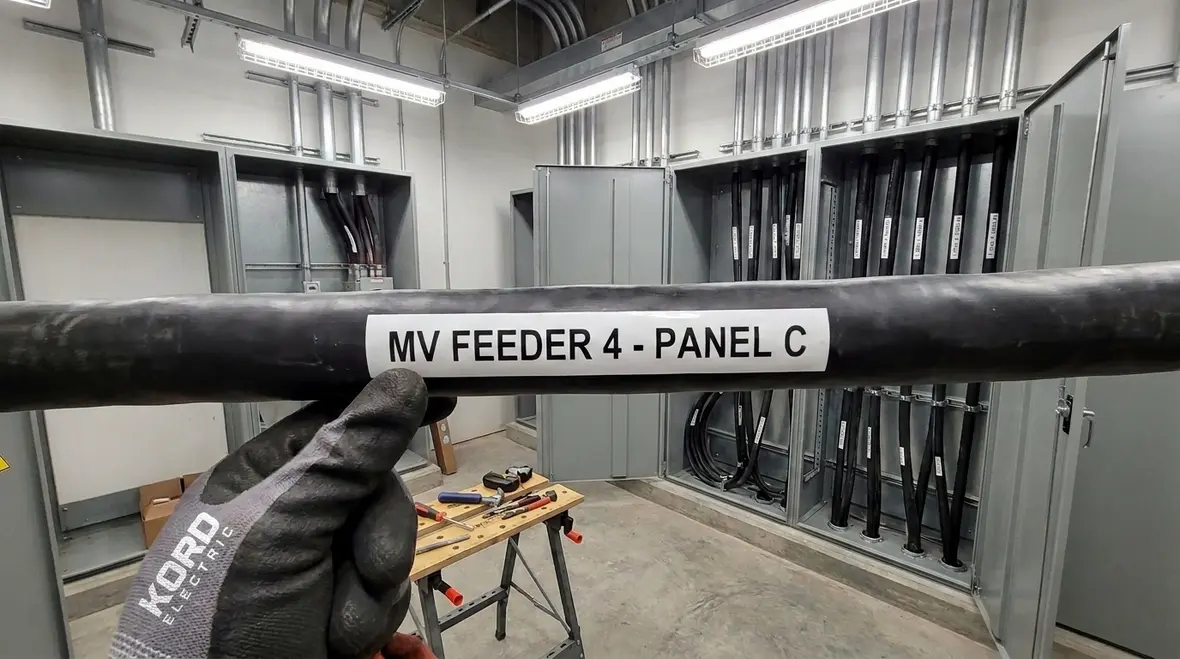
NEC MV Cable Marking Guide NFPA 70 315.16 Compliance
At Kord Electric, we make sure NEC MV cable marking gets handled the way NFPA 70 intends: clearly, consistently, and in a way that helps people work safely and fast. In fact, we rely on NFPA 70 Section 315.16 as a practical roadmap for how to identify medium voltage conductors and cables in real electrical rooms, generator feeds, and utility interconnections. Then we confirm the details on site, because labels that exist only in someone’s imagination do not protect anyone. And no, we are not trying to be dramatic like a soap opera; we simply want technicians to see the right information at the right moment.
In this guide, our expert service staff and technicians explain what Section 315.16 expects, how marking should look and work in real life, and how commercial and industrial facilities can avoid messy surprises during commissioning, troubleshooting, or maintenance.
NFPA 70 Section 315.16 in plain business terms
NFPA 70 Section 315.16 focuses on how installers mark medium voltage cables and conductors so that the identification remains reliable throughout the life of the installation. In other words, when we or others open a cabinet, trace a run, or verify a faulted section, the marking must help us identify what we are looking at without guessing. That matters most in commercial and industrial facilities, where one incorrect assumption can turn a routine inspection into an all day event that no one budgeted for.
Additionally, Section 315.16 exists because medium voltage systems can include multiple feeds, splices, parallel circuits, and equipment that share physical space. Therefore, marking becomes a tool for safe operations, proper coordination, and faster repair. Next, we align our marking practices with the intent of NFPA 70 and the NEC guidance discussed in the Kord Electric and Kord Fire resources, because codes and field reality must match. For facilities that want a broader code foundation behind their labeling plan, our team often connects this topic with our educational article Understanding NFPA 70: The National Electrical Code Explained for 2026, which links high level NEC concepts to everyday decisions in commercial and industrial buildings.
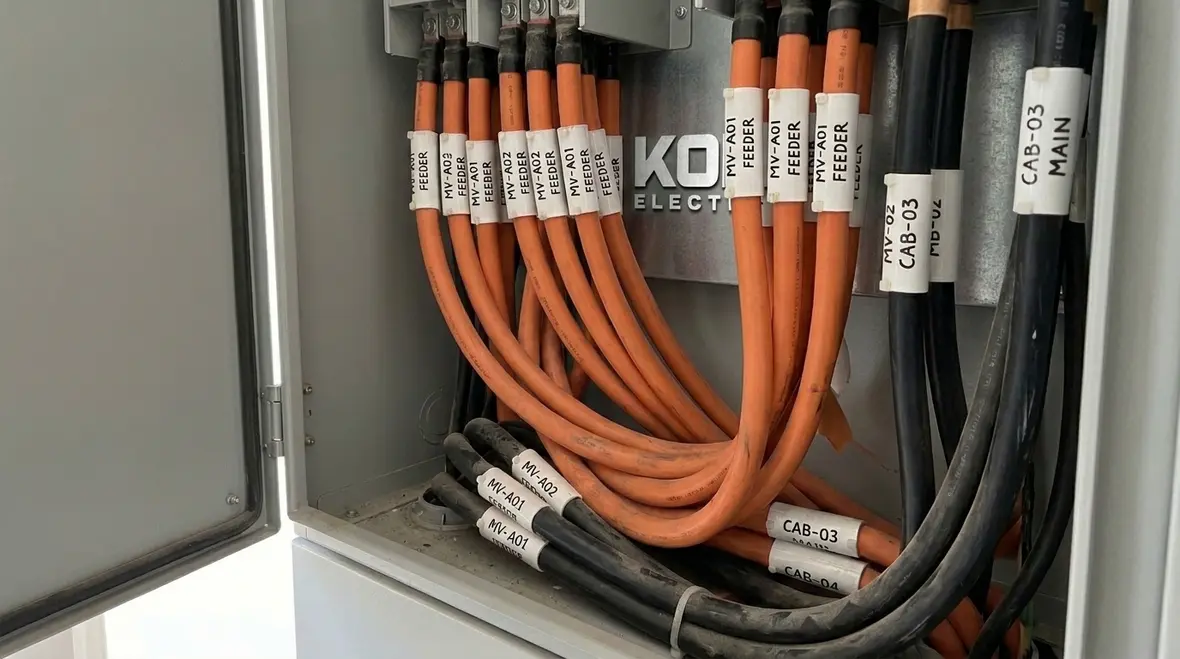
In many commercial and industrial electrical rooms, MV cable systems behave more like carefully choreographed traffic patterns than a single straight line. One feeder may serve critical production loads while another supports building systems, and a third ties into utility or generator infrastructure. Section 315.16 gives us the baseline expectation that every one of those conductors and cables should be identifiable without guesswork, even years after the installation is complete and after multiple maintenance cycles.
We treat that requirement as more than a sentence in a code book. When our technicians walk into a space, they expect to read the “story” of the system directly from the labels and diagrams. If the story does not make sense, we slow down, verify intent with the client’s team, and adjust. That habit keeps operations safer, reduces finger pointing during outages, and gives facility leaders confidence that their investment in medium voltage infrastructure is supported by practical, code minded identification.
Why MV cable labeling saves time during trouble calls
When electrical problems happen, time matters. However, the bigger issue often comes before the failure. People start troubleshooting, and they rely on identification to narrow down the source. If the markings are inconsistent, faded, or incomplete, we spend extra hours verifying the obvious. Meanwhile, production downtime grows like a bad pop quiz.
That is why our team treats NEC MV cable marking as an operational requirement, not a cosmetic choice. When the marking clearly communicates circuit identity and installation intent, our technicians can:
- Confirm cable runs during routine maintenance
- Locate correct terminations during switchgear inspections
- Reduce risk during energization and re-energization
- Support documentation and as built accuracy
Just as importantly, good identification reduces mistakes by visitors and contractors who come in later. We often see this in major property buildings that host multiple vendors over time. Therefore, labeling acts like a quiet teammate who never takes a break.
Clear MV markings also change the tone of a trouble call. Instead of a room full of people asking “Which feeder is that?” and “Who labeled this?” the conversation moves quickly to testing, diagnostics, and corrective work. The label does not fix the fault, but it keeps everyone focused on the right conductors and equipment. That focus matters when operations, safety, and schedule all collide at the same time.
What Section 315.16 expects from markings and identification
Section 315.16 requires that medium voltage cables and conductors receive marking that allows identification. Although the exact approach can vary by installation method, the standard intent stays consistent. We implement marking so that field staff can identify the cable or conductor in a reliable way.
Here is how we approach it with practical discipline, based on NFPA 70 and the explanations we reference across Kord Electric and Kord Fire content:
- Marking must be durable. It should stay readable under normal conditions, including handling during installation and exposure in typical electrical spaces.
- Marking must be specific. We do not treat “MV” as enough. We identify the circuit and related information so technicians can trace the correct pathway.
- Marking must be consistent. We follow the same formatting across runs and panels, so staff do not have to decode different styles on the fly.
- Marking must remain accessible. We coordinate labeling placement so it supports inspections and corrective work without excessive disassembly.
Then we cross check our work against the system design, one circuit at a time. If the drawings show a specific circuit name or run identity, we align the field marking to that reality. After all, if the label and the one line diagram argue with each other, the label often loses in the real world.
For complex facilities, we also coordinate MV markings with other documentation: panel schedules, cable schedules, arc flash labels, and maintenance tracking. The goal is not to create more paperwork. The goal is to make sure every person who touches the system can match what they see in front of them with what they see on the page, even if they were not there on day one.

We also pay attention to the environment around the conductors. In some MV rooms, labels must withstand elevated temperatures, vibration, or the occasional bump from tools and equipment. In others, the challenge is visibility in tight spaces or near crowded terminations. Section 315.16 does not list every possible field condition, so our technicians apply experience and judgment to choose materials and placements that hold up over time.
On projects that combine electrical and fire protection upgrades, we extend that same discipline across disciplines so life safety systems and power distribution tell a consistent story. Resources such as Kord Fire’s overview of the National Electrical Code for 2026 help clients see how electrical identification supports larger life safety strategies, including fire alarms, fire pumps, and emergency power interfaces.
How we implement marking in commercial and industrial projects
Kord Electric supports commercial and industrial facilities and major property buildings, where the stakes run higher. These sites often include switchgear rooms, electrical closets, generator systems, transformer feeds, and distribution panels stacked across multiple floors. Consequently, our marking workflow needs to handle complexity without creating chaos.
Our technicians follow a clear sequence:
- We review the design and as built expectations. We verify what identity information the project uses for each circuit.
- We plan marking locations before installation. We make sure the label can be read after pulling, terminations, and final cable dressing.
- We apply marking using field appropriate methods. We choose labeling approaches that stay legible in the space conditions and match medium voltage cable and conductor needs.
- We verify continuity of identification. We confirm the label matches the circuit route from source to termination.
- We document the labeling. We support maintenance and future troubleshooting with consistent records.
Meanwhile, our expert service staff explains the “why” during field coordination calls, so the client’s team understands what we did and how to use it later. That way, when others return for maintenance, they do not need a detective hat.

For facilities planning renovations or new builds, we often combine this workflow with broader consulting around code upgrades, equipment selection, and working space requirements. That means MV labeling is not an afterthought at the end of the job. It is part of a coordinated plan that keeps electrical rooms readable, maintainable, and ready for inspection.
Because many of our projects sit in busy regions with complex operations, we schedule labeling and verification around your production calendar. If a piece of switchgear can only be accessed during a planned outage, we prepare in advance, arrive with the right labels and documentation, and leave the space easier to navigate than we found it.
Common mistakes and how we prevent them
Even skilled crews can stumble. However, most marking problems come from predictable causes: unclear scope, rushed installation, or mismatched documentation. Here are the issues we watch for, along with the fixes our team applies.
- Labels that fade or smear. We prevent this by selecting durable labeling approaches suited for electrical spaces and by verifying readability after installation.
- Incomplete circuit identity. We prevent this by marking with enough information to identify the circuit during troubleshooting, not merely to satisfy a quick visual check.
- Different naming systems on different components. We prevent this through a consistent format and by aligning labels to project naming conventions and drawings.
- Labels placed where nobody can see them. We prevent this by planning label location around cable routing and termination access.
- As built drift. We prevent this by documenting changes as they happen rather than “fixing it later,” because later has a habit of turning into never.
And yes, we sometimes joke that bad labeling is like putting a character name in the credits but not on the actor. Everyone can argue about it, but nobody gets the story straight. The good news is that a disciplined approach keeps the electrical room behaving like a well rehearsed crew.
Another common pitfall appears when multiple projects and contractors touch the same electrical system over years. Without a firm standard, each team might introduce slightly different label styles, abbreviations, or color codes. Individually, they make sense. Together, they turn into a puzzle. Our crews reset that pattern by establishing a clear NEC MV cable marking standard, then applying it consistently so future work builds on the same language.

We also watch for what we call “ghost labels” — old tags that no longer match the actual circuit layout. These usually show up after undocumented modifications, equipment replacements, or temporary setups that quietly became permanent. During MV labeling projects, we track these ghosts down, reconcile them with current drawings and testing, and either update or remove them so they do not confuse the next crew.
Testing and inspection support for MV systems
Marking does not replace testing, inspections, or commissioning. Instead, marking works alongside those steps. When our technicians support inspections, we use identification to guide safe verification of medium voltage components. For example, the marking helps staff confirm correct cable routing to switchgear sections, transformer terminations, and distribution points.
Furthermore, during any reconfiguration, upgrade, or corrective work, identification supports a smooth workflow. Our expert service staff often explains how marking connects to maintenance planning, and how it helps reduce downtime. In other words, the label becomes part of the operational system. Then, when a fault occurs, the team can locate the relevant cable run quicker and focus on repair rather than searching.
We tie this support into broader NEC requirements for workmanship, wiring integrity, and working space. That means MV markings are not reviewed in isolation. They are evaluated alongside conductor terminations, equipment clearances, grounding and bonding, and panel labeling so inspectors and facility teams see a complete, coherent picture.
For properties that schedule periodic electrical maintenance or code reviews, we recommend treating MV labeling as a recurring checkpoint, especially after major changes. A quick verification pass during planned shutdowns often prevents confusion during the next unplanned event. It is a small investment compared to the cost of extended downtime and emergency troubleshooting in a poorly labeled space.
If you need code context for the NEC framework in general, our resources also align the larger picture with how NFPA 70 applies to building electrical systems, including the guidance discussed across Kord Electric and Kord Fire materials, plus additional industry context from Kord Fire and fire focused resources such as firepumps.org.
FAQ about NFPA 70 marking for medium voltage cables
Next steps for a cleaner, safer MV labeling plan
If your facility operates medium voltage systems, you deserve labeling that technicians can trust. At Kord Electric, we review your project intent, apply durable and consistent NEC MV cable marking practices, and help your teams use that identification during inspections and maintenance. If you want clear marking, fewer delays, and calmer trouble calls, we are ready. Contact Kord Electric to discuss your commercial or industrial electrical needs, and we will map the approach for your systems with care.
For clients across the region, our commercial and industrial electrical services cover everything from MV feeder labeling to panel upgrades, troubleshooting support, and planned maintenance. Whether you are building a new facility or updating an existing one, we tailor our NEC MV cable marking strategy to your specific equipment, operating schedule, and risk profile so your electrical rooms remain readable and ready for inspections well into the future.
If your operations are based in Southern California, you can explore how our Los Angeles County electrical services support code compliant installations, labeling, and long term maintenance planning. We bring the same practical approach to MV markings, panel work, and equipment upgrades, so your building systems stay aligned with NFPA 70 and your day to day reality.
When you are ready to move from “we should fix those labels” to a clear, documented MV marking plan, our technicians will walk the space with you, prioritize the riskiest gaps, and build a step by step roadmap. The result is simple: safer work, faster troubleshooting, and fewer surprises when the next outage or inspection shows up on your calendar.
If you want to see how this fits into your broader NEC strategy, you can also pair this guide with our resources on understanding NFPA 70 for 2026, reading the code efficiently, and planning upgrades before they become emergencies. Together, those pieces turn NEC MV cable marking from a compliance checkbox into a daily advantage for your facility teams.
Ready to tighten up your MV labeling before the next trouble call arrives? Our team is prepared to help you turn that list of “someday” projects into a real plan with schedules, documentation, and field proven markings that match how your electrical system actually runs.
From the first code review to the final inspection, Kord Electric stands beside your team as a practical partner, not just a contractor. We combine NEC expertise, field experience, and a calm, organized workflow so your electrical rooms feel less like a mystery and more like a well labeled, well rehearsed operation that everyone can navigate with confidence.
If your MV cables could use clearer labeling, this is the right moment to start.


