
NEC Section 650.6 EV DC Supply Grounding for Sites
Introduction: Why NEC Section 650.6 EV DC supply grounding matters on real sites
At Kord Electric, we build electrical safety the way a good fire watch builds trust: with care, checks, and clear explanations. Early in any EV charging project, we look at NEC Section 650.6 EV DC supply grounding because it sets rules for how EV DC circuits connect to the electrical system and to ground. Specifically, it guides the grounding and bonding approach for EV DC supply equipment, so faults do not turn into surprises.
In other words, when electrons misbehave, the path matters. And yes, we still hear the same joke from time to time, that grounding is “just the wire’s apology letter.” But we explain that grounding is actually the system’s safety backbone, especially for commercial and industrial facilities where uptime and compliance drive every decision.
On real projects, that backbone has to match both the latest National Electrical Code guidance and the way equipment behaves under stress. Our teams treat NEC language as a roadmap, not a suggestion. We read the updates, compare them with the conditions on site, and then build a grounding and bonding strategy that keeps people, equipment, and inspections on the right side of safe.
That means looking beyond the single charger or panel and understanding how the entire system responds when something goes wrong. NEC Section 650.6 EV DC supply grounding is one part of that story. The rest involves how the fault path ties back to service equipment, how bonding jumpers hold up over time, and how documentation keeps future crews from turning a safe system into a risky one by accident.
What NEC and the 2026 code shift really mean for commercial EV charging
When people hear “NEC,” they often picture a thick book on a shelf. Then they look at their schedule and realize they need it now. So we translate the code into what your site needs, not what the code wants in theory.
First, NEC updates focus on safety, testing, and practical installation methods. Next, they align more closely with how modern charging equipment behaves in the field. As a result, commercial and industrial operators face tighter expectations around how equipment interfaces with service equipment, how conductors route, and how grounding stays consistent from source to charger.
The 2026 direction also nudges teams toward better planning before construction ever starts. Instead of treating EV charging like a bolt-on accessory, facilities now approach it as a dedicated system with defined grounding, bonding, and protection priorities. Our article Understanding NFPA 70: The National Electrical Code Explained for 2026 sits behind many of those conversations, helping site leaders see how new rules tie into the larger NEC framework for safety.
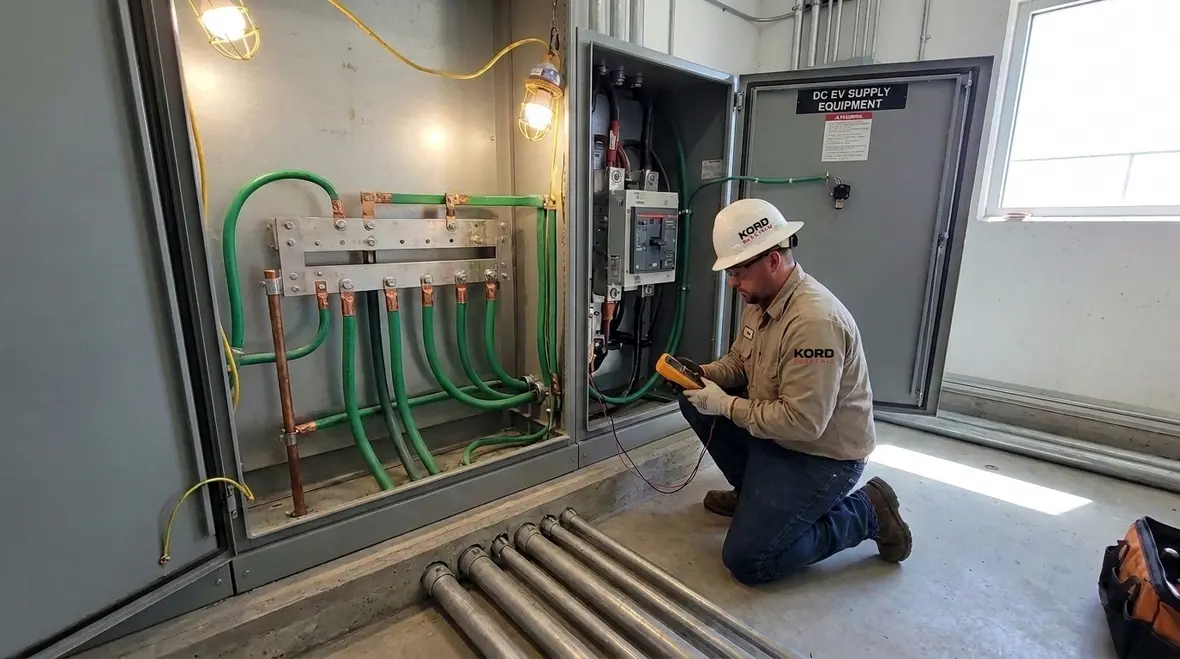
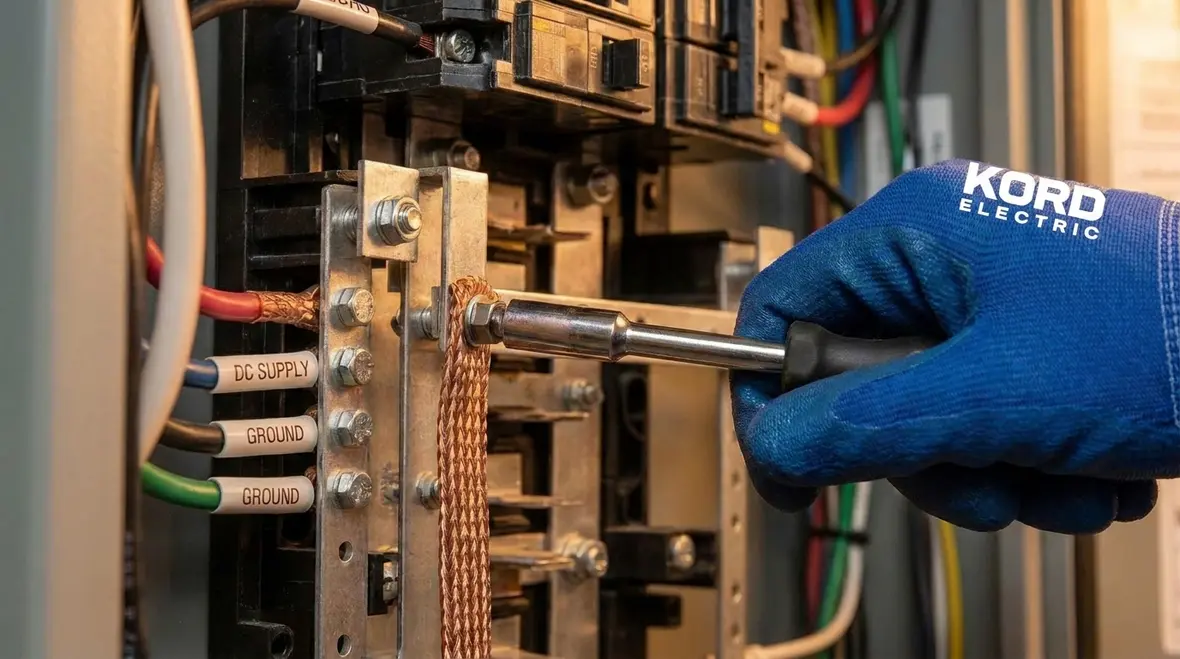
Our technicians and expert service staff walk job sites methodically. They verify terminations, check bonding paths, and confirm labeling. Then, just as importantly, they document what they did so inspectors and facility managers have clear answers. That reduces downtime when questions show up, because questions always show up. Even the most confident project manager eventually calls for documentation.
We also coordinate NEC guidance with manufacturer installation instructions, local amendments, and the way your operations team plans to use the site. For instance, a logistics yard that runs heavy traffic across conduit paths will need different protection choices than a quiet office campus. The 2026 code expectations simply give us a consistent safety baseline to design around.
Grounding and bonding strategy for EV DC supply systems
In our experience, the best grounding plan starts before a single conductor is pulled. That is because grounding is not one step. It is a system: bonding, conductor sizing, connection points, and continuity checks that all work together.
For NEC Section 650.6 EV DC supply grounding, the goal is straightforward. Fault current must have a low impedance path to ground. Meanwhile, conductive parts should not rise to unsafe voltage levels. To reach that goal on major property buildings, we plan for both normal operation and abnormal conditions.
That planning includes understanding how EV DC sources interact with upstream equipment, what happens when a fault occurs at the charger, and how bonding paths behave under real-world stress. We review the service configuration, fault current availability, and how the EV DC circuits tie into other loads. Then we make sure NEC Section 650.6 EV DC supply grounding requirements are applied in context, not in isolation.
We also help teams avoid common field mistakes. For example, some installations treat grounding like a box to tick. Then the crew discovers later that the bonding jumper path is awkward, the conductor routing creates strain, or connections rely on paint and corrosion layers. So we recommend clean metal contact, correct hardware, and protected routing, because you do not want “mostly grounded” in a system that must be fully grounded.
Another frequent issue appears when facilities expand charging capacity. Someone adds a new EV DC circuit, assumes the old bonding network is “good enough,” and never verifies the continuous path. Over time, those assumptions stack up. Our teams break that pattern by testing, documenting, and confirming the entire grounding and bonding arrangement every time we modify or add to the system.
Finally, we emphasize continuity and verification. Our technicians do not just “look” at the setup. They check connections and confirm the bonding network is intact. After all, you can’t measure safety with hope.
How we install EV DC grounding on real industrial and commercial sites
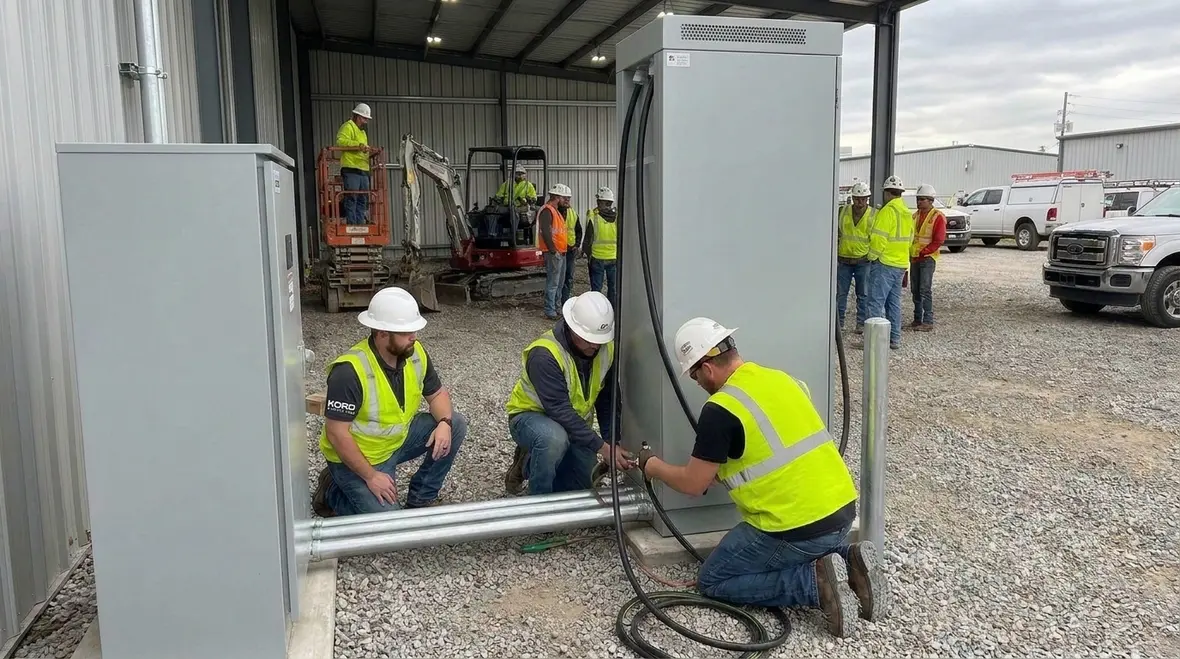
Commercial and industrial facilities bring unique realities. Power distribution may include multiple transformers, service entrances, and feeder pathways. Also, the charging area may sit inside a complex environment with conduit runs, structural steel, and existing electrical rooms.
So we approach installation like a coordinated project, not a last minute repair. First, we confirm the electrical one line, locate grounding electrodes, and map bonding points. Next, we plan the routing of grounding conductors so they stay secure, protected, and compliant. Then, we coordinate with general contractors and facility teams to reduce rework.
Our expert service staff also reviews equipment manufacturer requirements alongside NEC. That matters because EV DC supply equipment can have specific bonding and connection needs. When we align those requirements early, we avoid the situation where a charger arrives and the install team must “make it fit.” Making it fit is how headaches multiply.
We also consider other NEC elements that interact with EV work, including wiring methods, overcurrent protection, and coordination with life safety systems. Many clients first meet us through broader topics like NEC wiring planning fundamentals or NFPA 70 scope questions and then discover how directly those same concepts affect EV DC supply grounding choices.
At Kord Electric, we also treat labeling and records as part of the job. That includes documenting where grounding conductors land, what they connect to, and how the bonding network routes. As a result, future maintenance becomes faster and safer.
Those records come back into play whenever a facility adds more chargers, upgrades panels, or coordinates with fire protection teams. Clear documentation helps everyone see how NEC Section 650.6 EV DC supply grounding fits into the bigger picture of NFPA 70 compliance, emergency response expectations, and long-term building planning.
Testing, inspection readiness, and staying compliant with NEC 650
Compliance does not end at the final torque. It continues through verification. After installation, we perform checks that support both safe operation and inspection readiness.
Typically, that means confirming correct conductor connections and verifying continuity where needed. Additionally, we validate that bonding paths remain intact and do not rely on removable or unreliable elements. Because on commercial sites, vibration, corrosion, and future maintenance can change conditions over time.
We also help teams prepare for inspections by organizing documentation and aligning the installed conditions with the design intent. This is where our experience with major property buildings helps. Inspectors want clarity. Facility managers want minimal disruption. So we focus on both.
In practice, that looks like labeled terminations, up-to-date one line diagrams, and test records that match what inspectors see in the field. When questions come up about NEC Section 650.6 EV DC supply grounding or related provisions, we can show exactly how the design and installation align with code language and manufacturer instructions.
For facilities that already work with us on broader NEC topics, these EV-focused checks feel familiar. The same discipline that drives our code upgrade consulting and wiring planning guides applies here: verify, document, and keep the system understandable to the people who will live with it after construction crews leave.
In short, we help your team move from “installed” to “proven,” which is what matters when the building owner needs dependable performance.
Common site risks we prevent before they become costly failures
Many issues do not show up immediately. Instead, they emerge during load changes, weather exposure, or later facility modifications. So we plan for the long game, not the quick fix.
One risk we watch closely is poor bonding continuity. Even a small gap can increase resistance and reduce fault clearing performance. Another risk involves conductor routing that exposes grounding elements to damage. When grounding conductors sit where they get struck or where water collects, corrosion can follow. That is not dramatic, but it is deadly to reliability.
We also prevent mistakes tied to mixing system references. In EV charging layouts, teams sometimes assume that because multiple conduits exist, the bonding is automatic. It is not. Bonding must follow rules, and connections must follow best practice.
Another subtle risk appears when sites treat EV infrastructure as completely separate from the rest of the building. In reality, NEC Section 650.6 EV DC supply grounding lives inside a larger NEC environment that covers service equipment, emergency systems, and coordination with fire protection. Poor decisions in one area can ripple across the rest of the system, especially when expansion or renovations stack new work on top of old.
Our technicians explain these points in plain language to facility owners and site leaders. We do not just say “it’s code.” We show how a grounding path supports safe operation, and we explain what to look for during future work. When we do this, teams stop treating grounding as mysterious. Then they start treating it like the safety system it is.
That understanding makes a difference when your staff evaluates vendor proposals, reviews change orders, or plans additional EV chargers. A team that knows how grounding and bonding protect operations will spot shortcuts faster and ask better questions long before a problem shows up as an outage or failed inspection.
Dual column planning guide for grounding decisions and next steps
To help commercial and industrial teams move quickly, we use a simple planning mindset. Below is our practical guide for how we review a project. We keep it clear, because confusion is the real enemy of compliance.
| Planning step | What we do at Kord Electric |
|---|---|
Site review |
We confirm electrical distribution layout, existing grounding conditions, and charger placement for major property buildings. |
Grounding and bonding design check |
We align the grounding approach with NEC requirements and the EV DC supply equipment needs, including bonding paths. |
Conductor routing and protection |
We plan protected routes and correct terminations to reduce damage risk and prevent corrosion points. |
Installation verification |
Our technicians perform checks to confirm continuity and solid connections before turning over the system. |
Documentation and inspection support |
We provide organized records so facility managers and inspectors can review installed conditions easily. |
This planning flow also ties into broader electrical upgrades. If your facility is evaluating larger NEC-driven improvements, our Los Angeles County electrical services team can combine EV DC grounding work with panel changes, distribution upgrades, and other improvements so you only open the system once and close it in a better place.
By approaching EV DC grounding decisions through a repeatable structure, we help reduce surprises. Teams know what comes next, what information they need to provide, and how our technicians will translate NEC Section 650.6 EV DC supply grounding into hardware, labels, and test results they can trust.
FAQ: NEC EV DC grounding for commercial and industrial sites
Conclusion: Let our team handle your EV DC supply grounding with confidence
If you are planning EV charging for a commercial, industrial, or major property building, do not leave grounding to guesswork. At Kord Electric, our technicians and expert service staff plan, install, verify, and document the EV DC grounding approach so your site stays safe and inspection ready. Then, we support your team with clear explanations that make maintenance easier. Contact us to review your project and build a compliant electrical plan that performs, because the only thing that should trip during a fault is the safety system, not your schedule.
When you are ready to take the next step, we can integrate EV DC grounding work with broader NEC-driven upgrades, coordinate with fire protection partners, and align your project with the latest NFPA 70 direction. That way, your charging infrastructure becomes part of a strong electrical system instead of an afterthought bolted to the side of a busy facility.
Whether you are in the early planning phase or facing an upcoming inspection, our team is prepared to translate NEC Section 650.6 EV DC supply grounding into a clear, buildable, and testable plan tailored to your site. We focus on the details so you can focus on running the operation that depends on them.


