
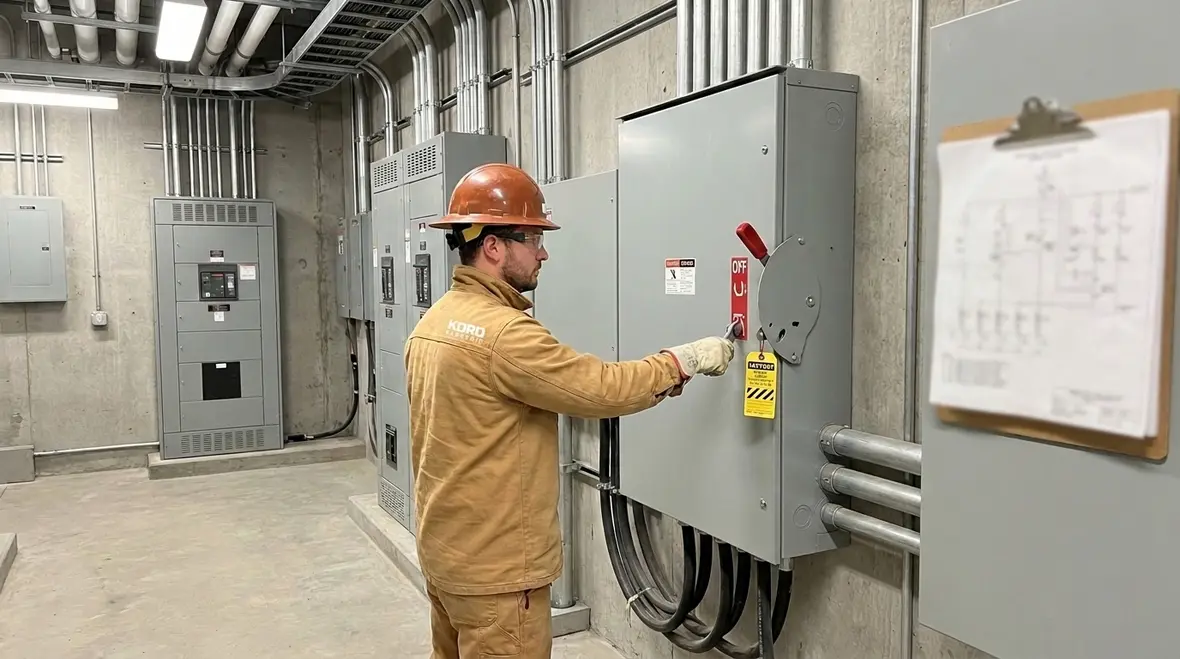
NEC Service Disconnect 2 kV Under NFPA 70 268.70
Imagine a high voltage system where the “off” switch actually means off. At Kord Electric, we see this every day in commercial and industrial facilities, and in major property buildings where downtime and safety both cost real money. Early in the process we explain NEC service disconnect 2 kV as part of a larger plan: the disconnects that let trained crews safely shut down power before anyone touches equipment. In other words, we do not treat these rules like paperwork. We treat them like protection for people, property, and operations. And yes, the code can feel like it was written by someone who never had to schedule a shutdown, but our expert service staff helps translate it into practical steps.
What NFPA 70 Section 268.70 requires for high voltage service disconnects
NFPA 70 Section 268.70 sets general rules for high voltage service disconnecting means. It focuses on how the disconnect should behave, how it should support safe operation, and how it should align with the rest of the system. Therefore, we help building owners and electrical teams understand not only what the code says, but also how it shows up on real sites.
To put it plainly, these disconnects act like a controlled boundary between energized sources and the parts of the system crews need to work on. As a result, the disconnect must allow the safe removal of power under defined conditions. Additionally, the code expects the equipment to support safe operation in the high voltage setting, which means you cannot just “make it work” with equipment chosen for a different voltage class.
When our technicians review your single line diagram and field layout, we connect the dots between the written rule and the physical installation. In our experience, that is where most problems start, because design intent and jobsite reality do not always match.

How the NEC service disconnect 2 kV fits into a coordinated shutdown plan
In commercial and industrial work, shutdown planning decides whether a project goes smoothly or turns into a long day of waiting. The NEC service disconnect 2 kV concept sits in the middle of that plan. It supports a defined method to de energize the service or parts of the service at the correct point in the electrical system.
However, the disconnect does not exist alone. It must coordinate with other protective devices, grounding and bonding elements, and the procedures used by your staff or contractors. So, we encourage teams to treat the disconnect as part of an integrated safety workflow.
For example, our expert service staff often explains the practical difference between “disconnecting” and “making a safe condition.” A disconnect creates the ability to shut off, and then your operational steps confirm conditions stay safe. That includes verifying the system status and following the proper lockout and tagout practices your site already uses. If you skip those steps, the disconnect becomes a fancy switch, and nobody needs a fancy switch during maintenance.

Placement, access, and what field teams should check
Section 268.70 emphasizes general rules, but the field checks matter just as much. We help teams confirm that the high voltage service disconnecting means supports safe access and safe operation. In many facilities, that means thoughtful placement, proper enclosure, and clear pathways for qualified personnel.
When our technicians walk through a major property building, we look for issues that codes cannot fully describe. For instance, we check whether access routes remain clear during daily operations. We also check whether the disconnect location creates confusion for operators who manage more than one system.
Additionally, we verify that the disconnect’s physical arrangement supports safe engagement and safe visual confirmation. If the operator cannot clearly determine state, the process slows down. And when the process slows down, the safety margin shrinks. As a calming joke we sometimes tell clients, “electricity does not care how late you are.”

Operation details that keep crews safe before maintenance begins
Safety does not start at the moment a worker picks up a tool. Safety starts when the team knows how to operate the disconnect correctly. Therefore, our approach at Kord Electric includes the operational “how” behind the code language.
Our expert service staff typically explains these elements in practical terms.
- Proper operating sequence so crews know what to do first and what to verify next
- Clear identification of the disconnect and the equipment it controls
- Coordination with protective devices so the system responds as designed when shut down
- Consistent documentation that matches what crews see on site
Then we connect it back to NEC service disconnect 2 kV in the way it functions during real work. When a shutdown occurs, crews must de energize the right section at the right time. If your labeling and documentation drift away from the actual configuration, confusion becomes a safety risk. So, we encourage facilities to update drawings after modifications, and we help them plan those updates before they become overdue.
Coordination with protection, metering, and system design
Section 268.70 works with the rest of the NEC, and coordination prevents problems that show up later. In commercial and industrial facilities, high voltage systems often include breakers, fuses, metering equipment, and sometimes multiple feeders feeding different loads. Therefore, the disconnect must align with how the system clears faults and how operators isolate sections during maintenance.
In our review process, we look at the system design flow. First, we examine where the service disconnecting means sits in the single line diagram. Next, we check how the downstream protective devices work with that disconnect. Finally, we verify that the metering and control elements integrate properly with shutdown procedures.
We also pay attention to the operational reality of major property buildings. A building owner rarely wants a full shutdown when only one area needs work. So, we help teams plan isolation points that reduce disruption while still meeting safety rules. That is where a well planned NEC service disconnect 2 kV strategy earns its keep. It supports safer work, and it protects schedules.

Common installation and compliance pitfalls we help clients avoid
Even with strong design, teams can fall into predictable traps. Our technicians have seen these patterns across warehouses, manufacturing spaces, campuses, and other major property buildings where high voltage service work happens.
- Disconnects installed without clear association to the equipment they control, which creates confusion during emergencies
- Documentation that lags behind field changes, so operators rely on outdated drawings
- Poor access paths that make safe operation harder during peak facility hours
- Labeling that does not match the actual configuration, which turns troubleshooting into guesswork
- Inadequate coordination with lockout procedures, which can undermine the disconnect’s safety purpose
And yes, some of these problems feel like they were installed by someone who watched one too many “fix it in a minute” videos. Electrical safety does not run on vibes. It runs on correct design, correct installation, and correct operation.
Working with Kord Electric on NEC service disconnect planning
Kord Electric focuses on commercial and industrial facilities and major property buildings. That focus matters because high voltage service work needs specialized planning, qualified labor, and a careful approach to compliance. When clients bring us into a project, we help them translate NFPA 70 Section 268.70 into actionable job steps.
We also take a practical view of communication. We explain things in a way your site teams can use. Then we align that understanding with design intent and field conditions. In addition, we coordinate with your maintenance staff so shutdown plans feel clear before the first breaker is touched.
To support planning, we stay aligned with the broader NEC context and fire and electrical code learning resources, because safety does not live in one chapter. If you want a deeper code refresher, you can explore our guide Understanding NFPA 70: The National Electrical Code Explained for 2026, which connects NEC fundamentals with real world facility decisions.
For facilities that expect growth, equipment changes, and evolving risk, we also recommend pairing high voltage service planning with broader electrical reliability reviews, such as the assessments we describe in our electrical asset site analysis guide. Together, these perspectives help you see how NEC rules, shutdown procedures, and long term reliability all connect.
When to revisit your NEC service disconnect 2 kV strategy
High voltage service disconnect planning is not a “set it and forget it” exercise. Your building, equipment, and operations keep changing, which means your NEC service disconnect 2 kV approach should be reviewed whenever the system shifts in a meaningful way.
We often suggest a fresh look at your service disconnect strategy when you:
- Add large new equipment or production lines that change load patterns
- Introduce new tenants or uses in a major property building, especially those with high electrical demand
- Plan electrical service upgrades or medium voltage modifications that alter the way power flows
- Update fire life safety systems, emergency power, or other critical infrastructure tied to the main service
- Experience nuisance trips, unexplained outages, or maintenance events that hint at coordination issues
In these moments, we bring our technicians and engineering partners together to confirm that the disconnect location, ratings, and operating procedures still reflect how the building runs today. If they do not, we help you adjust before those gaps become expensive downtime or, worse, a safety incident.
Tying NEC service disconnect planning into broader commercial electrical services
Because the service disconnect sits so close to the heart of your electrical system, planning around it naturally connects to other commercial electrical services. In Los Angeles County and surrounding areas, that often includes coordinated upgrades, preventative maintenance, and system expansion work across panels, feeders, and distribution gear.
For example, when we help a client refine their NEC service disconnect approach, we may also look at:
- Service capacity and whether upcoming projects require panel or feeder upgrades
- How new EV charging loads, data center equipment, or process lines will affect switching operations
- Whether existing grounding, bonding, and fault protection still align with NEC requirements and site conditions
- Opportunities to streamline shutdown workflows so crews can isolate high voltage sections with less disruption
When these elements are handled together, your service disconnect planning turns into a calm, systematic process instead of a scramble. If you are coordinating multiple upgrades or need a partner that understands high voltage work in busy facilities, you can explore how our Los Angeles County commercial and industrial electrical services support shutdowns, upgrades, and compliance across complex sites.
FAQ
Conclusion: let Kord Electric help you plan the safe shutdown
If you manage a commercial or industrial facility, you already know that safety is not a slogan. It is a procedure. Kord Electric helps your team understand NFPA 70 Section 268.70 and implement a reliable NEC service disconnect 2 kV plan that supports safe maintenance, correct coordination, and fewer surprises. Reach out to us to review your system layout, shutdown workflow, and compliance documentation. Then we will map the next steps with our expert service staff, so your operation stays calm while the equipment stays controlled.


