
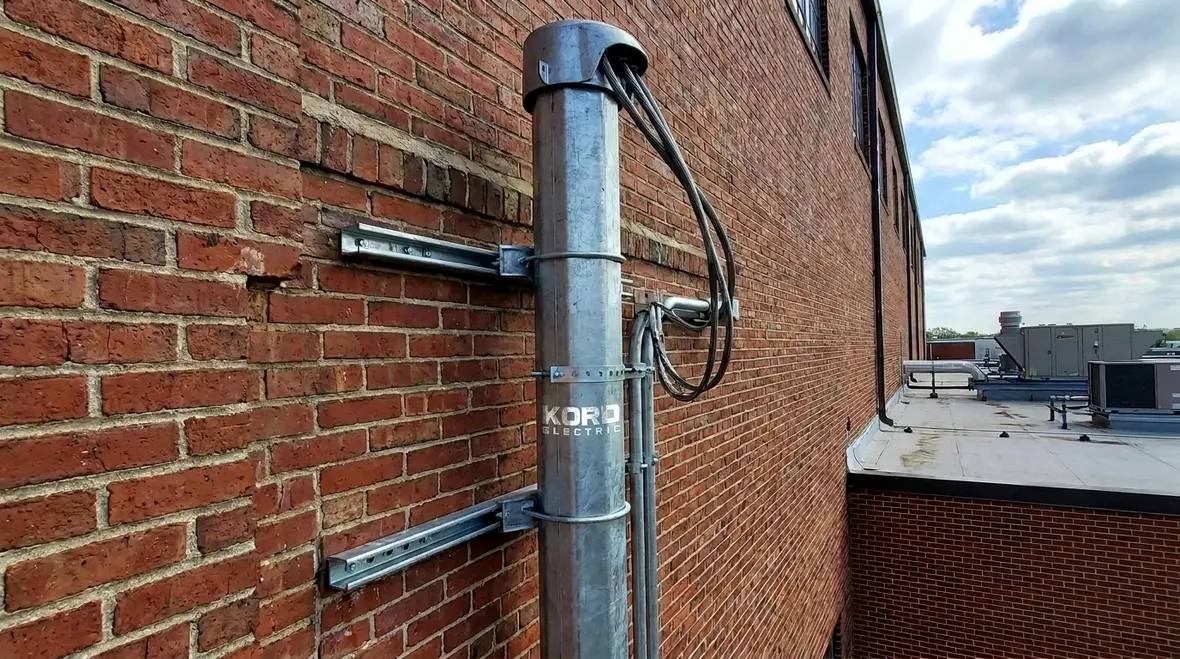
NEC Service Masts as Supports NFPA 70 Section 230.28
NEC service masts as supports: what NFPA 70 Section 230.28 demands
At Kord Electric, we regularly help commercial and industrial facilities keep power systems safe and compliant. And when a project involves NEC service masts as supports, we treat it like serious work, not guesswork. NFPA 70 Section 230.28 focuses on how service masts must be supported, sized, and spaced so they hold up under real-world conditions like wind, vibration, and time. In other words, it is not “install it and hope.” Our technicians explain this clearly on site, and yes, we also make sure nobody confuses a mast with a decoration. (If it looks like it belongs in a movie set, we still verify the code first.)
What Section 230.28 covers for service mast stability
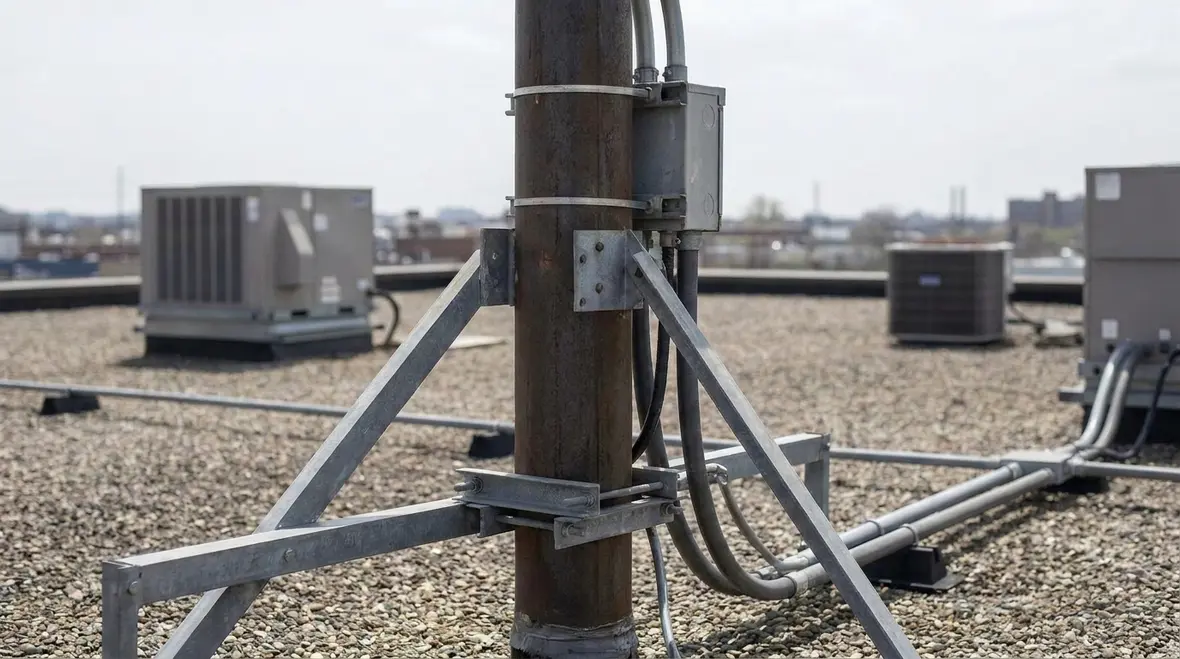
NFPA 70 Section 230.28 addresses how service masts function as the pathway between the service equipment and the overhead conductors. However, the key focus is support. When a mast is improperly supported, it can bend, loosen, or create stress on where cables enter the structure. Therefore, the code pushes designers and installers to use proper mast materials, secure attachment methods, and the right support spacing. This matters most for major property buildings and industrial sites where loads, exposure, and equipment pathways get more demanding.
In practice, we see three failure modes that trigger safety and inspection issues. First, teams install a mast that is physically capable of holding conductors but lacks the correct support spacing. Next, the mast attaches to a surface that does not provide the needed strength. Lastly, the support points get added “later,” but without alignment to the code requirements. Our expert service staff often notes that delays feel harmless until the inspector asks for documentation. And then suddenly, everyone remembers the deadline.
How we size and choose a mast that can take real stress
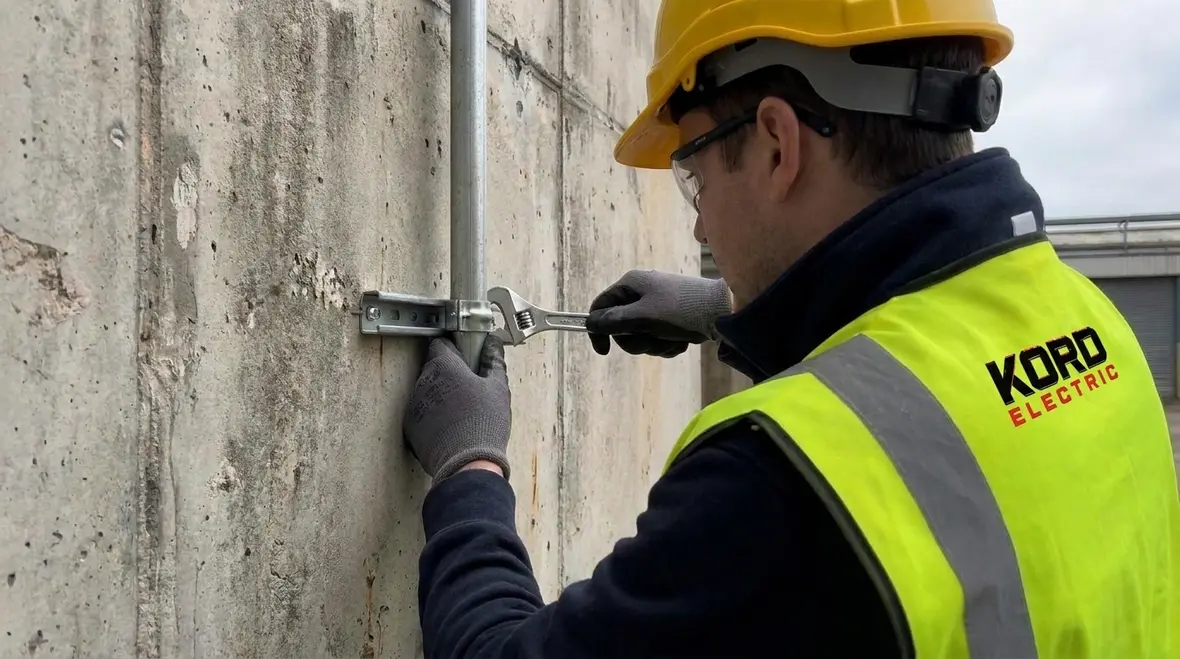
Section 230.28 works with the broader NEC approach: use equipment and methods that match the conditions. Since masts face wind pressure and mechanical strain, the chosen mast must have the strength needed for the install. That means the mast type, wall thickness, and overall rigidity matter. It also means installers should not treat the mast as a light-duty pole. For commercial and industrial work, we plan for conditions like rooftop equipment traffic, conductor weight, and long cable runs.
When Kord Electric reviews a design, our technicians confirm the mast size and support plan line up with the conductor configuration and the service arrangement. Then we check spacing between supports so the mast does not flex beyond safe limits. As a result, the install holds steady during storms and normal building movement. And if someone tries to cut corners with “a little extra bracing,” we politely remind them that bracing must still meet code logic, not vibes.
Spacing rules that protect against bending and loosening
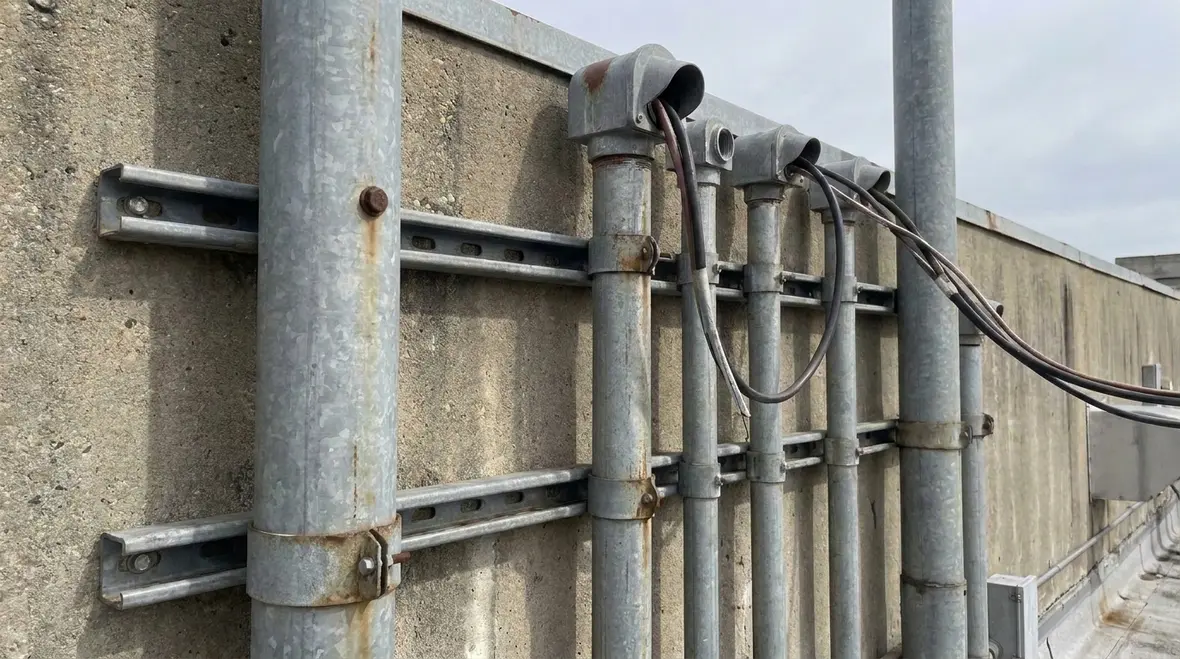
Spacing and support placement determine whether a mast stays rigid. Under Section 230.28, supports must be installed at the required intervals so the mast does not become a spring. If supports are too far apart, the mast can bend and shift, which then stresses the service connection points. On large properties, that stress compounds because the building envelope, mounting surfaces, and rooftop wind exposure can vary.
Our expert service team typically coordinates the support layout with the roof structure. That includes checking where the mast actually anchors and whether the mounting surface can take the mechanical load. Therefore, a spacing plan that looks correct on paper must still make sense in the field. We also make sure installers do not “adjust” the spacing after the fact without recalculating the entire plan. Transitioning from design to construction is where errors like to hide. Thankfully, we catch them early.
Attachment methods and support types we verify on the job
Section 230.28 does not only care about the support count. It also cares about how the supports do their job. At Kord Electric, we verify attachment methods so supports clamp and fasten correctly to the mast and connect to structural elements that can handle the load. In many commercial and industrial settings, teams face a challenge: rooftops use different materials and mounting conditions, so the support plan must fit the building.
We also check for alignment and proper hardware selection. Even a correctly spaced mast can misperform if supports attach at angles that allow shifting. So our technicians verify that the support system stays straight, secure, and durable for the long term. Then, because safety depends on details, we confirm workmanship at every connection point, including where conductors route to service equipment.
If you are wondering whether this is just “belt and suspenders,” the answer is yes, but in the best way. Pop culture taught us that duct tape fixes everything, yet code taught us that electricity needs more than duct tape. We use the right method, installed correctly the first time, and we document it so inspections go smoother.
NEC compliance in real commercial and industrial builds
Buildings do not behave like a textbook. Wind patterns change across a complex site. Rooftops hold equipment, and some areas get more traffic. Moreover, major property buildings often have multiple service pathways running near other systems. That is why we treat NFPA 70 compliance as an integrated task, not a single checkbox.
For example, when a facility adds a new load or upgrades service equipment, the mast support plan cannot be treated as “leftover infrastructure.” We evaluate the existing installation. Then, if the project requires modifications, we ensure the new layout supports the mast using code-based sizing and spacing. Kord Electric coordinates with facility teams so the work fits operational windows, not just calendar pages.
We also keep our work in line with the broader guidance people associate with NEC and NFPA 70. Resources from our Kord Fire teams reinforce the same theme: electrical safety comes from correct design and correct installation, not hope. For reference, readers often explore Kord Fire educational content, including NFPA 70 All About the National Electrical Code (NEC), and KordFire.com.au for additional regional clarity. Our approach stays practical, field-tested, and consistent.
If you want to connect Section 230.28 decisions to the bigger NEC picture, you can also review our related Kord Electric guide Understanding NFPA 70: The National Electrical Code Explained for 2026, which explains how current-cycle rules shape real project planning across commercial and industrial facilities.
How our technicians explain the plan so stakeholders can approve it
One reason projects slow down is that the people approving work may not speak “electrical engineering.” So we translate without dumbing it down. Our technicians explain what Section 230.28 targets, why support spacing matters, and how the mast stays stable under wind and mechanical stress.
Instead of overwhelming decision makers with jargon, we walk them through the key points: what we plan to install, where supports land, how attachment choices match the structure, and how spacing helps prevent dangerous bending. This calm, step by step method reduces back and forth. It also helps facilities avoid change orders caused by late misunderstandings. And for the record, we have seen enough “surprise inspections” to know that clarity beats panic every time.
Single mast, multiple constraints: a practical layout check
Below, we summarize how we run a layout check for commercial and industrial facilities. We focus on the constraints that usually cause rework, because that is where time and cost get swallowed.
|
What we confirm
|
What this prevents
|
FAQ: service mast supports and inspection readiness
How NEC service masts as supports tie into broader Kord Electric services
Service masts do not live in isolation. They connect to panels, distribution equipment, grounding and bonding systems, and life safety infrastructure across a facility. That is why we align our Section 230.28 work with the broader electrical services Kord Electric provides across Los Angeles County and surrounding regions. When we review a mast installation, we also look at how it interacts with overcurrent protection, labeling, and coordination so the entire service entrance behaves the way the NEC expects.
For facility leaders planning larger upgrades, it often makes sense to pair mast support projects with related work described in our Los Angeles County electrical services overview. That way, service entrance improvements, distribution changes, and inspection preparation all move together under one coordinated plan instead of fragmented tasks that compete for time and budget.
Call Kord Electric for code grounded service mast support planning
If your facility needs service mast work, Kord Electric brings calm, precise field experience to the planning and installation. We help commercial and industrial teams meet NFPA 70 Section 230.28 expectations for sizing, attachment, and spacing, so your service stays stable and inspection-ready. Our technicians explain the plan clearly, coordinate with your site needs, and document details that inspectors look for. Reach out to us at Kord Electric to get a code grounded review and a practical path forward. Your power system should not rely on hope.


