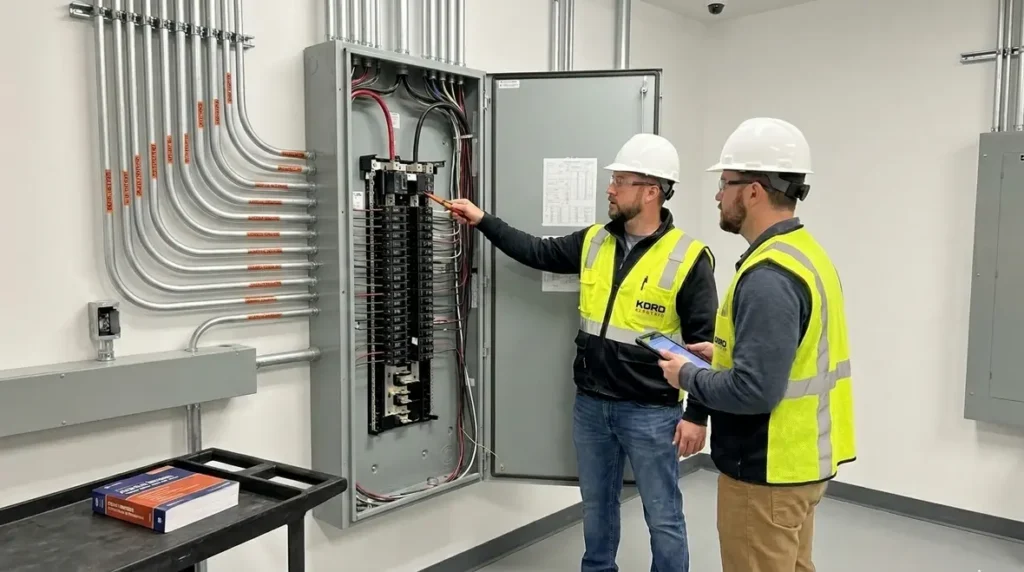
NFPA 70 265.22 NEC Individual Branch Circuit Loads Explained
At Kord Electric, we often see commercial and industrial sites where NEC individual branch circuit loads get treated like a vague suggestion instead of a real design rule. For example, one tenant plugs in a coffee station, another adds a server rack, and suddenly an entire floor acts like it is auditioning for a smoke drama. That is why we focus on NFPA 70 Section 265.22 — Permissible Loads on Individual Branch Circuits. We explain, in plain terms, how engineers, electricians, and facility teams should calculate and limit loads so circuits do not run hot, trip early, or fail at the worst possible moment. And yes, our technicians do explain it with patience, because nobody wants an electrical system that behaves like a pop star on tour, unpredictable and overbooked.
Why Section 265.22 matters for commercial and industrial buildings
In a major property building, the electrical system does not serve a single device. Instead, it supports lighting, mechanical equipment, receptacles, cooking or process loads, data, and life safety systems that must stay reliable. Therefore, Section 265.22 becomes a guardrail. It tells us that each branch circuit must carry only a permissible share of connected demand. As a result, the building can operate without over-stressing conductors, terminations, and overcurrent devices.
Moreover, this section helps prevent a common failure pattern. People assume that if the main service has spare capacity, then any circuit can absorb “just a little more.” However, current does not care about hope. It cares about conductor size, insulation temperature rating, and how long the load runs. If the design team allows excessive loading on an individual circuit, the problem shows up as voltage drop, nuisance trips, loose connections, and eventual wear that shortens equipment life.
Our expert service staff often illustrates this with a simple point. A branch circuit is like one lane of traffic. You can have plenty of roads elsewhere, yet if you block that lane, everything slows. Then, someone blames the city. Meanwhile, the issue was always the lane.

For teams who want a deeper NEC context behind branch circuit rules, this article pairs well with our broader code overview resource, Understanding NFPA 70: The National Electrical Code Explained for 2026, which shows how detailed sections like 265.22 fit into the 2026 NEC direction for commercial and industrial buildings.

How permissible load rules protect conductors and equipment
Permissible load limits aim to keep heat in check. When current flows through a conductor, it creates temperature rise. If the circuit stays within the approved limit, the conductor and its insulation stay within safe operation. Conversely, when the load exceeds that limit, the conductor temperature climbs. Then insulation ages faster, terminals loosen from thermal cycling, and downstream devices receive less stable voltage.
In commercial and industrial facilities, this matters because loads often run for long hours. Production lines, HVAC control panels, warehouse lighting, and process equipment may load circuits steadily, not just for a few minutes. Therefore, the code intent focuses on continuous, real-world demand, not best-case behavior.
Additionally, Section 265.22 supports consistent coordination with overcurrent protection. When a circuit carries the correct permissible load, the protective device can respond as designed. As a consequence, the system limits damage during faults and reduces the chance that personnel face unexpected outages.
We also recommend facilities plan for future changes. Many major properties evolve. New tenants arrive, equipment gets upgraded, and control strategies change. So we help teams review branch circuit loading before modifications, not after the breaker starts clicking like a nervous metronome.

NEC individual branch circuit loads: what “permissible” really means
When someone asks about NEC individual branch circuit loads, they usually mean two things: first, how much connected equipment a circuit can safely support; and second, how demand calculations affect that limit. Section 265.22 addresses permissible limits, which means the circuit cannot be treated like an open-ended extension cord for every new requirement a building throws at it.
In practice, we guide teams to treat permissibility as a set of constraints. Conductor ampacity sets the physical ceiling. Thermal conditions, insulation rating, and installation method also influence how much current remains safe. Then, the electrical distribution design uses those limits so the circuit stays within the allowed operating range.
However, there is more. Permissible loads link to how equipment uses electricity. Some loads draw steady current. Others cycle. Some loads vary by mode, like equipment that alternates between standby and active operation. Therefore, accurate documentation and a clear loading plan matter. When teams skip the details, they often create “invisible overloads” that only show up after the building runs for weeks.
Our technicians and expert service staff spend time with facility managers and electrical contractors to make sure the assumptions match reality. We review the load list, confirm breaker sizing strategy, and explain how the calculation supports safe operation without turning the project into a never-ending spreadsheet ceremony.

Common commercial load mistakes we help teams avoid
Even skilled teams run into predictable issues. First, they underestimate connected loads. A label on a panel might say “light duty,” but the actual branch circuit might feed more equipment than anyone remembers. Then, they reuse older circuit layouts without checking whether the new tenant’s equipment changes the load behavior. As soon as the site adds gear, the original loading assumptions drift out of date.
Second, they treat demand factors as a magic spell. Demand factors can help with calculating loads, yet they do not cancel out conductor limits on a given branch circuit. Therefore, the permissible limit still governs what each circuit can safely serve.
Third, they ignore installation details. Conduit fill, wiring method, ambient temperature, and bundling can all change effective conductor temperature. So even if the ampacity on paper looks fine, the real world can push temperatures higher. In that case, the circuit fails earlier than expected.
Finally, they skip verification. Many sites accept a design and move on. Yet later, maintenance adds outlets, replaces fixtures, or adds temporary equipment. Consequently, circuit loading grows quietly. That is when we step in with inspections, load reviews, and documentation updates.
If this all feels like counting calories, you are not wrong. Electrical load management is basically a diet plan for current. Do it right, and the system performs. Do it wrong, and everything runs hotter than it should. And nobody wants to deal with “hot breaker breath” in the middle of peak production.
We support code compliant planning and upgrades
Kord Electric focuses on commercial and industrial facilities and major property buildings. So we tailor our service to environments where downtime costs money and safety matters. When a project team plans tenant improvements, equipment additions, or panel upgrades, we help ensure the branch circuit design aligns with the intent of NFPA 70 Section 265.22.
We also work with facility stakeholders to keep documentation accurate. That includes circuit directory updates, load lists, and clear labeling so future changes do not repeat past mistakes. As a result, the next tech who arrives does not have to guess what feeds what. And guesswork is the enemy of reliability.
In many cases, we coordinate with design partners and contractors to align assumptions before equipment lands on site. Then, our technicians verify field conditions. We look at conductor routing, terminal integrity, and evidence of thermal stress. If something looks off, we address it early.
For teams that want a broader code foundation, we connect our explanations to the national electrical code guidance people commonly reference, including NEC and related resources hosted by Kord Electric and Kord Fire. We also stay tuned to industry updates from credible fire and electrical code education sources, because fire safety and electrical safety share the same real world consequences.
When upgrades trigger a new branch circuit load review
Upgrades rarely stay “just an upgrade.” They usually bring more equipment, new controls, and different usage patterns. Therefore, before a major property installs new production equipment, adds EV charging stations for commercial fleets, increases lighting zones, or updates HVAC controls, we recommend a branch circuit load review that follows Section 265.22 principles.
We help teams decide what requires recalculation and what requires replacement. Sometimes the right answer is rebalancing loads across circuits. Other times, it calls for new circuit runs or new panel capacity. In each case, the goal remains the same. We keep each branch circuit within permissible load limits and protect the system from overheating and premature failure.
Also, we advise facilities to plan for phased changes. Many commercial builds operate while work happens. So we schedule verification steps to match downtime constraints and to reduce risk. Our technicians and expert service staff explain the plan clearly to the people who run the building day to day, so the upgrade stays manageable.
For organizations across Southern California that want field-tested support on complex power changes, our dedicated Los Angeles County electrical services team provides code-focused planning, load reviews, and upgrades that respect NEC branch circuit limits.
FAQ about permissible loads and branch circuit limits
Conclusion and call to action
If your commercial or industrial facility plans upgrades, tenant changes, or equipment expansions, we urge you to verify permissible branch circuit loading before problems show up. Kord Electric supports major property buildings with expert technician service staff explanations, clear documentation, and field checks that keep systems reliable. We help teams apply NFPA 70 Section 265.22 in a practical way, so branch circuits stay within safe limits and downtime stays unlikely. Call Kord Electric today and let us review your circuit loading plan with calm, code grounded confidence.