NFPA 70 267.14 NEC Open Conductor Supports Spacing
NFPA 70 Section 267.14 and NEC open conductor supports spacing for commercial sites
In commercial and industrial buildings, contractors do not get to “hope” the electrical system holds up. They must build it right. That is why NFPA 70 Section 267.14 matters to facilities teams, and it is also why we at Kord Electric treat NEC open conductor supports spacing like a serious safety detail, not trivia. Early on, our technicians explain that open conductors need proper support and correct spacing so heat, vibration, and mechanical stress do not turn routine wiring into a future failure. And yes, we have heard the joke that “wires are flexible, so they will be fine.” Then our expert service staff calmly explains why code does not care about jokes. It cares about rules, measurements, and the real world.
If your facility team wants a broader foundation for how this rule fits into the bigger NEC picture, resources like Understanding NFPA 70: The National Electrical Code Explained for 2026 help connect section-level details to long term planning, inspections, and future upgrades.
What Section 267.14 actually requires for open conductor systems

Section 267.14 in NFPA 70 focuses on how open conductors get supported and spaced. This is the part of the code that addresses how conductors hang, run, and remain stable when they are exposed to the conditions of a building environment. Therefore, it is not just about where the wire goes. It is about how the wire behaves over time, especially where mechanical stress exists.
In practice, facilities teams often see issues that start small and then grow. For example, a missing support point might seem harmless, until a cable route experiences movement from HVAC cycling, a tenant renovation, or a nearby equipment vibration. As a result, the conductor can sag, twist, or rub against structure. Consequently, the insulation can degrade, and the wiring can end up closer to surfaces and clearances than anyone planned.
Our role at Kord Electric is to help owners and contractors prevent those problems before they show up in the field. We send our expert service staff, and they explain requirements in clear language. They also show how proper support and spacing reduce strain on terminations and keep systems aligned with the NEC framework. In the end, compliance becomes a stability plan, not a checkbox.

Open conductor supports spacing: how to think about spacing values in the field
When teams apply NEC open conductor supports spacing rules, they must treat spacing as a control method, not an arbitrary number. The spacing governs how often support points hold the conductor in place. If supports are too far apart, the conductor can droop and swing. If supports are too close, install practices can become messy and create their own problems, such as overcrowding or incorrect routing.
So, how do we approach this without turning it into a late night spreadsheet ritual? We do it the way our technicians do it: we start with the route, the conductor type, and the environment. Then we verify support hardware placement against the code rules for open conductors. Next, we check how the conductor runs through bends, changes in direction, and near structural interfaces.
Additionally, we account for loads that do not show up in drawings. Construction traffic, future ceiling modifications, and even minor impacts from maintenance carts can change how a conductor sits. Therefore, the support plan must lock the system into a stable geometry from day one.
And for those who wonder whether this is overkill, remember: electricity does not care if your building is “chill.” Physics is not chill. It is very much like that show you never watched, but everybody told you was great: it shows up anyway, and it follows the rules.

Support hardware, routing, and attachment details that prevent failures
Correct spacing only works when supports get installed correctly. In other words, we can meet the letter of the spacing rule and still end up with poor performance if hardware choice and mounting methods do not match the design. For commercial and industrial facilities, that means paying attention to bracing quality, attachment points, and protection from damage.
Open conductor runs often exist near places where other trades work. That might include cable tray zones, mechanical service corridors, or near the edges of equipment rooms. Then tools and materials move through the area. As a result, supports must hold the conductor securely against normal handling impacts. Also, the conductor must not rub on sharp metal edges or pass through points that create abrasion.
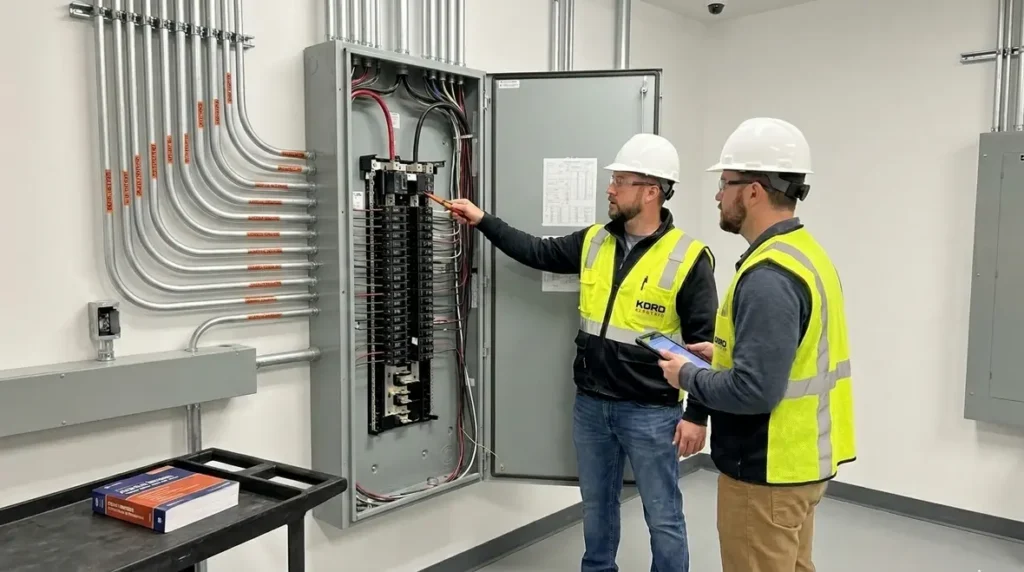
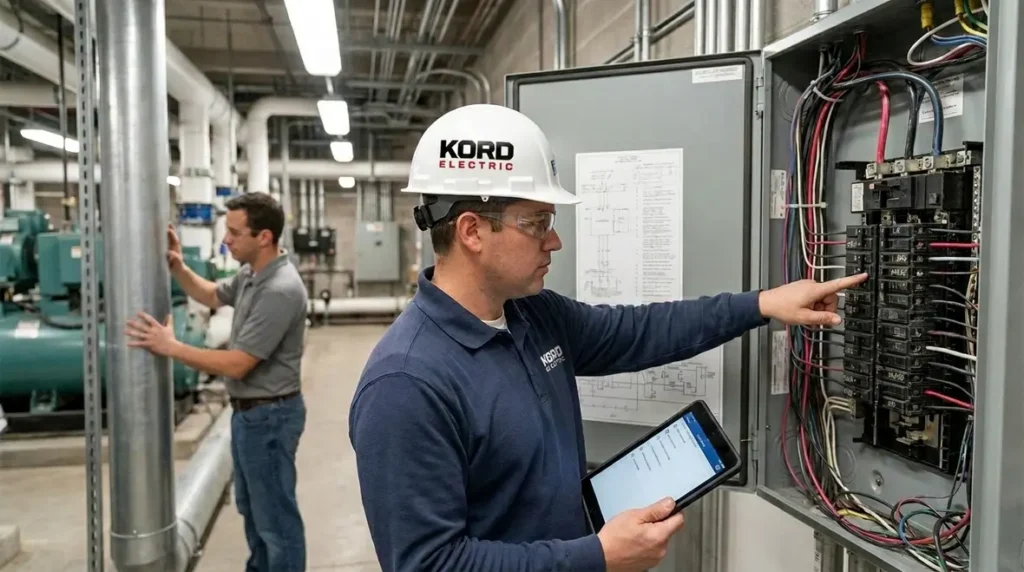
Our technicians typically focus on practical checks during commissioning and service visits. They verify conductor position, confirm that supports align with the route, and confirm that bends do not pull conductors out of spec. Meanwhile, they document what they find so the owner can see a clean path from inspection to correction. That way, future maintenance teams understand what was done and why.
Transition matters here. If one crew supports a line one way and a later crew modifies it without the original plan, the system can drift out of compliance. Therefore, our approach at Kord Electric includes communication and clear labeling so the “next person” does not have to guess. We already did the thinking. We do not want the next team to pay for it with downtime.
Common commercial building mistakes we see with open-conductor installation
Over time, we see repeat patterns, especially after tenant improvements, equipment upgrades, or partial rewires. First, teams may add new conductors along an existing route but place supports inconsistently. Second, the conductor may experience movement at transitions where it crosses structural elements. Third, hardware might get installed without checking how the conductor sits under its own weight.
Also, some installers focus only on the straight sections. However, open conductor behavior changes at turns, near enclosures, and where the conductor approaches equipment terminations. Consequently, a route can pass inspection in the center while failing in the transition areas that carry mechanical stress.
Another mistake we notice involves future work. For instance, a building team might plan to run new conduits later, and they temporarily relocate or loosely support conductors during the wait. Yet “temporary” can become long term. Eventually, the spacing and support plan no longer matches the original design intent.
In response, we handle these issues with careful review and field verification. Our expert service staff explains the risk and then corrects the installation method. We also advise facility managers on how to protect open conductors during future work. That way, they do not reintroduce the same problem with the next project.
Inspection, documentation, and ongoing service for NEC compliance
Commercial and industrial facilities rarely stay static. Therefore, we help our clients treat NEC compliance as a living practice. During inspections, we focus on more than a quick visual. We verify that supports hold conductors in the intended position and that the system maintains proper spacing along the route. In addition, we check how the conductor relates to surrounding structures to prevent unintended contact or interference.
Documentation plays a major role. When we provide records, we explain what we measured, what we observed, and what we corrected. Then facility teams can connect the electrical installation to the site’s maintenance history. This matters when questions come up later, such as insurance reviews, code compliance audits, or internal safety programs.
Moreover, ongoing service helps catch issues before they become downtime events. If equipment vibration or changes in airflow create new movement, a scheduled service visit can identify drift early. As a result, the building avoids emergency fixes that cost more and disrupt operations more.
We do this work with the same calm discipline you would expect from professionals who actually read the code. And if someone ever tells you, “We will just fix it later,” our technicians will smile, then politely explain how later often arrives as a problem that nobody wants.
For facilities that operate across Los Angeles County, this ongoing verification becomes even more important, which is why many clients lean on our dedicated Los Angeles County electrical services team to keep commercial and industrial sites safely aligned with current NEC expectations.
Featured FAQ for NFPA 70 open conductor support rules
Frequently asked questions for facilities teams
Is this only for new construction?
No. We check existing commercial and industrial installations during service calls, renovations, and upgrades when conductor layouts change. Open conductors that have been in place for years can drift out of alignment with NEC open conductor supports spacing expectations as new work gets layered onto the original system.
Do we only focus on spacing or also on hardware?
We focus on both. Correct spacing depends on proper support hardware, secure attachment, and stable routing. A perfectly measured spacing plan still fails if the supports themselves flex, corrode, or loosen under real operating conditions.
How do we explain the code to building managers?
Our technicians and expert service staff explain the “why,” then show the “how” through field observations and clear documentation. Instead of dropping code section numbers and walking away, we connect rules to specific runs, support points, and risk scenarios that managers already worry about.
What if another contractor touched the wiring?
We verify the full route and transitions. Even small changes can shift spacing and support alignment beyond safe intent. When multiple contractors have touched the same open conductor runs over time, a fresh review helps you avoid the “we thought someone else checked it” problem that often shows up just before an outage.
Call Kord Electric for expert NEC support, spacing, and service
If you manage a commercial or industrial facility, you cannot afford guesswork with open conductors. Kord Electric brings experienced technicians and expert service staff who verify support methods, spacing alignment, and installation details against NEC and NFPA 70 expectations. Then we document what we find and correct issues before they create downtime. For new builds, tenant upgrades, and ongoing service, contact us and let us help you keep your electrical system stable, safe, and code-ready. We handle the heavy lifting, so your team can stay focused.
When you are ready to look beyond a single project and plan a longer NEC roadmap, pairing our field work with internal education resources such as Understanding NFPA 70: The National Electrical Code Explained for 2026 helps your team connect section-level details like 267.14 to the broader strategy that keeps your building prepared for inspections, audits, and future expansions.