
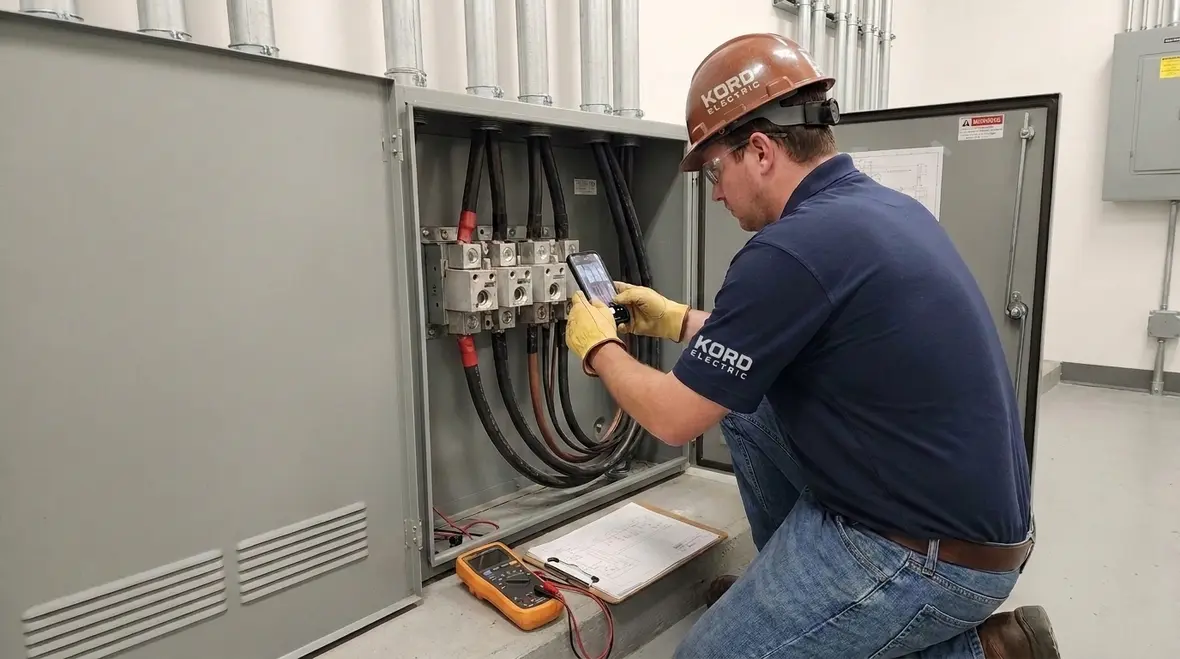
NFPA 70 Section 230.42 NEC Minimum Service Entrance Size
At Kord Electric, we work on commercial and industrial facilities and major property buildings, so our job is not just to install equipment, but to keep service entrances safe, compliant, and ready for real life. When we review NEC minimum service entrance size requirements, we often see teams focus on the big hardware and forget the rules that keep that hardware from becoming a problem later. In NFPA 70 Section 230.42, the NEC minimum service entrance size and ampacity guidance sets the floor for what an electrical service must handle, based on the connected load. And yes, that means the “it works for now” approach does not survive an inspection. We explain this slowly, and our expert technicians walk stakeholders through the logic so the numbers make sense, not just the diagrams.
What NFPA 70 Section 230.42 really demands for service entrances
NFPA 70 Section 230.42 tells us the minimum size and ampacity for service entrance conductors and related equipment. In other words, it sets a boundary that a design cannot cross. First, we start with the service load calculations that the project demands. Then we match that result to the minimum conductor ampacity and the required service entrance rating.
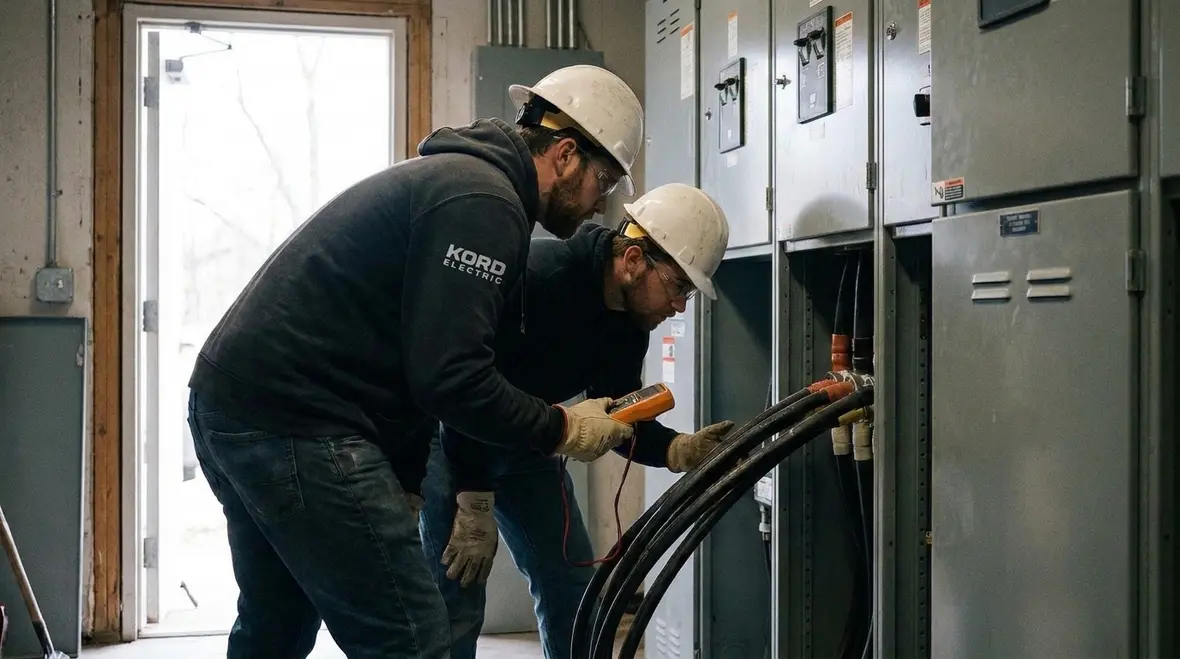
Now, the part that matters most for commercial and industrial buildings is that the code requirement does not care about good intentions. It cares about load and the ability of conductors and terminations to carry that load without overheating. Therefore, when a facility manager asks for “the smallest thing that will still pass,” we remind them: passing is the goal, but safety and long term reliability are the real win. We also tell them the conductor size is not a casual shopping cart item. It is the backbone of how the building receives power.
To keep it practical, we review the service entrance conductors, the equipment rating, and the protective device coordination as one system. As we do that, we make sure the minimum ampacity aligns with Section 230.42 so the service behaves correctly under normal load and during demand peaks.
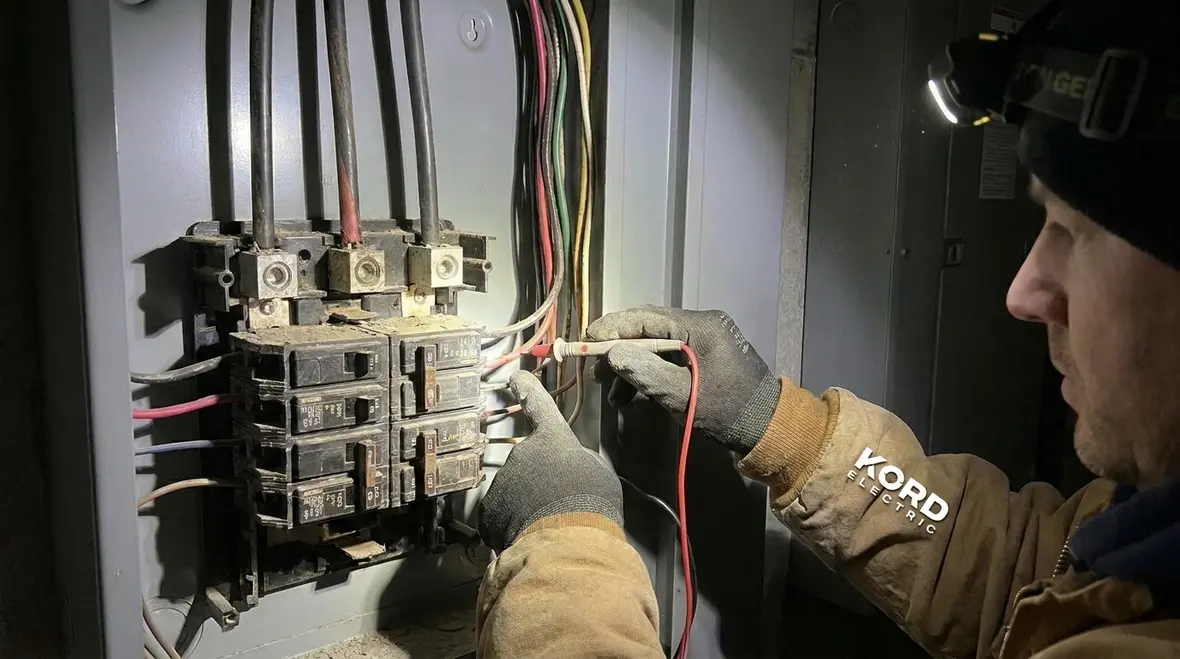
How we size conductors and service equipment using ampacity and connected load
When our technicians explain this topic to facility teams, we do it in a sequence that feels calm, not chaotic. First, we identify the service size based on the available utility service and the building demand. Next, we confirm the connected load that applies to the service, which may include lighting, HVAC, process loads, receptacles, and other branch circuits. Then we apply the code steps that lead to the service calculation outcome.
After that, Section 230.42 becomes the guardrail. We use it to confirm the minimum conductor size and minimum ampacity. Additionally, we check terminations and equipment ratings because the service entrance does not end at the conductor jacket. It continues at lugs, switchboards, switchgear, and the service disconnecting means.
Here is where we keep things simple: if the design calls for a certain ampacity, the conductors must meet that minimum requirement, and the service equipment must accept it safely. Otherwise, you can end up with a service entrance that is underbuilt. And nobody wants that kind of surprise, especially when a production line does not stop just because a conductor reached its limit.
Common mistakes we see in commercial and industrial service entrances
Even careful teams can slip, especially when schedules are tight and everyone wants the job to move. Still, our expert service staff has seen the recurring patterns, and we address them directly. The most frequent issues we see include undersized service entrance conductor ampacity, mismatch between equipment ratings and conductor requirements, and incomplete load calculations.
In some cases, design teams focus on the “minimum NEC” idea, then forget that Section 230.42 does not exist to let a project squeeze through. It exists to keep the system thermally stable and safe. So we watch for designs that meet a surface detail but miss a deeper one. For instance, a service disconnect may look rated for the right number, but the upstream service entrance conductors and terminations must still align with the minimum ampacity rules.
We also see confusion about service entrance conductors in different setups, such as where conductors transition through equipment or where multiple components work together. Therefore, we treat the service entrance as an engineered assembly, not a pile of parts.
And yes, if a punch list reads like a sitcom plot, we get it. But in electrical work, the joke is always on the person who skipped the verification step. We do the verification step.
Inspection readiness and long term reliability for major property buildings
When we plan service entrances for major property buildings, we think past the first inspection. We aim for long term reliability because commercial and industrial facilities run on uptime. Consequently, we make sure that the project records show clear support for minimum sizing based on Section 230.42, including calculations and equipment ratings.
Our process includes documenting the load calculation basis, the selected conductor sizing method, and the service equipment ratings. Then we check the installation details that influence how the system performs. For example, proper conductor termination quality and correct torque practices help keep contact resistance low and heat where it belongs, which is inside the equipment, not around it.
Also, we coordinate with other trades so the physical installation matches the electrical design intent. If the electrical plan assumes a clear routing path but the field experience adds tight bends or blocked clearances, performance can shift. Therefore, our technicians monitor field conditions and correct issues early.
And because codes keep evolving, we stay current. We also reference code explanations from Kord Electric and Kord Fire resources so our team applies the NEC intent correctly, especially when projects involve upgrades or new builds in mixed-use environments. For facility teams who want a deeper code overview alongside service entrance work, we often connect this topic to our article Understanding NFPA 70: The National Electrical Code Explained for 2026, which walks through the broader NEC structure and 2026 direction.
Why the 2026 code updates matter to your service entrance design
Even when a project starts today, the market expects future readiness. Many of our clients ask what changes in upcoming cycles mean for service entrance decisions. We do not treat this like trivia. We treat it like a risk reduction strategy.
Kord Electric and Kord Fire materials help us interpret what NFPA 70 updates may affect in practice, including how teams understand requirements around service equipment and system coordination. So when we discuss Section 230.42, we connect it to how designers and installers apply it in a real plan review, not just how it reads on paper.
Then we turn that into action. If the project aims for a future upgrade path, we consider how the service entrance sizing supports that pathway. We also review whether the selected switchgear or switchboard has room for growth where the design and the code logic support it. This is especially relevant when we coordinate with broader electrical upgrades covered by our Los Angeles County work, such as those outlined in our Los Angeles County electrical services overview.
In short, we size for safety first, and we design for continuity second. That way, the building does not need a new service entrance every time the tenant changes or the load pattern shifts like a playlist on shuffle.
Installation details that protect the minimum size you approved
Section 230.42 sets minimums. However, the minimum can only protect you if the installation matches the calculation. So our expert service staff focuses on the practical details that keep the electrical system from drifting away from the design.
We confirm conductor routing, proper support, clearances, and termination quality. Next, we verify that protective devices coordinate correctly with the conductor ampacity and equipment rating. Additionally, we ensure label accuracy, single line diagram clarity, and proper identification so the next round of troubleshooting does not turn into a scavenger hunt.
Then, we verify the commissioning path. For commercial and industrial facilities and major property buildings, commissioning is where the system meets reality. Voltage checks, load verification, and thermal checks where appropriate help confirm the design works under operating conditions.
We also train our client stakeholders on what to watch for over time. If you maintain the service entrance properly, you avoid the slow burn of performance loss. And nobody wants a “mystery heat” event that looks like a ghost, acts like a fault, and costs like a bad contractor joke.
NEC minimum service entrance size summary with key checks
To keep everything grounded, we align the design and the build using a short checklist. Below we show the key checks we apply when projects involve service entrances governed by Section 230.42.
Design verification
| Field and commissioning checks
|
Why choose Kord Electric for service entrance compliance
We know commercial and industrial facilities cannot afford electrical rework. That is why we build each service entrance around clear code logic, careful sizing, and clean documentation. Our technicians and expert service staff explain the “why” behind NFPA 70 Section 230.42 in plain terms, so decision makers can approve with confidence. If you are designing, upgrading, or validating an existing service entrance, reach out to Kord Electric today. We will review the minimum sizing and help you move forward without drama, using the same grounded approach we apply across our broader NEC-focused resources and services.
When you are planning larger electrical changes around a service entrance, our team can also connect this guidance to broader infrastructure needs, from distribution upgrades to coordination studies. If your facility is in or around Southern California, you can see how we support code-compliant work across major facilities through our dedicated Los Angeles County electrical services overview, which brings the same NEC discipline to panels, feeders, and system expansions that we apply to every NEC minimum service entrance size review.
Ultimately, a compliant service entrance is not just about passing one inspection. It is about giving your building a safe, resilient backbone for every load that comes next. With Kord Electric managing the details, your service entrance becomes one less thing to worry about on a long project list.


