Title 24 Lighting Requirements for CA Commercial Buildings
Title 24 Lighting Requirements for Commercial Buildings in California: What Facilities Need to Know
California does not play games with energy use, and that includes Title 24 lighting requirements. In the first place, the rules affect how commercial and industrial buildings in the state select, install, and control lighting, so it meets strict energy standards. In practice, this means designers and building teams must plan lighting that uses the right power levels, provides the right brightness, and still keeps occupants comfortable. Yes, it is detailed, but it is not random. And when Kord Electric steps in, our technicians and expert service staff explain the “why” behind the numbers, so our customers understand compliance without feeling like they are trapped in a never ending lighting spreadsheet.
In this article, we outline what facility owners and property managers need to handle, how inspections and documentation usually work, and where common mistakes show up. Then we close with a clear call to action for Kord Electric, focused on commercial and industrial facilities and major property buildings only.
How the Code Shapes Real Lighting Design

Title 24 standards focus on energy performance. So, while people often think the rules only cover fixtures, they actually guide the entire lighting strategy. That includes layout, wattage, controls, and how spaces respond to occupancy and time of day. As a result, the most compliant lighting designs treat lighting like a system, not like a box you swap out during a remodel.
Typically, facilities must meet maximum power limits for lighting in specific areas. At the same time, they must maintain proper light levels for tasks and safety. However, meeting light level targets is not enough. The system also needs effective controls that reduce energy waste when spaces are empty or daylight makes extra lighting unnecessary.
Our technicians at Kord Electric often point out a simple truth: if a design team selects efficient fixtures but skips controls, the building can still fall short. Meanwhile, if the controls exist but the installed hardware does not match what the plans assumed, the compliance path gets bumpy. In other words, “almost” compliant is still a problem, and the inspector does not accept vibes as documentation.
For a deeper dive into how statewide expectations shape real-world lighting layouts, you can also review Kord Electric’s California Commercial Lighting Code Guide for 2026, which connects Title 24 requirements to practical design choices for large properties.
What Counts as Compliance: Power, Controls, and Lighting Quality
Facility teams usually chase compliance through three main lanes. First is lighting power. Second is controls. Third is how the light functions in the space.
1. Lighting power and efficiency
Standards typically require that installed systems stay within allowed energy use limits. That does not mean every fixture must be the dimmest option. Instead, it means the selection should balance lumen output with power draw. Therefore, the best approach involves calculating total load based on the fixture schedule and room usage.
On large retrofit projects, Kord Electric often helps customers compare fixture packages and control options against guidance from resources like the California Commercial Lighting Code Guide and our own California Title 24 Lighting Retrofit ROI Guide, so energy use limits stay aligned with real savings and payback.
2. Controls that actually work
Controls matter because they prevent energy waste. For example, occupancy sensing can reduce lighting in offices, corridors, restrooms, and storage areas. Additionally, timers and scheduling help manage after hours usage. Furthermore, daylight responsive controls can dim or switch off lights when natural light covers the need.
Here is the practical part. Controls have to be set correctly. Our expert service staff explains that even when the building has the right equipment, incorrect settings can cause lights to stay on longer than the plan expects. Then, the energy model no longer matches reality.
3. Lighting quality and safety
Commercial and industrial spaces also require adequate visibility. So, when compliance efforts reduce power, they cannot reduce usability. If a warehouse aisle becomes too dark or a work area loses clarity, occupants feel it immediately. As a result, good compliance supports both energy performance and safe operations.
Kord Electric’s commercial and industrial lighting work focuses on both aspects: keeping Title 24 lighting requirements in view while still delivering lighting quality that helps people do their jobs without eye strain, guesswork, or unsafe shadows in critical areas.
Building Types and Typical Spaces We See
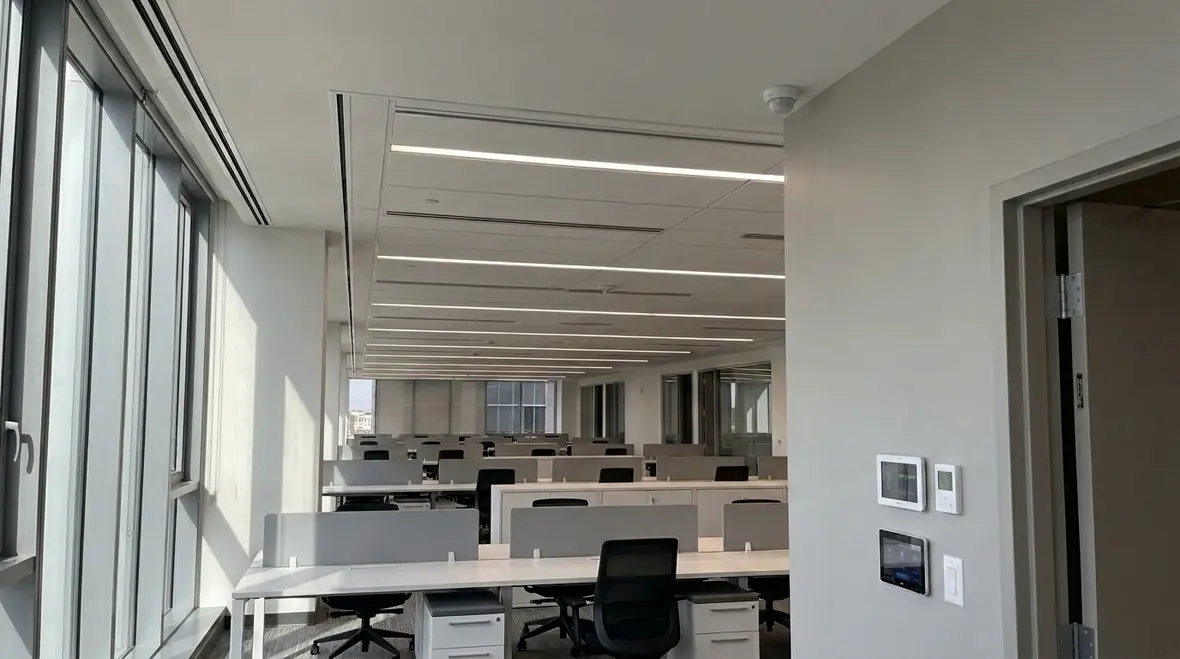
Commercial and industrial buildings use lighting differently than homes. That difference drives the details teams must handle. Kord Electric serves commercial and industrial facilities and major property buildings, and we commonly see these space types in our projects.
Office areas and administrative floors
Offices often use task lighting plus ambient lighting. Occupancy controls and time schedules reduce waste. Therefore, the design should prevent “lights on forever” behavior.
Warehouses, distribution centers, and back of house spaces
In industrial spaces, fixtures cover wide areas and sometimes have higher initial output. Yet controls still matter because many areas sit empty during off shifts. Our team helps align controls with operating schedules and traffic patterns.
For example, our recessed lighting installation services for warehouses and industrial spaces often pair high-efficiency fixtures with occupancy-based zoning, so long aisles and loading docks only receive full output when needed.
Corridors, stairwells, and parking or loading areas
Safety lighting plays a key role. So the controls approach must still keep areas safe and usable. In addition, some locations need emergency lighting coordination under separate rules, which teams must avoid mixing up during planning.
Retail style common areas in major property buildings
Even when a building includes multiple tenants, the shared lighting systems still must perform correctly. Hence, building owners benefit from a consistent approach to scheduling and control settings across common areas.
And yes, lighting layouts in large buildings can feel like a puzzle box. But our service staff treats it like a checklist with real outcomes, drawing on experience from lighting installation projects across campuses, warehouses, and multi-tenant properties.
Documentation, Inspections, and What Facilities Often Miss

Even strong hardware can struggle if the paperwork and settings do not match the design assumptions. That is where many teams stumble, especially during fast rollouts or remodels. The goal is to show that what gets installed aligns with the planned system.
Common misses we see include fixture substitutions that change total power, control wiring that gets altered during tenant work, and schedules that do not follow actual occupancy patterns. Also, lighting control devices sometimes get installed, but they never get tuned. Then the building behaves like it is on autopilot, and energy performance does not follow the model.
To keep things smooth, Kord Electric’s expert service staff supports facilities with explanations that make the compliance process easier to follow. We help our customers understand what to verify before final signoff, and we also recommend a practical commissioning approach that reduces surprises.
Most importantly, our technicians focus on measurable outcomes. They do not just walk away after installing equipment. Instead, they support confirmation of control behavior, lighting levels, and system operation so the building performs as expected. For many customers, this commissioning and documentation support aligns naturally with our broader electrical preventive maintenance programs, especially where Title 24 lighting compliance is part of annual reporting.
Retrofits That Meet Requirements Without Shutting Down Operations
Facilities rarely have the luxury of long closures. So retrofit planning must reduce downtime while still improving compliance. The best path usually starts with evaluating the existing system. That includes fixture types, control layout, wiring condition, and how the space operates day to day.
Once that baseline is clear, a retrofit can move in stages. For example, a facility might replace the most wasteful lighting first, then update controls where occupancy and scheduling can reduce energy use. In the same phase, the team can plan how tenants and building departments will coordinate access times.
During these upgrades, our technicians at Kord Electric guide customers through decisions that affect compliance. They can also help avoid “looks good today, fails later” situations, where a fixture replacement seems successful but creates mismatches with power limits or control intent.
And when someone asks, “Can we just change bulbs?” our staff gives a calm answer that often sounds like comedy. Bulbs are not the main problem. Controls, system power, and how lighting behaves across the space matter more than people think. It is like changing one character in a movie and expecting the plot to stay the same.
For teams comparing different upgrade paths, Kord Electric’s Commercial Lighting Upgrade Cost Guide and our California Title 24 Lighting Retrofit ROI resources help connect retrofit decisions to both budget and compliance outcomes.
Title 24 Lighting Requirements and Control Strategies for Large Properties
For major property buildings, control design determines whether the lighting system stays efficient across many zones. Therefore, a strategy based on zone control, scheduling, and occupancy patterns usually performs better than a one size fits all approach.
In many facilities, large common areas and corridors run on different schedules than offices or industrial work zones. As a result, the lighting should respond to those schedules rather than just a generic time clock. Additionally, daylight harvesting works best when sensors receive stable daylight conditions, not when window shading changes throughout the day.
Kord Electric’s expert service staff helps facility teams understand how to match control sequences to real use. Then we support commissioning steps that confirm sensor behavior and verify dimming or switching performance. When systems behave correctly, energy savings become predictable instead of accidental.
Finally, our approach stays practical. We focus on maintaining occupant comfort and safety while aligning performance with the Title 24 lighting requirements used in California commercial and industrial compliance planning. That means the building looks good, works well, and avoids the dreaded “why does this still consume power” question from a manager who is not paid to decode lighting controls.
FAQ for Commercial and Industrial Facilities
Contact Kord Electric for a Compliance-Ready Lighting Plan
If your commercial or industrial property needs lighting upgrades that align with California energy expectations, Kord Electric can help you move forward with confidence. Our technicians and expert service staff explain the process in plain terms, then they verify controls and system performance so the building behaves like the plan. Reach out to us for an evaluation, a retrofit roadmap, and installation support designed for major property buildings and industrial sites. Let’s handle the details now, so your team spends less time guessing and more time operating.
For property managers ready to take the next step, our dedicated Lighting Installation Services page outlines how we design, install, and commission commercial and industrial lighting systems that align with Title 24 from day one.
Whether you need a full Title 24 lighting retrofit, targeted controls upgrades, or support integrating lighting into a broader electrical preventive maintenance program, Kord Electric is built for large facilities that cannot afford guesswork.
Connect with our team to discuss your facility, review current Title 24 lighting requirements for your building type, and outline a practical path from “we think we are close” to documented, inspected, compliance-ready lighting.