Troubleshooting Flickering Commercial Lights Fast
Spotting and Solving Troubleshooting Flickering Commercial Lights in Real Time
Troubleshooting flickering commercial lights usually starts with a simple complaint from a tenant, operator, or facilities manager. The lights blink when the HVAC kicks on. They pulse after a transformer cycling event. Or they flicker only in one hallway while the rest of the building looks fine. In commercial and industrial facilities, we see these issues often enough that our team treats them like a priority, not a nuisance.
Still, flicker is not always “just bad bulbs.” In many cases, it points to wiring stress, loose connections, power quality problems, or code related hazards that can escalate into downtime. And since others sometimes try to solve it by swapping lamps until the building feels better, we focus on the real cause first.
Common Causes in Commercial Buildings That Our Technicians Trace
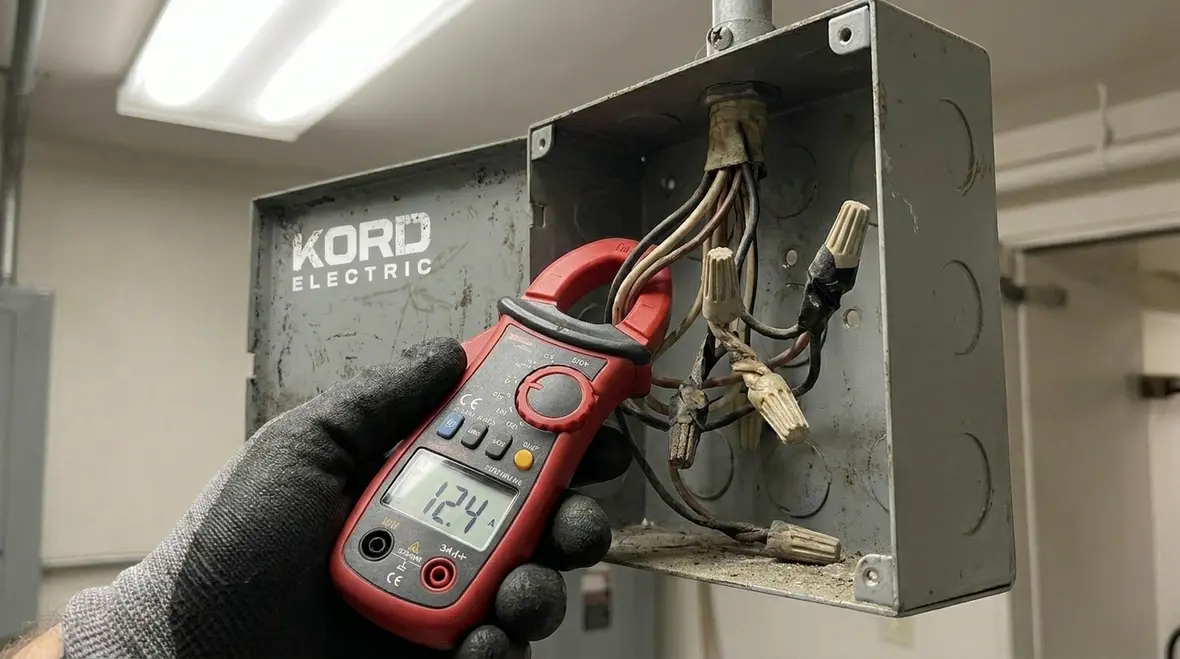
To keep a facility reliable, we identify flicker patterns and then match them to the most likely sources. As a rule, we look for what changed and what the lights share with the rest of the electrical system. Then, our expert service staff explains what we find in plain terms, so your team understands the “why,” not just the “what.”
Flickering commercial lighting commonly comes from these causes.
- Loose or failing connections in luminaires, junction boxes, or panel feeders. Heat and vibration slowly loosen terminations, and the connection “chatters.”
- Voltage drops caused by overloaded circuits or long conductor runs with aging loads.
- Power quality issues such as harmonic distortion from variable frequency drives, LED drivers, or modern controls.
- Improper dimming or controls including mismatched drivers, bad control wiring, or settings that do not suit the load.
- Neutral problems such as open neutrals or high neutral resistance. This often shows up as flicker, buzzing, or uneven brightness across phases.
And yes, we have seen cases where someone “fixed” it by turning lights on and off. Unfortunately, that makes the root problem feel invited, like a bad sitcom character returning for another season.
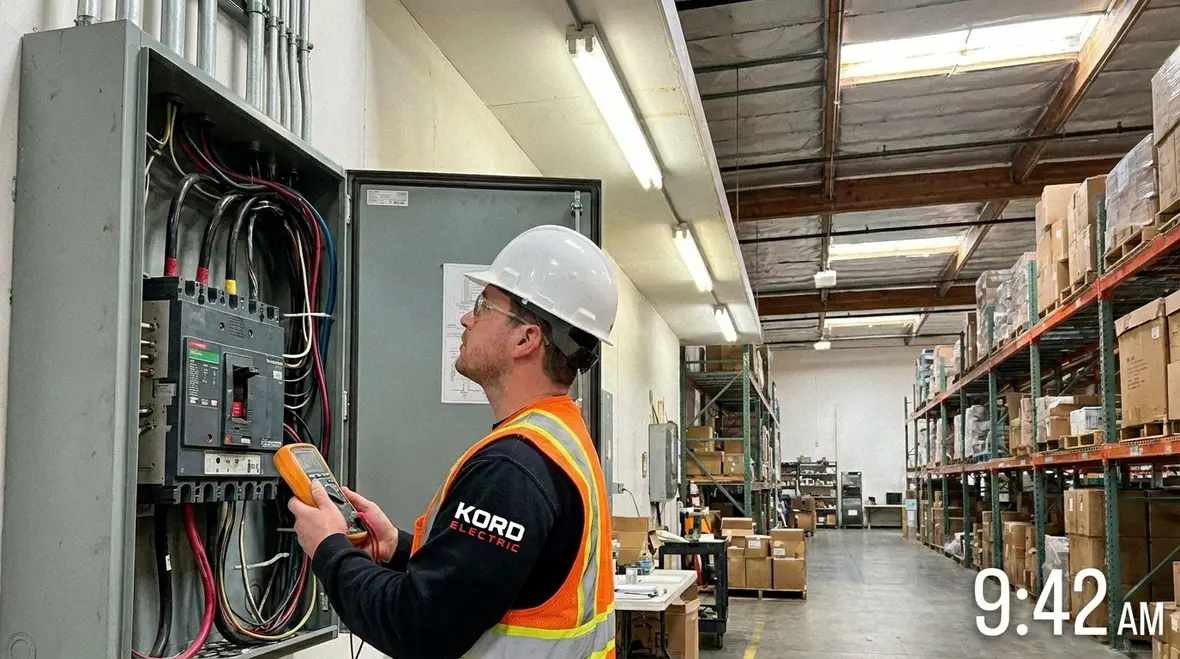
How to Distinguish Flicker From Dimming, Overload, and Wiring Problems
When we troubleshoot, we treat the symptom like a clue. For instance, if the lights flicker only when a specific machine starts, we suspect an inrush current or voltage sag. However, if flicker happens across multiple areas at the same time, we narrow it to upstream supply, panel connections, or system wide power quality.
Here is how our technicians and expert service staff break it down during on site assessment.
- Local flicker usually points to a single circuit, a specific lighting run, or a luminaire driver issue.
- Zone wide flicker often indicates a feeder, panel terminations, or load interaction in that section.
- Whole building flicker can suggest service problems, utility variation, grounding issues, or neutral resistance.
- Flicker that changes with dimmer level points to driver compatibility, control settings, or wiring polarity concerns.
Next, we confirm what the operator observes. Then we test voltages, check connections, and review how the lighting interfaces with controls. Because commercial facilities rarely run on “one problem at a time,” we approach it as a system, not a single lamp.
Why Loose Neutrals and Terminations Cause the Blink
Loose neutrals and tired terminations behave like a silent villain. They create unstable voltage and uneven distribution, and the lights respond by blinking. Meanwhile, other equipment may still “work,” so the problem can hide until it grows.
In practical terms, we watch for these signs:
- Flicker that appears after maintenance or after someone worked near a panel, lighting run, or junction box.
- Uneven brightness where some fixtures stay steady while others pulse.
- Warm or discolored conductors at terminations that suggest heat damage.
- Buzzing or surging behavior tied to the lighting circuit or nearby loads.
Even when the building “looks okay,” loose connections raise risk. Therefore, we emphasize safe inspections, tightening, torque verification, and clean contact surfaces. We also explain the findings clearly, so your maintenance team can spot similar warning signs later.
If anyone tells you the flicker is harmless, we politely remind them that electricity does not do “harmless.” It either stays within safe limits, or it escalates.
Power Quality and NFPA 70 Impacts on Lighting Performance
Some flickering commercial lighting comes from power quality issues that only show up under real operating conditions. For example, when variable frequency drives start, or when certain HVAC controls cycle, the system can introduce harmonics. Those harmonics can stress electronic drivers in fixtures, then result in unstable light output.
Also, building electrical systems must align with applicable code requirements. Our team reviews the installation and operating setup with a code aware mindset, including the principles found in the National Electrical Code. In our referenced blog content, we explain how the NEC supports safe design and proper installation practices across many electrical scenarios. You can see our breakdown of Understanding NFPA 70, the National Electrical Code Explained for 2026 to understand how code thinking connects to real world outcomes.
Then we translate that into what matters for your facility. We focus on:
- Correct conductor sizing and protection to reduce voltage stress.
- Proper grounding and bonding to stabilize system behavior.
- Safe practices for switching, dimming, and control wiring so drivers operate as intended.
We make this approachable. In other words, we do not hide behind jargon. Our expert service staff walks the property team through what power quality means, how it shows up as flicker, and what changes actually reduce repeat calls. Nobody wants a revolving door of “it will get better next week.”
Flickering LEDs, Drivers, and Controls in Industrial and Commercial Spaces
LEDs bring efficiency, but they also bring driver electronics that can react to unstable power. When a facility upgrades lighting without matching drivers or control settings, flicker can appear fast. Likewise, when dimming controls get replaced, or when someone changes a control strategy, the lighting system may no longer behave smoothly.
Our troubleshooting flickering commercial lights process includes these checks:
- Driver compatibility with the existing dimming method and control brand or model.
- Correct wiring for controls and polarity, especially in multi switch and multi zone layouts.
- Load interaction between lighting and other electronically controlled devices.
- Fixture level diagnostics to confirm whether flicker originates at the driver or upstream supply.
Next, we document the environment. We also review how the facility runs day to day. For example, a warehouse with frequent dock door cycles may see load changes that impact voltage. Then the LEDs show the stress. That is not a lighting “defect,” it is system behavior.
And yes, we have heard the punchline: someone said, “It is probably a ghost.” In truth, the ghost is usually a driver that does not like the control signal, or a connection that has warmed up too many times.
Our Service Approach: Testing, Safety, and Clear Explanations
Kord Electric serves commercial and industrial facilities and major property buildings. So our approach stays practical, safety centered, and focused on minimizing downtime. We begin with a fast fact gathering step, then we move into targeted testing instead of random swapping.
Here is the flow we use with our customers.
- On site observation to capture when flicker occurs and which zones and circuits it affects.
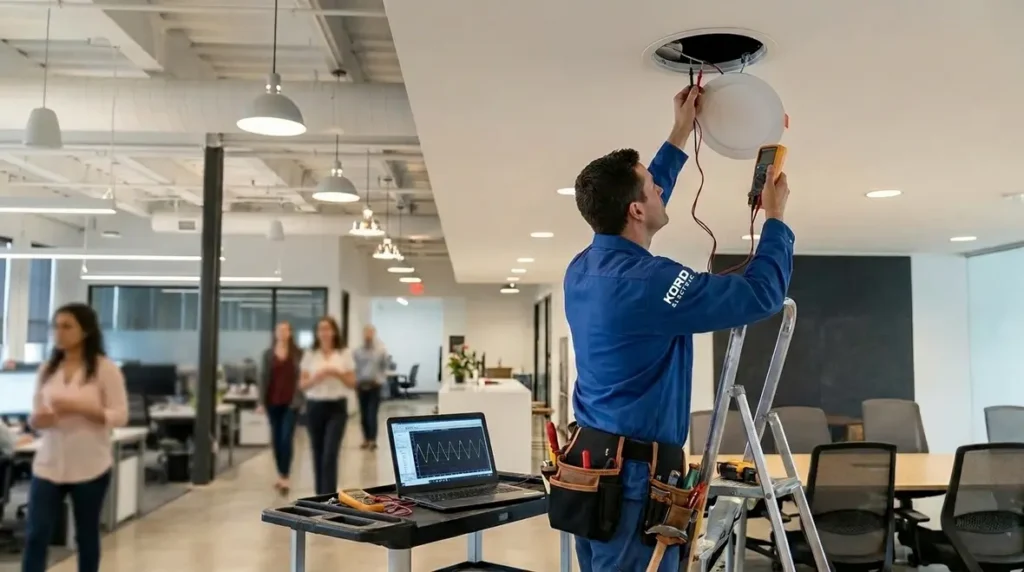
- Electrical measurements to check voltage, stability, and signs of load interaction.
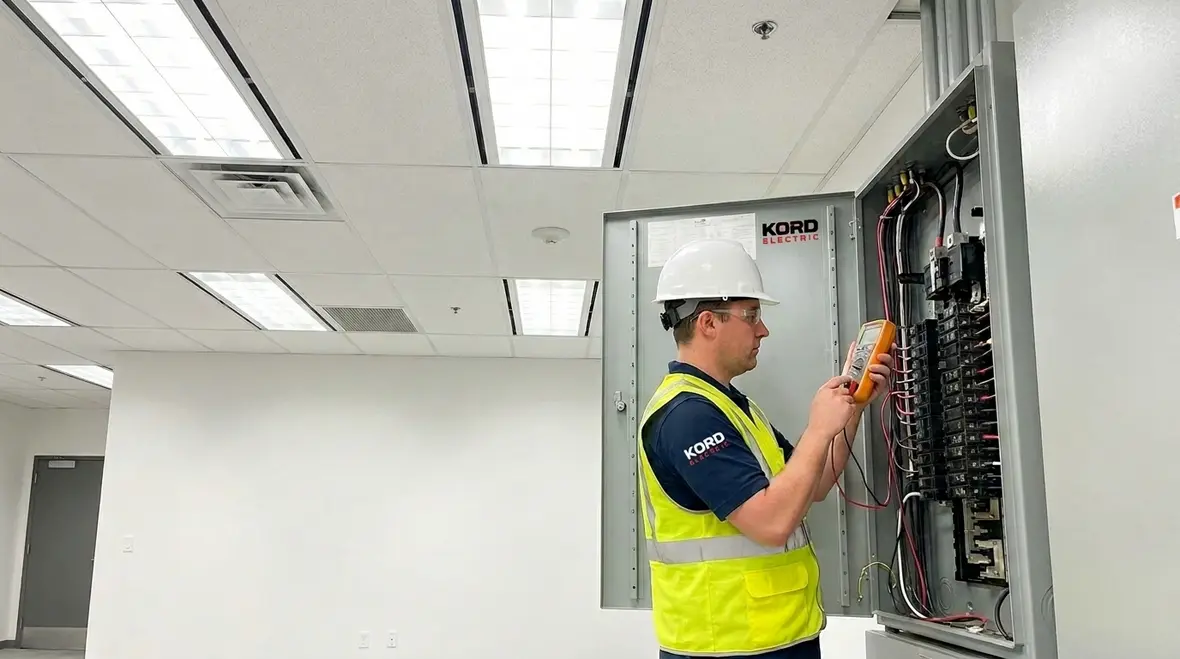
- Connection inspection at luminaires, junctions, and panel terminations to confirm mechanical integrity.
- Control and dimming review to ensure the system operates within the driver and control requirements.
- Code aligned recommendations based on safe installation principles and the electrical conditions observed.
Most importantly, our expert service staff explains the results in a way your teams can act on. Therefore, you receive not only a fix, but also a plan that reduces repeat events. We do not just make the lights steady today. We help you keep them steady next month.
If you are planning a broader upgrade or need new systems to support long term reliability, you can align this troubleshooting work with dedicated services like Lighting Installation Services or structured electrical preventive programs. Coordinating repairs, upgrades, and maintenance gives your facility a stronger foundation instead of a series of one off fixes.
FAQ About Troubleshooting Flickering Commercial Lights
Get the Right Fix From Kord Electric, Not Another Guess
If your facility suffers from flicker, we will help you pinpoint the cause and restore stable lighting safely. Kord Electric focuses on commercial and industrial needs, and our expert service staff brings testing, inspection, and clear explanations that your team can trust. Stop treating flickering as a daily annoyance and start treating it like an electrical issue with a real solution. Contact us to schedule troubleshooting and restore dependable performance across your building.
When you are ready to move from reactive fixes to long term stability, pairing this work with services like Electrical Preventive Maintenance or a full Lighting Installation Services upgrade gives your building a stronger, more resilient electrical backbone. That way, the next time someone walks into a hallway, they notice reliable lighting, not another round of blinking.