2020 NEC Emergency Disconnect Panel Safety Guide
At Kord Electric, we see commercial and industrial panels every day, and we also see the same moment go wrong when emergency power systems fail under stress. That is why we pay close attention to the 2020 NEC emergency disconnect and the safety details around it. In the field, the goal is simple: when something goes bad, the right person can cut power fast, clearly, and safely, without guessing. Meanwhile, building teams want confidence, not confusion. So we make sure our expert service staff explains what the code requires, how your equipment should look, and what a safe inspection actually covers. And yes, we know. “Emergency disconnect” sounds dramatic. But in real life, it is the difference between controlled action and chaos, like a movie scene where the hero finally finds the panel door that was apparently hidden behind a stack of paperwork.
1. Why 2020 NEC emergency disconnect rules matter in real life
Third person teams often assume that once a disconnect exists, the job is done. However, the 2020 NEC emergency disconnect requirements exist because people do not behave like checklists during emergencies. They act under time pressure, smoke, noise, and stress. Therefore, the code pushes design choices that make operation predictable.
In commercial and industrial facilities, these systems are tied to life safety, fire and smoke response, and safe shutdown of circuits. Consequently, the emergency disconnect cannot be an afterthought or a “we’ll deal with it later” item. Instead, it has to be located, identified, and installed so that authorized responders can act quickly and without risk of exposure to energized equipment.
Our technicians and expert service staff often explain it this way: if the panel safety plan relies on someone finding the correct switch during an emergency, then the building is already gambling. We help reduce that gamble by making compliance practical, not just theoretical.
2. NEC panel safety basics that technicians verify on site
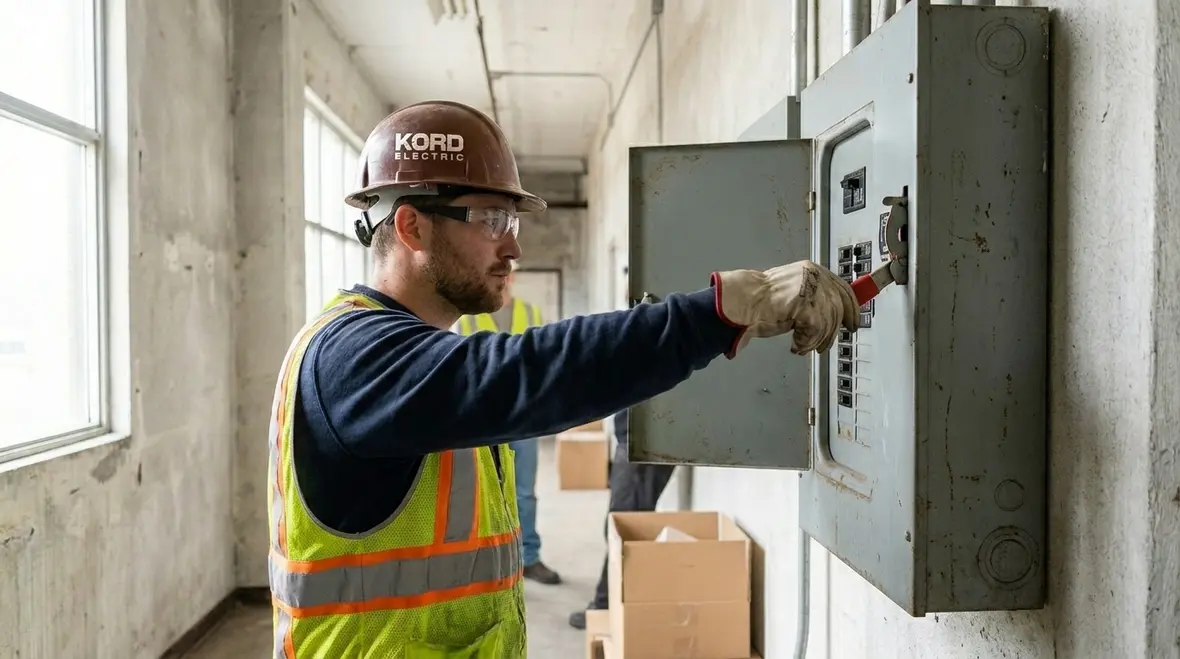
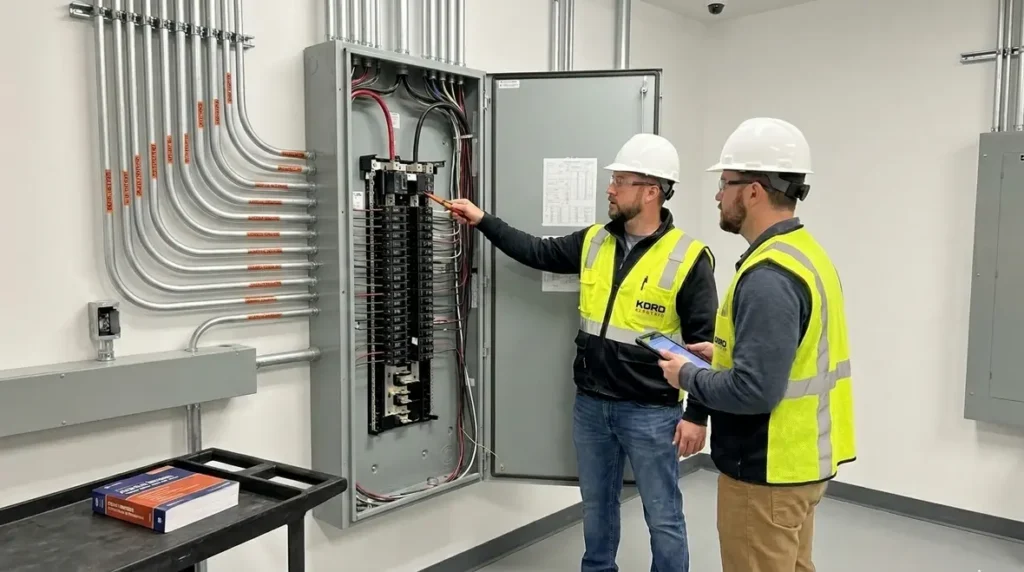
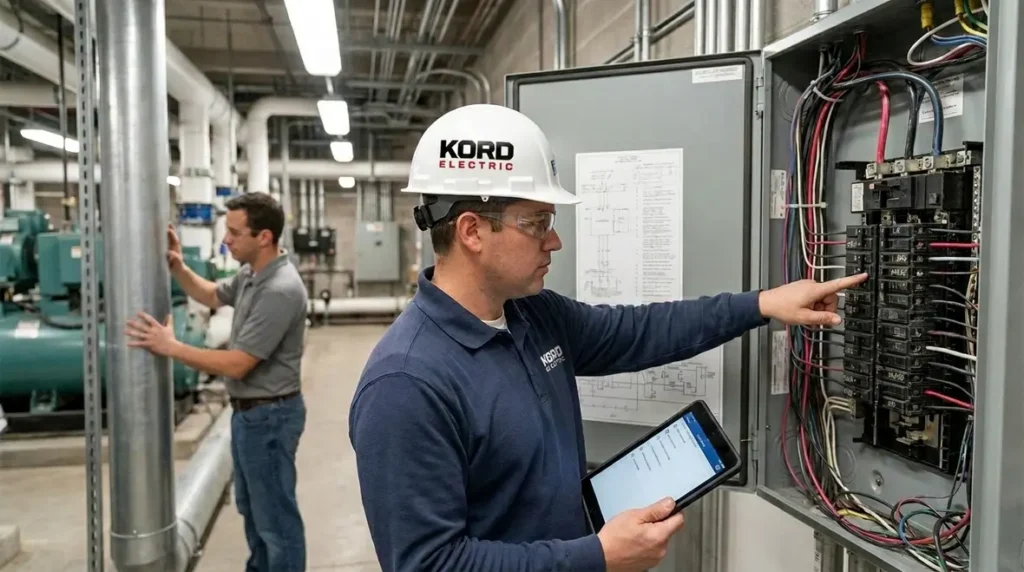
When Kord Electric arrives on a major property project, we start with what people can see and operate. After that, we check what people cannot see, but should still be safe. That is how panel safety becomes real. In practice, our team verifies key points that align with the 2020 NEC approach to safe operation and labeling, including clear access, secure enclosure conditions, and correct circuit separation where required.
First, we inspect the physical layout. We confirm that required clearances around equipment are maintained and that access paths do not get blocked by storage, temporary construction, or overgrown cable routes. Then we review how the panel is marked, because unclear labeling turns a response into a guessing game. Next, we evaluate whether the disconnecting means supports safe interruption of power in the relevant emergency scenario.
Even when the equipment looks fine, we still ask one question: does the system behave safely under real conditions? In other words, if someone had to act quickly, could they do it without opening the wrong door or stepping into an unsafe zone. Our experts take the time to explain their findings in plain terms, because the fastest way to prevent repeat issues is to make sure the maintenance team understands what they are responsible for.
For facility teams looking at the bigger picture of system performance and risk, it also helps to connect emergency disconnect planning with a broader strategy for hidden electrical risks in commercial buildings. That connection turns a single device into part of a much more dependable safety story.
3. Where and how emergency shutoff equipment should be installed
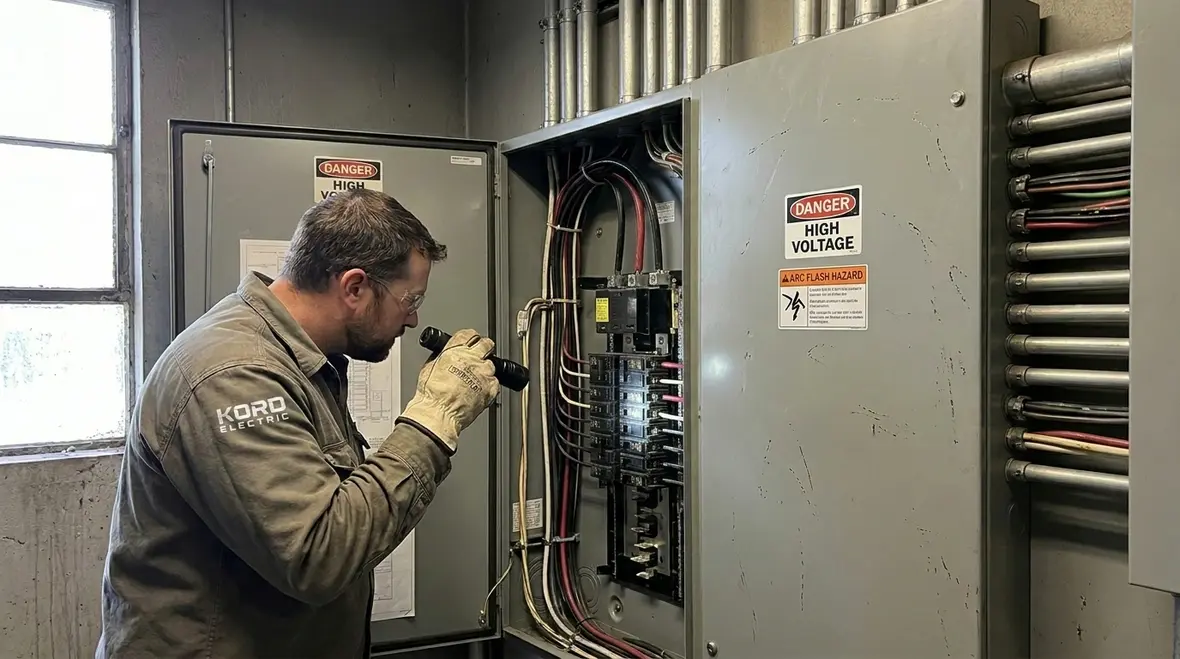
Emergency shutdown equipment has to follow predictable rules on placement and usability. That is the point. Therefore, the installation must support rapid access without forcing a responder to travel through hazards or waste time identifying the correct control. In commercial and industrial settings, we pay special attention to traffic patterns, door swings, lighting, and whether the equipment is reachable during the building’s worst moments.
In addition, the shutdown device must connect to the correct circuits and systems as intended by the design. So, Kord Electric confirms that the emergency disconnecting means actually disconnects the circuits it is supposed to. Otherwise, the label on the panel becomes a prop. And prop control is fun in theater, but it is not acceptable for major property safety.
Our technicians also look at how the disconnect’s enclosure supports safe handling. If a device lacks adequate guarding or does not protect against accidental contact, the “emergency” tool turns into a risk factor. We address these gaps with practical recommendations that fit how the facility operates, not just how the plan looked on paper.
On larger campuses, emergency shutoff equipment often sits alongside other major infrastructure like switchgear, transfer switches, and lighting controls. Treating all of these as part of an integrated system, rather than isolated hardware, aligns well with the way modern commercial electrical systems for modern buildings are designed to perform.
4. Identification, labeling, and signage that responders can read
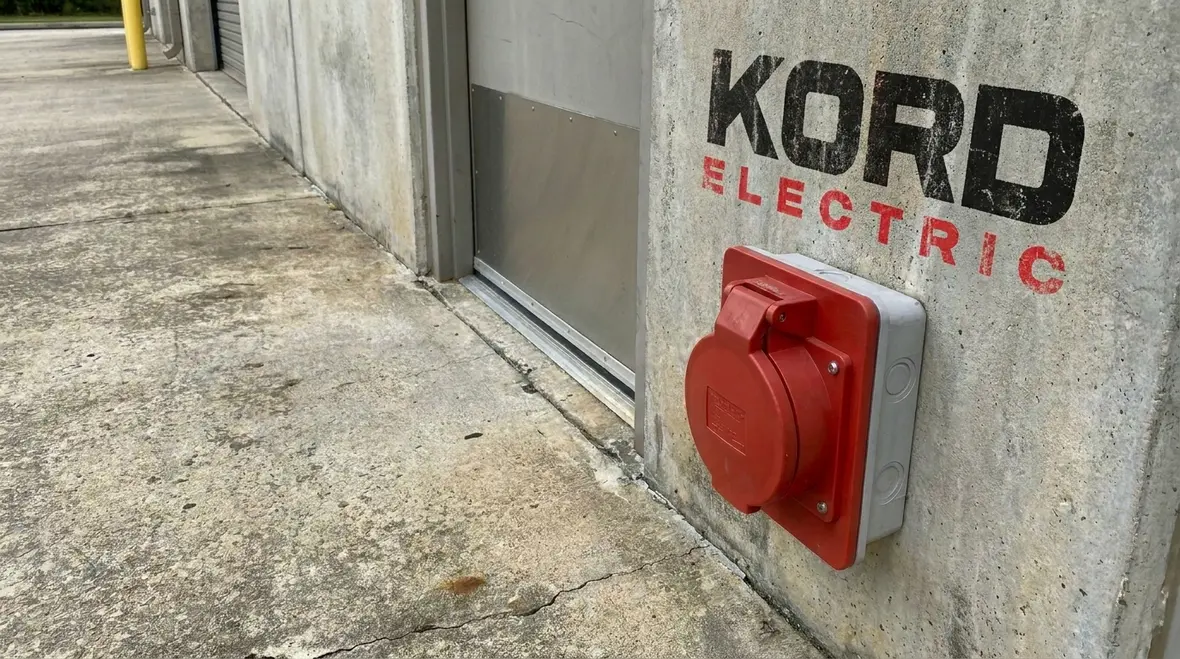
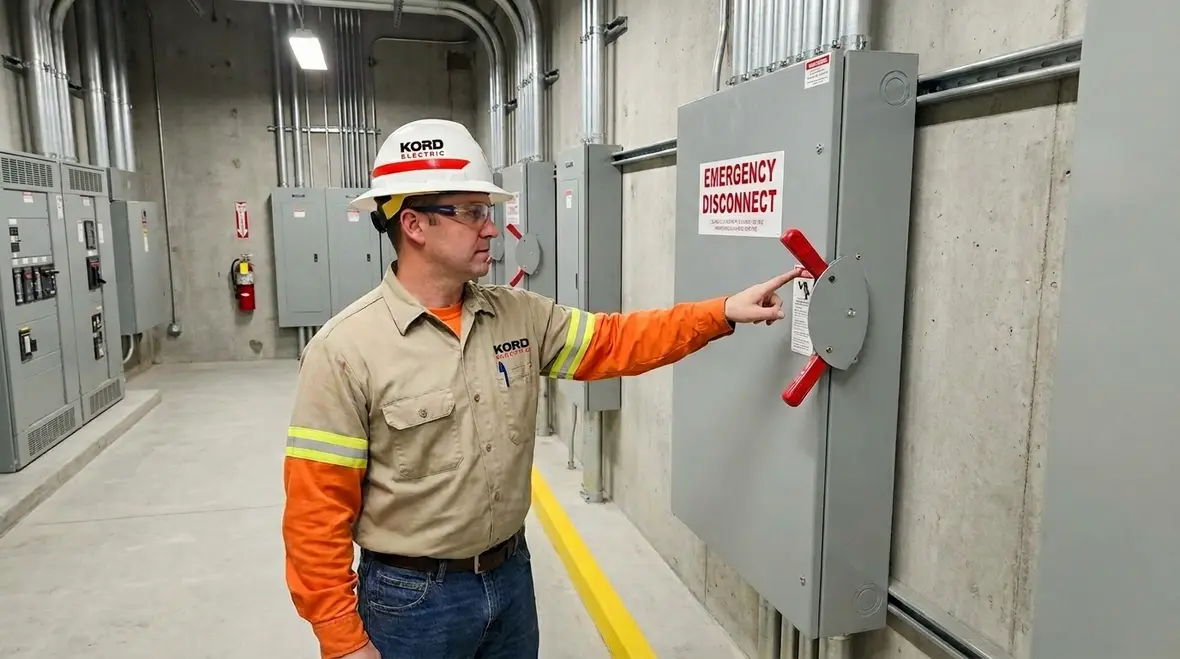
During an incident, people do not read like they are on a calm Tuesday morning. They scan. They trust. They act. So, identification and signage matter as much as electrical performance. Under the 2020 NEC framework, equipment used for emergency control must be identified clearly so that the correct action happens the first time.
Kord Electric focuses on labels that match how responders think. We do not mean fancy graphics for aesthetics. We mean clear, consistent naming that lines up with the electrical one line and with the facility’s operating procedures. As a result, the building team can create a simple response flow: find, confirm, disconnect, then move to the next step.
Our expert service staff also supports training, because a label that no one understands is just decoration. When our technicians explain how the emergency power shutdown integrates with the rest of the safety approach, facility staff gain a clearer mental model. That reduces mistakes during maintenance and improves coordination during real events.
Clear labeling and documentation around emergency controls also reinforce broader code compliance efforts, especially as standards evolve. Facility leaders who stay informed on resources like Kord Electric’s guide to understanding NFPA 70 and the national electrical code tend to have an easier time keeping emergency disconnect strategy aligned with the latest requirements.
5. How clearances and access affect compliance and safety
Panel safety is not only about wiring. It also depends on space. Therefore, we verify access and working clearances around panels and disconnect locations. If a facility stores items in front of the equipment, or if cable trays and conduit create barriers, the practical safety value collapses.
In commercial and industrial facilities, access problems often come from routine operations. A loading area expands. A temporary project lingers. A maintenance cart parks where it always has. Then, when an emergency happens, the team does not have room to act safely.
So, Kord Electric takes a site driven view. First, we map access routes. Then we check equipment surroundings. After that, we recommend changes that facility staff can maintain without a full remodel. This is where we earn trust. We do not just point out issues. We show what to adjust and how to keep it corrected.
And if someone asks, “Do we really need all that clearance?” our technicians answer politely, slowly, and with the calm of someone who has seen this go wrong. The code is not writing poetry. It is trying to prevent contact with energized parts and to support safe operation.
6. Coordination with fire and life safety systems in major buildings
Emergency disconnecting means rarely work alone. They coordinate with fire and life safety strategies, including shutdown actions and operational sequencing. Therefore, Kord Electric reviews how electrical control decisions fit the building’s overall safety plan.
In real projects, coordination breaks down when electrical shutdown controls do not match how the building’s life safety systems expect the power to behave. For example, a facility might assume that certain circuits de-energize in a specific order, yet the wiring or control design does not support that behavior. Then, staff face uncertainty. And in emergencies, uncertainty wastes time.
Our expert service staff helps by connecting the electrical details to operations. We explain what the emergency disconnect does, what it does not do, and how that aligns with the facility’s procedures. Then we help document the information so the team can maintain it over time. Because the system is not just installed once. It is lived with, tested, and maintained throughout the building’s life.
For facilities that lean heavily on continuity of operations, integrating emergency disconnect controls with broader electrical preventive maintenance programs turns one more compliance checkbox into a coordinated, tested safety asset.
7. Testing, maintenance, and documentation that keep the system dependable
Compliance does not stop at installation. In commercial and industrial facilities, an emergency shutdown device has to remain dependable. Therefore, Kord Electric recommends structured maintenance practices that include visual checks, operational testing where permitted, and documentation updates after any work in the electrical room.
We also help teams avoid common maintenance pitfalls. Over time, labels fade, access gets blocked, and modifications get added without updating the operating plan. In other words, the building slowly drifts away from the original intent. So, our technicians look for evidence of drift and then help correct it before it becomes a problem.
Documentation is part of that plan. We encourage facilities to keep clear records of the emergency disconnecting means, including circuit identification, equipment description, and any associated coordination details. That way, when another trade comes in, they do not “figure it out” from a blank wall. They follow the information that keeps everyone safer.
For many properties, the most effective way to keep this information accurate is to fold emergency disconnect checks into broader commercial and industrial electrical maintenance plans. With a clear schedule, documented findings, and repeatable tests, the “emergency” system stops being mysterious and becomes part of everyday reliability.
FAQ for commercial and industrial emergency disconnect compliance
Request a safety review with Kord Electric
If your commercial or industrial facility depends on emergency power shutdown, Kord Electric can help you verify installation details, access, identification, and coordination with life safety strategies. We send our technicians and expert service staff to explain findings in plain language, so your team understands what to fix and why it matters. Contact us to schedule a review and strengthen your panel safety plan with confidence. Don’t wait for an incident to find out the system behaves like a mystery novel. Let’s keep it clear, tested, and dependable.
For facilities building out broader reliability and safety programs, emergency disconnect reviews pair naturally with structured electrical preventive maintenance services. That combination keeps everyday operations steady while ensuring that, if the worst day arrives, the 2020 NEC emergency disconnect strategy is ready to do its job.