Commercial EV Charging Load Balancing Guide
Kord Electric approaches the problem of scaling commercial EV charging the way good crews handle critical uptime work: calmly, methodically, and with a plan that won’t surprise the grid later. In our work, EV Charging Load Balancing helps facilities add chargers while keeping power steady, demand predictable, and schedules realistic. Then, once we bring in our expert technicians and service staff, we explain the next steps in plain language, because nobody should need a power engineering degree just to add parking lot convenience.
And yes, the grid can handle it. But it needs help. Otherwise, the story ends like a bad sitcom: the chargers show up, the lights dim, and everyone acts shocked. We do not do shocked. We do measured.
Commercial EV charging scaling starts with load math
When a commercial or industrial facility plans to expand EV charging, we start with the actual electrical picture, not assumptions. First, we review existing site demand, utility service size, transformer capacity, and panelboard limits. Then we map charging behavior by phase, circuit, and expected utilization.
After that, we build a demand forecast that reflects reality. Today’s drivers charge at different times, and fleets often cluster charging into shift changes. As a result, the load curve can spike even if the total monthly energy looks fine. Therefore, scaling chargers means scaling the system’s ability to manage the moment demand peaks.
Our expert service staff also asks a practical question that tends to get ignored: who controls charging behavior? When the facility can coordinate start times, throttle charging power, or prioritize certain vehicles, the electrical stress drops. In other words, we turn a “sometimes chaotic” load into something orderly.
Why grid overload happens even when “capacity” exists
Facilities often have enough power on paper, yet overload still occurs. That is because electrical “capacity” is not one number. It is a mix of limits, such as service amperage, feeder ratings, busbar heat rise, transformer temperature, and voltage drop at peak current. Moreover, utility tariffs can influence how much headroom remains affordable.
Next, charging loads add harmonic noise and can increase stress on electrical components if not managed well. Meanwhile, short duty cycles and high-power chargers can cause rapid current swings that tighten safety margins. So even if the service size seems adequate, a poorly planned expansion can push breakers into nuisance trips, raise equipment temperatures, and trigger protective shutoffs.
At Kord Electric, our technicians treat this like a reliable power story, not a guesswork story. We apply EV Charging Load Balancing logic to align charger output with what the electrical system can carry at that time. This approach supports uptime, avoids sudden spikes, and helps keep critical operations steady.
Design the charging plan around uptime and redundancy
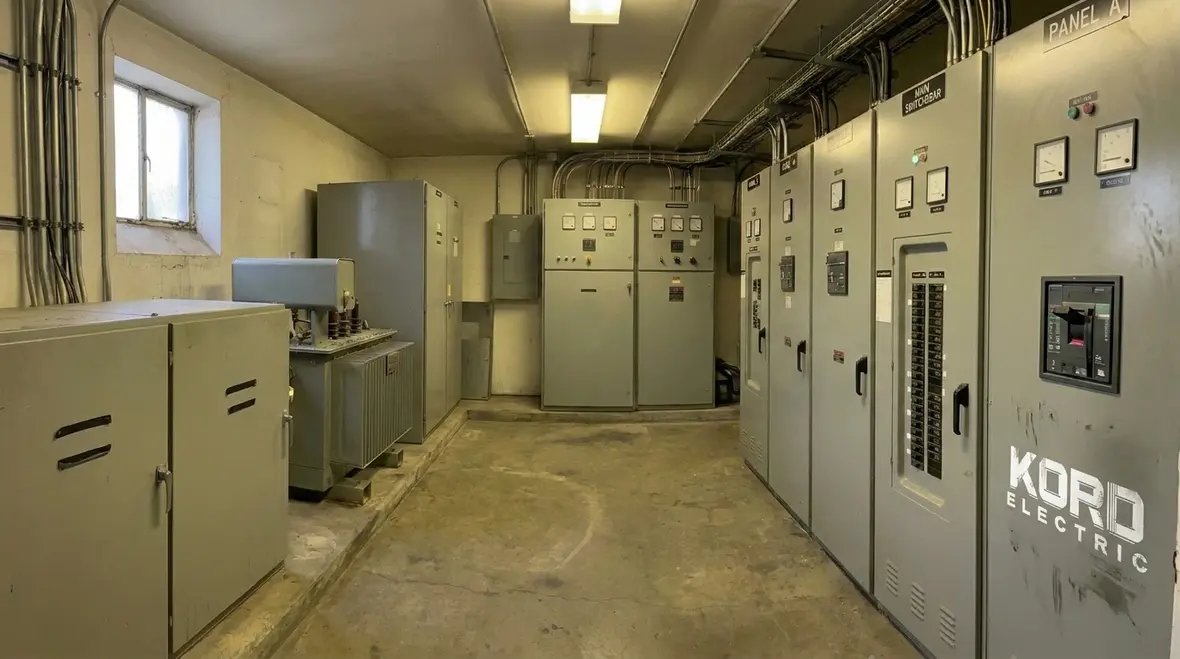
Commercial and industrial buildings cannot treat charging like a side quest. They need power systems that stay stable, especially for life safety, process equipment, and building controls. Therefore, we design EV charging scaling to fit the facility’s power architecture and operational needs.
First, we coordinate with the building’s electrical one line diagram, then we check where chargers connect and how that impacts upstream devices. Afterward, we evaluate whether the site has backup power and how charging should behave during outages. For example, some facilities prefer to pause charging during generator operation to preserve runtime for critical loads.
Next, we consider controlled ramping. Instead of letting each charger start at full output instantly, we use coordinated control so chargers “wake up” in sequence. As a result, demand grows smoothly rather than slamming into a spike. If a property also carries HVAC, kitchen equipment, lifts, data loads, and other high draw items, smooth demand matters even more.
If the facility is similar to the kinds of power critical spaces described in Kord Electric’s guidance for uptime focused electrical needs, then the charging system should follow the same discipline. We still keep it straightforward, but the method stays serious. You can read about those uptime oriented electrical requirements in our blog article on data center electrical planning, because the same logic applies when stability is non negotiable.
How EV Charging Load Balancing works in real sites
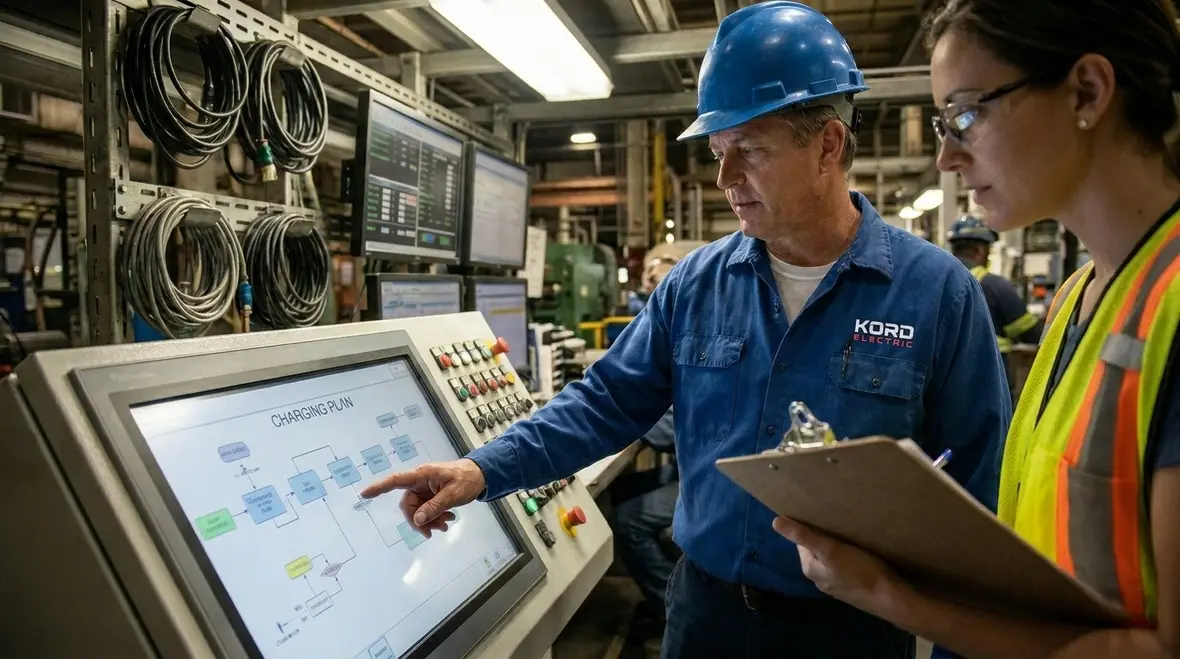
Once the facility has a load forecast and a clear electrical map, Kord Electric implements a balancing strategy that controls charger power based on available capacity. Here is how it plays out in the real world, not just on a slide deck.
- Measurement and feedback: We monitor site demand and incoming power limits so the system sees what is happening now.
- Setpoint control: We keep charger output within safe limits by adjusting charging rate as demand changes.
- Prioritization: We set rules for which vehicles or stations receive power first, when multiple chargers want full output at the same time.
- Scalable expansion: We plan the system so adding more ports does not require a full redesign.
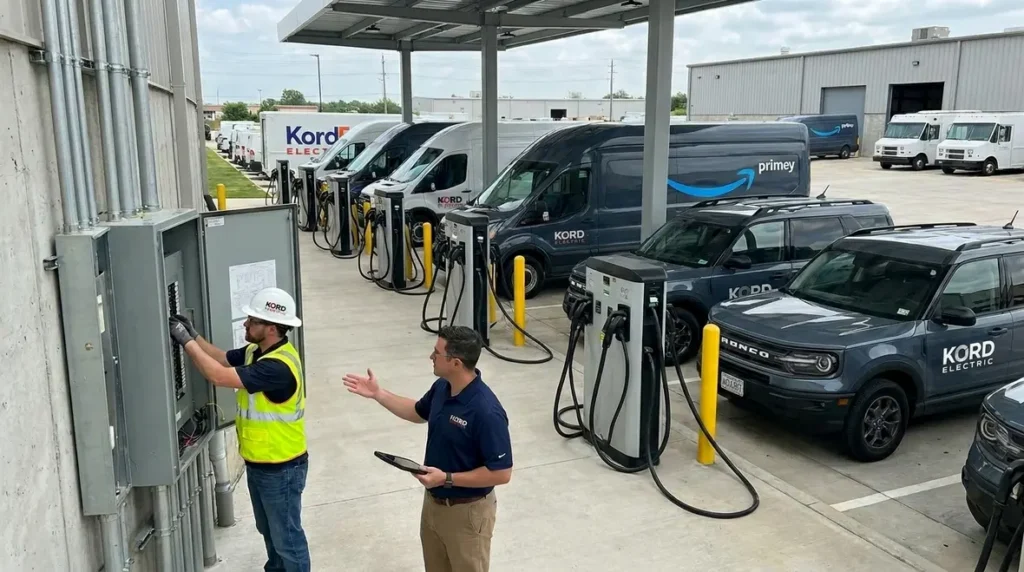
Then, just to keep things human, we explain the logic to the facility team. Our technicians and expert service staff walk through how load changes affect charging speed, and how staff can interpret simple notifications. In most cases, the facility learns quickly because the concept is simple: charging adapts to the available power like a smart thermostat. It is not magic, it is just good control.
We also make sure the solution respects equipment protection. That means breaker coordination, correct circuit sizing, and stable control paths. If it cannot operate reliably under load, we do not install it. We have no interest in building a high power parking lot that behaves like a dramatic reality show.
Phasing and circuit strategy for larger expansions
When a facility plans multiple phases, the electrical strategy should match the growth path. Otherwise, the next expansion forces costly upgrades. Therefore, we favor staged design that leaves capacity and clean pathways for later additions.
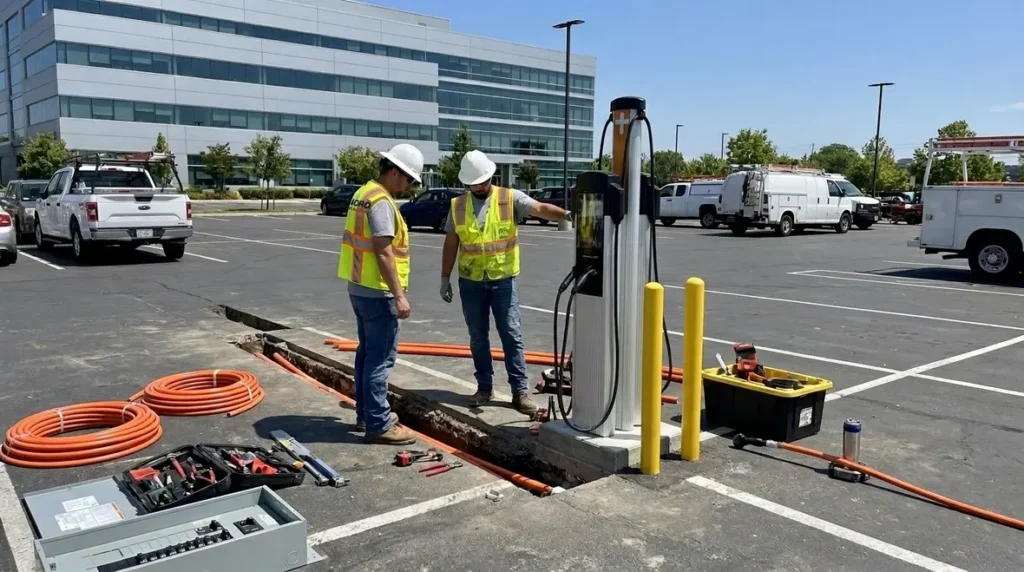
First, we evaluate whether we can add chargers by using spare breaker space, rebalancing circuits, or adding a controlled load panel. Then, we plan cable routing and conduit capacity so future stations do not require disruptive rework.
Next, we decide on where the system should concentrate control devices. Centralized control can simplify balancing, yet distributed architecture can reduce wiring complexity in large lots. Either way, the goal stays the same: keep power management aligned with site limits while reducing install disruption.
We also consider the human schedule. For example, a warehouse may need heavy evening charging, while an office tower may see demand around business hours. When we align charger control with those real patterns, EV Charging Load Balancing becomes more effective, because it targets the times that actually matter.
And if someone asks, “Can we just add a few more chargers and hope?” our expert service staff responds with kindness, then hands them a load calculation. Hope is nice, but circuit ratings pay the bills.
Commissioning, monitoring, and maintenance that prevent surprises
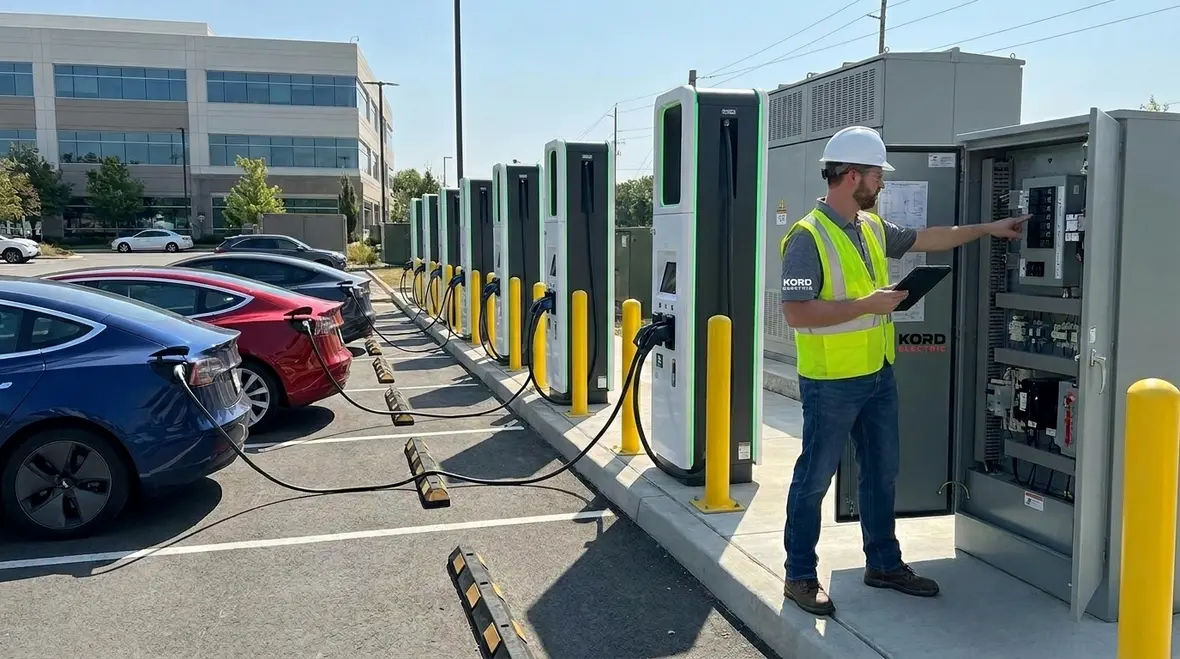
Scaling EV charging is not finished at installation. Commissioning determines whether the system performs as designed under peak conditions. After installation, Kord Electric runs functional tests, confirms proper sensor readings, verifies charger behavior under varying load, and checks fault responses.
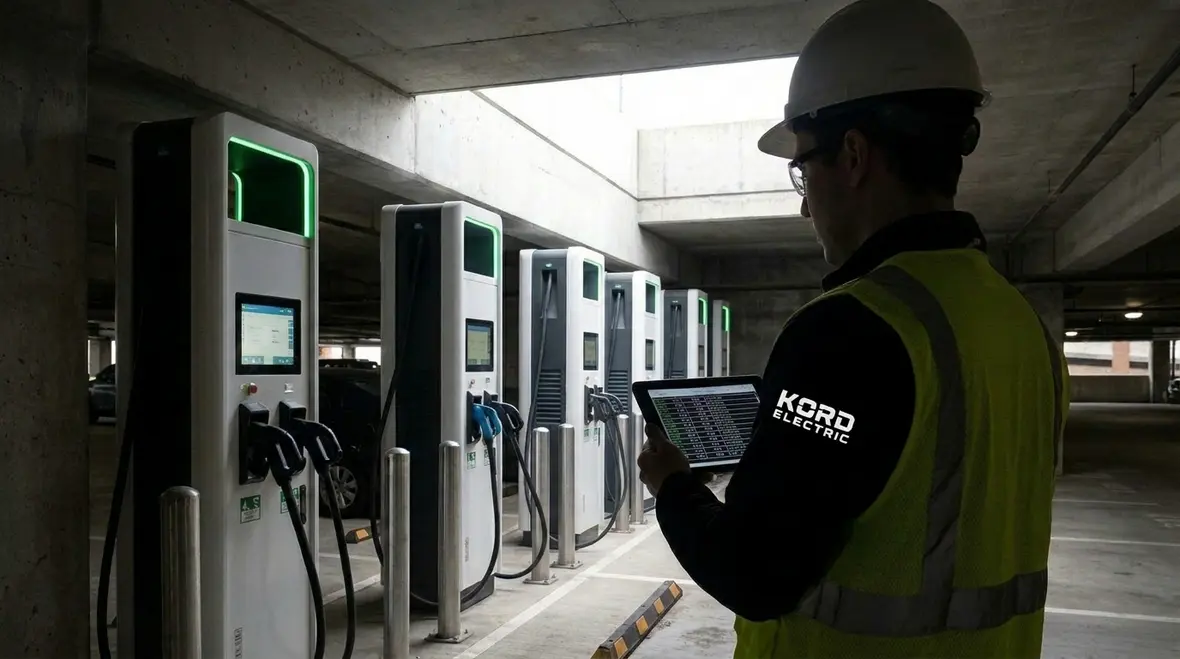
Next, monitoring keeps the facility informed. With performance tracking, the team can see whether charging power limits are acting correctly, and whether demand trends align with forecasts. If the site expands again, the data helps update planning and avoids “blind growth.”
Then, maintenance keeps things stable over time. Connectors wear. Fans age. Firmware updates can change behavior. We recommend schedules that fit commercial and industrial environments, with inspections and preventive checks for key components.
Our goal stays simple: support uptime, protect electrical equipment, and keep operations calm. The best compliment we hear is that the charging system “just works,” even during the busiest hours. That is what we aim for.
If your project is moving from early planning into real-world execution, you can also connect this work with Kord Electric’s broader commercial support, including Los Angeles County electrical services that understand how EV charging fits into the rest of your facility loads.
FAQ for scaling commercial EV charging
Conclusion and next step
Scaling commercial EV charging should feel controlled, not chaotic. Kord Electric helps facilities add chargers while protecting electrical capacity through disciplined planning, coordinated control, and EV Charging Load Balancing that adapts to real demand. Our technicians and expert service staff support commissioning and ongoing monitoring so uptime stays the priority. If your property is planning new ports this quarter or this year, we will map the electrical constraints and build a phased plan that actually works.
For facilities that want help moving from concept to site-ready design and installation, Kord Electric’s dedicated commercial EV charger installation services connect EV Charging Load Balancing with real-world hardware, permits, and safe commissioning.
Reach out to Kord Electric today and we’ll help you scale EV charging in a way that keeps the lights steady, the circuits honest, and the schedule realistic.